There are melodies we learn.
And then there are melodies that somehow feel as though we have always known them.
Every Shabbat, in synagogues across the world, as the Torah is returned to the Ark, Jews sing words from the Book of Proverbs:
“It is a tree of life to those who hold fast to it.”
The words are ancient, drawn from Proverbs 3:18, where King Solomon describes the Torah as a tree of life to those who grasp it. But the melody so many of us instinctively hear when we read them is not.
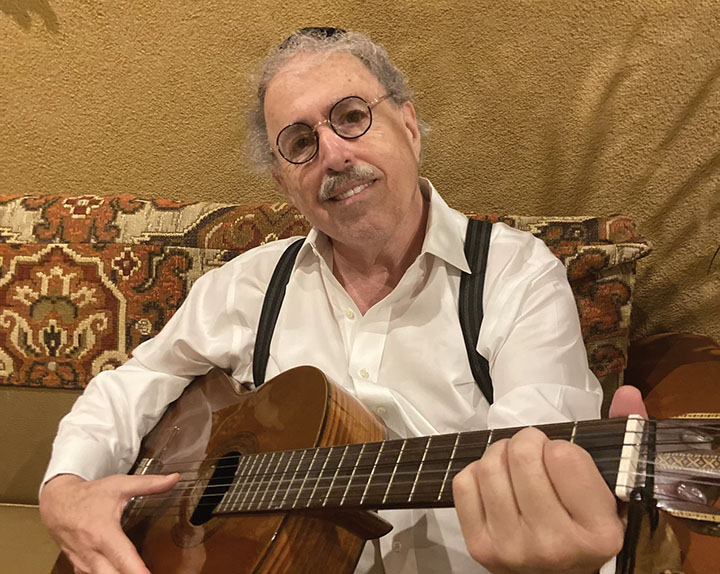
It was written in the last century by a young Jewish musician named Tanchum Gershon Portnoy.
Portnoy passed away this Rosh Hashanah at the age of 75. He composed his beloved “Eitz Chaim” melody when he was just 22 years old and recorded it on his 1975 album, Tanchumim.
And then something extraordinary happened. He gave the song to the world.
It traveled from synagogue to synagogue, community to community, country to country. I grew up singing that very tune all the way down under in Melbourne, Australia. Years later, I heard it sung in Honolulu. I also found myself chanting those same notes at a Jewish conference in Riga.
Different hemispheres. Different communities. Different Jewish worlds.
Somehow, the melody had arrived before me.
Someone heard it and taught it to someone else. A cantor introduced it to a congregation. A child learned it beside a parent and carried it into adulthood. Voice by voice, generation by generation, Portnoy’s melody quietly made its way around the Jewish world.
There was no marketing campaign. No viral video. No influencers or algorithm recommending it to millions. It traveled the old-fashioned Jewish way: from person to person, voice to voice, generation to generation.
Eventually, Portnoy’s melody became so ubiquitous that many people stopped knowing it was Portnoy’s at all. In some places, it was labeled simply “traditional.”
There is something profoundly Jewish about that.
A person creates a melody.
A community carries it.
A generation inherits it.
And eventually, nobody asks who owns it. Because it belongs to everyone.
When authorship becomes inheritance.
We live in an age obsessed with attribution. We count followers, likes, downloads and impressions. We watermark our work and build personal brands. We want to know who created something and whether they received appropriate credit for it.
But Portnoy’s story offers another conception of impact.
Perhaps there is a form of influence even greater than having your name remembered: creating something so meaningful that it becomes part of the vocabulary of a people.
Most Jews who have sung Eitz Chaim over the past half-century probably never knew Portnoy. They did not know when he wrote the melody or how young he was when he composed it. They simply knew the song.
And perhaps that is precisely the point.
Jewish civilization has always depended on people willing to contribute something to a story much larger than themselves.
We inherit customs whose origins have faded into history. Melodies passed from grandparents who learned them from grandparents. Ideas whose authors have disappeared while the ideas themselves remain vibrantly alive.
We are beneficiaries of countless people whose names we will never know.
They built institutions. They taught children. They opened their homes. They composed melodies. They preserved traditions. They gave something away without knowing where it would eventually travel.
Portnoy now joins that extraordinary chain. The melodies that unite our disagreements.
His passing also comes at a moment when the Jewish people could use the lesson embedded in his music.
We waste enormous amounts of energy on matters that only separate us.
Orthodox. Conservative. Reform. Secular. Ashkenazi. Sephardi. Israeli. Diaspora. Left. Right.
Our disagreements are real. Some are important. Jewish unity has never meant Jewish unanimity. But then Shabbat arrives.
A Torah scroll is lifted. And somewhere in Melbourne, Manhattan, Jerusalem, London or Johannesburg, Jews who might disagree about almost everything begin singing.
And often, remarkably, they sing the same tune. Think about that.
Without a central authority mandating it or a committee coordinating it, a melody has crossed the boundaries we spend so much time constructing.
“Eitz Chaim” does not ask how you vote. It does not ask which synagogue you attend or which Jewish label you use. It simply gives us a few moments in which our voices can meet.
Maybe unity does not require uniformity. Maybe we do not need to erase our differences to remember our shared destiny.
There is particular poignancy in Portnoy’s passing on Rosh Hashanah, just as one Jewish year ended and another began.
The days from Rosh Hashanah through Yom Kippur asked us to examine the lives we are building. But they also asked us to look beyond ourselves and consider the Jewish future we are building together.
What will we pass on?
What will our children inherit from us?
Which institutions, values, rituals, ideals and melodies will endure?
Around the world on this Shabbat, Torah scrolls will once again be read, lifted, embraced and eventually returned.
And something beautiful will happen. Jews will begin singing a melody written more than half a century ago by a 22-year-old man who could never have imagined how far those notes would travel.
Perhaps this week we can listen a little more carefully.
Listen to the person beside you. Listen to a congregation united in song. Listen to a melody crossing generations.
Listen to the extraordinary sound of something that once belonged to one person becoming the inheritance of an entire people.
Rabbi Jonathan Sacks taught us that Judaism is built on a covenant that came before us and continues forever after. Our task is not merely to receive that inheritance, but to add something worthy to it before passing it forward.
Tanchum Gershon Portnoy did exactly that.
He gave the Jewish people an everlasting melody.
“It is a tree of life to those who hold fast to it.”
Perhaps Portnoy’s life leaves us with one more question as 5787 begins:
What can each of us create, teach, build or give that might continue singing after we are gone?
“Eitz Chaim”’s gentle melody reminds us that our souls are bound to its symphonic refrain.
May Tanchum’s memory be a blessing.
Rabbi Daniel Kraus serves as vice president of Strategic Partnerships at the Birthright Israel Foundation and Director of Community Education at Congregation Kehilath Jeshurun in New York.