In some ways, next week’s election outcome in Israel doesn’t matter that much. Of course, no politician is going to tell you that. The politicians pretend that it’s them, or all hell breaks loose. They pretend that this cycle is one in which the future of Israel will be determined for generations to come. But that’s the job of the politician on the eve of election, and the job of the sober citizen is to see through the rhetoric and realize that this cycle is just another cycle within the larger cycle of electoral crisis of the last four years. The sober citizen must contend with the high probability that this cycle in not the cycle to end all cycles. The crisis is not over, no matter who wins next Tuesday. That’s why the winner’s identity is likely to be less important that we might think.
The polls tell the story of a country stuck in something very close to a political tie. Ask: a tie between what teams? By and large, the answer is that on one team there is a more Jewishly traditional-religious Israel, and on the other side a more urban, affluent, secular Israel. Ask: what is it that they disagree on? Here, the answer becomes more complicated. A simple answer would be that they disagree on whether Benjamin Netanyahu should be Prime Minister, but that’s just pushing the real question one step back, as it forces the next question: Why do they disagree on Netanyahu?
You could say it’s his personality, but that would hardly explain anything. One of his main political allies, the head of the Religious Zionist Party was caught on tape this week calling Netanyahu “the liar of all liars.” So, it’s not as if his allies see him as noble person while others see him as a villain. It’s something else: It is an undercurrent of emotional apprehension about the true intentions of the “other camp.” Center-left voters believe that the Netanyahu camp is an enemy of democracy, that it will turn Israel into a radical theocracy. Right-wing voters believe that the anti-Netanyahu camp is on its way to secularize Israel and turn it into something that we can no longer call “Jewish.”
One camp believes that the other will destroy its most precious value, democracy, while the other camp believes also that the other will destroy its most precious value, Jewishness.
In other words, one camp believes that the other will destroy its most precious value, democracy, while the other camp believes also that the other will destroy its most precious value, Jewishness. The irony is twofold. Once because both camps, generally speaking, want Israel to be both Jewish and democratic. Twice because as these camps highlight their respective fear, they only enhance the apprehension of the other side. Pro-Bibi voters cry: See, all they care about is their neutral democracy (and they do not care about Israel’s tribal Jewishness). Anti-Bibi voters cry: See, all they care about is their tribal Jewishness (and they do not care about Israel’s democracy).
Most of this is nonsense, and yet, it sticks, it works, it divides and complicates. Israel is stuck between these two imaginary camps, a creation of politicians, activists and pundits. What are the true things they disagree on? Most of it is peanuts. The leaders of the main parties — that is, Likud and Yesh Atid — mostly agree on Iran, on the economy, on social welfare, on the legal system, on relations with the U.S., on the IDF, on dealing with Gaza. They pretend to disagree — they must, to win an election—but don’t really disagree.
Take, as example, the legal system. Likud leaders and their allies are up in arms on the need to reform the legal system, and their rivals are up in arms that the legal system must be defended. But a quick examination of the record would reveal that Yair Lapid, the leader of Yesh Atid, believes there a need to initiate certain legal reforms, quite similar to the reforms proposed by his rivals. A quick examination of the record would also reveal that Netanyahu, while in office, was the one preventing many of the reforms he now supposedly promotes.
So where does that leave us, a few days before Election Day? It leaves us with an unresolved political crisis and with a meager chance that it could be resolved next week. Could there be a government? Maybe. Could it be a government with a significant majority and a clear mandate to enact changes and implement policies? It doesn’t seem so. The fifth round looks like a prelude to a sixth round. We called it a crisis. It is a crisis. And it’s not yet over.
Something I wrote in Hebrew
Responding to a debate ignited by a right-wing pundit who called Likud voters “bums” for not coming to vote in greater numbers I wrote this:
Sometimes, not coming to vote is a calculated step that makes sense. For Likud voters this can be a way of saying “I’m fed up,” “I’m not happy,” “maybe it’s time for a change.” Ask: If so, why don’t these Likud voters vote for another party? The answer is, at least in some cases, that it is difficult for loyal Likud voters to vote for another party. They love Likud, they identify with Likud. They are not comfortable voting for anyone else. For them, not voting is the simple and direct way to say: “When you come back to your senses, we’ll go back to the polls.”
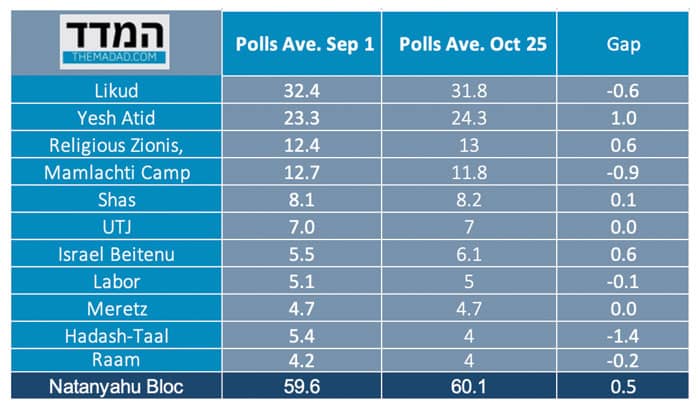
A week’s numbers
The static election: When people vote for a fifth time, they basically know what they want, and the polls barely move.
A reader’s response:
Jeff Elias writes: “I don’t see how Jewish Americans can support Israel if the government includes bigots such as Ben-Gvir”. My response: did they support the US when they thought its government includes bigots? So why not Israel?
Shmuel Rosner is senior political editor. For more analysis of Israeli and international politics, visit Rosner’s Domain at jewishjournal.com/rosnersdomain.