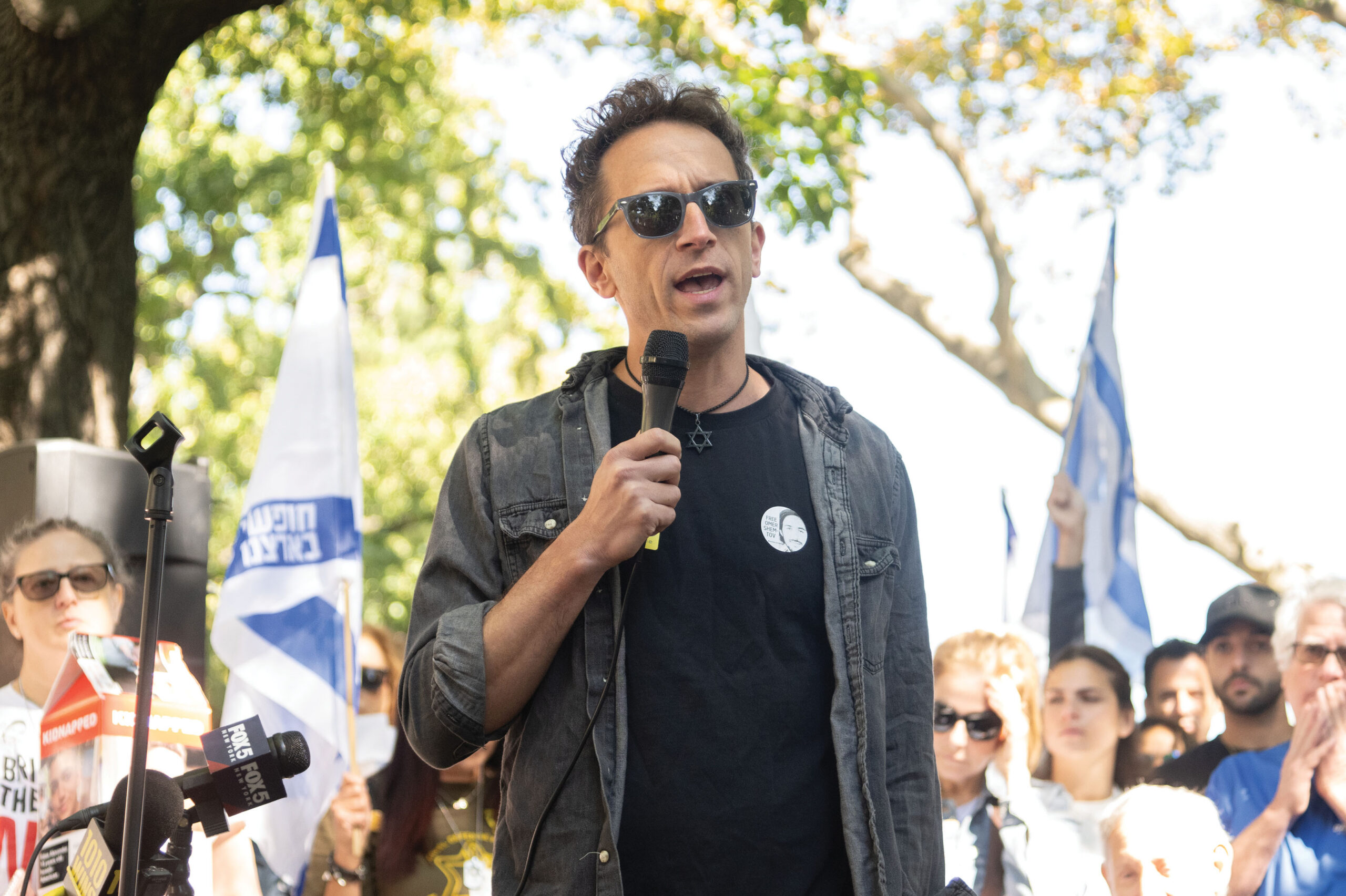
“The Maccabees did not wait for a miracle,” Shai Davidai told me. “They stood up, fought and then the miracle came.”
Eleven days after the Oct. 7, 2023 massacre, former Columbia professor Shai Davidai posted the video seen around the world. “It felt like the ground dropped from underneath our feet. I was thrown in the deep end, not the shallow water, learning with everyone else. That video was pure grief and pain that is somehow narrated through my intellect.”
In the epic video, taken by his wife, author Yardenne Greenspan, an emotional Davidai said the words we were longing to hear from every American leader but never did: “I am not afraid to speak up. I am speaking up because I am afraid.” Citing his then 7-year-old son and 2-year-old daughter, Davidai said he was speaking both as a dad and a professor: “We cannot protect your children from pro-terror student organizations who view murder, kidnapping and rape as legitimate acts of ‘resistance.’”
For her unconditional support of terrorist organizations and quest to silence him, Davidai spoke directly to then- Columbia University President Minouche Shafik: “You are a coward.”
With that video, Davidai became the leader New York City needed in that moment. He became a beacon of light for most of us, especially after Zohran Mamdani’s foreboding mayoral win two years later.
Unlike so many who have used Oct. 7 to “become famous,” Davidai didn’t want fame. He didn’t even want to be a leader. But like so many Jewish leaders throughout history, G-d had another plan for him.
You’re kind of like a young King David, I said to him. He shrugged, shook his head, and said “maybe more Noah than David.” “The world is being destroyed, and I have a responsibility. We all have a responsibility. We are at war. No one is going to come and save us. We are all potential soldiers. We need to train, fight, win. We are outnumbered, out-cashed, and out-trained, but we have the truth on our side.”
Oct. 8
Davidai was born in Ramat Gan, Israel. His grandfather Benjamin was vice president of El Al and assisted in capturing Adolf Eichmann.
In 2009, Davidai earned a B.A. in psychology and cognitive science from the Hebrew University of Jerusalem. After moving to the U.S., he earned a Ph.D. in social psychology and personality psychology from Cornell University, did a post-doctoral fellowship at the Princeton University School of Public and International Affairs and was an assistant professor of psychology at The New School for Social Research until 2019.
Davidai then became an assistant professor in the Columbia Business School, studying how individuals’ views on inequality, success and failure affect their well-being. Davidai didn’t fully realize how much the political spectrum had shifted, with the left embracing antisemitism just as the Democrats had embraced slavery before the Civil War.
“I was very surprised because I assumed that everyone is acting from the perspective of classical liberalism. I assumed those with crazy ideas were on the fringe, and that everyone realizes how crazy they are. So I didn’t feel any urgency. All of that changed after Oct. 7.”
He thought, this is just politics, and “politics are complicated and boring. After Oct. 7, I realized this has nothing to do with politics. This is hatred. A clash of belief systems where one negates the other.
“I was scared, and the people around me at Columbia were rationalizing, justifying — accepting. That video was recorded at one of the lowest points in my life; that’s how people were introduced to me.”
But it propelled a lot of people into action.
“As an Israeli, I was scared because I know what could happen next. But also: I didn’t grow up in the Diaspora where there’s always a low hum of othering — of antisemitism. I had not developed the psychological defense mechanism that Jews who live here have. I found myself thrown into a battle I didn’t even know existed.”
When we don’t want to see something, we don’t see it, he said. “Oct. 7 forced me to stop thinking about everything with the lens I had adopted since moving to the U.S.”
But it also allowed him to have immediate moral clarity about the situation, something many of his Jewish colleagues intentionally lacked. “I was able to say: let’s cut through the B.S. and talk about the real thing.”
And the real thing — antisemitism in academia — had started long before 1948.
Antisemitism in academia
In researching his first book — “American Intellectual Antisemitism” (Wicked Son) — Davidai discovered a long and sordid history of antisemitism in universities, particularly at Columbia.
Before quotas were instituted in the 1920s, Jews had been accepted into schools like Columbia, becoming roughly 40% of the student body by the beginning of the decade. So Columbia also introduced the personal essay as a way to keep Jews out. With the second wave of Jewish immigration to New York, Columbia then instituted geographical diversity to keep Jews out. And then Jews began graduating high school early. So Columbia demanded that students start at 18, so Jews would be forced to go to community college instead.
In the 1930s, many American universities were closely aligned with German universities. When a Nazi “ambassador” came to Columbia in 1935, there were protests. A Jewish professor was fired for organizing the protests; his protest was cancelled, and two of the students were arrested.
Edward Said started teaching at Columbia in 1963, setting in place theories about the West that would eventually lead to “post-colonial” studies, which aligned perfectly with the Marxist oppressor-oppressed narrative, and eventually removed objectivity from the classroom. “Said introduced the activist scholar: first an activist, second a scholar,” Davidai said.
And then Said’s students began teaching at other schools. “And slowly you get this idea that the professor is not only supposed to be non-objective, but that objectivity — truth — doesn’t exist.” By the 1990s, the idea that professors aren’t supposed to teach their personal opinions was considered obsolete.
And while leftist professors were proclaiming a win for diversity, a rigid collective orthodoxy began to take hold on every subject. And that ideological collectivism — meta-conformity — steeped in anti-Western sentiment and values, became the perfect platform for an “intellectual” antisemitism acutely obsessed with Israel.
“Intellectual because unlike antisemitism that comes from the beer halls, this comes from the lecture hall: it’s intellectualized as moralistic and virtuous. And yet it’s still antisemitism.”
Davidai has been as surprised as the rest of us at how many professors — even pro-Israel professors — have remained silent. “I was shocked to find that there are professors who support Hamas,” says Davidai. “Right now, an establishment of professors is intentionally obscuring the truth.”
He expected his colleagues to speak up after the video went viral. “Professors who preach democracy did nothing as the anti-democratic mob took over. In the end all the extremists needed was the silence of their moderate peers.”
Both students and professors at Columbia had been born and raised in an individualistic culture. “But now they’re looking for a collective identity. The other problem: intellectual laziness. Everything gets dumbed down today, allowing extremists full range.”
“The universities did nothing to allow healthy debate and dialogue — to allow dissent.” Davidai even suggested to Columbia that he would meet with moderates. A hard no. “Students were being radicalized because there wasn’t a third option.”
I asked Davidai if he thought we would ever return to a time when teaching one’s personal opinions is considered unethical; when objective truth and facts are respected; when morality is no longer “subjective.”
“No,” he told me. “Behind every raging student protester in a culturally-appropriated keffiyeh stands a radical professor, thrilled to see their post-colonial theories play out.”
Diversity, dialogue, dissent
Davidai believes that we can begin to return to the pursuit of objective truth by first working toward ideological diversity — heterodoxy, a key principle of classical liberalism.
Professors have typically leaned left. “The problem today is not that they’re 94% Democrat. The problem is that they’re 94% something. Because then it stops being a university for the people. It’s a university for the party. … Right now, I tell people I’m not a Republican or a Democrat — I’m Jewish.”
An ideological orthodoxy has allowed ideological persecution. “Columbia intimidated me into silence — a baseless investigation for 20 months,” Davidai said. “Terrified of its most outspoken Jew, Columbia made silencing me its priority.”
Many have forgotten what dialogue — civil discourse — even means. “American polarization in the past 20 years has taken us apart from even people we agree with. We splintered into smaller and smaller bonfires; and right now we’re not even sitting around the same bonfire.”
“We’ve forgotten how to argue. Luckily coming from an Israeli family, we argue all the time.”
Winning an ideological war
Given that we aren’t returning to truth, objectivity, or even morality any time soon, how do we win this ideological war? This topic became White Rose Magazine’s inaugural Forum of Art + Ideas, with Davidai as our initial speaker.
“We need to get better ideas to more people faster,” Davidai said. “This is a war of belief systems — a war about and for the truth. We need to teach people the truth, and we need to do it faster.”
Davidai explained how all of this didn’t start on Oct. 8. “In 1993, in a meeting in a Marriott outside of Philadelphia, senior Hamas officials met to discuss how they’re going to infiltrate the American media, the American academy and American research centers.” That meeting, bugged by the FBI, was also the genesis of CAIR, the Council on American Islamic Relations. “A few months later,” Davidai continued, “a graduate student named Hatem Bazian at Berkeley started the first chapter of Students for Justice in Palestine.”
For the next three decades, “they worked slowly and steadily to create an entire ecosystem to indoctrinate people into this ideology. They took their raw hatred, put it in a blender of nonsensical academic jargon and lies, and because facts are no longer trending, they were able to spit out moral virtue.”
The great irony: “With no objective truth, every person’s subjective experience equally matters. Unless you’re Jewish.”
The battlefields of this ideological war of course include not just colleges, but K-12, politics, media, social media, the art world and cultural institutions. “Each battlefield requires different strategies. The basic training here is cognitive, informational, emotional.”
“Learn our history. Read books, watch documentaries, listen to podcasts. Understand the content but also how to get the message across clearly and with impact.” And because Judaism is a religion and ethnicity but not a cult, we should aspire to unity but not uniformity. “Everyone needs to figure out what’s the best way for you to contribute. Defensive strategies; offensive strategies. Reclaiming Zionism to normalize it. I’m a moderate in my views, and I am a radical in my methods. I stand up to bullies. The silent majority just looks the other way.”
This war is far from over, but Davidai is optimistic that the pendulum is starting to swing back. “Our job is to create a strong center so it doesn’t swing in the other direction.”
Here I Am
Davidai is focused right now on recreating that center, as well as teaching Jews how to be activists. “Activism without principles is chaos,” says Davidai. “Here I Am” is a community for peaceful Zionist activists who “choose action over outrage and substance over performance.”
For those of us who have had to deal with the neo-Hellenistic ego-fest that erupted after Oct. 7, Davidai’s anti-narcissistic approach couldn’t come soon enough. “Activism isn’t about being loud or perfect. It’s about choosing to act, using the strengths you already have, and refusing to stand by when something is wrong.
Be proud,” he said. “Live your life like you want your kids to do.” The only rules are “no hate, no lies” and following these seven principles:
1. HERE I AM FOR THE TRUTH
Grapple with complexity instead of running from it. Reconcile conflicting truths with reason and non-violent action. Choose curiosity over conformity and dialogue over dogma.
2. HERE I AM FOR EVERY JEW
Inclusion strengthens action. Stand for all Jews, no matter denomination, ethnicity or identity. Show up for the whole community, not just parts of it.
3. HERE I AM AGAINST HATE OF ANY KIND
Confront extremism wherever it appears. Attack ideas, not identities, and debate arguments, not people. Act with conviction, never hate.
4. HERE I AM FOR AND WITH MY ALLIES
Judge allies by their principles, not politics. Prioritize collective action over labels. Show up for everyone, no matter who they are.
5. HERE I AM FOR ISRAEL
Zionism is the radical belief that Jews are a people too. Support the Jewish people’s right to self-determination in their ancestral homeland.
6. HERE I AM ALL THE TIME
Act with conviction, never hate. No action is too small. Persistent, intentional effort moves the needle. Over time, small steps add up to lasting impact.
7. HERE I AM, A WORK IN PROGRESS
Learn from mistakes. Celebrate small victories. Study what works and use failures as springboards for growth.
Davidai will also continue his “Here I Am with Shai Davidai” podcast, featuring allies who are “committed to turning moral clarity into bold action against extremism, antisemitism and institutional cowardice.”
While writing this piece, I watched the 2024 documentary “Elie Wiesel: Soul on Fire.” I was struck by the profound similarities between Wiesel and Davidai, despite the monumental differences. For both, the ability to rise up at excruciatingly difficult times came not from a need for attention or fame but from the sacred fire burning in their souls.
Perhaps the reason we can’t point to a “Jewish Douglas Murray” is because we have Douglas Murray. What we’ve needed is a voice of moral conscience, a voice that transcends centuries and conflicts, a voice that links generations. A voice that stems from deep within the Judean soul.
We now have that voice, no longer censored by Columbia University. Here he is: Shai Davidai.
Karen Lehrman Bloch is editor in chief of White Rose Magazine.