fbpx

February 5, 2026

On Sunday, America Will Be Asked to Stand Up to Jewish Hate. Will They?

A new commercial that will air this Sunday during the Super Bowl will inform America that “2 in 3 Jewish teens have experienced antisemitism.”

The assumption is that if we tell Americans how much Jews are hated, they’ll be less likely to hate us.

Is that so?

The Jewish teen walking in a school hallway in the commercial looks weak and rather nebbish. And that’s before he realizes that someone has put a “dirty Jew” sticky note on his backpack. A tall Black student tells him “not to listen to that” and covers up “dirty Jew” with a blue square, the campaign’s visual icon.

At the end, viewers are asked to “stand up to Jewish hate.”

But who will stand up?

When football fans think of standing up during the Super Bowl, it’s usually to get another beer or more nachos.

In any case, why would anyone stand up for Jewish victims? Are Jews seen as that needy and vulnerable? Are Jews so afraid of antisemitism they must run ads on the Super Bowl?

Americans much prefer to stand up for winners.

They’d rather stand up to give Jerry Seinfeld a standing ovation for making them crack up.

They’d rather stand up and applaud Steven Spielberg after one of his great movies.

They’d rather stand up after loving a documentary showing how Jews fought for civil rights.

Let’s face it: No matter how hard we try and how many surveys we show, Americans will always have a hard time seeing Jews as powerless victims in need of ads on the Super Bowl.

The Jewish brand is success, not failure. It’s winning, not losing.

We can and should fight antisemitism, but when we go as public as Super Sunday, it behooves us to show strength, not weakness. Instead of reminding Americans that Jews are hated, we ought to remind them why we’re admired.

The creators of the ad mean well, but on the biggest television stage of the year, “dirty Jew” is a risky thing to bring up, regardless of context. For all we know, drumming up the poison may even give people ideas– the wrong ones.

Ironically, the Jewish billionaire behind the campaign, Patriots owner Robert Kraft, is the ultimate winner. He’s won a boatload of Super Bowls and can win it again this year.

If he wins, jubilant Patriots fans across the country will stand up. But they won’t stand up to Jewish hate. They’ll stand up because a Jew won.

On Sunday, America Will Be Asked to Stand Up to Jewish Hate. Will They? Read More »

We All Need a Jethro – A poem for Parsha Yitro

Yitro — Jethro (Exodus 18:1–20:23)

Appoint yourself a wise person
to advise you on how to do the
things you do, like Moses did

with Jethro, his father-in-law
who told him to not spread himself
so thin and delegate.

I have one of those too. He told me to
get in the system (it was real estate
advice) and so I did and now

in the system, I’m better than I
would have been if I wasn’t.
He told me to not put the trash can

up against the AC compressor unit.
Advice I heeded and now the
insurance company has nothing to

complain about (it all goes back to
real estate). Appoint yourself a cheerleader
who will read your poems and tell you

how unique your voice is, and you
realize he bought a copy of his
son-in-law’s (that’s you, but really

it’s all a metaphor for me) book
when you easily could have
just mailed him one. Like Moses

did with his father-in-law, Jethro
who listened to the stories of
demands and plagues and

water coming out of rocks
and seas parting, so everyone,
literally, everyone could be free.

Jethro’s eyes listened with
the wideness of ascent offerings.
Jethro rejoiced. Appoint yourself

someone like that, like Jethro who
will tell you how it is, how it should be,
and will always be on your side.


Rick Lupert, a poet, songleader and graphic designer, is the author of 29 books including “God Wrestler: A Poem for Every Torah Portion.” Visit him at www.JewishPoetry.net

We All Need a Jethro – A poem for Parsha Yitro Read More »

Trees Try to Celebrate the Jewish New Year

Trying to reciprocate the fruitful way,
Jews celebrate the trees’ New Year on every Tu B’Shvat,
poetic trees decided in a chorus they
should sing  to Jews on their New Year. One brilliant tree, a nut,

said: “I’ll compose a poem like the greatest one
Jews sing on Rosh Hashanah,” and it wrote a knock off
of a prayer Jews make on their New Year, which isn’t fun,
predicting bad things that might happen, U’nettaneh Toqef.

Trees in the forest said that they would sing as they once did
when God gave Jews the Torah. In the Hallel you will find
a reference to these trees. Although none was a kosher yid,
they loved it even though they were less kin to it than kind.

The plan trees made to sing the Hallel on the Jews’ New Years
evoked from one of them a most fantastic psalm, and
God loved it so much he exclaimed, with other trees, “Three cheers!”
and added, “Henceforth you will be the first to blossom, Almond!”

However, you won’t ever hear this psalm since Jews don’t say
on Rosh Hashanah the great psalms of David called Hallel,
despite the fact that it may be the whole wide world’s birthday,
they do not say it. Ask me why! There hangs another tale!

I recalled this poem on 1/29/26, a few days before Tu Bishvat 5786, after reading that Rabbi Jonathan Sacks, in a discussion of the New Year for trees, approved Rabbi Samson Rafael Hirsch’s suggestion that when Gen. 1:26 states that God uses the royal plural when creating man, “Let Us make Man,” He is asking all animal and I recalled this poem on 1/29/26, a few days before Tu Bishvat 5786, after reading that Rabbi Jonathan Sacks,in a discussion of the New  Year for trees, approved Rabbi Samson Rafael Hirsch’s suggestion that when Gen. 1:26 states that God uses the royal plural when creating man, “Let Us make Man,” He is asking all aanimal and vegetable being a He created before creating the ancestor of mankind to approve of the creation of Adam One. It occurred to me, reading Hirsch’s explanation of the use of the royal plural in Gen. 1:26, that the creation of Adam Two, whom God, in the second chapter of Genesis, commands to perform work on earth and guard it, reflects the fact that mankind is a partner not only of God but of nature, and that Tu Bishevat reflects this partnership just as Rosh Hashanah, New Year, reflects God’s royal Supremacy. The link between Tu Bishvat  is also linked to Rosh Hashanah by being a new year festival on which Hallel is not recited.


Gershon Hepner is a poet who has written over 25,000 poems on subjects ranging from music to literature, politics to Torah. He grew up in England and moved to Los Angeles in 1976. Using his varied interests and experiences, he has authored dozens of papers in medical and academic journals, and authored “Legal Friction: Law, Narrative, and Identity Politics in Biblical Israel.” He can be reached at gershonhepner@gmail.com.

Trees Try to Celebrate the Jewish New Year Read More »

A Bisl Torah — The Second Soul

The month of sabbatical has ended. I wrote, read, exercised, and cooked. Among the lessons gleaned during this precious time, one of the greatest was felt the very last day. While it took a good week to get used to being on sabbatical, quieting the relentless questions and worries in my mind, it took almost no time to jump back into work. A light switch immediately turned back on.

We are living in environments in which productivity, exertion, and movement connote success. If we’re not emailing, calling, or creating, we must not be doing anything of value. However, even this one month of respite reminded me of the importance of restoration and rejuvenation: Planned moments to give ourselves room to think, breathe, reevaluate, reflect, and reprioritize—not only as gifts to ourselves but as gifts to those around us.

The Talmud (Beitzah 16a) reminds us that human beings change with the onset of Shabbat, our weekly mini sabbatical. When Shabbat begins, we are given an additional soul and when Shabbat concludes, the soul is taken away. The extra soul is akin to an extra battery. Shabbat, the designated time to cease from “doing,” is meant as a recharge, sacred hours in which the extra soul calms the body, stills the mind, and readies us for what we might face in the week to come. When the soul is taken away, we walk into time a bit more refreshed, motivated, and inspired.

We cannot ignore the extra soul God offers each week. I return to my professional responsibilities with a widened understanding that rest is not frivolous. Rest is essential for progress and growth.

Each Shabbat, God’s holy, soulful gift is our reminder to look at everything we’ve done, breathe, and know that with a little grace and recharge, we have so much more to offer, so much more to do.

Shabbat Shalom


Rabbi Nicole Guzik is senior rabbi at Sinai Temple. She can be reached at her Facebook page at Rabbi Nicole Guzik or on Instagram @rabbiguzik. For more writings, visit Rabbi Guzik’s blog section from Sinai Temple’s website.

A Bisl Torah — The Second Soul Read More »

Craving Kitsch

It’s unusual to crave things like kitsch. Anything kitschy is cheap, gimmicky, mass-produced, the very opposite of cool and sophisticated.

And yet, there I was on the Santa Monica Pier the other night, surrounded by a sea of kitsch, and feeling this weird sense of liberation.

Everywhere I turned was another kiosk selling either sticky sweet things or tourist trinkets. I was in tacky heaven and, somehow, it felt great.

As my friend and I made our way to the Ferris Wheel, the joy just increased. Maybe it was a feeling of nostalgia for our family summer trips from Montreal to Wildwood, New Jersey, and its famous boardwalk.

Whatever it was, tackiness aside, the mood was festive. Lots of people strolling, a beautiful sunset, and no one looked uptight.

I read somewhere that our distaste for kitsch stems from a distaste for any kind of emotion that is seen as too sentimental or “sweet.” Kitsch is too corny to take seriously.

But corny does come with a subtle but surprisingly satisfying benefit: It’s innocent. It doesn’t pretend to be something it’s not. It’s just there, in its kitschy glory.

The times we’re living in are the opposite of innocent. They are the cynical times, when it’s cool to be snarky. That kind of coolness, however, tends to get exhausting.

Give me kitsch.

Craving Kitsch Read More »

Nourishing Our Neshamas ft. Tav Hariri

Marla and Libby kick things off with life updates after a brief scheduling delay, including Marla getting snowed in on the East Coast and unexpectedly staying long enough to celebrate her sister’s engagement party. Marla shares details about helping to plan her sister’s surprise proposal, the fun of her whole family being together and what she knows so far about the upcoming wedding timeline.

Libby reflects on nearly one year of working for herself and opens up about her recent experiences with TikTok, including being invited to Jewish American Heritage Night. She talks about attending creator events, speaking on a panel about Judaism and social media, and what it meant to feel genuine support for Jewish creators in person.

The conversation turns reflective as Marla and Libby discuss the emotional weight of recent events in the Jewish community, the relief of having all hostages home, and the importance of continuing to share stories while also making space for Jewish joy.

They lighten things up with Valentine’s Day plans, Marla shares plans for a weekend getaways. The episode wraps with a thank-you to listeners and a teaser for a special upcoming conversation with Tav Gross focused on Jewish culture, food, and matchmaking.

Marla and Libby sit down with Tav Hariri, a registered dietitian and familiar face from Jewish Matchmaking, to talk love, food, faith, and finding “your person” in unexpected ways. Tav shares how a casual coffee with matchmaker Aleeza Ben Shalom led to her appearing on the show — and how the series ultimately played a role in meeting her now-husband.

Tav walks through her real-life love story, from long-distance FaceTiming to him flying to Israel for their first in-person date, a fast-paced engagement, and planning a wedding in just a few months. She opens up about married life, relocating, and the sense of security that comes with commitment.

The conversation expands into what it’s been like being visibly Jewish online, navigating virality, antisemitism, and finding confidence in sharing Jewish identity post-October 7. Tav also dives into her career journey, explaining why she founded Nourish Neshama, her approach to nutrition, and how food, culture, and family dynamics intersect — especially in Jewish households.

The episode wraps with advice around food guilt, wedding pressure, parenting and eating habits, a round of “cute or cringe” dating and food scenarios, and Tav’s definition of a true “schmuckboy.”

You can follow schmuckboys @schmuckboysofficial on Instagram and submit your questions or stories there or email us at schmuckboys@jewishjournal.com You can find more information about Tav’s business at https://www.nourishneshama.com/.

Nourishing Our Neshamas ft. Tav Hariri Read More »

Print Issue: Here He Is | February 6, 2026

CLICK HERE FOR FULLSCREEN VERSION

Print Issue: Here He Is | February 6, 2026 Read More »

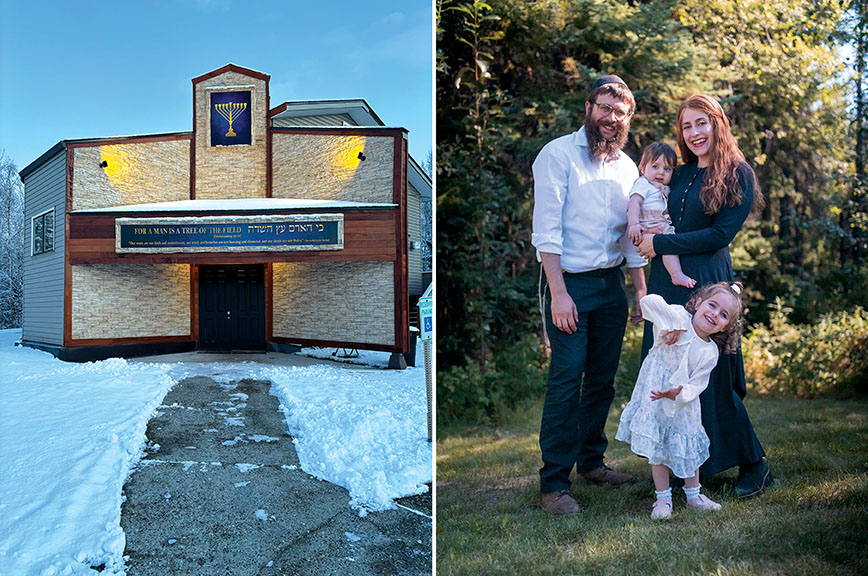
Bringing Jewish Life to the Last Frontier: The Wolfs Open Chabad in Fairbanks

When Rabbi Heshy Wolf and his wife Chani announced to their family and friends that they were moving from Los Angeles to Fairbanks, Alaska, they were met with skepticism.

“Everyone was looking at us like, ‘What are you doing? You’re crazy,’” Heshy told The Journal on a Zoom interview from his home in Fairbanks, where he now lives with Chani and their two children. “Now that we’re here, everyone is so excited about it,” added Chani. “They came to visit and saw how beautiful it is here.”

Before the Wolfs’ arrival 18 months ago, Fairbanks had never had a Chabad rabbi. The local Jewish community of approximately 1,000 people had been managing life events on their own — brit mila, weddings, funerals, and everything in between. To date, Heshy has only conducted six or seven funerals, but hopefully there will soon be weddings and bar mitzvahs.

Rabbi Yosef Greenberg, who has served as the regional director of Chabad in Alaska since 1991, offered Heshy the opportunity to come to Fairbanks and see if he would like to open a Chabad house there. Heshy was interested, but first he needed to convince his wife.

At first, Chani admitted, she wasn’t thrilled about the idea of moving to Alaska. She was born in Australia and moved to Los Angeles with her family at age 12. She had spent her entire life in a warm climate. “I said, ‘No way. It’s way too cold there,’” she said. “Then he suggested we just come for a summer trip to meet the people. My daughter was only a few months old then — now she’s two. We went for a week and really connected with the community right away. They were begging us to come, teach Torah and give them the Jewish experience they’d been missing.”

There was one big perk about moving to a place where the temperatures in the winter can drop below -50°F.  One of the Jewish community members, Jay Ramras, really wanted the couple to move to town and open a Chabad house. He was born and raised there and felt it’s time the Jewish community have a rabbi in town. “So when I told him we are planning to move, he said I’m going to help you out,” Heshy said.

Ramras, a local businessman who was a Republican member of Alaska House of Representatives, offered to help the couple find a place where they could open a synagogue. Heshy traveled back to Alaska, and soon after they began looking, a church came up for sale on two acres of land. Ramras immediately made an offer and purchased it. He renovated the entire building. The Wolfs later built a mikveh on the grounds.

“When Chabad opens in a new town, it usually takes time to raise funds and secure a building,” said Chani. “You start in your home, expand, grow and eventually purchase a place. But here, we already had a building thanks to Jay.”

On their first Rosh Hashanah, they hosted around 20–25 people. The following year, attendance grew to 60, and last Hanukkah, about 100 people came to the candle lighting and party — even with temperatures at -20°F outside.

The cold doesn’t seem to deter anyone from attending Friday dinners, Shabbat services or weekly lessons with the rabbi.

“A couple of weeks ago it was 45 below zero, and people still came over. Nothing stops them here,” said Heshy. “I feel like in a big city, people are more scattered. But in a place like Alaska, far from everywhere else, people really want to connect and engage with their community.”

Ten months ago, Chani gave birth to the couple’s second child, a boy. They had to fly in a mohel from Los Angeles. They also need to ship dairy products and meat from L.A., but they insist on focusing on the positive aspects of living in Fairbanks. While kosher products in local stores or Costco are limited, they have plenty of fish.

“In order to fish salmon here, there’s a quota on how much you can catch, but it’s pretty generous,” Heshy said. “We went fishing during the salmon run and caught 55 salmon. Now we have them in our freezer.”

Living as an Orthodox Jew in Alaska brings other challenges that one may not necessarily think about before moving there. In the winter there are only three and a half hours of light and during the summer, it’s mostly light and a few hours of darkness.

“Sometimes my daughter wakes up and asks me, is it morning or night-time?” said Chani. “It can be very confusing. Often the cold temperatures here get a lot of attention but for us it’s a challenge during Shabbat because then Shabbat enters really early or ends really late.”

Raising two children in a town without Jewish schools or daycare presents unique challenges, but the Wolfs are finding creative solutions. Chani has been connecting with other moms in the community, building friendships, and creating activities where children can play, sing and learn together.

“My kids come with me to everything,” she said. “We want to build a community where Jewish moms can raise their children together. My daughter already knows her entire alef-bet, and she isn’t even three yet – she knows how to pray and knows almost everyone in the community by name.” For now, the Wolfs plan to homeschool their children, using online programs, but in the future, they might even open a Jewish school in Fairbanks.

Some of the people who attend their Shabbat dinners and services are students, professors and researchers from the local university, personnel from the nearby Air Force and Army bases and locals who are grateful to finally have a synagogue in town.

“A lot of them know very little and didn’t have much exposure to Judaism in the past; however, they aren’t scared of us. They want to learn, they say, ‘Teach us more,’ they really come out of the woodwork,” said the rabbi. Chani added that “even though they haven’t been practicing their whole life, they are excited to start now.”

Before moving to Alaska, the couple held a fundraiser in their community in LA and are planning to do another one soon. They admit it’s not as easy to raise money when you live in a small, less wealthy town. The hope is that with the establishment of Chabad in Fairbanks, there will be more Jewish tourists coming to the area.

“The northern lights are incredible here,” said Heshy. “It’s like a winter wonderland. It’s a beautiful place to live in and visit.” And in the summer, Chani said, people love coming here for the beauty and nature.

Despite all the challenges of living in the northernmost Chabad in the world, the Wolfs never had a second thought about their decision. Fairbanks is now their home for life. “We are going to stay here forever,” said Chani.

“Until Mashiach comes,” added Heshy.

To donate to the Chabad of Fairbanks’ fundraising drive on Feb. 15-18, visit Charidy.com/NorthernLight. Email Rabbi Heshy at Rabbi@jewishfairbanks.org

Bringing Jewish Life to the Last Frontier: The Wolfs Open Chabad in Fairbanks Read More »

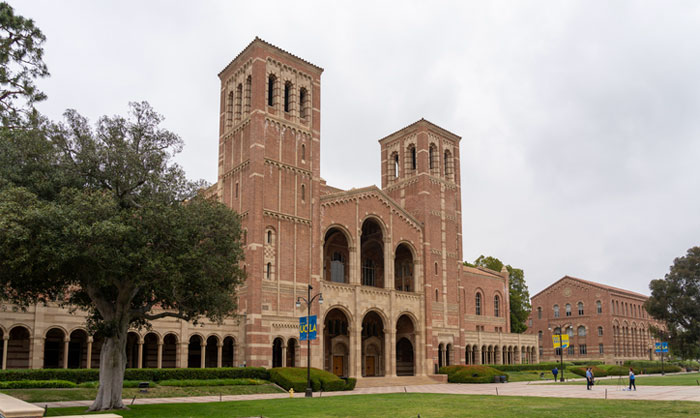
Jewish Leaders and Students Define Resilience at UCLA Hillel Event

On Sunday night at UCLA Hillel’s “Celebration of Jewish Resilience,” about 275 people gathered to honor Distinguished Professor Stuart Gabriel and Assemblymember Jesse Gabriel (D-Encino). Speakers and guests tried to answer a timely and practical question: what does resilience look like when it’s being tested in real time?

Chancellor Julio Frenk opened the event by calling on attendees to “celebrate Jewish resilience — the intergenerational passing down of Jewish pride, Jewish leadership, and Jewish persistence.” He cited Jesse Gabriel’s role as co-chair of the California Jewish Caucus and Stuart Gabriel’s leadership of UCLA’s Initiative to Combat Antisemitism, describing the work as ongoing rather than ceremonial. “These are lived values,” Frenk said.

Dan Gold, Hillel at UCLA’s executive director, framed the evening as both a celebration and a checkpoint. “Tonight is both a powerful celebration and a meaningful opportunity for us to come together at Hillel to reflect on the past few years, to recognize the enduring strength of Jewish resilience, and ultimately to celebrate the promise of a strong and united Jewish future,” he said. The decision to honor a father and son, he added, reinforced the theme of continuity across generations.

One of the most personal moments came from Maayan Goldman, a third-year psychology major and the only Jewish undergraduate member of UCLA’s Initiative to Combat Antisemitism. She asked the audience to think back to their first weeks on campus — meeting friends, finding routines, settling into a new life. Then she described her second week at UCLA: “For the first time in my life, my identity and existence was threatened.”

Goldman pointed to Oct. 12, 2023, five days after the Oct. 7 Hamas attacks, when the first pro-Hamas rally took place on campus. “UCLA students are marketed as the future leaders of our world, and yet my peers were chanting ‘our people are occupied, resistance is justified’ after over 1,200 of our friends and family members were murdered, raped, or kidnapped just five days prior,” she said.

Goldman described what she saw as the limited set of choices Jewish students felt they had in the months that followed. “There were several options for Jewish students to take following the rising cesspool of antisemitism: Hide, assimilate, Hillel,” she said. For students who leaned into Hillel, Goldman described a place that offered routine as much as refuge. “We were welcomed with a loving embrace, with a kosher cafeteria, with free coffee, and with a community that grieved together and supported one another unconditionally,” she said.

Additional speakers defined resilience not as an exercise in quiet endurance but as seeking visibility supported by institutions. They spoke of the need for spaces, programming and leadership that allow students to show up as themselves without feeling exposed to discrimination and harassment as many Jewish students have in the last two years.

Frenk connected the evening to International Holocaust Remembrance Day and emphasized the administration’s responsibility for campus climate. “As chancellor of UCLA, I will always be clear: hate has no place on our campus,” he declared. The statement drew applause, but it also carried a subtext familiar to many attendees. Those commitments are measured not in speeches, but in how the university responds when protests, policy and student safety collide.

Gold closed by describing initiatives he said Hillel is pursuing, including the Fund to Beat Campus Antisemitism and efforts to bring non-Jewish faculty to Israel. He presented the work as concrete and resource-dependent, and a reminder that, for the organizations tasked with supporting Jewish students, resilience often looks like budgeting as much as inspiration.

Goldman ended on a carefully optimistic note. “While it’s been over two years since Oct. 7 and the campus climate has improved, we can never let what happened repeat itself,” she said. “The need for a place like Hillel will always exist in order for future generations of Jewish students to thrive.”

By the time the program ended, the theme of the night — Jewish resilience — had taken on a specific meaning in the room: not a slogan, but an ongoing set of choices, and a set of responsibilities shared by students, institutions and university leaders. 

Jewish Leaders and Students Define Resilience at UCLA Hillel Event Read More »

The Charm of Shabbat Chamin

It’s been six years, dear reader! Six years of cooking and taking photos, sharing our recipes and stories, as well as trying to describe food using only one “delicious” per article.

To say that we are grateful to write this column is an understatement. It has been the impetus for us to record recipes that existed solely in our mothers’ memories or handwritten on loose sheets of paper.

Over the past six years, we have had the privilege to cook (and eat) for gloriously happy milestones, including wedding showers and baby showers, birthday celebrations and cooking classes. We cooked through the COVID pandemic and for the saddest times in our lives — the passing of my father David in 2023, as well as Rachel’s mother Rica in 2022 and recently, her father Messod and Neil’s mother Becky.

Funnily enough, the first two recipes we featured in the Journal were traditional Shabbat stews — Moroccan Dafina and Iraqi T’bit. So it feels like a full circle to share this recipe for chamin. This past week, I had invited a lot of Shabbat guests and Shevy, my youngest daughter, had invited a lot of her friends, so chamin was my perfect solution for feeding a crowd.

While Iraqi Jews traditionally make a chicken and rice dish for Shabbat, my mother sometimes made a flavorful chamin, a meat and bean stew. Inspired by her recipe, I bought a beef shank and beef neck bones. On Thursday, I set out my beans (Cholent bean mix works perfectly) and my pearled barley for an overnight soak.

On Friday morning, I sautéed the beef and bones in a Dutch oven until they were nicely browned. I sautéed onion and garlic and lots of spices, including paprika, turmeric and red chili flakes, granulated garlic and onion flakes. I added my beans and barley and covered everything with tomato paste, honey, brown sugar and chicken consommé.

Instead of cooking overnight (see Rachel’s notes below), I brought everything to a slow boil, then I left the chamin on the stovetop for five hours.

On Saturday morning, I popped it back into my oven for four hours before lunch. The chamin was perfectly beefy and caramelized and oh so delicious!

—Sharon

Ever since I was a small child, Dafina has been a favorite food. This Moroccan hamim (Shabbat stew) is the ultimate comfort food. Nothing can compare to the wonderful, smoky, sweet and savory long cooked flavors of the meat, onions, rice, wheat berries, garbanzos, potatoes, sweet potatoes and dates.

Honestly, I don’t make it every week because it’s very hearty and quite heavy on the stomach. It’s a lot of work to prepare and that long list of ingredients makes it more suited for feeding a crowd. So, I make it for the Shabbats when I know my entire extended family will show up.

Of course, Dafina holds so many precious memories that when I do make it, they all show up.

However, Dafina does present me with a logistics problem! Since this stew cooks overnight, the smells spread throughout the house. For me, the aroma wafting up to our bedroom in the middle of the night brings such comfort and joy. But my husband Neil didn’t grow up with hamim, so it doesn’t stir any fond feelings for him. For poor Neil, the smell is overpowering and makes him feel dizzy. He cannot sleep and has to open all the windows and close the doors. You can imagine the midnight drama!

So, many years ago, I had the ingenious solution of setting up a folding table in my backyard and using a long extension cord to plug in my crock pot.

The first few times I did this I was quite nervous and I had to get up in the middle of the night to check that no animal had tried to eat my Dafina. It proved to be an amazing way to solve the problem. But then we cannot open our bedroom window because that intoxicating aroma works its way up to my window from the backyard!

Looking forward to the next six years!

—Rachel

Meat Chamin

1 cup Cholent bean mix, soaked overnight

1 cup pearled barley, soaked overnight

1/3 cup extra-virgin olive oil

1 lb beef shank or chuck roast

1 lb beef neck bones

2 large onions, diced

10 garlic cloves, roughly chopped

3 tsp kosher salt

1 tsp ground black pepper

2 tsp garlic powder

2 tsp onion flakes

2 tsp sweet paprika.

2 tsp turmeric

1/2 tsp red chili flakes

5 large potatoes

5 Tbsp tomato paste

1/4 cup honey

2 Tbsp brown sugar

3 cups chicken consommé or water

In a Dutch oven, warm olive oil over medium heat. Add the beef and the bones and brown for 3 – 5 minutes on each side. Remove from the pot and set aside.

Add the onions and garlic and sauté for a few minutes. Add the salt, pepper, garlic powder, onion flakes, paprika, turmeric and chili flakes and sauté for a further two minutes.

Return the beef and bones to pot. Rinse and drain the beans and barley, then add to the pot. Add the potatoes, tomato paste, honey and brown sugar and cover with consommé.

Gently mix the ingredients and bring the chamin to a slow boil. Cover the pot and simmer over low heat for five hours. Taste and add salt, if necessary. Refrigerate overnight.

Before sundown on Friday, set the oven to Sabbath mode at 250°F.

On Saturday morning, heat chamin for at least 4 hours before serving.


Sharon Gomperts and Rachel Emquies Sheff have been friends since high school. The Sephardic Spice Girls project has grown from their collaboration on events for the Sephardic Educational Center in Jerusalem. Follow them
on Instagram @sephardicspicegirls and on Facebook at Sephardic Spice SEC Food. Website sephardicspicegirls.com/full-recipes.

The Charm of Shabbat Chamin Read More »