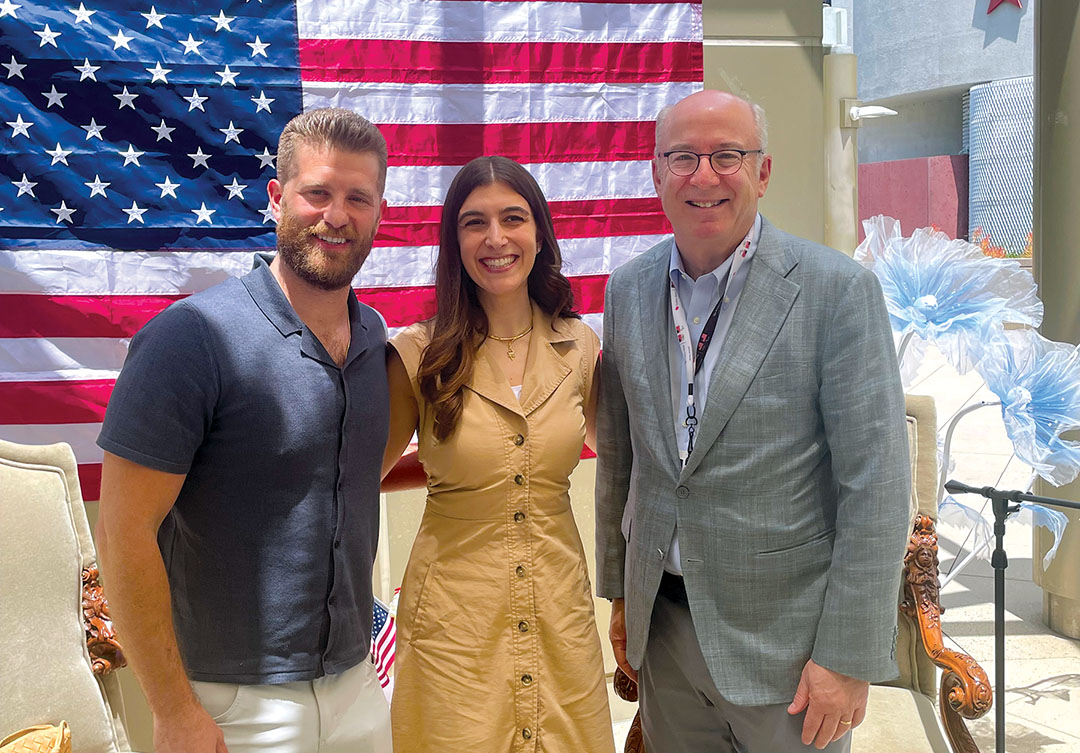

On July 1, it will be 15 years since 22-year-old Ariel Chaim Avrech died from severe pulmonary fibrosis. In what has become a tradition, family and friends recently gathered for the annual Ariel Avrech Yahrzeit lecture at Young Israel of Century City.
“We all want to remember those who have passed away,” Ariel’s father, Robert Avrech, said of the ongoing tribute to his son, who was pursuing a degree in special education at the time of his death.
“All [parents] feel that their children are special,” he said. “Ariel was a super special person. He was an unusual person, and we wanted to make sure that he’s not forgotten and do something that was in the spirit of his life.”
Part of that decision he made with his wife, Karen, was to hold a lecture each year and bring in a wide range of speakers who reflected Ariel’s religious convictions. Over the last decade-and-a-half, speakers have included Dennis Prager (“Happiness Is a Mitzvah, Not an Emotion”), Michael Medved (“Shifting Alliances: Why Liberals No Longer Reliably Support Israel, and Conservatives Do”), Larry Elder (“The New Black Antisemitism”), Rabbi Steven Pruzansky (“Conformity in Jewish Life: Virtue, Vice or Affection?”), Ben Shapiro (“How You Can Help Israel”) and Yossi Klein Halevi (“What Is Expected of a Survivor People: Lessons My Father Taught Me”).
This year’s speaker has a personal connection with the Avrechs. Brand innovator Jackie Danicki’s first contact with the family was through a blog Robert set up barely a year after Ariel’s death.
“Robert and I have spoken about how my relationship with their family and how my path progressed seemed to suggest Ariel has been intervening with God on my behalf.” — Jackie Danicki
Danicki, 41, who completed her conversion to Judaism just three days before her memorial lecture on June 10, was born in Ohio and raised Catholic. She grew up on a farm and didn’t meet a Jewish person until she was 15. Yet she said even before she began kindergarten, she was drawn to Judaism.
Danicki splits her time between New York and Atlanta but was living in London when Robert ran his first blog post about Ariel in June 2004. She was first person to leave a comment on the site. She also emailed Robert and said as she was running errands in London, “I sat on the top deck of the big red bus and looked out at the clouds and thought about Ariel. I don’t know why. I almost felt like he was sitting next to me.”
“Rereading this, I really cringe,” Danicki said in her talk, “because it could have been insensitive to somebody in mourning or presumptuous of me. [But Robert] simply replied, ‘I’m glad you had a nice ride with Ariel.’ ”
She added, “I felt deeply moved and honored to be asked to speak at Ariel’s memorial lecture. I could never say no to the Avrechs, especially for something done in Ariel’s memory. I love them and am grateful I got to help them honor their son.”
Through her talk, “What’s a Goy Like You Doing in an Eruv Like This?” Danicki shared the story of her conversion. On June 7, the day of her conversion, Danicki took the Hebrew name Ahava Ariel, which means “Love Ariel.”
She spoke about how she’d been interested in Judaism since she was a child, “but when I observed the Avrechs living Orthodox Judaism on a daily basis, and saw how it imbued even the mundane parts of life with meaning, I knew I had to dig deeper.”
Danicki said it was unlikely she would have met the Avrechs were it not for Ariel. “Robert and I have spoken about how my relationship with their family and how my path progressed seemed to suggest Ariel has been intervening with God on my behalf,” she said.
Robert said, “I’ve known Jackie for 13 years. I met her when she was not Jewish, and we’ve developed a close relationship and now she is Jewish. And she’s been inspired by Ariel’s holy soul. So it’s very meaningful to us.”
Ariel’s friend Jonathan Beck also spoke briefly at the event and said, “Ariel was such an example of what it means to truly enjoy Yiddishkayt, to be so connected to HaShem, to be so connected to learning.”
Beck also spoke about how “when we think about our own health and we take it for granted, it would be a nice thing to think about Ariel — a person who never took anything for granted.”
Ariel’s mother, Karen, told the Journal following Danicki’s lecture, “Ariel told me that the best joy in his life was not a great pizza, or a great meal, [but] to go through a Gemara or Talmud [passage], figure it out, feel like you understand it, and then drink a tall glass of ice water.”