
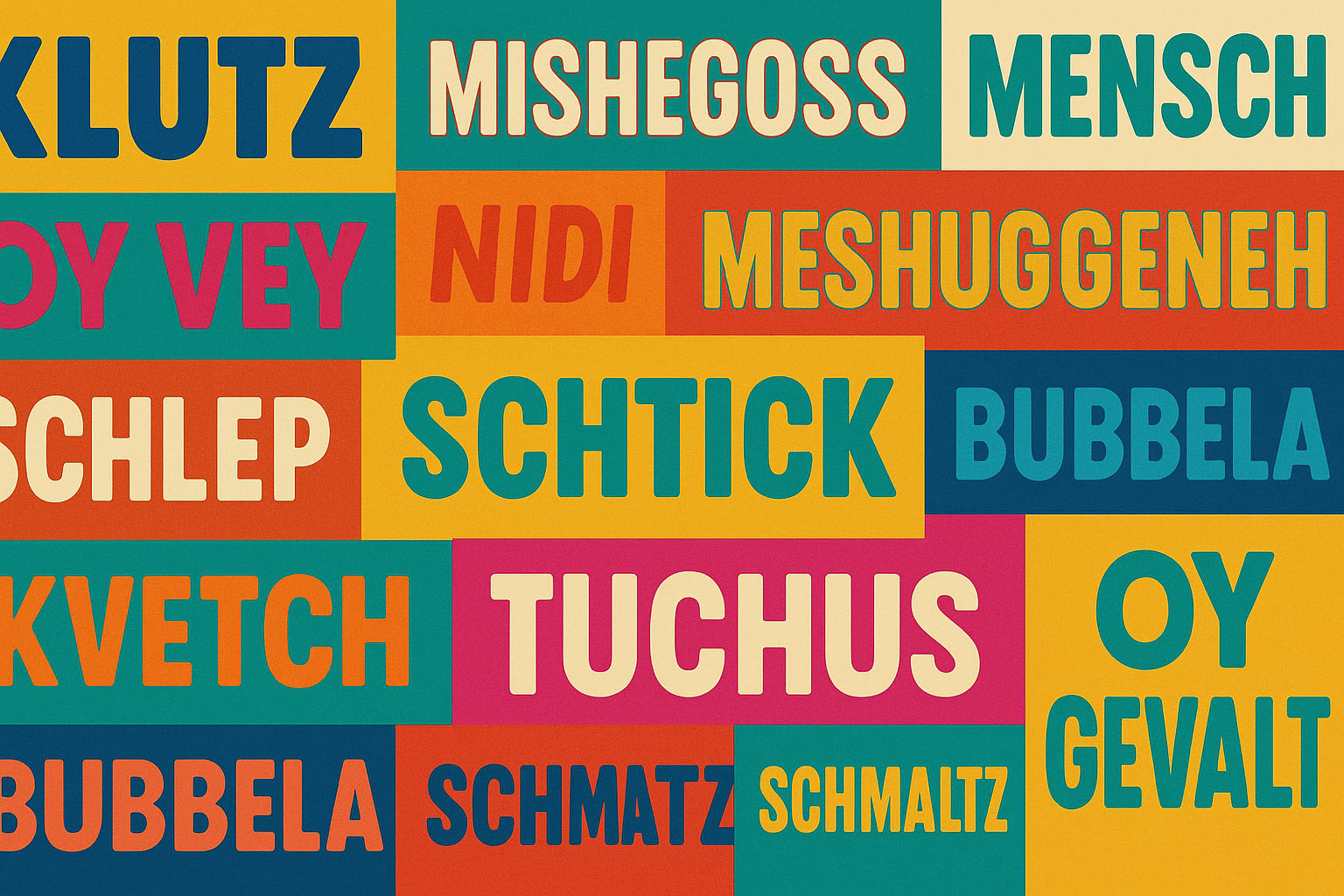
On my mother’s side, they all spoke fluent Yiddish. Most of these conversations took place while eating moisture-free yellow pound cake and washing it down with warmed-up day-old Maxwell House Coffee. On my father’s side, except for Oy Vey, they just spoke English.
My wife Nancy’s grandparents, on her mom’s side, also knew Yiddish.
One reason my wife and I never learned Yiddish was that our families didn’t want us to. Yiddish was only spoken when they tried to hide things from us. Since we didn’t speak another language, my wife and I would spell out words we did not want our own kids to understand. Even though our kids are now in their 30s, spelling out certain words still works. Thank God for Day School.
The Yiddish language began around the 9th to 10th century CE. By the 19th and early 20th centuries, Yiddish was the everyday spoken language of millions of Jews while they were running from one Eastern European country to another, trying to avoid being murdered by their neighbors, to whom they lent sugar and babysat. Outside of Eastern Europe, a Yiddish-speaking Jew could starve to death trying to find someone to take a food order in a restaurant.
At its peak, roughly between the 1910s and 1930s, the Yiddish press was huge, with hundreds of Yiddish newspapers worldwide. In fact, Isaac Bashevis Singer wrote most of his stories on a Yiddish typewriter. Today, it is estimated that globally, there are only 40-50 Yiddish-language print media sources serving a readership of up to 2 million people.
These days, most Yiddish speakers wear a long black coat, a black hat, a beard you could trip over, and the ability to drink steaming hot tea out of a glass. If you are a woman, characteristics include the ability to have a baby every five months and wear a sheitel (wig) that is sometimes worn more to one side, like a beret.
Many Hasidim speak Yiddish as a first language at home, school and designated smoking areas. These include: Satmar, Belz, Vizhnitz, Ger and other sects most people have never heard of. Each group has a slightly different Yiddish dialect, accent and beard length. It is forbidden for these men to shave; if they want to trim the beard instead of using a razor, they light a cigarette off a gas burner on a stove. Yet there is a Yiddish word for shaving: “der riyer,” from the verb rayen, meaning to shave. This word is only used when a Hasid almost gets killed at 3 a.m., dressed in black, while reading the Talmud and crossing a busy Brooklyn street at the same time. That is called a “close shave.”
If you are wondering if new Yiddish words are still being created today, here are a few: kompyuter (computer), telefon or fon (phone), imeyl (email) and internet (internet).
Most Hasidim own computers, but they are usually in disrepair because of the raisin noodle kugel stuck in between the keyboard keys.
The wisdom of this language is timeless and as relevant today as it was back then.
Here are a few quotes from Leo Rosten’s “Treasury of Jewish Quotations”:
“A child without a mother is like a door without a knob.” I think it means that without a mother, it’s complicated to open the door to life.
“Fish die out of water; men die without law and order.” Even back then, they knew not to defund the police.
“Adam was the luckiest man: he had no mother-in-law.” Ain’t that a mouthful?
“We would all be rich if we did not have to eat.” It is a widely known fact that most Jews never stop eating.
“Dear God: I know you will provide, but why don’t you provide until you provide?” The story of my dating life before marriage
It’s my fault that my children don’t know the Yiddish words I grew up hearing. Words like schlemiel, schlimazel, schlep, shyster, schemer, shonda, schecht— all very beautiful and descriptive. The one they all do seem to know is shiksa (blonde).
More than likely, our grandchildren will know even less. Even if they do happen to know a few Yiddish words, Dolarn un Donats or “dollars to doughnuts”, they won’t realize they’re speaking Yiddish.
Mark Schiff is a comedian, actor and writer, and hosts, along with Danny Lobell, the “We Think It’s Funny” podcast. His new book is “Why Not? Lessons on Comedy, Courage and Chutzpah.”