fbpx

September 23, 2025

How Not to Respond to the Charlie Kirk Memorial Service

The memorial service for Charlie Kirk took place this Sunday; chances are the only things you know about it are that Erika Kirk gave a graceful, heartfelt speech; Tucker Carlson blew a dogwhistle; and President Trump joked-not-joked that he genuinely hates his political opponents. I watched the entire event, and it struck me as a pivotal moment that will impact American politics for decades to come. 

And I am terrified — not primarily by the dangers of Christian nationalism itself (though those are real), but by the likelihood that well-meaning people in the Jewish community are going to bungle their response to it and to the political juggernaut that has burst onto the scene. 

Most Jews don’t understand what is taking shape in Christian America. They fear it, conflate its diverse voices and want to denounce it with great moral force, as if that will somehow make it all go away. They think that if they call it “White Christian Nationalism,” condemn every comment Charlie Kirk ever made (real, fake or distorted), and label the entire movement irredeemably racist, then kind-hearted Americans will push back at it. But none of that will happen, will it?

Dan Williams, a philosopher at the University of Sussex, well expressed such confusion:

“Watching the Charlie Kirk memorial, I’m struck by how extremely culturally distant I feel from this world. Everything about it feels alien — the aesthetics, symbolism, music, rituals, mythology, gurus, ideas and norms. It feels like being exposed to the cultural and symbolic universe of a distant tribe.”

Humility is a good starting place for American Jews. Rabbis, communal leaders, philanthropists, Jewish professionals — I beg you: hit the pause button. Put aside the old Jewish advocacy playbook, just for a moment. Listen. Read. Engage with people who truly come from a different cultural and spiritual universe than your own.

If you watched the memorial service closely, you could hear four distinct voices:

Erika Kirk

Erika Kirk spoke with composure and grace. She thanked supporters for their prayers, reflected on her marriage, framed Charlie’s death in Christian terms and emphasized hope in eternal life. Crucially, she publicly forgave Tyler Robinson — the 22-year-old man accused of killing her husband. She said, “That young man, I forgive him,” invoking Jesus’ words: “On the cross, our Savior said, ‘Father, forgive them for they not know what they do.’” She also said: “My husband, Charlie, he wanted to save young men just like the one who took his life.” “The answer to hate,” she said, “is not hate. The answer we know from the gospel is love and always love. Love for our enemies and love for those who persecute us.”

Jack Posobiec

Jack Posobiec, a controversial far-right commentator and longtime Kirk ally, leaned heavily into spiritual warfare rhetoric. He likened Charlie Kirk to Moses, saying he “brought us to the promised land,” and argued that the activist’s killing will save “Western civilization” by “returning the people to Almighty God.” He urged the crowd to engage in “spiritual warfare” on Kirk’s behalf and to “put on the full armor of God.” Our very own Stephen Miller, deputy chief of staff to the President, sounded a similarly combative note. In the days to come, will we hear more of Erika Kirk’s forgiveness or Jack Posobiec’s retributive politics?  

JD Vance

Vice President JD Vance delivered a confession of sorts — a rare admission of how private his faith has often been. He said: “I always felt a little uncomfortable talking about my faith in public. As much as I love the Lord, and as much as it was an important part of my life, I have talked more about Jesus Christ in the past two weeks than I have my entire time in public life.” His words undoubtedly presage a renewed Christian pride and accompanying public professions of faith. 

Tucker Carlson

Tucker Carlson, unsurprisingly, played the role of provocateur. His remarks ridiculed “the hummus-eating people” who, in his telling, mocked traditional Christian faith. He pivoted to the crucifixion, charging that the death of Jesus had been “a deliberate act” by those who hated God’s truth, implying that Charlie Kirk was the victim of the same. The dogwhistles were unmistakable. His voice, too, represents a small but growing segment of the Christian right.

All of these disparate voices were present on Sunday, and will compete for influence within the Christian national movement and for the hearts and minds of Americans.

Here’s my advice to Jewish leaders:

Don’t lump them all together. Some are conciliatory and respect our democratic values, others do not. Some we can work with, others we cannot. Instead, study up on the various branches and schools of thought. Go on a listening tour and talk to the key voices in the movement.  Who are the Erika Kirks within the movement and how can we strengthen our ties to them?

Don’t engage in “offense archeology” and dig up and denounce every problematic statement from Christian figures. Those days of keeping problematic voices on the margins are over. You will only isolate yourself and the Jewish community, not the intended target of your moral condemnation. Instead, try to understand the entirety of their philosophies and approaches to politics, and then decide whether we should get to know them or keep them at arm’s length. 

Don’t slam their public professions of faith, even if they make you uncomfortable. A public figure has every right to share their faith, as long as they don’t deploy the coercive power of the state. Instead, welcome their voices of faith. They are filling the moral vacuum that has set into our society. Jewish leaders should add their own professions of faith to the mix of public voices.  

We are in for a major shift in American politics. Now is the time to understand it, not condemn it and ourselves to the margins. 


David Bernstein is the Founder and CEO of the North American Values Institute (NAVI).

How Not to Respond to the Charlie Kirk Memorial Service Read More »

Living as Jews in Latin America After Oct. 7

Antisemitism is a social illness that we Jews — in Latin America and around the world — have sadly learned to live with. We know that even when it appears dormant, it always remains latent, waiting for the right moment to resurface with force.

Both of us have spent years monitoring and combating antisemitism in the region. But never did we imagine that we would witness in our lifetimes a resurgence as fierce as the one we are experiencing today.

Oct. 7, 2023 marked a turning point not only for Israelis but for every Jew, everywhere. The barbarity of the Hamas-led massacre that took place that day — the worst slaughter of Jews since the Holocaust — shattered any illusion of security and crossed every boundary of humanity.

Perhaps even more shocking, however, has been what followed. Instead of a unanimous condemnation of terrorism, we have seen — in countless cities across the globe — the unjustifiable defended, the facts twisted and the victims blamed. Israelis, who suffered brutal terror, are now being accused for defending themselves — an immoral reversal of the truth.

Universities, social media platforms, news outlets and even international organizations have displayed a troubling tolerance toward antisemitic rhetoric disguised as a legitimate cause. Synagogues are attacked, Jewish students are threatened, businesses are vandalized with Nazi symbols — all in the 21st century. 

Latin America is home to roughly 450,000 Jews, nearly 150,000 of them in Argentina alone. In Brazil, antisemitic attacks have surged by nearly 1,000 percent since Oct. 7. Argentina and Uruguay have seen the sharpest increases in antisemitic content on Facebook and X. The rise is widespread: almost every country in the region has seen a growth in Jew-hatred since Oct. 7.

Fueled by the rhetoric of certain governments, political parties, and in some cases shadowy operatives financed by Iran and other rogue regimes, the demonization of Israel in Latin America has spread rapidly—moving from social media into mainstream media, academia, and even official institutions.

In cities large and small across the region, “pro-Palestinian” marches are taking place. And in almost every one of them, we see images of malnourished children — images already proven false — displayed alongside openly anti-Jewish slogans.

Almost invariably, protesters wave antisemitic signs (such as those equating the Star of David with the swastika), chant things like “judíos asesinos” and deface synagogues and Jewish institutions with hateful graffiti. This goes far beyond acceptable criticism of the Israeli government’s actions and clearly crosses the line into antisemitism.

There is no condemnation in these protests of the atrocities committed by Hamas against Israeli civilians, nor of the way this terrorist regime treats its own people: using them as human shields, stealing humanitarian aid, robbing children of their childhood and abusing women. Israeli hostages are not even mentioned.

The word “genocide” is used with absolute frivolity (insulting the memory of the victims of the Holocaust); Israelis are compared to Nazis and Israel is held to impossible standards. All of this fits perfectly within the IHRA (International Holocaust Remembrance Alliance) definition of antisemitism, and only exposes the underlying truth: antisemitism — not genuine concern for human rights — is at the core of these demonstrations.

Much like in other parts of the world, most of those who criticize Israel in Latin America have little or no grasp of the realities on the ground, yet they readily join the chorus of demonization.

The charge of genocide is being wielded irresponsibly and with malice. Israel harbors no genocidal intent, while the Palestinian side openly proclaims one—yet this inconvenient truth is one the world refuses to confront. Anyone familiar with the strength of the Israeli army knows that if genocide had been its intention, the war would have been over by Oct. 8, 2023 — without risking the life of a single Israeli soldier.

The fate of the Israeli hostages seems to matter little to the world — and the simple fact that the war could end today if the ruthless Hamas terrorists released them all is almost entirely ignored. Those still alive are being held in inhuman conditions: starved, denied access to the Red Cross, and completely cut off from their families. One of them — visibly malnourished — was forced to dig his own grave. Yet even that image (released by the terrorists themselves) was not enough for the world to demand their immediate release. Because it contradicts the narrative of Israel (the world’s only Jewish state) as the villain, it is quickly dismissed. Undoubtedly, the long-standing anti-Jewish prejudice has found a new excuse to show its face.

But in Latin America, this surge did not occur in a vacuum. For many years, some Latin American governments have tolerated or even promoted language that crossed the line into antisemitism, creating a hostile atmosphere for the local Jewish communities, and opening the door for what is happening now.

This is certainly the case of Colombia, where President Gustavo Petro showed his antipathy toward Israel and the Jewish people well before taking office. His long record of hostility — rooted in his past as a member of the ELN guerrilla force — culminated in open alignment with Iran and Hamas after Oct. 7. He equated Gaza with Auschwitz, accused Israelis of behaving like Nazis, and broke diplomatic ties with Israel — discarding decades of friendship.

In Brazil, President Lula da Silva has long used offensive and unwarranted rhetoric when referring to Israel and, after October 7, he compared Israel to the Nazis and declared that Israel’s actions in Gaza amounted to “a new Holocaust.” Diplomatic relations are now frozen.

In Venezuela, relations with Israel have been broken for years, first under Hugo Chávez and now Nicolás Maduro, both close allies of Iran. After Oct. 7, Caracas openly defended Hamas and even joined South Africa at the ICJ (International Court of Justice) to accuse Israel of genocide.

In Chile, President Gabriel Boric—who has a history of hostility toward the Jewish community — has echoed similar narratives, repeating the rhetoric of Brazil and Colombia and also supporting South Africa’s accusation at the ICJ. In Bolivia, President Luis Arce broke relations with Israel, accusing it of “crimes against humanity.”

The dictatorships of Nicaragua and Cuba, long hostile to Israel, also aligned with Hamas after Oct. 7. In Nicaragua, Jewish cemeteries were vandalized shortly after the Hamas pogrom.

Meanwhile, Iran continues to fund operations against Jews and Israel in the region. Its responsibility for the 1992 bombing of the Israeli Embassy in Buenos Aires and the 1994 AMIA (Argentina Israelite Mutual Association) bombing remains a chilling reminder of how far its reach extends.

In the face of these brutal reactions against Israel and Jews in Latin America and all over the world, there are, of course, some people of good faith who are tempted to think that if only Israel had acted differently, much of this tragedy could have been avoided. But this view overlooks the deeper reality behind these events. No Israeli policy could ever justify the savagery of Oct. 7. What triggered this horror was the dangerous ideology with which the Palestinian people have been indoctrinated for decades. 

Nor were Israel’s government actions after Oct. 7 the cause of the atrocious wave of antisemitism that followed. The antisemitic demonstrations began even before Israel set foot in Gaza. And the sheer ignorance displayed by most of those judging Israel only confirms this.

The Israeli army is operating in an extraordinarily complex environment, confronting a terrorist regime that deliberately endangers its own civilians in order to maximize casualties and then shift the blame onto Israel. Passing judgment from afar on the decisions of a democratic government fighting a brutal, inhumane death cult like Hamas — without the necessary knowledge to evaluate the realities and dilemmas it faces — is not only irresponsible, but also fuels the dangerous tide of demonization sweeping the world.

The vast majority of Jews in Latin America understand this. And while deeply empathizing with innocent Palestinians — whose suffering is real and tragic — they reject the cynical attempts to blame Israel for it. History has shown us, time and again, how demonization of Jews has been used as a dangerous weapon. Each time, lies and slanders paved the way for violence. Today, the same pattern is reemerging. That is why those of us with a moral compass must stand firm and reject this chorus of demonization that not only affects Israel and Israelis but also leaves Jewish communities across Latin America and the world even more exposed and at risk. 


Eduardo Kohn is B’nai B’rith’s director of Latin American Affairs. Adriana Camisar is B’nai B’rith’s special advisor on Latin American and U.N. Affairs. 

Living as Jews in Latin America After Oct. 7 Read More »

On These High Holy Days, Rabbis Must Restore Jews’ Faith in Israel

One Erev Yom Kippur a few years ago, I introduced a sermon by saying, “I am going to give a nonpolitical sermon tonight. I am going to talk about why we must support Israel.”  

To many, that statement may seem paradoxical. But just as rabbis, regardless of affiliation, are advocates for living a Jewish life, so too should we be advocates for the Jewish people, especially for the nation-state of the Jewish people. And this has never been more important than today.

We are living through one of the most challenging times in recent history. The past 23 months have felt as if we are on a roller coaster — mourning the death of innocent Israelis, praying for the hostages, rejoicing when any of them have been freed, celebrating the extraordinary Israeli military successes as it fought a conflict on multiple fronts, and so much more. 

Compounding all of this is the explosion of anti-Jewish hate which is fueled by the inexplicable fact that Hamas is winning the PR war and the media’s overwhelming acceptance of their depiction of events. But just because the media presents a distorted one-sided narrative and Hamas is not held responsible for the suffering in Gaza or the war crimes they commit every day they are holding captives, does not mean that our opinions and those of our congregants should be formed only by what we read and hear in the press. 

We must not allow Israel’s enemies to define our relationship with Israel. 

Rabbis need to remind everyone, including those in our community, why Israel is fighting this war and of the reality that Israel faces. Rabbis have an obligation to dispel the lies, misimpressions, distortions and misrepresentations about Israel. People may forget that she is fighting an implacable enemy who hide behind civilians in hospitals, mosques and schools in a vast network of tunnels, and who do not care about the loss of innocent lives on either side. 

The High Holy Days represent an opportunity to challenge the prevailing narrative and educate our congregants, to restore faith in the Jewish people and Israel.  If we do not counter the lies and propaganda against the Jewish people from the pulpit, we risk it becoming internalized, leading Jews to believe the horrible things said about Israel and their fellow Jews, which ultimately leads to a distancing from the Jewish people, a weakening of Jewish identity, Jewish pride and Jewish sense of belonging. 

If we do not counter the lies and propaganda against the Jewish people from the pulpit, we risk it becoming internalized, leading Jews to believe the horrible things said about Israel and their fellow Jews, which ultimately leads to a distancing from the Jewish people, a weakening of Jewish identity and Jewish pride and Jewish sense of belonging.

As Israeli Arab commentator Yoseph Haddad recently explained, to survive in the Middle East, Israel has to speak Arabic – meaning be tough, and not perceived as soft. Its actions may make Jews in the United States cringe at times, but it is doing what it needs to do to survive as the only democracy in the Middle East for more than 75 years. 

We should approach the topic of Israel with a sense of humility. We in the United States cannot imagine the daily events that occur that we never hear about — the car rammings, the stabbings, the constant red alerts — and the impact they have on the psyche and trauma of the people of Israel. We aren’t awakened in the middle of the night to run to a safe room, or carry our babies to a protected area. The role of rabbis is to help our communities understand the multiple challenges that Israel faces and to ensure that she is not fighting the battle against Islamic extremists who seek her destruction alone.

To those rabbis who think Israel needs to hear their critique, I say Israel does not lack for critics. Their perspective will not impact decisionmakers in Israel. It will, however, impact the hearts and minds of those who hear their words — their congregants. And while many share their critiques out of love, I fear that nuance will be lost to many in the Jews in the pews, who will come away thinking that their rabbi does not support Israel, and therefore, neither should they. 

Is Israel perfect? Absolutely not. No person is, nor is any country. We do not love Israel because she is perfect, nor do we need Israel to be perfect for us to love her. We are family, and when your family is hurting, when it is isolated and alone, it is your obligation to offer comfort and support, not public condemnation, neither from the pulpit nor from unsolicited open letters.

The midrash tells us that Abraham, the very first Jew, was called HaIvri, the Hebrew, because he was courageous enough to stand on one side while everyone else in the world was on the other side. We are like Abraham. We are on one side, with a few outspoken courageous allies, while the rest of the world is on the other. And we should also be like Moses, passionate defenders of our people.  

So, on these High Holy Days, rabbis have an important role to play. We must rise to the challenge and fight the global efforts to delegitimize and demonize Israel and the Jewish people. We must fortify our communities with truth, so they do not doubt Israel or the justness of the battle it is waging. 

This is a time to ask — will we stand with our family or with its detractors. This is a time when we can and must restore faith in our people. 


Rabbi Stuart Weinblatt is the Chair of the Zionist Rabbinic Coalition: The Voice of Zionist Rabbis, a network of over 2,000 rabbis committed to fostering love and dedication to Zionism and Israel.

On These High Holy Days, Rabbis Must Restore Jews’ Faith in Israel Read More »

Our Sacred Promise

Before Rosh Hashanah, a project called Bring Them Light uploaded a video to Instagram that is so devastatingly powerful I watched it over and over for hours, crying continuously.

The video is a montage of Nova, IDF, kibbutz and hostage victims — dancing, singing, smiling, alive. Accompanied by “Stand by Me” and the Hebrew song “Keren Shemesh” (“Sunbeam”), the video seeks to “rehumanize the fallen” by showing the world their beautiful souls.

Founded by Lihie Gilhar in November 2023, Bring Them Light seeks to preserve not just the memory of those we lost, but their faces, their names and their life stories.

“This project does not focus on how they died. It honors how they lived,” says Gilhar. It began with a single impulse: “the murdered should not be reduced to anonymous casualty lists. Each person was a universe of light, joy, and love — and that humanity needed to be preserved.”

“This project does not focus on how they died. It honors how they lived … the murdered should not be reduced to anonymous casualty lists. Each person was a universe of light, joy and love — and that humanity needed to be preserved.” – Lihie Gilhar

“What binds us as a people is not only blood, nor history, nor land. It is the sacred, unbreakable thread of memory,” are the first words seen on the website.

“It’s a promise to not forget”

A clinical psychologist, Gilhar speaks with each bereaved family, listens to their stories, collects photos, videos, music and memories, and crafts these heartfelt digital tributes, which are then translated into both Hebrew and English and shared only with the families’ full approval.

To date, she has told 295 stories. “Each one is a soul reclaimed from erasure.”

But Bring Them Light is not just about grief and memorialization. “It’s about legacy,” Gilhar said. “It transforms trauma into memory, memory into meaning — and remembrance into action.” What began as a temporary installation at Habima Square in Tel Aviv has expanded into a digital archive (the website and Instagram) and a billboard in Times Square — a 15-second video collage of victims — with one purpose: to keep the light alive. 

“A light that cannot be dimmed”

The website warns “The truth has become fragmented … The facts are scattered. And on social media, the story is not being told right. Even during this ongoing war, Oct. 7 is already vanishing from the conversation. We keep hearing: Yes, Oct. 7 was terrible, but …

“But politics. But context. But everything except the truth. There is no ‘but.’

“On Oct. 7 there were massacres, rapes, burnings, kidnappings. Children murdered. Parents slaughtered in front of their children. Lives destroyed in the most brutal ways. This is not a footnote. This is where it all began. This is the rupture. The wound that will never fully heal. And yet — silence grows.

“We cannot be silent. For the victims. For their families. For history.”

“Their stories live forever”

I asked my favorite doorman if I could show him a video. Smart and soulful, he and I have talked about nearly every subject — but we never talked about the war. He watched the video for just a few seconds and then gave me back my phone. “All I see all over social media are children’s body parts,” he said.

Stunned, I managed to respond: “You know most of that is fake, right?” He shrugged.

I walked out onto the streets of New York City trying to emotionally grapple with something I knew intellectually: most non-Jewish people who stare at my tiny Star of David necklace think I’m evil. 

Yes, Islamists excel at lying; the Quran even encourages it — taqiyya. Second to violence, propaganda is their forte. Leftist and far right “media” outlets compound the problem by presenting the lies as facts (Shalom, New York Times). But I truly never expected intelligent people to believe the lies. 

Of course, it has little to do with intelligence. These very same people would never believe whatever ISIS or al-Qaida says. But when Jews are the sole victims, blood libels go viral. Believing blood libels about Jews goes back to the Middle Ages. The truth is, antisemitism is a failure of decency, humanity and character. 

Which is precisely why Zohran Mamdani, a Muslim millennial socialist who just pledged to abandon the International Holocaust Remembrance Alliance definition of antisemitism; supports the BDS movement against Israel; still defends “Globalize the Intifada” and whose Columbia University “professor” father praised Hitler, will soon be mayor of this dying city.

I will never forgive those who choose to believe Hamas’ blood libels because we know exactly what it leads to. My great-grandparents didn’t flee the evils of Russia more than 100 years ago for me to become the scapegoat of narcissistic millennials. 

“Their names echo; their faces shine”

But the point of this incredible video is to carry the light of these beautiful souls into the world. And I will try to do so every way I can, mostly through teaching my 16-year-old son and his friends the truth every single day. And through them, we can hopefully stop Gen-Z from turning into the millennial teachers they despise. 

Because building the character that would never engage in blood libels begins in the home, as Martin Luther King Jr. well knew.

The video ends with this beautiful quote: “We remember with love what hate tried to erase.” It is our sacred promise to do so.


Karen Lehrman Bloch is editor in chief of White Rose Magazine.

Our Sacred Promise Read More »

Investing in Israel is No Longer About Charity

If you were the lead investor for a Jewish foundation with anywhere from $80 million to $1.3 billion in assets, how would you invest? The answer is simple: Invest in companies that provide for long-term, low-risk growth of your principal while also aligning with the mission of your foundation. In other words: Make the most amount of money with the least amount of risk all while ensuring that your investments support the values you believe in.

One way to do this is to invest in Israel, but there’s still a major misconception about what this means. It used to be that investing in Israel was about propping up a fledgling country, but those days are long gone. Sure, investing in Israeli companies does help Israel, but that’s not what’s driving savvy investors to put their money there. Yet few Jewish foundations and Federations are investing in Israeli companies, which means they’re missing an important opportunity to grow their portfolios while strengthening a key part of their philanthropic mission. Investing in Israel offers not only the potential to generate wealth but also to redefine what we mean by philanthropy—all while supporting the Jewish people.

The facts speak for themselves. Israel’s stock market has significantly outperformed the U.S. market since Oct. 7, 2023. The TA‑125 gained 46% (including dividends), while the S&P 500 returned 40% during the same interval. In 2025 alone, Israel’s gains (34.6%) far exceed the U.S. (10.9%). In a global context, Israel has been among the top five best performers worldwide, dominating the MSCI World, Dow Jones, and FTSE-100 in 2024 (Times of Israel). It’s one of the fastest rising economies in the world now, even and especially post-Oct. 7. Ongoing military challenges may give some pause, but Israeli markets have staged a remarkable rebound that has been consistently maintained.

Israel has all the elements of a strong economy. So why don’t people understand just how good it is? Many are still locked into the idea that Israel bonds are the place to be, but “Israel is an evolved economy,” says Selwyn Gerber, Founder and Chief Strategist at RVW Wealth LLC. He believes it’s “ignorance” that is preventing people and organizations from prioritizing investing in Israel. “People react to headlines, many of which can be scary,” says Gerber. But “investing according to headlines,” which are often volatile, “is a very bad way to invest. The flavor of the month is for ice cream, not portfolios. Most people just don’t know enough to understand the fundamentals,” and so investing in Israel is “still seen as risky.” But Gerber says “there’s no reason it shouldn’t be in every portfolio,” and foundations especially should have an Israeli option.

People with their finger on the pulse of investing, like Bill Ackman—who along with his wife Neri Oxman purchased a 4.9% stake in the Tel Aviv Stock Exchange in January of 2024 and saw an 80% return in only ten months—know it’s true. And the big tech funds in Silicon Valley take it for granted. As of 2024, U.S. venture capital fund Andreessen Horowitz, managing $45 billion, has become one of the most active foreign investors in Israel, investing in seven new Israeli companies in the past year. Marc Andreessen goes so far as to say that if Andreessen Horowitz was ever to expand, office number two would be in Israel. Other big funds active in Israel in the past year include Lightspeed Venture Partners with six new investments, and Insight Partners, Index Ventures, and Bessemer Venture Partners with five new investments each. Tech columnist Hillel Fuld even asks whether, with record-breaking investments in Israel’s economy and geopolitical tensions at an all-time high, this the beginning of a new era.

It’s become crystal clear that the future is Israel. And while Jewish foundations and Federations, many of which are in fact sitting on investment funds of nearly one billion dollars (and more in some cases), have been reticent to put their money into Israel outside of charitable donations, it’s time for them to change course.

In an interview with the Journal, former Wall Street pro Michael P. Lustig, who has written about the need for foundations to make sure that their investments align with their philanthropic goals, suggested that there is a disconnect in the way some foundations see the Israel of the past versus the Israel of today. “If you’re a grant-making body that has always viewed Israel as a recipient of funds for grant making purposes, you don’t think of it necessarily as this thriving place where you can invest.” For Lustig, the problem is that there’s a very “ingrained approach that is, to some degree, also just inertia, where you have investment communities that have been doing something a certain way for decades.”

In other words, if something isn’t broken, it doesn’t need to be fixed. Or does it?

“I remember when Israel was a third world country,” he said. “And you don’t invest in a third world country … it’s not where people naturally go to invest. And for whatever reason, the people who control the purse strings of investments have not changed their thought process and don’t realize that Israel is a thriving economy. It’s in the top 10% upper decile of GDP per capita in the world.” Israel is a thriving economy with an “incredibly vibrant tech ecosystem that lends itself to some very, very lucrative investments, if you just put diversified money to work.”

Israel is a thriving economy with an “incredibly vibrant tech ecosystem that lends itself to some very, very lucrative investments…”

Lustig believes so strongly in investing in Israel that he—along with Yael S. Simon and Ruthie Rotenberg of Arakura Consulting, Moshe Bellows of Maccabee Ventures, and Israel’s Special Envoy for Trade and Innovation Fleur Hassan-Nahoum—recently organized their first investors summit (AMPLIFY) in Israel. The summit was highly curated for 15 Chief Investment Officers of U.S. philanthropic foundations, Jewish Federations, Jewish community donor advised funds, and family offices with assets over $100 million. At the summit, attendees had direct access to Israel’s premier tech innovators, VCs, and PE firms and were given a crash course in types of investments and develop relationships needed to be able to start investing in Israeli companies. It’s a networking dream when it comes to investing. The next summit—taking place Dec. 7-9 with 20-25 spots—will include speed networking to further maximize the opportunity to connect with as many people as possible. Attendees will network with people including: Andrew Abir, Deputy Governor of Bank of Israel; Bruce Taragin, Managing Director of Blumberg Capital; Sender Cohen, Managing Partner at KH2 Capital; Lee Moser of Protego Ventures; Guy Cherni of ClimateFirst; Avi Hassoon, CEO of Startup Nation Central; Chen Smilo of 8200; and Samer Haj Yehia, former Chairman of Bank Leumi among many others. With a partnership in place with itrek to cover the summit expenses for CIOs from Federations and other Jewish community donor advised funds, it’s a no-brainer. AMPLIFY delegates also have the opportunity to use the AMPLIFY OnePass, giving them access to additional investor events happening in Tel Aviv the same week.

The goal of the summit is to help investors build relationships with the right people in order to develop their portfolios. While some Jewish foundations are already supporting Israel philanthropically, some do not have the means for it. But they can also support Israel by putting a percentage of their portfolio into Israeli companies, while not lowering their investment standards. Investing in Israel and ensuring that there is a strong economic Israel only gives foundations more money to support their philanthropy.

AMPLIFY addresses two problems in the world of Jewish foundation investing: a lack of exposure to the right opportunities and a lack of connectivity. Institutional portfolios are lacking when it comes to Israel, one of the world’s most dynamic innovation economies. They are missing out on its “unparalleled blend of technological leadership, market resilience, and outsized growth potential.” AMPLIFY offers foreign institutional investors the chance to overcome traditional obstacles in accessing premier investment opportunities by helping them to “efficiently navigate the local ecosystem and build rewarding relationships.”

Institutional portfolios are lacking when it comes to Israel, one of the world’s most dynamic innovation economies.

Moshe Bellows, one of the founders, has been involved with Israel since as long as he can remember. His family has a long history with Menachem Begin, and Bellows was “weaned” on the idea that Israel is a charity that needs to be supported. “It’s part of my DNA,” he says. But when he started running a large healthcare company, as well as a family office for 16 years, he started to think differently.

“As I started being exposed to Israeli founders and the Israeli tech ecosystem, I moved from, oh, this is just what we can give” to the question of “what can we get, and how can we grow?” Bellows says that his mindset needed that shift. “I think our Jewish institutions [as well as] Christian institutions or even investors in general, also need that shift.”

But it’s easier said than done. The shift may be necessary, but it takes longer when you’re not intimately familiar with how it works. “It’s other, it’s foreign, literally and figuratively.” Bellows ultimately started Macabee Ventures, an early stage venture fund bridging between North America and Israel, which further drove home the need for more education when it comes to investing in Israel.

“I’m sitting there in this collaborative ecosystem, and they kept coming to me, and all these companies had contracts with Israeli companies but they had never been there, and so I was doing all their due diligence, and one day, the light bulb went off, and I said, ‘I’m doing you a disservice. I’m doing Israel a disservice. I will not do your due diligence anymore, but I will send you to Israel.’”

After Oct. 7., “some of these funds bubbled up in Israel, like Iron Nation Fund and others,” says Bellows. “But I have been looking at the data over decades, and the data shows that family offices, foundations and Federations are underweighted” when it comes to investing in Israel. It always bothered me, and I didn’t understand why.” Bellows spoke with Rotenberg and Simon and the three explored the question of why. “I think the why is a lack of familiarity, it’s a lack of access, it’s a lack of trusted network.”

The AMPLIFY Investor Summit became the solution. It’s a conference that’s curated, tailored, and strategic for family offices, foundations and Federations. “If we can bring 100 million to a billion more dollars to Israel, that would be our life’s work,” says Bellow. While many people know that Israel is a top three ecosystem and that they should allocate there, they just don’t know how to get started. Israel is a small country, and so “once you meet 10, 20, 30, 40 people in the ecosystem, that’s your entry.” It’s like a party that you walk into, says Bellows. “If you come with a couple of trusted people into that ecosystem, you’re welcomed with open arms … And so that’s the experience that we wanted to provide.”

For those who remain locked into the traditional model of charity when it comes to Israel, investing in Israel still checks that box. By investing in Israeli companies, thousands of jobs are created. “Teach a man to fish, right?” says Bellows. The many visits to Israel that are being facilitated are another key component. “Think about those thousands of people and the companies that they’re doing business with now coming to Israel, staying at hotels, eating at restaurants.”

For those who remain locked into the traditional model of charity when it comes to Israel, investing in Israel still checks that box.

But the biggest question for Bellows is: What’s the impact? When jobs are created, we’re contributing to the social good. If it’s security and defense tech or health tech, then we’re “creating solutions to the biggest problem in our in the world today.” At AMPLIFY investors are given “exposure to world class institutions and folks that are literally changing the face of technology, of health, defense, and agriculture tech.” One example is drip irrigation, which Israel exports to Africa that results in millions of meals. Another is cancer research and innovative treatments that can save countless lives. And then there’s Eleos Health, a company that develops AI for behavioral health and has saved therapists many years of wasted time with their technology. “Imagine if a Federation gets to say they’ve allowed there to be a million more therapist hours in the world.” The examples are endless. Consider the donor who pays $250,000 for a program for one year. “But imagine if I took that $250,000 and invested in the company that’s doing the same thing, and then I get a return, and I’m still touching those lives. It’s the gift that keeps on giving.”

The events of Oct. 7 made many things clear to the Jewish community. But perhaps more than anything, we now understand that in order to fulfill their missions, Jewish foundations need a strong Israel. For this reason, it’s imperative that foundations invest in Israel—and not just through the traditional method of Israel bonds. Foundations don’t need to lower their investment criteria; they can elevate it both financially and ethically by investing in Israeli companies. Jewish foundations and local Jewish Federations across the U.S. are sitting on enormous assets. Why not follow the lead of savvy investors like Ackman, Sender Cohen, and others and invest in Israel, thereby strengthening Israel, building assets, and ensuring that investments align with the philanthropic missions devoted to Jewish identity and fighting antisemitism?

The Journal reached out to Jewish Federations of North America (JFNA) to get a sense of why there is still reticence on the part of many Federations to invest in Israel. Rebecca Caspi, Director-General of JFNA’s Israel Office, confirmed that financial investing in Israel is “a great way to support the Jewish state, which is why we offer our Federations training and support on impact investing through our Jewish values.” She also agreed that “conferences like [AMPLIFY], which raise awareness and help bring additional investment capital to Israel, are vital and strategic.” But for Caspi, the Federations’ “most profound influence in Israel” is still “through the targeted, high-impact philanthropic contributions” they have been making for over 100 years “to build the Jewish state and support its people through good times and bad, including over $900 million in emergency funding since Oct. 7th that has gone to support essential lifeline services, medical and trauma relief, economic recovery and support, and community resilience and rebuilding.” These contributions are undeniably important. But why not prioritize investment strategies that grow portfolios even more to further enable this philanthropic mission?

The investment opportunities curated by AMPLIFY are on par if not better than what we are seeing in the U.S. with the bonus of strengthening Israel, which strengthens the philanthropic mission of Jewish organizations. It’s a different lens. “We’re trying to change the mindset of these foundations and Federations to stop seeing Israel” as a place only for philanthropic investing, said Rotenberg. “Send your CIO here (even an outsourced one) and/or head of your investment committee here to help you build the relationships needed to develop an Israel investment portfolio.”

Israel’s stock market is at a record high. As Jacob Sivak points out, “Israeli stocks have surged 200 percent from a post-Oct. 7 low. Participation in retail investment has surged, along with foreign investment in Israeli equities, the latter driven largely by increased investor confidence in Israeli technology and defense sectors … Additionally, as World Bank data show, Israel spends more on research and development, by far, than any other country. The amount, six percent of GDP, is double the average for the 38 OECD countries.” The days of the blue Israel donation box being passed around are over. Google, for instance, recently acquired Israeli-founded cybersecurity company Wiz for $32 billion.

The days of the blue Israel donation box being passed around are over.

Some foundations already doing this—the Russell Berrie Foundation and Schusterman come to mind—but the chasm of missed opportunity when it comes to large Jewish foundations is wide. With rising antisemitism across the world and the increase of economic pressure on Jewish institutions, it’s even more important now that foundations know where their money is going, and that their investments are not working against their philanthropic mission. AMPLIFY is a great opportunity for this. It began with three old friends—Rotenberg, Simon and Bellows—with diverse networks who believe in the importance of investing in Israel. They want to help facilitate change in the world of Jewish investing and believe they can because they are not constrained by institutional affiliations. A new paradigm is emerging: one that recognizes both the moral imperative and financial opportunity to ensure investment strategies that strengthen their mission. Now is the time to invest in Israel.

The AMPLIFY Summit is open to Chief Investment Officers of family offices, foundations, and Federations (min $100M AUM). Registration for AMPLIFY and more information can be found here. Jewish Federation and community DAF CIOs can register for the itrek grant and program here.


Monica Osborne is a former professor of literature and Jewish studies. She is Editor at Large at The Jewish Journal and is author of “The Midrashic Impulse.” X @DrMonicaOsborne

Investing in Israel is No Longer About Charity Read More »

Recognition Sans Reality: How and Why the West Capitulates to Hamas

Recognition of a Palestinian state — while hostages remain in captivity, while Hamas continues to rule Gaza through violence against Israel and its own citizens, and while the Palestinian Authority remains ineffectual, kleptocratic and supportive of terrorism — is as imbecilic as it is dangerous. No amount of erudition, accolades or public office guarantees wisdom; high rank often amplifies habit and fear, not judgment. Global politics requires emotional intelligence, honesty, and, above all, common sense. Britain, Canada, Australia and others, including France, which has signaled its intent, reveal not wisdom but expedience: an attempt to manage domestic unrest, to advertise moral virtue, and to wield a diplomatic cudgel against Israel. Recognition is not merely a declaration of sympathy. To recognize something is to affirm that it exists as claimed. One can call a duck a pencil, but it remains a duck. The same holds for statehood.

International law has long relied on the Montevideo Convention of 1933 as its touchstone. To qualify as a state, an entity must have a permanent population, a defined territory, a government exercising effective control and the capacity to enter into relations with other states. These are descriptive, not moral, criteria. They do not require perfection or virtue. But they do require something more than slogans and symbolic flags.

Palestine meets the first element. Today, there is little dispute that Palestinians constitute a permanent, identifiable population. But the case weakens immediately after that. The claimed territory — the West Bank (including East Jerusalem) and the Gaza Strip — remains unsettled. For the protection of its citizens after years of deadly attacks, Israel maintains security control over large parts of the West Bank, and the borders of a potential Palestinian state have never been agreed upon. Gaza, meanwhile, has not been under Palestinian Authority (PA) administration for nearly two decades. In June 2007, after a brief and bloody civil war, Hamas fighters hurled PA officials from rooftops and seized full control of the Strip. Since then Gaza has been ruled not from Ramallah but by Hamas, a group designated as a terrorist organization by the United States, the European Union and others.

The problem of governance is even more decisive. The PA functions as a limited municipal authority in parts of the West Bank, but it is widely acknowledged to be corrupt and chronically ineffective. Its own budget testifies to the problem: roughly 7% of its annual expenditures go to stipends for Palestinians imprisoned for or killed while carrying out attacks on Israeli civilians, a practice so notorious it is colloquially known as “pay-for-slay.” Hamas’s record is darker still. On Oct. 7, 2023, its fighters massacred some 1,200 Israelis, raped women and dragged more than 250 hostages into Gaza. Many of those captives remain unaccounted for today. That is not simply a lapse of moral governance; it is the active perpetration of war crimes.

Recognition of a state normally implies the expectation that it can honor international obligations and control the armed groups operating within its borders. Yet no Palestinian body can plausibly claim that capacity. The PA lacks effective authority over Gaza; Hamas’s charter continues to call explicitly for the destruction of Israel; and armed militias in the West Bank operate with minimal central control. When Germany recognized Croatia in 1991, or when the United States recognized Kosovo in 2008, those governments at least exercised effective monopoly on force within the territory they claimed. No such claim can be made here.

Supporters of recognition sometimes point to the fact that more than 140 United Nations member states have recognized Palestine and that in 2012 the U.N. General Assembly granted it “nonmember observer state” status. But diplomatic recognition cannot conjure away the absence of a single, responsible government. France continued to exist as a state during the Nazi occupation even though it could not defend itself; that was because it still had a legitimate government-in-exile that spoke for the French nation. Palestine has no equivalent: it has two rival claimants, one of them openly genocidal, the other, more discreetly so.

If the legal and practical prerequisites have not changed since before Oct. 7, why are Western governments choosing this moment to move toward recognition? The reasons have less to do with the Middle East than with their own domestic politics. In London, Paris and Ottawa, mass protests over the Gaza war have shaken city centers and threatened fragile political coalitions. Leaders under pressure to calm their streets and court voters have found that a symbolic nod to Palestinian statehood is an easy gesture. Recognition also serves a second purpose: it allows them to signal even-handedness and to pressure Israel into concessions that years of direct negotiations have failed to produce. These are motives of expedience, not of realism.

Meanwhile the facts on the ground have grown only grimmer. UNRWA schools —  funded in part by the very governments now talking of recognition — have repeatedly been found to use textbooks that demonize Jews and, according to investigations by several donor countries, employed staff who took part in the Oct. 7 attacks. Hamas continues to hold hostages and to fire rockets from beneath hospitals and apartment blocks. The Palestinian Authority shows no capacity, or desire, to confront Hamas militarily or to end the practice of rewarding convicted killers. And neither Israel’s government nor any Palestinian faction is negotiating a two-state settlement. To imagine that recognition in these circumstances will conjure peace is to indulge in fantasy.

Israel, by contrast, is a small nation fighting on multiple fronts to free its citizens, protect its borders, and limit civilian casualties in the face of an enemy that embeds itself among civilians. Since Oct. 7 it has endured rocket attacks from Iran, Gaza, Lebanon, Syria and Yemen. Its army has entered Gaza repeatedly not for territorial conquest, but to destroy Hamas terror-tunnels and to rescue its hostages. This is done at significant risk to its own soldiers. That some Western governments have grown weary of Israel’s prolonged effort to defend itself should make no difference to the justice of that effort.

If the true goal were Palestinian self-determination and regional peace, the responsible policy would look very different. It would begin with coordinated international action to secure the immediate release of every hostage. It would continue with the on-the-ground dismantling of Hamas’s military infrastructure so that no governing entity in Gaza could again launch an Oct. 7 – style massacre. It would demand transparent and unified Palestinian governance that renounces terror and ends the payment of “martyrs’ salaries.” It would overhaul or replace UNRWA so that Palestinian education and relief are no longer conduits for indoctrination and violence. Only then would recognition serve as more than a symbolic blow against Israel.

Recognition of a Palestinian state under present conditions is therefore not diplomacy; it is political theater — a way for Western governments to quiet street protests and posture on the world stage while avoiding the harder work of freeing hostages, confronting Hamas and fostering genuine Palestinian civil society.

A duck called a pencil remains a duck. A political entity that lacks unified governance, defined and controlled territory, and a commitment to peace remains something other than a state. To pretend otherwise is not compassion. It is dangerous negligence.

May God bring us a New Year of joy, health, enduring peace, with the immediate return of every captive to their families. 


Peter Himmelman is a Grammy and Emmy nominated performer, songwriter, film composer, visual artist and award-winning author. 

Recognition Sans Reality: How and Why the West Capitulates to Hamas Read More »

The Big Sorry: Atoning All Year

Every fall millions of Jews worldwide solemnly observe Yom Kippur. The “Day of Atonement” is the holiest holiday of the year in Judaism. It ends the Ten Days of Repentance that start with Rosh Hashanah, the Jewish New Year. 

Accordingly, the most devout among us – about half to two-thirds, it’s estimated, depending on whether you’re Orthodox, Conservative or Reform and also American, European or Israeli – demonstrate our commitment to a tradition dictated in the Torah’s Book of Leviticus. We congregate in synagogues on the 10th of the Hebrew month of Tishrei, the end to the Days of Awe. We abstain from working, washing our hands and other routine daily activities. We fast from sundown to sundown. And, above all, pray to God and our fellow humans for forgiveness for our sins. 

I, on the other hand, prefer to honor Yom Kippur differently. I atone year-round.

My rationale is simple. I believe that setting aside a single day for penance, especially given my numerous earthly transgressions, is abjectly insufficient. I have too much to be sorry about, too much atoning to pull off, too many mistakes to live down, to squeeze all the contrition that has accumulated over my lifetime into merely 24 hours. That would take nothing less than a miracle. 

I’m as sorry as I am because I’m so profoundly guilty — guilty as charged, guilty in the first degree, guilty on all counts, and every inch the guilty party. 

As a boy and young man, I was decidedly guiltless and unapologetic. I could enumerate my misconduct here – throwing snowballs at cars driving through the street, aiming at the windshields; making prank phone calls to strangers to ask, “Is your refrigerator running?” and then joking, “Maybe you better chase after it;” and talking to my sister about our mother behind her back in the same room because my mother was stricken deaf in infancy and would never be the wiser – but the rap sheet would get encyclopedic. 

But once I got married and we had two children, I learned to apologize. Indeed, I became a serial apologist. I’ve probably devoted roughly half of our 46-year marriage to apologizing to my wife for my frequent bouts of misbehavior, otherwise known to science as being a jerk. And even then it’s nowhere near enough.  

I’ve probably devoted roughly half of our 46-year marriage to apologizing to my wife for my frequent bouts of misbehavior, otherwise known to science as being a jerk. And even then it’s nowhere near enough. 

I’ve apologized to pretty much everyone else in my life owed an act of atonement, too – other family, friends, colleagues, neighbors. I apologized to my favorite uncle years after the fact for disregarding his spot-on advice about switching from freelancing to gainful employment. I apologized to my supervisor at a global corporation after she gave me a major raise and I blurted out, “I expected more.” I apologized to my fellow tenant in the apartment above ours for banging on the ceiling in protest of noises that I later learned came from a two-year-old playing with his toys on the floor. 

The examples of malfeasance I could cite here number approximately umpteen. 

I apologize so frequently that I’ve gotten really good at it. Somewhere along the line I even got into the habit of apologizing in advance, preemptively. I often start sentences with “Sorry to state the obvious” or “Forgive me if this is offensive.” 

No, I’ve never worn a hairshirt. Nor have I ever lashed myself bloody in acts of flagellation. And none of this confession should be construed as a bid for martyrdom.

Still, as I’ve long since discovered, guilt, despite its bad name, is actually good for me. Like regret and remorse and shame over my wrongdoings, guilt can be instructive and downright motivational. How else was I ever to grow a conscience? 

So even if I were to attend shul on this designated date – and face it: what better opportunity than the advent of a new year to pursue catharsis and redemption? – I would still atone the other 364 days of the year, too. By definition, atonement differs from apology – more than lip service, it entails taking action to make amends, repair damage inflicted, restore relationships and generally attempt to right a wrong. 

And for this lifestyle preference of mine, this article of faith, let it be noted, I make no apology.


Bob Brody, a consultant and essayist, is author of the memoir “Playing Catch with Strangers: A Family Guy (Reluctantly) Comes of Age.” His writings have appeared in The New York Times, The Wall Street Journal and The Washington Post, among other publications.

The Big Sorry: Atoning All Year Read More »

Jonah, the Dovish Divine

Often unnoticed as the tale of Jonah being swallowed by a whale is read in synagogue on Yom Kippur is a much smaller animal. Jonah, “Yonah” in Hebrew, means a dove. 

As the two Israeli scholars Menahem Blondheim and Hananel Rosenberg have noted, consideration of the dove’s characteristics holds the key to understanding the very nature of the Book of Jonah. 

The dove appears early in the Bible in the Book of Genesis as the bird sent by Noah from his ark to check for dry land. It returns with an olive branch, symbolizing that peace and tranquility have been restored following the flood and renewal is at hand. In the Song of Songs, a dove is used as a metaphor for a loyal and loving partner, in verses such as “Unique is my dove, my perfect one.”

A dove is known for its repetitive cooing sound, its serene white feathers, and its agile ability to traverse long distances, soaring through the heights to return home. As another prophet, Isaiah, admires in his vision of the return of Israel’s exiles, “Who are these that float like a cloud, like doves to their cotes?” In ancient Egypt and Assyria, doves were even utilized to carry mail. Messages were inserted into a container attached to their legs. 

The prophet Jonah ironically betrays his avian essence. A prophet whose voice is meant to repeat divine messages of moral improvement stays silent despite God’s command to head towards Nineveh and convince its citizens to change their evil ways. 

Jonah’s righteous anger at God for giving him these instructions is reflective of his volatile personality. 

And instead of honing in on his destination, he originally heads not towards Nineveh but toward Tarshish, in the opposite direction. He objects to the effort to inspire the Ninevites to return to God. Instead of soaring freely above the clouds, Jonah goes to a port, boards a cramped ship, climbs down into a dank cabin, and eventually sinks even lower, into the cramped belly of the fish. 

Jonah’s betrayal is unique in his book. After all, in the story, God summons a storm to toss the ship on which Jonah tries to flee from his mission. God commands the large fish to swallow the prophet once the sailors toss him overboard. And, later, as Jonah pouts under a small tree after finally fulfilling his mission of catalyzing Nineveh’s repentance in accordance with God’s desire, God sends a worm to wither the tree and a hot wind to cause him discomfort. As Blondheim and Rosenberg put it, “The inanimate, the living and humans — all are messengers of God who fulfill their roles faithfully. They contrast with Jonah — the ‘ultimate’ messenger — who desperately seeks to evade his mission.” 

Interpreters both ancient and modern have long debated Jonah’s book’s central lesson. Is it about God’s mercy prevailing over His judgment, or the power of repentance? 

While in its original context, perhaps it was the former, Jewish tradition has privileged the repentance reading. After all, all that time spent praying in synagogue on Yom Kippur can essentially be distilled into the hope the people of Nineveh express when Jonah finally arrives with his warning from God. “Who knows, God may relent  … and show compassion … and not bring calamity.” 

Jonah, in the end, despite his objections, ends up returning to God, bringing Nineveh with him.

“Unique is my dove, my perfect one,” the midrashic collection Song of Songs Rabbah explains, “this is the Congregation of Israel. As it says (2 Samuel 7:23), ‘who is like Your people Israel, a unique nation on earth.’” 

Jonah, then, is all of us. 

Despite a year full of distance, imperfections, disappointment, perhaps even betrayal of our very nature, on Yom Kippur we are all doves, possessing the ability to, in the end, return home.


Rabbi Dr. Stuart Halpern is Senior Adviser to the Provost of Yeshiva University and Deputy Director of Y.U.’s Straus Center for Torah and Western Thought. His books include the newly released “Jewish Roots of American Liberty,” “The Promise of Liberty: A Passover Haggada,” “Esther in America,” “Gleanings: Reflections on Ruth” and “Proclaim Liberty Throughout the Land: The Hebrew Bible in the United States.”

Jonah, the Dovish Divine Read More »

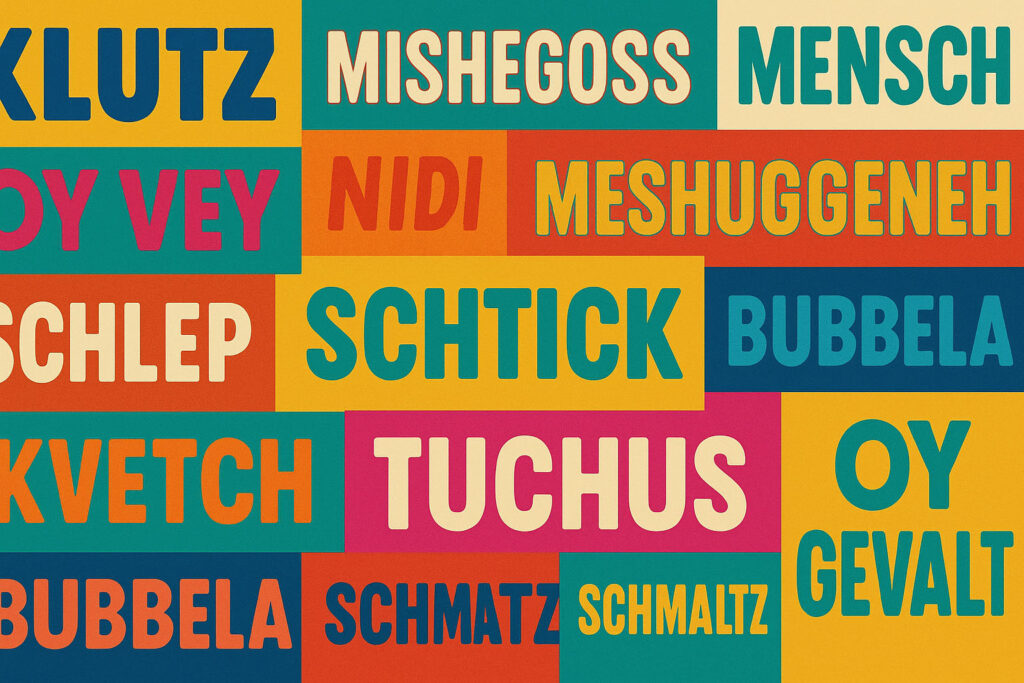
The Oys of Yiddish

On my mother’s side, they all spoke fluent Yiddish. Most of these conversations took place while eating moisture-free yellow pound cake and washing it down with warmed-up day-old Maxwell House Coffee. On my father’s side, except for Oy Vey, they just spoke English.

My wife Nancy’s grandparents, on her mom’s side, also knew Yiddish. 

One reason my wife and I never learned Yiddish was that our families didn’t want us to. Yiddish was only spoken when they tried to hide things from us. Since we didn’t speak another language, my wife and I would spell out words we did not want our own kids to understand. Even though our kids are now in their 30s, spelling out certain words still works. Thank God for Day School.

The Yiddish language began around the 9th to 10th century CE.  By the 19th and early 20th centuries, Yiddish was the everyday spoken language of millions of Jews while they were running from one Eastern European country to another, trying to avoid being murdered by their neighbors, to whom they lent sugar and babysat. Outside of Eastern Europe, a Yiddish-speaking Jew could starve to death trying to find someone to take a food order in a restaurant. 

At its peak, roughly between the 1910s and 1930s, the Yiddish press was huge, with hundreds of Yiddish newspapers worldwide.  In fact, Isaac Bashevis Singer wrote most of his stories on a Yiddish typewriter. Today, it is estimated that globally, there are only 40-50 Yiddish-language print media sources serving a readership of up to 2 million people.

These days, most Yiddish speakers wear a long black coat, a black hat, a beard you could trip over, and the ability to drink steaming hot tea out of a glass. If you are a woman, characteristics include the ability to have a baby every five months and wear a sheitel (wig) that is sometimes worn more to one side, like a beret.

Many Hasidim speak Yiddish as a first language at home, school and designated smoking areas. These include: Satmar, Belz, Vizhnitz, Ger and other sects most people have never heard of. Each group has a slightly different Yiddish dialect, accent and beard length. It is forbidden for these men to shave; if they want to trim the beard instead of using a razor, they light a cigarette off a gas burner on a stove.  Yet there is a Yiddish word for shaving: “der riyer,” from the verb rayen, meaning to shave. This word is only used when a Hasid almost gets killed at 3 a.m., dressed in black, while reading the Talmud and crossing a busy Brooklyn street at the same time. That is called a “close shave.”  

If you are wondering if new Yiddish words are still being created today, here are a few: kompyuter (computer), telefon or fon (phone), imeyl (email) and internet (internet).

Most Hasidim own computers, but they are usually in disrepair because of the raisin noodle kugel stuck in between the keyboard keys. 

The wisdom of this language is timeless and as relevant today as it was back then.  

Here are a few quotes from Leo Rosten’s “Treasury of Jewish Quotations”:

“A child without a mother is like a door without a knob.” I think it means that without a mother, it’s complicated to open the door to life. 

“Fish die out of water; men die without law and order.” Even back then, they knew not to defund the police. 

“Adam was the luckiest man: he had no mother-in-law.”  Ain’t that a mouthful?

“We would all be rich if we did not have to eat.” It is a widely known fact that most Jews never stop eating.

“Dear God: I know you will provide, but why don’t you provide until you provide?” The story of my dating life before marriage

It’s my fault that my children don’t know the Yiddish words I grew up hearing. Words like schlemiel, schlimazel, schlep, shyster, schemer, shonda, schecht— all very beautiful and descriptive. The one they all do seem to know is shiksa (blonde).

More than likely, our grandchildren will know even less.  Even if they do happen to know a few Yiddish words, Dolarn un Donats or “dollars to doughnuts”, they won’t realize they’re speaking Yiddish. 


Mark Schiff is a comedian, actor and writer, and hosts, along with Danny Lobell, the “We Think It’s Funny” podcast. His new book is “Why Not? Lessons on Comedy, Courage and Chutzpah.”

The Oys of Yiddish Read More »

Two-State Delusions

In the abstract, a two-state solution makes a great deal of sense. These are two ancient peoples with longtime historical and religious claims to the same patch of land between the Jordan River and the Mediterranean Sea. This was the compromise solution offered by the United Nations in 1947, quickly accepted by the Jewish leadership who would found the state of Israel and just as quickly rejected by Palestinian Arabs and the neighboring Arab states. For the past 78 years, this concept has been supported by the United States, China, Russia, the European Union, the African Union and most Latin American and Asian countries.

In other words, the entire world supports a two-state solution, with the notable and troublesome exception of the two states themselves. I might think that it’s a good idea for congressional Republicans and Democrats to take a long weekend camping trip together to resolve the budget stalemate, or that the Lakers and Dodgers should agree to trade of LeBron James for Shohei Ohtani, but unless the two involved and impacted parties want to do it, there’s a fairly small chance of it happening.

That’s why it’s so confounding to watch France, Great Britain, Canada and other sometimes stalwart U.S. allies formally recognize a Palestinian state. They know that there is no possibility of such a state existing in the near-to-medium future. They know that given the choice between a corrupt Palestinian Authority, a homicidal Hamas, an unwilling Arab League and a mythical homegrown alternative, there is no one to run a Palestinian state. There is also the inconvenient reality that Israel and Hamas continue a war that shows no sign of ending, so even this fictional leaderless state could not exist until the fighting is done.

But let’s pretend that the war has ended, a credible leadership team has emerged and the terrorist threat that has been omnipresent for decades has magically disappeared. The fact still remains that the Israeli people’s ambivalence toward a Palestinian state has understandably hardened into fervent opposition since the Oct. 7 Hamas mass kidnappings and murders. The fact remains that every Palestinian leader has turned down every proposal ever offered for a two-state solution. The fact also remains that the Palestinian people have so little trust in the 85-year-old Abbas, who will soon mark the 20th anniversary of his original promise to hold still-unheld elections, that they would almost certainly revolt if he were sufficiently brave and visionary to accept such an offer. Which he is not.

And again, let’s remember that neither the Israelis or Palestinians want a two-state solution. 

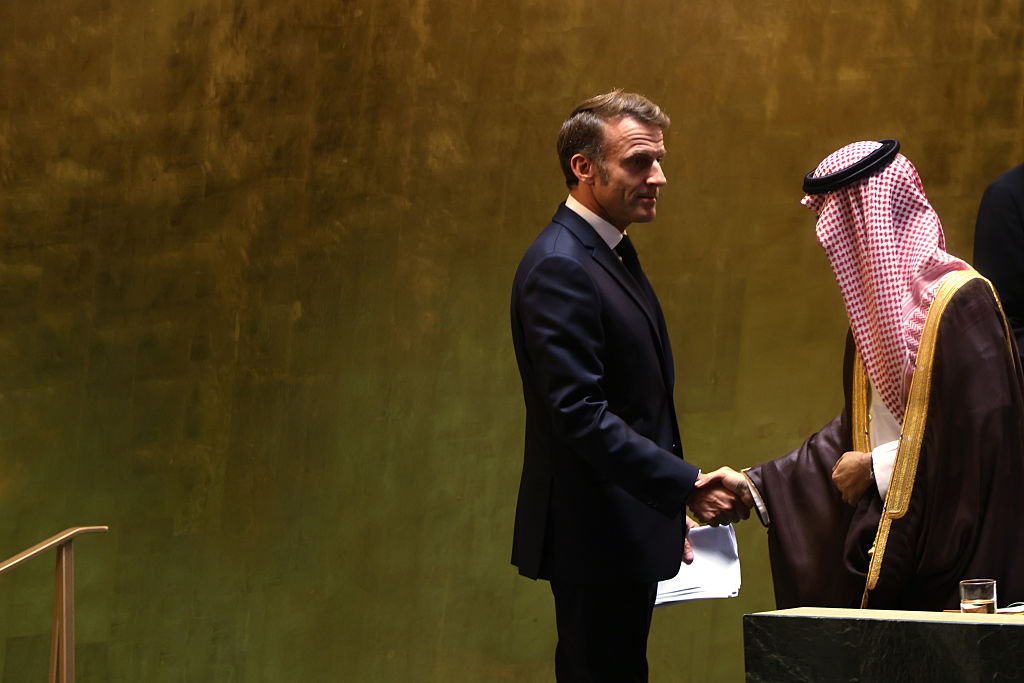
Emmanuel Macron, Keir Starmer and the other Western leaders who made this proposal know all this. They know that calling for a Palestinian state has as much likelihood of success as proposing a U.N. mission to Jupiter. So what was their real goal?

While each of these leaders’ pronouncements on the Middle East are geopolitically preposterous, when it comes to the domestic politics of their own countries, all of them are depressingly realistic. They all recognize the growing global opposition to Israel’s prosecution of the war against their attackers. So rather than investing the political capital to explain to their constituents why a Jewish state feels the need to defend itself against ceaseless terrorist attacks or the time and energy to pressure Hamas back to the negotiating table to disarm, free the hostages and actually help end the war, it is much easier to posture on behalf of a make-believe solution. 

Let’s not be ingenues. These are politicians with significant problems to face in their respective countries. It is undeniably easier for them to attempt to pacify angry voters with meaningless pomposity than to either confront difficult domestic challenges or engage more seriously on the world stage. We should also remember that all of them are doing far more than the U.S. to assist Ukraine in its war with Russia.)

But they also must understand that their empty gesture is emboldening Hamas, extending the war and endangering innocent Israelis. Perhaps they also understand how embarrassed they should be.


Dan Schnur is the U.S. Politics Editor for the Jewish Journal. He teaches courses in politics, communications, and leadership at UC Berkeley, USC and Pepperdine. He hosts the monthly webinar “The Dan Schnur Political Report” for the Los Angeles World Affairs Council & Town Hall. Follow Dan’s work at www.danschnurpolitics.com.

Two-State Delusions Read More »