On October 29, the British Equality and Human Rights Commission (EHRC) released its long-awaited report on anti-Semitism in the Labour party. It was a cathartic moment for the British Jewish community. It had been almost one year since, on December 12, 2019, Labour leader Jeremy Corbyn suffered the worst defeat for the party in a British general election in nearly one hundred years, under a torrent of accusations of anti-Semitism.
The EHRC’s multi-year investigation recognized harassment and discrimination against Jewish members, the party leadership’s unwillingness to address anti-Semitism and Labour’s legal culpability. It was not news for Britain’s Jews, but after years of vicious gaslighting from Corbynites, the non-partisan report was a validation and a shield. The cherry on top was Corbyn’s immediate suspension from the party for dismissing these charges as politically-motivated smears. 
A meme posted by a Labour member. (Screenshot by Labour Against Anti-Semitism; permission to repost from Labour Against Anti-Semitism.)
How did anti-Semitism gain such a foothold in the mainstream British left? To tell that story is to braid the strands of Soviet anti-imperialism, leftist ideas of racism and populist conspiracy theories. They came together in 2015, when Jeremy Corbyn, a long-time backbencher from the party’s far-left, vaulted to Labour leadership. For decades, Corbyn had supported, honored, or donated to terrorists, Holocaust deniers, anti-Semitic conspiracy theorists, and fanatical enemies of Israel. He otherized British Jews and called Hamas his friends.
Anti-Semitism, overt or camouflaged, skyrocketed in the Labour party, coming from members, staff, members of Parliament, and other elected officials. In May 2019, the EHRC, Britain’s human rights watchdog, announced a formal investigation. Complaints submitted to the EHRC numbered in the thousands. One party member listed 22 examples of abuse directed at him, including the phrases “Hitler was right,” “child killer,” and “shut the f**k up, Jew.” Another report alleged that Labour member David Cooper called for “the complete annihilation of every Jew on the planet” on social media.
Nine sitting members of Parliament quit the party in protest. More than sixty Labour peers condemned Corbyn in an open letter. Famed Rabbi Lord Jonathan Sacks, who passed away November 7, put his reputation and credibility on the line with his censure. Leftist anti-Semitism had its moment in the spotlight, and for many, it seemed to have been born fully formed. Some knew better.
“There’s a long tradition on the left of conspiratorial anti-Semitism…to think of the Jews as exceptional and a kind of conspiracy against good decent working-class people,” David Hirsh, a sociology lecturer at Goldsmiths College, University of London and author of the book “Contemporary Left Antisemitism,” told the Journal. He cited several influential nineteenth-century socialists and the Dreyfus Affair. (The Affair was a scandal from late nineteenth-century France, in which the Jewish artillery officer Alfred Dreyfus was wrongfully tried and sentenced for espionage and treason. The ordeal led to a public debate on the loyalty of French Jews, with crowds chanting “Death to the Jews” and led famed writer Emile Zola to publish his open letter, “J’accuse…!,” laying bare the anti-Semitism of the French government).
“There’s a long tradition on the left of conspiratorial anti-Semitism…to think of the Jews as exceptional and a kind of conspiracy against good decent working-class people.” — David Hirsh, sociologist and author
After World War II and the Holocaust, the birth of Israel led to a new era in anti-Semitism. According to Hirsh, the Soviet Union, for various political purposes (including anti-Semitism) “consciously tried to create an anti-Semitic politics in which Israel and Zionism were symbolic of imperialism.” The Soviets repurposed propaganda from the Nazi and Tsarist eras, showing Jews as aliens, leeches, dogs, insects, or as world puppeteers controlling governments, banks, and media, against Zionists. Even “The Protocols of the Elders of Zion” — a 1903 Russian forgery pretending to be the minutes of a meeting plotting Jewish world domination — made a comeback. The Soviets distributed their anti-Semitic propaganda domestically and to Arab states and Soviet-friendly audiences in the West.
By “associating imperialism with Zionism,” Hirsh said, the Soviets provided a cover for anti-Semitism that served their political purposes. This Soviet and Arab campaign was so successful that, in 1975, they managed to pass a U.N. resolution stating, “Zionism is a form of racism and racial discrimination.” (The U.N. revoked this resolution in 1991.) Making Zionism an emblem of imperialism “creates the Israel-Palestine conflict as a key symbolic issue around which people form their political identity. … So Jeremy Corbyn believes that Hamas and Hezbollah, which are anti-Semitic organizations, are in some bigger sense on our side in a war against imperialism.”
“Zionism is racism” found its way to college campuses. Hirsh recalled that in the mid-1980s, when he was a student and involved in far-left politics, “there were fights about whether Jewish societies should be banned from campus, as ‘Zionism was racism’ and Jewish societies were Zionists” (e.g. at Sunderland Polytechnic). Hirsh later came across this idea as a university lecturer at Goldsmiths, University of London, when he fought the academic boycott of Israel. Hirsh noted that singling out Israel “became much more mainstream, first in the trade unions, and then the Labour party.”
The turning point for anti-Semitism in the British left came when Labour changed its voting procedures. Voting for party leadership had previously been a complex system that elevated the influence of sitting members of Parliament. But in 2014, then-party leader Ed Miliband introduced one-member-one-vote (so members of Parliament had no more say than anyone else) and allowed registered supporters to vote if they paid the £3 voting fee, rather than the full £45 membership fee. Corbyn supporters flooded the party, with 200,000 people joining Labour as voters. Corbyn, who would not have had the support from MPs as needed under the old rules, took over, bringing anti-Semitism to the party’s mainstream.
Over the next four years, more red flags from Corbyn’s past came to light, just as the Soviet brand of anti-Semitic images began to appear in social media posts from Labour members, staff, and elected officials. 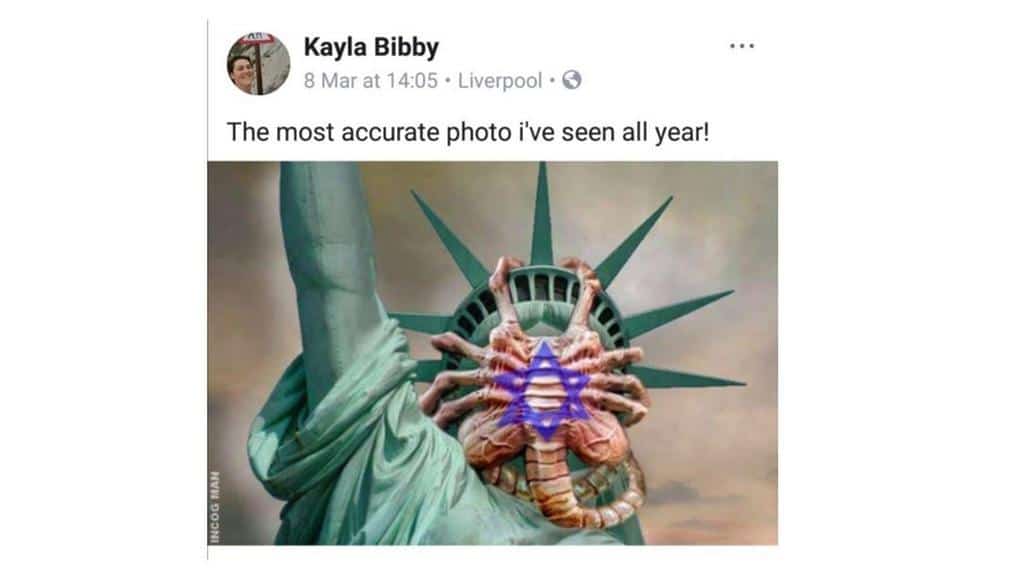
A Labour activist posted this meme, taken from a far-right website.
Jewish members and the Jewish Labour Movement (one of the oldest socialist societies affiliated with the party) condemned the new atmosphere. Dame Louise Ellman, a long-time Labour member and member of Parliament, resigned during the 2019 campaign. In a withering letter, she declared Corbyn was “not fit to serve as our prime minister” and that “The Labour party is no longer a safe place for Jews.”
“I never faced anti-Semitism directly until Jeremy Corbyn,” she told the Journal. “After Jeremy Corbyn was made leader, it changed very drastically. The membership of 500 people in my local party had risen to 2,700 … The first thing I noticed about the new members was that they were targeting me as an MP and they had an obsessional hatred of Israel.” Despite having many other topics of greater importance to cover, she said, the new members turned each meeting “into what I would call an interrogation of me, all to do with Israel. They never spoke about anywhere else. It became very hostile.”
According to Ellman, the new members asked “how I felt [about] being an elected MP of a democratic U.K. party but representing a fascist government abroad. There were more statements being made about me that I was a supporter of Israeli racist child abuse. Or that I don’t have human blood.” (Ellman is a frequent critic of Israel and proponent of a two-state solution.) Ellman also saw social media posts from Labour members about the Rothschilds controlling the world and about her being a member of Mossad.
Although it is possible to indict Corbyn and Labour on charges of anti-Semitism without mentioning Israel, it would be illusory. Modern anti-Semitism inevitably targets the world’s only Jewish state. A study of Facebook groups supporting BDS has shown consistent anti-Semitic material — excluding those relating to Israel. Other studies have linked anti-Israel events on American college campuses to spikes in anti-Semitic incidents. Just as anti-Semites are drawn to the anti-Israel movement, if one starts believing the Jewish state is uniquely evil, how far can one be from suspicion of Jews?
Hirsh described the attacks against Ellman as “The Livingstone Formulation,” named for the notorious Corbyn ally and former London Mayor Ken Livingstone. He defined it as a type of “counter-accusation” to an individual accusing anti-Semitism. “Anyone who brings up anti-Semitism is accused of being against the left,” he said. Corbyn fans have consistently dismissed allegations of anti-Semitism as made-up smears from the Israel lobby or billionaire media barons. These counter-accusations have been employed to deflect the anti-Semitism allegations in the media and public. The EHRC specifically called out this tactic as anti-Semitic in its report.
Hirsh also links current anti-Semitism to the rise of populism in Europe and the United States. Populism — and its stepchild conspiracism (almost always involving Jews) — often bridges the far-right and the far-left. Some of the racist social media posts of Labour members in the Corbyn era actually originated with the American far-right.
“You can split anti-Semitism into blood libel or conspiracy fantasy. Every single example basically fits into those two things,” Ben Freeman, a Scottish educator on anti-Semitism and the Holocaust and the author of the upcoming book Jewish Pride: Rebuilding a People, said. “When you accuse Israel of purposely murdering Palestinian children, that is an example of blood libel. Or when you say Israel is manipulating the U.S. election, that is an example of conspiracy fantasy.” 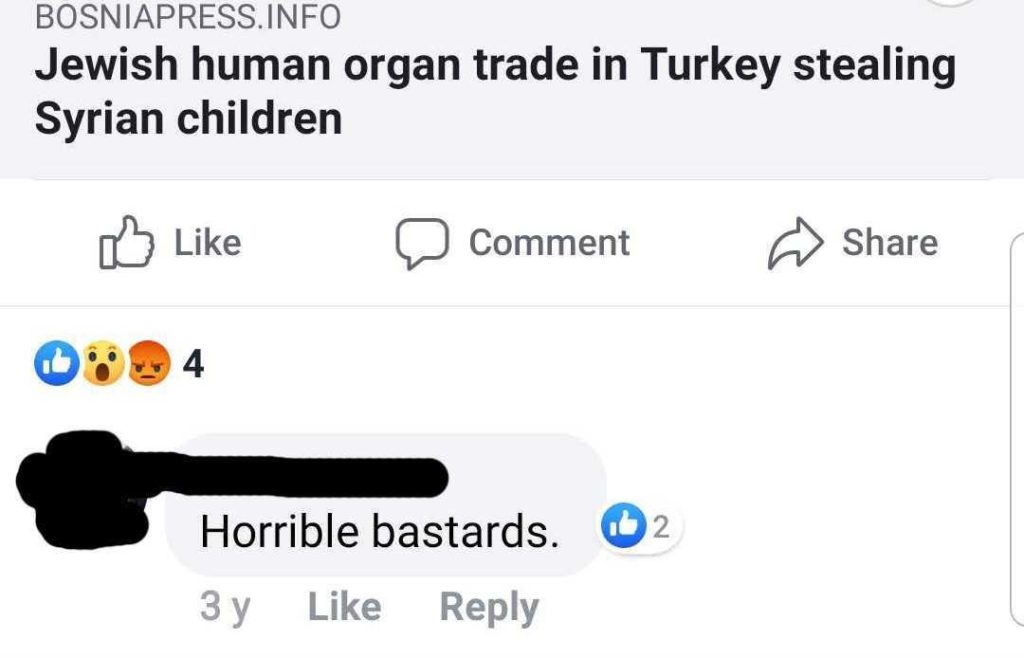
A meme posted by a Labour member, found by Labour Against Anti-Semitism.
Crucially, Freeman noted that “Anti-Semitism is on the left and it’s on the right, and there’s enough evidence to demonstrate that very clearly. It’s not about which is more dangerous because they manifest differently.” What left anti-Semitism does, he said, “it erases us as a legitimate minority. We’re seen as white and powerful, but at the same time, that is a form of anti-Semitism.”
On Corbyn’s denial of the EHRC report, Freeman says that Labour members “really don’t believe they are anti-Semites, because they do not believe anti-Semitism is a legitimate form of prejudice.”
Labour Member of Parliament Lisa Nandy elaborated on this blind spot at a Jewish Labour Movement event in February 2020. Anti-Semitism, she said, “is a sort of racism that punches up not down, that argues that Jewish people are privileged and powerful, and because there are people on the Left who believe that their job is to challenge privilege and power, therefore, [they] wrongly and disgracefully argue that Jewish people are a legitimate target for racism.”
Despite Labour’s denialism, the British Jewish community made anti-Semitism a major public issue. Freeman says that was because “We marched, and we wrote, and we tweeted, and we just didn’t stop talking about it.”
British Jews were accustomed to being Dreyfus: always suspect. But to take on modern anti-Semitism, they had to become Zola and call it out. In the United Kingdom, Jewish television stars such as Rachel Riley and Tracy-Ann Oberman and Labour members of Parliament such as Ellman, Margaret Hodge, and Luciana Berger risked their careers, lost friends, and accepted a barrage of hate and death threats by calling out Labour’s anti-Semitism.
“The EHRC said we were correct,” Freeman said, “and that’s a lesson: they have to listen to us. We need to demand public reckoning… Universities need to talk about this in the same way they talk about other forms of prejudice. They need to teach the Holocaust in its proper context, of thousands of years of anti-Semitic murder and oppression.” But Freeman argued that “The most important thing for the global Jewish community to do is to strengthen the global Jewish community. There’s 14.6 million of us. We may have different perspectives, different identities, different experiences. We have to dialogue.”
Corbyn’s replacement, Keir Starmer, ran for party leader on the pledge to rebuild trust with the Jewish community. But as Freeman has pointed out in social media posts, Starmer was still part of the team working to make Corbyn prime minister a year ago. Nevertheless, the suspension of Corbyn makes a good start and a potential turning point for Labour.
David Sachs is an author and political commentator. He has been a communications specialist on campaigns for four Canadian cabinet ministers.
How Corbyn Breathed Anti-Semitism Into The Labour Party
David Sachs
On October 29, the British Equality and Human Rights Commission (EHRC) released its long-awaited report on anti-Semitism in the Labour party. It was a cathartic moment for the British Jewish community. It had been almost one year since, on December 12, 2019, Labour leader Jeremy Corbyn suffered the worst defeat for the party in a British general election in nearly one hundred years, under a torrent of accusations of anti-Semitism.
The EHRC’s multi-year investigation recognized harassment and discrimination against Jewish members, the party leadership’s unwillingness to address anti-Semitism and Labour’s legal culpability. It was not news for Britain’s Jews, but after years of vicious gaslighting from Corbynites, the non-partisan report was a validation and a shield. The cherry on top was Corbyn’s immediate suspension from the party for dismissing these charges as politically-motivated smears.
A meme posted by a Labour member. (Screenshot by Labour Against Anti-Semitism; permission to repost from Labour Against Anti-Semitism.)
How did anti-Semitism gain such a foothold in the mainstream British left? To tell that story is to braid the strands of Soviet anti-imperialism, leftist ideas of racism and populist conspiracy theories. They came together in 2015, when Jeremy Corbyn, a long-time backbencher from the party’s far-left, vaulted to Labour leadership. For decades, Corbyn had supported, honored, or donated to terrorists, Holocaust deniers, anti-Semitic conspiracy theorists, and fanatical enemies of Israel. He otherized British Jews and called Hamas his friends.
Anti-Semitism, overt or camouflaged, skyrocketed in the Labour party, coming from members, staff, members of Parliament, and other elected officials. In May 2019, the EHRC, Britain’s human rights watchdog, announced a formal investigation. Complaints submitted to the EHRC numbered in the thousands. One party member listed 22 examples of abuse directed at him, including the phrases “Hitler was right,” “child killer,” and “shut the f**k up, Jew.” Another report alleged that Labour member David Cooper called for “the complete annihilation of every Jew on the planet” on social media.
Nine sitting members of Parliament quit the party in protest. More than sixty Labour peers condemned Corbyn in an open letter. Famed Rabbi Lord Jonathan Sacks, who passed away November 7, put his reputation and credibility on the line with his censure. Leftist anti-Semitism had its moment in the spotlight, and for many, it seemed to have been born fully formed. Some knew better.
“There’s a long tradition on the left of conspiratorial anti-Semitism…to think of the Jews as exceptional and a kind of conspiracy against good decent working-class people,” David Hirsh, a sociology lecturer at Goldsmiths College, University of London and author of the book “Contemporary Left Antisemitism,” told the Journal. He cited several influential nineteenth-century socialists and the Dreyfus Affair. (The Affair was a scandal from late nineteenth-century France, in which the Jewish artillery officer Alfred Dreyfus was wrongfully tried and sentenced for espionage and treason. The ordeal led to a public debate on the loyalty of French Jews, with crowds chanting “Death to the Jews” and led famed writer Emile Zola to publish his open letter, “J’accuse…!,” laying bare the anti-Semitism of the French government).
After World War II and the Holocaust, the birth of Israel led to a new era in anti-Semitism. According to Hirsh, the Soviet Union, for various political purposes (including anti-Semitism) “consciously tried to create an anti-Semitic politics in which Israel and Zionism were symbolic of imperialism.” The Soviets repurposed propaganda from the Nazi and Tsarist eras, showing Jews as aliens, leeches, dogs, insects, or as world puppeteers controlling governments, banks, and media, against Zionists. Even “The Protocols of the Elders of Zion” — a 1903 Russian forgery pretending to be the minutes of a meeting plotting Jewish world domination — made a comeback. The Soviets distributed their anti-Semitic propaganda domestically and to Arab states and Soviet-friendly audiences in the West.
By “associating imperialism with Zionism,” Hirsh said, the Soviets provided a cover for anti-Semitism that served their political purposes. This Soviet and Arab campaign was so successful that, in 1975, they managed to pass a U.N. resolution stating, “Zionism is a form of racism and racial discrimination.” (The U.N. revoked this resolution in 1991.) Making Zionism an emblem of imperialism “creates the Israel-Palestine conflict as a key symbolic issue around which people form their political identity. … So Jeremy Corbyn believes that Hamas and Hezbollah, which are anti-Semitic organizations, are in some bigger sense on our side in a war against imperialism.”
“Zionism is racism” found its way to college campuses. Hirsh recalled that in the mid-1980s, when he was a student and involved in far-left politics, “there were fights about whether Jewish societies should be banned from campus, as ‘Zionism was racism’ and Jewish societies were Zionists” (e.g. at Sunderland Polytechnic). Hirsh later came across this idea as a university lecturer at Goldsmiths, University of London, when he fought the academic boycott of Israel. Hirsh noted that singling out Israel “became much more mainstream, first in the trade unions, and then the Labour party.”
The turning point for anti-Semitism in the British left came when Labour changed its voting procedures. Voting for party leadership had previously been a complex system that elevated the influence of sitting members of Parliament. But in 2014, then-party leader Ed Miliband introduced one-member-one-vote (so members of Parliament had no more say than anyone else) and allowed registered supporters to vote if they paid the £3 voting fee, rather than the full £45 membership fee. Corbyn supporters flooded the party, with 200,000 people joining Labour as voters. Corbyn, who would not have had the support from MPs as needed under the old rules, took over, bringing anti-Semitism to the party’s mainstream.
Over the next four years, more red flags from Corbyn’s past came to light, just as the Soviet brand of anti-Semitic images began to appear in social media posts from Labour members, staff, and elected officials.
A Labour activist posted this meme, taken from a far-right website.
Jewish members and the Jewish Labour Movement (one of the oldest socialist societies affiliated with the party) condemned the new atmosphere. Dame Louise Ellman, a long-time Labour member and member of Parliament, resigned during the 2019 campaign. In a withering letter, she declared Corbyn was “not fit to serve as our prime minister” and that “The Labour party is no longer a safe place for Jews.”
“I never faced anti-Semitism directly until Jeremy Corbyn,” she told the Journal. “After Jeremy Corbyn was made leader, it changed very drastically. The membership of 500 people in my local party had risen to 2,700 … The first thing I noticed about the new members was that they were targeting me as an MP and they had an obsessional hatred of Israel.” Despite having many other topics of greater importance to cover, she said, the new members turned each meeting “into what I would call an interrogation of me, all to do with Israel. They never spoke about anywhere else. It became very hostile.”
According to Ellman, the new members asked “how I felt [about] being an elected MP of a democratic U.K. party but representing a fascist government abroad. There were more statements being made about me that I was a supporter of Israeli racist child abuse. Or that I don’t have human blood.” (Ellman is a frequent critic of Israel and proponent of a two-state solution.) Ellman also saw social media posts from Labour members about the Rothschilds controlling the world and about her being a member of Mossad.
Although it is possible to indict Corbyn and Labour on charges of anti-Semitism without mentioning Israel, it would be illusory. Modern anti-Semitism inevitably targets the world’s only Jewish state. A study of Facebook groups supporting BDS has shown consistent anti-Semitic material — excluding those relating to Israel. Other studies have linked anti-Israel events on American college campuses to spikes in anti-Semitic incidents. Just as anti-Semites are drawn to the anti-Israel movement, if one starts believing the Jewish state is uniquely evil, how far can one be from suspicion of Jews?
Hirsh described the attacks against Ellman as “The Livingstone Formulation,” named for the notorious Corbyn ally and former London Mayor Ken Livingstone. He defined it as a type of “counter-accusation” to an individual accusing anti-Semitism. “Anyone who brings up anti-Semitism is accused of being against the left,” he said. Corbyn fans have consistently dismissed allegations of anti-Semitism as made-up smears from the Israel lobby or billionaire media barons. These counter-accusations have been employed to deflect the anti-Semitism allegations in the media and public. The EHRC specifically called out this tactic as anti-Semitic in its report.
Hirsh also links current anti-Semitism to the rise of populism in Europe and the United States. Populism — and its stepchild conspiracism (almost always involving Jews) — often bridges the far-right and the far-left. Some of the racist social media posts of Labour members in the Corbyn era actually originated with the American far-right.
“You can split anti-Semitism into blood libel or conspiracy fantasy. Every single example basically fits into those two things,” Ben Freeman, a Scottish educator on anti-Semitism and the Holocaust and the author of the upcoming book Jewish Pride: Rebuilding a People, said. “When you accuse Israel of purposely murdering Palestinian children, that is an example of blood libel. Or when you say Israel is manipulating the U.S. election, that is an example of conspiracy fantasy.”
A meme posted by a Labour member, found by Labour Against Anti-Semitism.
Crucially, Freeman noted that “Anti-Semitism is on the left and it’s on the right, and there’s enough evidence to demonstrate that very clearly. It’s not about which is more dangerous because they manifest differently.” What left anti-Semitism does, he said, “it erases us as a legitimate minority. We’re seen as white and powerful, but at the same time, that is a form of anti-Semitism.”
On Corbyn’s denial of the EHRC report, Freeman says that Labour members “really don’t believe they are anti-Semites, because they do not believe anti-Semitism is a legitimate form of prejudice.”
Labour Member of Parliament Lisa Nandy elaborated on this blind spot at a Jewish Labour Movement event in February 2020. Anti-Semitism, she said, “is a sort of racism that punches up not down, that argues that Jewish people are privileged and powerful, and because there are people on the Left who believe that their job is to challenge privilege and power, therefore, [they] wrongly and disgracefully argue that Jewish people are a legitimate target for racism.”
Despite Labour’s denialism, the British Jewish community made anti-Semitism a major public issue. Freeman says that was because “We marched, and we wrote, and we tweeted, and we just didn’t stop talking about it.”
British Jews were accustomed to being Dreyfus: always suspect. But to take on modern anti-Semitism, they had to become Zola and call it out. In the United Kingdom, Jewish television stars such as Rachel Riley and Tracy-Ann Oberman and Labour members of Parliament such as Ellman, Margaret Hodge, and Luciana Berger risked their careers, lost friends, and accepted a barrage of hate and death threats by calling out Labour’s anti-Semitism.
“The EHRC said we were correct,” Freeman said, “and that’s a lesson: they have to listen to us. We need to demand public reckoning… Universities need to talk about this in the same way they talk about other forms of prejudice. They need to teach the Holocaust in its proper context, of thousands of years of anti-Semitic murder and oppression.” But Freeman argued that “The most important thing for the global Jewish community to do is to strengthen the global Jewish community. There’s 14.6 million of us. We may have different perspectives, different identities, different experiences. We have to dialogue.”
Corbyn’s replacement, Keir Starmer, ran for party leader on the pledge to rebuild trust with the Jewish community. But as Freeman has pointed out in social media posts, Starmer was still part of the team working to make Corbyn prime minister a year ago. Nevertheless, the suspension of Corbyn makes a good start and a potential turning point for Labour.
David Sachs is an author and political commentator. He has been a communications specialist on campaigns for four Canadian cabinet ministers.
Did you enjoy this article?
You'll love our roundtable.
Editor's Picks
Israel and the Internet Wars – A Professional Social Media Review
The Invisible Student: A Tale of Homelessness at UCLA and USC
What Ever Happened to the LA Times?
Who Are the Jews On Joe Biden’s Cabinet?
You’re Not a Bad Jewish Mom If Your Kid Wants Santa Claus to Come to Your House
No Labels: The Group Fighting for the Political Center
Latest Articles
Regime Change, Interrupted
Israeli Filmmaker Bashes Israel. Palestinians Still Cancel Him.
Sinai Temple Gala, Black-Jewish Entertainment Alliance, ‘Jewish Tomorrow’ Podcast
Have You Found Your Mission?
Artificial Everything: The More AI Grows, the Blander it Becomes
Small Eyes – A poem for Parsha Sh’lach
A Bisl Torah — A Real Graduation Message
We are meant to be learners. Our values guide our path, and our curious, thoughtful questions lead to a greater understanding of who we are meant to become.
A Moment in Time: “29 Years in the Rabbinate”
Moses Found Brevity to be the Soul of Levity and Wit
Sleepless in Jerusalem, Mad About the Knicks
I’ve been a sports nut my whole life, so it was no big deal to be up in the middle of the night to follow a major sporting event.
Print Issue: Is History Asking Too Much of Us? | June 12, 2026
The question for the Jewish people today is not merely whether we believe in the future but whether we are willing to become the kind of people that the future requires.
Jonah Platt Brings Jewish Identity Conversation to Cedars-Sinai Rooftop
This marked J-STAR’s second event overall, with this gathering held in celebration of Jewish American Heritage Month.
Voice Actor Jeff Bergman on Replacing Don Rickles in ‘Toy Story 5’
“We very much want to keep the spirit and the essence of that iconic character that Rickles created.”
Why I Cried Watching ‘Crossing Delancey’ Performed Live on Stage
As I left the theater, wiping my eyes, I felt renewed gratitude for traditions that slow us down enough to truly see one another.
Miznon Expands with New West Third St. Location and a Kosher Restaurant, Malka
The concept, brought to life by Israeli chef Eyal Shani, is deceptively simple: pita as a canvas, filled with everything from lamb kebab and rib-eye minute steak to schnitzel and their signature candy steak, overnight seared brisket, aioli, mustard, pickles, tomato, and red onion.
A Magical Potato Carpet Ride
Who doesn’t love potatoes? And this potato carpet recipe is sure to satisfy the potato lovers in your life.
Sushi Day Recipes with Marisa Baggett
Whether you’re a longtime sushi lover or a newbie to preparing this creative cuisine, Baggett’s recipes are a delicious way to mark the holiday.
Table for Five: Shlach
Spying Out The Land
What Antisemitism Requires of Us
The current Jewish debate cannot end with a choice between fighting antisemites and strengthening Jewish life. Both are necessary, but neither fully answers what this moment requires.
Is History Asking Too Much of Us?
The question for the Jewish people today is not merely whether we believe in the future but whether we are willing to become the kind of people that the future requires.
Rosner’s Domain | Can Israel’s Image Be Fixed?
Israelis view themselves as fighting for survival, just, fair, moral and brave, while the rest of the world sees something else entirely, viewing Israel as a country that has lost its brakes, destabilizing the order and running amok without justification.
The Nakba as Libel: How a Narrative Engine Drives Antizionism
The Nakba narrative does not merely tell a story of displacement. It functions as a libel. Understanding that distinction is essential to understanding why the world reacted to Oct. 7 the way it did.
Do Not Blame the Child, Blame the Leadership
The answer is not hatred of ordinary Haredim. The answer is a clear law against organized calls for refusal.
The Courage of Jacob and Commitment to the Union
Liberation of the slaves was a cause long dear to Jewish hearts.
Nothing to Fear but Fear
If I toss out a can of baked beans that expired one day earlier for fear of botulism, what do you think goes through my mind when it comes to bears, mountain lions, sharks and rattlesnakes?
The Many-States Solution
As we weigh the benefits and downsides of a potential two-state solution, the unguaranteed but plausible prospect of an unprecedented regional peace should be considered as part of that discussion.
More news and opinions than at a Shabbat dinner, right in your inbox.