Imagine being at S.Y. Agnon’s Passover Seder. What would a Seder with Judaism’s modern-day master storyteller be like? How did Agnon explain the Haggadah to his family? While we have no actual information about the Seder in the Agnon home, in the spirit of Agnon’s own imaginative storytelling (and using his own Passover-themed stories as our guide), let’s take an imaginative journey through a Seder with S.Y. Agnon.
What would a Seder with Judaism’s modern-day master storyteller be like? How did Agnon explain the Haggadah to his family? While we have no actual information about the Seder in the Agnon home, in the spirit of Agnon’s own imaginative storytelling (and using his own Passover-themed stories as our guide), let’s take an imaginative journey through a Seder with S.Y. Agnon.
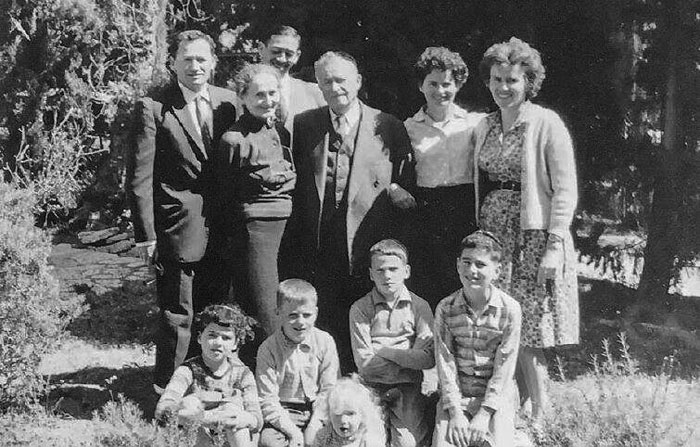
I imagine the Agnon family – Shmuel Yosef (S.Y.), his wife Esther, their daughter Emunah and their son Hemdat – sitting down to their Seder in their small Jerusalem home in Talpiot. The table is adorned for Passover, and the family eagerly awaits Agnon’s opening reflections. Agnon begins by sharing childhood memories of his Seder, all of which are told in his story “A Pleasant Tale about my Prayer Book”:
“Our home was filled with light, our vessels were polished and bright, and the smell of karpas and maror spread throughout our house. My father wore a white garment and seemed to like an angel standing before God, reciting songs of praise. Opposite him sat my mother with her head adorned in a beautiful silk scarf.”
Agnon proceeds to share a memory about his siblings at the Seder:
We all sat between our parents, dressed in new clothing and shoes. The boys wore brand new hats on our heads, and the girls’ hair exuded the smell of fresh pure water with which they washed their hair in honor of the holiday.”
While pouring wine for Kiddush, Agnon recounts an insight sparked by his father’s recitation of Kiddush:
My father made Kiddush over wine, reciting the words ‘God who has chosen us from all peoples, and elevated us above all languages.’ I was amazed how a few words of Kiddush from my father’s mouth gave me the impression that the whole world was elevated, and that we, the Jewish people, were elevated above it.
Agnon breaks a matzah, lifts the broken piece and recites: “Ha Lahma Anya – This is the bread of poverty … let all who are hungry come and eat, let all who are needy come and share the Passover meal.”
These words trigger another profound childhood memory that Agnon shares with his family:
My father was a soft-spoken person, yet I recall him lifting his voice out loud when reciting the words ‘let all who are hungry come and eat.’ Why, I wondered, would such a soft-spoken person raise his voice for this sentence?
Given the abundance of poor people in the world who do not have what to eat, my father raised his voice and said ‘let all who are hungry come and eat,’ to assure that all poor people could hear and join us at our Seder.
This memory inspired Agnon to explore these themes in other stories, a few of which he chooses to share with his family.
I imagine Agnon continues: “In my story HaSeder, I tell the tale of two ‘needy’ souls who meet on the night of Passover – Mikhel the Shamash (the caretaker of the synagogue) and Sara Lea. They are needy, not because of finances, but because they are both widowed and do not have anyone with whom to share the Seder. Their state of human loneliness brings them together on Passover, where they share the evening and then share the rest of their lives together.”
I imagine Agnon also relating one of his darker Passover stories, where the term “hungry” takes on an aura of fear and uncertainty:
“In my story HaBayit (The Home), I explore a family’s fear of eviction from their home. The husband and wife agree that a home from which one fears eviction is not really a home. Out of fear that the landlord may show up and evict them, they leave their home on the night of Passover, ultimately arriving to a hotel where the manager greets them with the words ‘let all who are hungry come and eat.’”
The rest of Agnon’s Seder must have been filled with questions and stories. Some of these stories would eventually earn Agnon a Nobel Prize in Literature, but on this Passover night, they are simply stories being shared with his family.
Agnon rewrote Had Gadya, and I imagine he ends his Seder by sharing his own creative retelling:
“This cat seems to have committed an evil deed by eating the kid!
Therefore… the dog did good by biting the cat, the stick did bad by hitting the dog, the fire did good by burning the stick, the water did bad by extinguishing the fire, the ox did good by drinking the water, the butcher did bad by slaughtering the ox, and the Angel of Death did good by slaughtering the butcher. This leads to a theologically problematic conclusion: that God was unjustified in slaughtering the Angel of Death! That can’t be!
So, the story must go like this:
It’s true that the Cat committed an evil deed by eating the Kid
But when a Kid and a Cat fight with each other
We can assume they may have reconciled on their own and concluded in peace.
If so — what business is it of the Dog to get involved and play the judge?
If so — the Dog is equal to the Stick, and the Stick did good by hitting the Dog!
If so — the Fire misbehaved by burning the Stick!
If so — the Water was justified by extinguishing the Fire!
If so — the Ox misbehaved by drinking the Water!
If so — the Butcher did well by slaughtering the Ox!
If so — the Angel of Death sinned by slaughtering the Butcher!
In the end — God determines that the Angel of Death is evil — and slaughters him —
And we conclude all’s well that ends well, with God being righteous in all His ways!
Hag Sameah from the Agnon home…and from my imagination. ■
Rabbi Daniel Bouskila is the Director of the Sephardic Educational Center and the rabbi of the Westwood Village Synagogue.