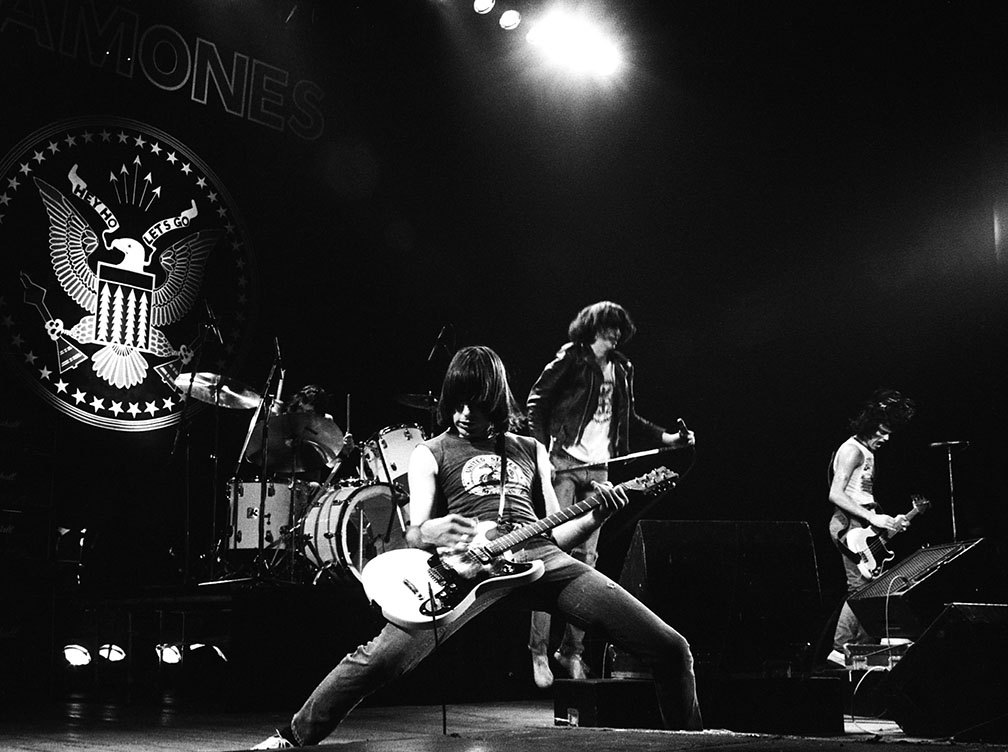
According to Tamás Erdélyi “People don’t associate Jews and punk.” The new exhibit at the Skirball Cultural Center, “Outsiders, Outcasts, Rebels + Weirdos: Punk Culture 1976-86,” wants to change that. And who’s this Tamás Erdélyi? The Budapest-born, Forest Hills raised son of Holocaust survivors is better known as Tommy Ramone, the original drummer for Ramones, arguably the most identifiable band that came out of the mid-70s CBGB scene, whose uniform of tight jeans, T-shirt and leather jacket became visual shorthand for “punk rock” (and, along with Jeff Hyman/Joey Ramone, the Jewish half of the band).
For Cate Thurston, the chief curator at the Skirball, the exhibit gives the museum a chance to “explore this sort of underserved story” about the Jewish relationship and participation and crafting the look of punk. She said the show was trying to “tease out an interesting diversity of voices that were cohesively contradictory.” One example, she said, is Jonathan Richman, “who said ‘you can hear parts of my uncles’ and Seders in my music,’ and Blondie’s Chris Stein, who insists it has nothing to do with anything.”
The handsomely mounted exhibit tells a mostly chronological story that focuses on New York, London and Los Angeles. It starts with New York, where two Jewish bar owners – Mickey Ruskin at Max’s Kansas City and Hilly (né Hillel) Krystal at CBGB – started featuring live music. Max’s, located just around the corner from Andy Warhol’s Factory, was known for its mix of the music and art worlds; Hilly wasn’t looking for his Bowery bar to become ground zero for a musical revolution, only to have some bands playing his favorite music: CBGB stood for Country, Blue Grass and Blues.
Krystal’s focus changed after guitarists Tom Verlaine and Richard Lloyd of the band Television walked by the club, and asked if their band could get a gig there. Joined by Jewish bassist Richard Hell (né Richard Lester Meyers) and drummer Billy Ficca, Television played its first show at CBGB on March 31, 1974. Within a year, Television, supporting the Patti Smith Group (featuring guitarist Lenny Kaye, né Kusikoff), had found an audience and CBGB became the place to hear new, unrecorded music.
One of those who went down to the Bowery was Londoner Malcom McLaren, a nice Jewish boy working in the rag trade. McLaren was taken by the music’s energy and, especially, Hell’s ragamuffin style, with safety pins holding together his thrift shop clothes. Back in London, McLaren, who had an interest in the Situationists and their idea of public pranks as a form of protest, was looking for something new and exciting. He wanted something revolutionary, a sound that would reflect the youthful frustration with Britain’s economic malaise … and promote the new boutique he opened with designer Vivienne Westwood, Sex. Thus was born the Sex Pistols. Their first single, “Anarchy in the U.K.,” released on Nov. 26, 1976, is a stunning record, and one that sounds just as fresh and angry today as it did then. Its influence spread to Los Angeles, where bored suburban kids were taken with the record’s power and anyone-could-form-a-band spirit, and gave birth to the first wave of LA punk bands, including the Germs, the Screamers, the Bags and X.
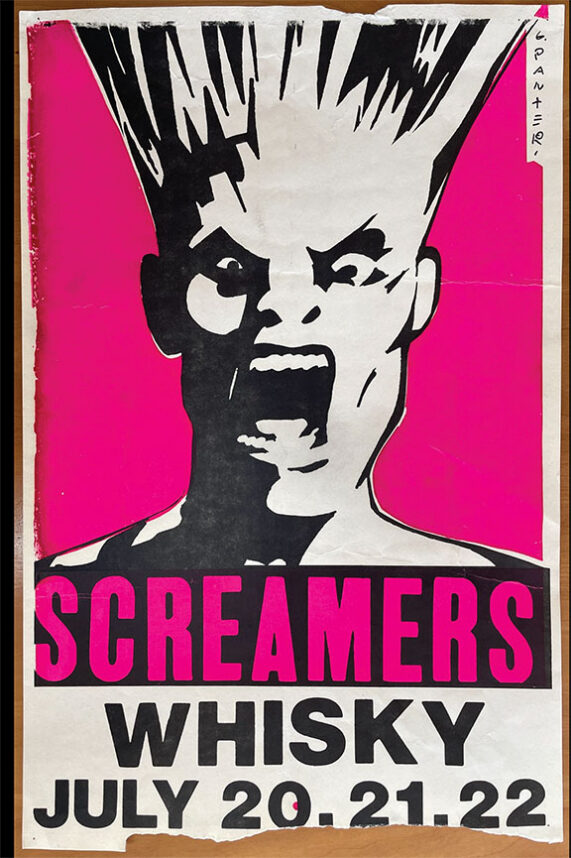
As might be expected, the show does tilt towards the Los Angeles scene, even having a map showing the locations of Club Lingerie, the Anti-Club, Madame Wong’s and other venues. There’s also a section devoted to the LA Hardcore scene, including Black Flag, fronted by a Jewish singer, Henry Rollins (born Henry Lawrence Garfield) and the Circle Jerks (fronted by Jewish singer Keith Morris).
There was no music playing during the press preview, but even if you had no idea who any of the bands were, just looking at the posters, ephemera and photos could give an idea of how they sounded. The crude, bumptious and proudly handmade handbills (Xeroxed at the local copy store or, if you were lucky, on your job’s copy machine) were a visual correlative to the often crude, aggressive bands they promoted. Two of the most successful fanzines have multiple issues displayed: New York’s Punk, a gonzo combination of comics and Mad and Creem magazines that inadvertently gave the scene its name, and LA’s Slash (which later gave birth to Slash Records, home of the LA bands X, The Blasters and Los Lobos). There are live performance photos by Jewish photographer Jenny Lens, and a short film by Don Letts. The photos and film give an idea of how diverse the scenes were. Women and homosexuals were welcomed as performers and fans. “They made their own world for themselves where they did fit in,” Thurston said. “And I think that’s really interesting and that’s the commonality, that people view themselves as outsiders and then created this music and culture for themselves.”
You get a sense of how the scenes came at the music from different angles: New York’s art world cool (even the Ramones – who stripped rock and roll down to the bare essentials – shared some DNA with Jewish Minimalist composers such as Steve Reich and Philip Glass), the English bands’ political engagement and economic rage and LA’s sunbaked nihilism, but also of their congruences. For Thurston, one of the surprises was “how interconnected everything was.” Michael Worthington, a graphic design professor at CalArts who co-curated the exhibit, said that in the mid-’70s, “there was still a mainstream culture to push back against,” which was much less fractured and diverse than today, and the musicians in all three cities “were pushing back against that mainstream that they had in common.”
And it’s that sense of being on the outside that attracted Jews to punk rock. “They were choosing to be outsiders in a way,” Worthington said. “They were self-selecting to create their own community with different political views, different philosophical views. And also I think they had in common a kind of economic situation. A lot of these scenes were built around people doing things for themselves because they weren’t coming from necessarily a kind of privilege.”
One thing the exhibit had to navigate was the use of the swastika by some of the early British punks. Thurston was emphatic that the museum could not ignore it and “not remove it from the discussion … it was used in a way to try and shock people.” It was equally important “to understand how it was used and how it was pushed back against,” mentioning the Rock Against Racism movement and the Dead Kennedys single “Nazi Punks F— Off.” The only swastika seen in the exhibit is on a handbill announcing an anti-Nazi benefit. The exhibit includes two stories of individuals taking a stand: Siouxie and the Banshees were opening for the Clash at the Roxy in London, and the Clash – a band that took the communal tenets of the punk seriously – offered to let them use their equipment. When singer Siouxie Sioux showed up wearing a swastika, the band, then managed by the Jewish Bernie Rhodes, told her unless she took it off, the band would not allow her to take the stage. In New York, when the Dead Boys showed up to a session with their producer, Genya Ravan (née Genyusha “Goldie” Zelkowitz), she told them that there were people in the room who lost their families in the Holocaust, and they didn’t see it as a fashion statement.
“Punk changes every couple of years,” Worthington said, and like the music it covers, “the exhibit loses some steam after the initial explosion. The one-time outsider movement gets absorbed into the mainstream and the bands are courted by major labels. The posters get slicker, the graphics professionally designed. There are still great things to see, from a rare copy of Public Image, Ltd. “Metal Box,” and the Peter Saville designed sleeve for New Order’s “Blue Monday,” which ended up costing more than the record it held, so the label and band lost money on every sale, but it’s hard not to feel that something was lost.
But Worthington still sees the original energy in today’s music. “The thing (the musicians) continually have in common is the idea of rebellion, this sort of being an outsider, building a community and finding a place to put that kind of energy.”
Sounds like a Jewish story to me.
“Outsiders, Rebels + Weirdos: Punk Culture 1976-86,” is on view at the Skirball Cultural Center, 2701 N Sepulveda Blvd., in Los Angeles through Sept. 6. For more information, visit https://www.skirball.org/.