Our nation’s history seems to repeat itself, but so do our nation’s qualities of unbridled bravery, leadership, faith and hope, among our women and men.
How do we deal with Israel’s never-ending challenges?
In the summer of 2024, one of my colleagues in our Raise Your Spirits Theatre troupe, Baltimore-born Shayna Levine-Hefetz, of Neve Daniel, suggested that we create a show similar to a show we performed in 2008-9. It was called “In Search of Courage.”
In that play, we had interspersed songs from our biblical musicals with monologues of the biblical protagonists, embedded in a storyline of an American gap year student who is wounded in a terror attack during the bloody Second Intifada.
She asks, “How do you go on?” and the social worker replies, “Come, I’ll show you,” and takes her back to biblical times to show her the meaning of courage.
In the tradition of art imitating life, unknown to many in the audience, the woman who acted the role of the social worker was Toronto-born Cheryl Mandel, of Alon Shvut, whose 24-year-old son, Lt. Daniel Mandel, was killed leading an elite IDF anti-terrorism unit in Nablus in 2003. Cheryl has said, “We cannot control what happens to us. We can only control our response.”
Fast forward to Oct. 7, 2023.
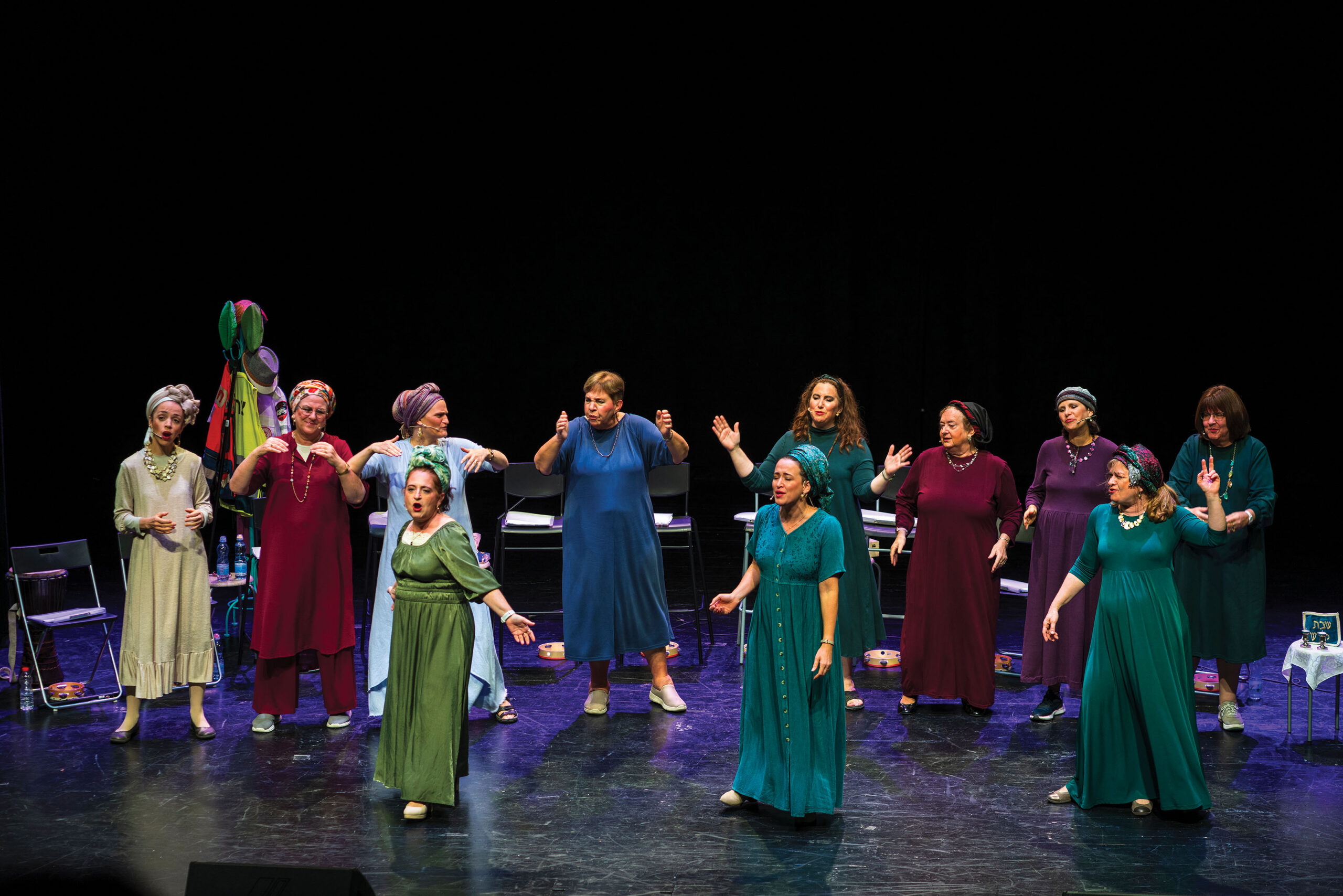
Our response to the horrors of that event and its aftermath was to create a new women-to-women production, called “HEROINES! Songs & Soliloquies for the Soul.”
Who are these heroines?
Shifra Buchris, an Orthodox mother of ten and a border guard down south, together with others on her team, rescued hundreds of Nova survivors.
Inbal Rabin-Lieberman, the head of the security team of Kibbutz Nir Am, saved the entire kibbutz with her ingenuity and leadership.
Tasha Cohen created a network of more than 250 holistic therapists she calls Chayal’s (Soldiers’) Angels.
Ronit Cohen, a Haredi mikvah attendant, saved an entire busload of people in Beitar Illit before an impending rocket attack, with her quick thinking and actions.
A female tank crew – the first one in military history – saved an entire kibbutz.
Adi Kaploun died protecting her children. Before her death, she and her partner, Anani, planted a pineapple farm which now operates in her memory. Her mother Jacqui says, “It is not just about fruit, it’s about the desire to continue to live, to love, and to work the Land, even after our hearts are broken.”
Halleli Aloush survived the Nova massacre and returned to reserve duty in her unit, called “Lionesses of the Jordan.”
Hostage Agam Berger, and her mother Meirav, were sustained by their deep faith in God.
Rose Lubin, from Dunwoody, Georgia, was a border policewoman who fell at her post, defending her beloved Jerusalem.
We portray women who have lost husbands, children or grandchildren in battle, and women who keep the home fires burning while their husbands are at war.
To express the multiethnic reality of Israel, we include the wives of a Bedouin tracker and of a Druze officer, respectively, and a caregiver from the Philippines who saved her patient by bargaining with the terrorists.
There is an LA connection. In the playbill, I thank Ronda Spinak of The Braid theater in Los Angeles for introducing me to the concept of readers’ salon theater. We perform on high bar stools as an open book dramatic presentation with minimal blocking. Rather than elaborate costumes, each woman wears her own attractive dress that meshes with a soft, yet vibrant, color palette. The performer’s goal is to read a script effectively, using voice, facial expressions, and gestures, enabling the audience to visualize the events and the feelings, though we’ve expanded the concept to include some movement on stage.
For a lighter touch, we gathered anecdotes of life in the hotels where the evacuees from the south and north were sent, stories that came from evacuees themselves, along with volunteers who had worked with them tirelessly. Together with the hardship of being displaced for so many months, and the challenges it posed for children and their schooling, there were moments that they called on humor to deal with it all.
Channah Appel, originally from Cleveland, a volunteer who collected and distributed clothing and toys in the hotel, and entertained as a clown, started a campaign to raise funds to buy bras for women who had fled in their pajamas. People had donated massive amounts of new and used clothing, and of course new underwear, but bras were trickier and had to be fitted. She gave her campaign the playful name “Support our women!” Fortunately, we perform only before women, so as director, I felt comfortable instructing our (Orthodox) actresses, at that line (spoiler alert!), to, in tandem, all lift up their busts with their hands. It always brings the house down.
The biblical song we chose to follow that scene, from our RYS play “Noah! Ride the Wave,” is the upbeat “It Takes a Woman to Make an Ark a Home” that includes a short dance with mops, channeling “Fantasia.”
On the flip side, we follow the dramatic stories of female combat soldiers with a song from our show on Deborah, called “Prayer for the Troops.”
The song “Here am I” (“Hineni”), from our show “Rebecca,” is deeply inspirational. We sing it following the monologue in the name of Sharon Laufer, head of the women’s IDF Chevra Kadisha unit, whose story has appeared previously in this paper. Only after that song was matched with that scene did she reveal to me that each time the women (and men) begin the holy work of identifying a deceased person, and preparing them for burial, they say the word “Hineni.” Chills.
Levine-Hefetz wrote the haunting, inspirational “Rachel’s Song” originally about Rachel Goldberg-Polin (author of the best-selling book, “When We See You Again”), mother of Hersh, who was murdered in captivity, imagining her in conversation with her Biblical namesake, and she expanded it to include Rachel Goldberg, widow of the beloved educator Rabbi Cpt. Avi Goldberg, who was killed in action in Lebanon, and Rachel Edri, the gutsy grandmother from Ofakim who placated terrorists with cookies till she and her husband were rescued.
Levine-Hefetz says, “Working on this show has been a sacred mission. We have gotten to know our heroines as if they are family, come together to heal through music.”
Writers, editors, YouTubers, lyricists, composers and the women themselves were generous with their stories and songs. Everyone is acknowledged in our playbill and on our website; some of the heroines are women I had interviewed as a journalist. The stories were adapted to monologues and dialogues by myself and by Levine-Hefetz, who is also our production manager. Tammy Rubin, chairwoman of Raise Your Spirits, is my co-producer. I also directed. One helpful source, among many, was Hadassa Ben-Ari’s book, “The Heroes of October 7.”
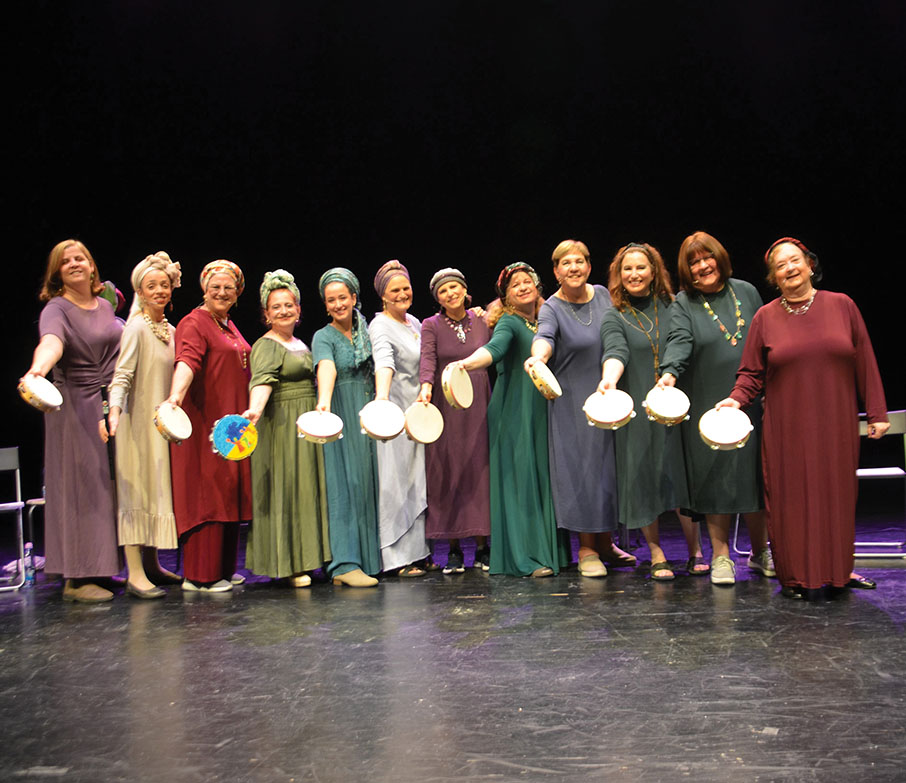
Our performers, all from Gush Etzion, range in age and include an attorney, several teachers, a museum professional, a non-profit writer, a naturopath, singer-composers and this journalist, among others.
Rivka Morowitz of Elazar, a nurse, college lecturer and special ed teacher, was born in East Windsor, New Jersey. She plays, among other roles, the heroic paramedic Amit Mann of Be’eri, who continued to tend to the wounded until she was murdered by Hamas, and the only female pilot who bombed Iran. She says, “This show has been the most deeply emotional show I have been part of. I’ve experienced feelings of joy, sadness, and pride through my singing and speaking parts, and when seeing the amazing reactions of the audience.”
Our cast members had their own challenges. Franny Waisman of Efrat, a tour guide and professional singer originally from Memphis, Tennessee, who has an original song in the show, has five boys, and her husband, a combat platoon commander, was on reserve duty for the entire time we were rehearsing and performing, with an occasional Shabbat off.
One night her babysitter canceled. Our music director – who is also a music therapist – led the rehearsal while I babysat, soothing the youngest child with a story till he fell asleep.
Having performed in Modiin, Beit Shemesh, Raanana, Neve Daniel and Jerusalem, we will be performing, God willing, on Sunday, May 31, in Ashkelon, hosted by the Ohel Hannah shul. The show was postponed from March 22 because of, well, Iran. Hopefully this time it will happen.
If you’re too far to make the trip to Ashkelon, you can catch it on livestream; it will be accessible for ten days. All the information is on: www.RaiseYourSpirits.org.
I always ask the women in the audience to raise their hands if they have volunteered for the war effort in the last two-plus years. The response is almost unanimous.
These are the women of Am Yisrael and they, too, are heroines.
How appropriate that our tambourine finale is about Miriam, a preview of our next production, for through righteous women, we are redeemed.
Toby Klein Greenwald has won awards in journalism and theater and is the editor-in-chief of WholeFamily.com.