“It is a Tree of Life for those who hold fast to it, and all its supporters are happy” is Proverbs 3:18’s praise of God’s law as the sustaining source of our existence. The line is sung in synagogue on the Sabbath as the Torah scroll is put back into the ark. As shul-goers look ahead to joyously reciting the customary melody once more this weekend, it’s worth recalling that a tree served as a symbol of life and liberty during the American Revolution’s early days, a phenomenon long forgotten.
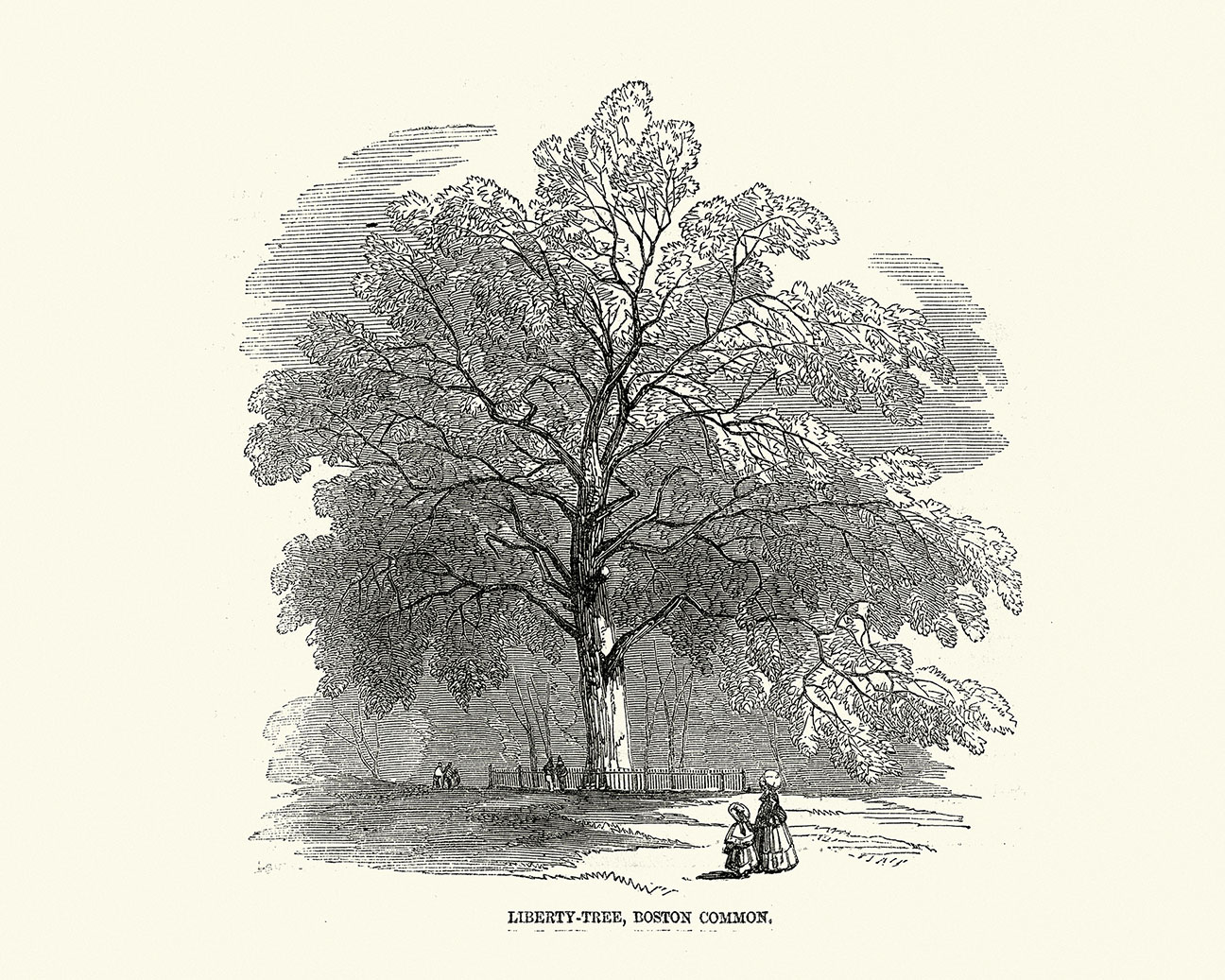
A large, 120-year-old elm in Boston, where Orange and Essex Streets intersected (present-day Washington and Essex) began to serve as the gathering place for the rebels known as the Sons and Daughters of Liberty in 1765. As Erick Trickey traces in a 2016 article for Smithsonian magazine, following the passage of the Stamp Act, “Early in the morning of Aug. 14, Bostonians discovered the effigy hanging from the tree. Initials pinned to the effigy, ‘A.O.,’identified it as Andrew Oliver, the Boston merchant who had agreed to collect the stamp tax [ordered by the British]. Next to him dangled a boot, a reference to Lord Bute, the former British prime minister whom many colonists blamed for the act. A small devil figure peeked up from inside the boot, holding a copy of the law. ‘What Greater Joy did ever New England see,’ read a sign that hanged from one of the effigy’s arms, ‘Than a Stampman hanging on a Tree!’”
On May 4, 1766, John Adams recalled how: “Sunday. Returning from meeting this morning and saw for the first time a likely young button-wood tree, lately planted on a triangle made by three roads. The tree is well set, well guarded, and has on it an inscription, ‘The Tree of Liberty, and cursed is he who cuts this tree.’”
Paul Revere included the Liberty Tree, effigy and all, in a political cartoon about the events of 1765. When word of the Stamp Act’s repeal reached Boston, crowds gathered at the Liberty Tree to celebrate, with the colonists hanging flags and streamers from the tree and fastening lanterns to its branches.
In 1767, when the Massachusetts General Assembly was ordered by the British to approve the oppressive Townshend Acts – adding costs to glass, paint, lead and tea – led by Samuel Adams, they overwhelmingly voted in favor of not obeying, 92 to 17. In celebration, the tree was decorated to feature exactly 92 branches adorned with lanterns, alongside 17 stubs.
Other towns in New England and beyond, sensing the growing power of the image, followed suit, naming their own liberty trees in Providence and Newport, Rhode Island; Norwich, Connecticut; Annapolis, Maryland; and Charleston, South Carolina.
As Trickey writes, “In 1768, the Liberty riot, a protest over the seizure of John Hancock’s ship, ended when the crowd seized a customs commissioner’s boat, dragged it from the dock to the Liberty Tree, condemned it at a mock trial there, then burned it on Boston Common. In 1770, a funeral procession for Boston Massacre victims included a turn past the tree. In 1774, angry colonists tarred and feathered Captain John Malcom, a British customs official, for caning a shoemaker, then took him to the Liberty Tree, where they put a noose around his neck and threatened to hang him unless he cursed the governor. (He didn’t, and they didn’t.)”
The original Liberty Tree, which one Bostonian had described as “a stately elm… whose lofty branches seem’d to touch the skies,” was cut down by the British in 1775 (it was later replaced by a pole). The Essex Gazette on Aug. 31, 1775 reported that a Loyalist died during the act, slipping off one of its branches amidst the demolition. The paper ran a poem by Philip Freneau’s poem, titled “A Voyage to Boston,” which gloated, “Each, axe in hand, attacked the honored tree, Sweating eternal war with Liberty. But e’er it fell, not mindless of its wrong, Avenged it took one destined head along.”
“A Liberty Pole had no roots,” the historian David Hackett Fischer observed. “It could be constructed anywhere on the spur of the moment and in many different sizes.” Some were so tall they towered over colonial cities’ largest buildings. Though the substitute stick didn’t last as an enduring image, the recollection of the original elm did, at least for a while. Thomas Paine celebrated the Liberty Tree image in a poem in the Pennsylvania Gazette, celebrating its potency for all Americans:
“Unmindful of names or distinctions they came,
For freemen like brothers agree,
With one spirit endued, they one friendship pursued,
And their temple was Liberty Tree …”
Native American tribes who sent delegates to the Continental Congress called the wealthy merchant and statesman John Hancock “Karandawan” which, roughly translated, means “The Great Tree of Liberty.”
Thomas Jefferson, in a 1787 letter declared, “The tree of liberty must be refreshed from time to time with the blood of patriots & tyrants.”
The Marquis de Lafayette, in his 1825 tour of Boston, proclaimed “The world should never forget the spot where once stood Liberty Tree, so famous in your annals.”
Today, the spot where the Liberty Tree once stood is commemorated by a bronze plaque lying at ground level in the brick plaza. Across the street you can spot an 1850s wooden carving of the tree that still adorns a building. The site was, alas, left out of Boston’s Freedom Trail.
As an article by Harry Schenawolf in the Revolutionary War Journal reports, the last remaining Liberty Tree was a 400-year-old tulip poplar on the campus of St. John’s College, Maryland. It was cut down on Oct. 25, 1999, after being irreversibly damaged by Hurricane Floyd. Several hundred people gathered solemnly, as crews removed the tree. Wreaths were laid at its base. A bell tolled 13 times for each of the original colonies.
Though Trees of Liberty no longer stand and are largely forgotten as a symbol, arboreal imagery continues to be invoked for by all those, particularly Jewish Americans, who have long recalled with affinity President George Washington’s Letter to the Jewish Congregation of Newport, in which he envisioned a country in which “every one shall sit in safety under his own vine and fig tree and there shall be none to make him afraid.”
Rabbi Dr. Stuart Halpern is Senior Adviser to the Provost of Yeshiva University and Deputy Director of Y.U.’s Straus Center for Torah and Western Thought. His books include the newly released “Jewish Roots of American Liberty,” “The Promise of Liberty: A Passover Haggada,” “Esther in America,” “Gleanings: Reflections on Ruth” and “Proclaim Liberty Throughout the Land: The Hebrew Bible in the United States.”