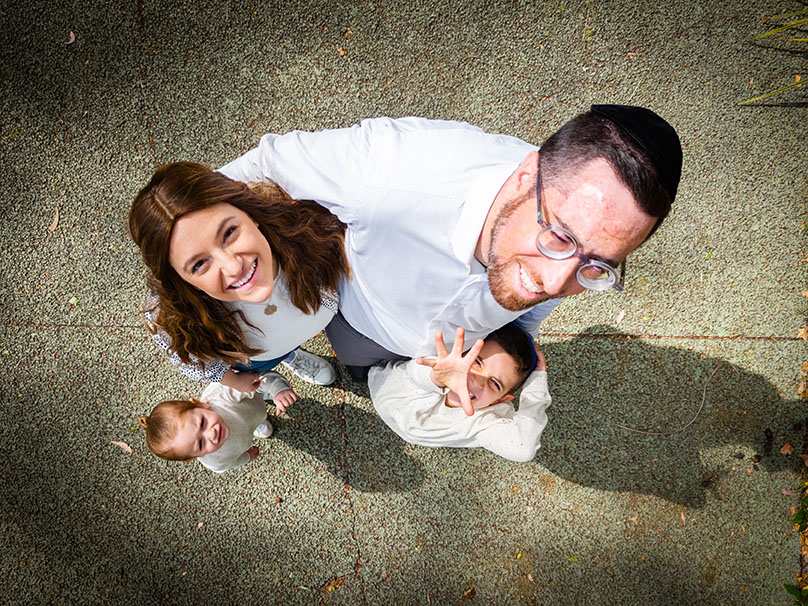

Unlike most rabbis, when Daniel Burg, the new senior rabbi of Hamakom, comes home, Miriam, his spouse, is also a rabbi. Asked if he and his wife speak business at home, he laughed heartily. “Yes, we will definitely talk shop,” he said. “She reads a lot of my sermons and gives me feedback. We bounce ideas off of each other.” Are there intellectual exchanges? “Oh, definitely,” he said. The Burgs are normal Jews. “We also talk about who is going to go to the grocery store and who’s going to take out the trash.”
They’ve learned how to accommodate their differences. Rabbi Burg recalled that “the biggest fight we ever had was whether to have fleishig dishes in our house because she is a vegetarian, and I really wanted to have meat. I won that battle. But it was a pyrrhic victory because we registered for meat dishes. She does most of the cooking so I use the top dish in my stack of dishes.”
Then there is their religious distinction. “When it comes to our Reform and Conservative backgrounds, I would say that we have similar practices – and different ideological reasons for doing what we do.” But they long ago agreed to live with their differences – just as they agreed on a kosher home. “We believe in Jewish pluralism,” said the male Rabbi Burg, “and we want people to be able to be comfortable by us.” Both Burgs are “passionate” about keeping a kosher home, he said, adding “she actually is a little more strict about certain things than I am. …I feel commanded by God to keep kosher,” he said, “and for her it probably is a little less specific. … She feels it is important for anybody to be able to eat in our home even if their observances are a little more strict than ours, including her cousin who is an Orthodox rabbi in Los Angeles, Rabbi Yosef Kanefsky. They are very close.” (He is the longtime leader of B’nai David-Judea Congregation in Pico-Robertson.)
What is the best part of marrying a rabbi? His response was immediate: “A shared appreciation for Jewish leadership and Jewish education. We love what we do, and we believe in the Jewish people.”
In Baltimore, Rabbi Burg led the Conservative (and historic) congregation of Beth Am (located in a Black majority neighborhood) for 16 years. When he signed a three-year deal in 2023, he told shul leaders it was his final contract. Was there anything that prompted the decision? “No,” he said. “It just felt like it was time. The things I was excited to do in the coming years were not entirely in line with the leadership. It felt like it was time to part ways.”
For those three years, he was looking for possibilities, the 50-year-old rabbi said. “I looked at pulpit, nonpulpit jobs, foundations. … I was recruited and had a couple of interviews to be chancellor of the Jewish Theological Seminary. I looked at other synagogues as well.”
He realized then that “I am very committed to synagogue life. I really love being a pulpit rabbi.” The best part is the people, he said and then quickly ticked off the reasons. “Having community. Getting to interact. Getting to work with people one-on-one, with family groups through a range of Jewish experiences.”
And there’s another element. “I enjoy fundraising. I don’t mind doing it. But,” he quickly added, “I wouldn’t want it to be the entirety of my job.” He thrives on being able to “teach classes, do pastoral work, visit people in hospitals, lifecycle events, counseling newly marrying couples, working with children toward smichot. I enjoy writing and doing some thought leadership. I get to flex a lot of different muscles as a pulpit rabbi.”
If he had gone in another direction, what would he miss most about synagogue life? He thought for a moment. “There’s a teaching in the Mishnah,” he began, “that when two people study the Torah together, the Shechinah descends and dwells between them. There’s a sense that when Jewish people are building a vibrant community together, we bring the Divine into the world. For me, I experience God between and among other human beings, between and among other Jews. I would feel isolated if I were away from Jewish life for too long.”
Rabbi Burg was eager to talk about his new home. “We started talking about the possibility of this job with a few different people here, I would say late last year.” What appealed most about West Hills? “This is an exciting place,” he said. “It’s really a dynamic, bold, forward-thinking community. They are interested in innovation, trying new things. There’s a vibrance in the Early Childhood. They touch lives at different stages. … It’s also bigger than the synagogue I am coming from. The opportunity to lead a larger place was very exciting to me with its program, Religious School and classes for older adults.”
West Hills is also very different from Beth Am’s location in Baltimore’s Reservoir Hill, a once-thriving Jewish area now home to a majority Black community. “Living in that Baltimore neighborhood helped me understand the truth about urban violence and also the truth of inner city life,” he said. “It was a warm and welcoming neighborhood, the kind of place where people shovel each other’s sidewalks, borrow a cup of sugar from a neighbor. We loved it. Remember, we weren’t building a shul. We were just doubling down on the Jewish presence in a Jewish neighborhood. We were not interested in doing that in a way that would alienate our neighbors. We wanted to invite our neighbors into our building.
“We had a good relationship with our neighbors because we were intentional about that relationship.”
For the Burgs, what was the best part of being in Baltimore? “The Jewish community mostly was not in the neighborhood where I lived,” he said. “Most of it is in Pikesville and Park Heights, suburban, northwestern enclaves. We were in the old Jewish neighborhood, in central West Baltimore. We had a lot of contact with the Jewish community because it is relatively small town. My kids went to day school. We were in the county to buy kosher food and educate our children.”
Beth Am’s Jewish community was unique because many of its members were transplants. “We had a number of legacy Baltimore families, but we also had people who had come to Baltimore for educational positions who were involved in civil society in Baltimore.” Rabbi Burg characterized Beth Am as a hub for those who were devoted to Baltimore city. “We had a lot of members who were upper level professionals,” he said, “leaders in society or industry who were really connected with the life blood of Baltimore city. This was not necessarily the case for the entirety of the Jewish community of Baltimore.”