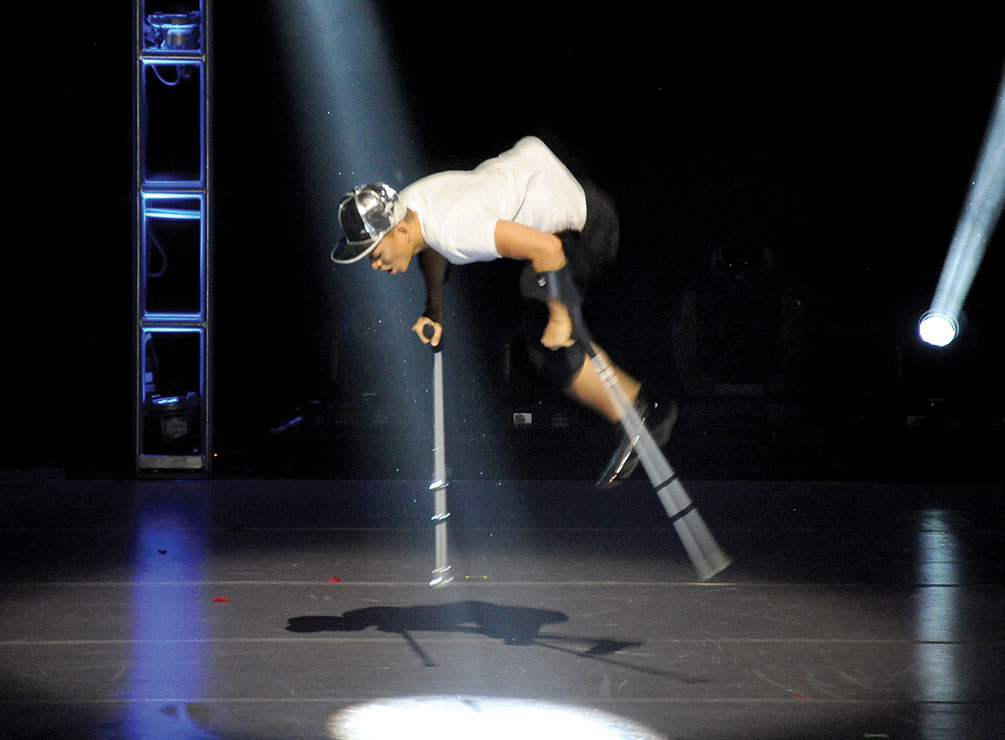
Of all the breathtaking acrobatics, the impossible contortions and the electrifying special effects that erupted across the stage at Cirque du Soleil’s “Michael Jackson ONE” in Las Vegas, none of them matched the force of what happened when a single dancer stepped forward on one leg. In a show built on spectacle, the moment that struck me hardest was quiet, human and profoundly moving. Jean Sok, an amputee who dances with crutches, didn’t just perform. He redefined the stage. His presence cut through the noise and shimmer of Cirque du Soleil and delivered something far more powerful: a living example of what true inclusion looks like when it is embraced wholeheartedly.
Sok’s movements were fierce, intentional and deeply expressive. He didn’t defy gravity; he defied expectation. The crutches were not props. They were extensions of his artistry as instruments of balance, rhythm and strength. Watching him, I felt a shift inside me, a kind of moral clarity. It wasn’t the typical awe that Cirque du Soleil is known for. It was recognition: this is what happens when a community understands that disability is not a limitation but a dimension of human experience that can expand creativity, deepen connection and elevate collective excellence.
That moment stayed with me long after the curtain fell and consequently caused me to reflect deeply on disability inclusion within the Jewish community – a community rooted in values that demand we see the divine in every person. Judaism teaches that each of us is created b’tzelem Elohim, in the image of God. This is not metaphor. It is a mandate. It means that every person, regardless of ability, carries inherent dignity and spiritual worth. It means that exclusion is not simply a logistical oversight; it is a moral failing.
Yet historically, Jewish institutions have not always lived up to this ideal. Many synagogues remain physically inaccessible. Programs are often designed around assumptions of ability. Neurodiverse and disabled Jews frequently encounter barriers not out of malice, but out of a lack of awareness, imagination or intentionality. And while the community speaks passionately about inclusion, the lived experience of many disabled Jews tells a different story.
Yet there are bright spots in our own backyard – examples of Jewish institutions that understood early on that inclusion must be woven into the fabric of communal life. Drawing on personal experience, when deToledo High School was established in 2002, its founding head of school, Dr. Bruce Powell, made a bold and visionary decision: he established American Sign Language as one of the school’s flagship programs alongside the most rigorous STEM and humanities classes. At that time, it was a bold decision. Today, it stands out for its uniqueness, excellence and its message — that communication, accessibility and human connection are central to Jewish education. ASL at deToledo is not a novelty. It is a statement of values, a commitment to ensuring that students understand the richness of deaf culture and the importance of inclusive communication. It is exactly the kind of leadership our community needs.
Jean Sok’s performance offers a model for what inclusion can be when it is done right. He was not placed on stage to inspire pity or to serve as a symbol. He was there because he is an extraordinary dancer whose disability is part of his artistic identity. His inclusion strengthened the entire production. It expanded the audience’s understanding of movement, beauty and human possibility. It demonstrated that diversity — authentic diversity — is not a burden. It is a source of power.
Jean Sok’s performance crystallized this truth. He didn’t ask the audience to overlook his disability; he showed us how it could become a source of power, beauty and artistic innovation. His presence on that stage was not symbolic — it was transformative. And it reminded me that inclusion, when done with intention and authenticity, elevates everyone. Now the responsibility is ours. To build synagogues, schools, camps and communal spaces where disabled Jews are not merely welcomed but expected. Not accommodated, but empowered. When we do this, we don’t just fulfill a moral obligation. We become the community we are meant to be — namely one that reflects the divine image in every person and celebrates the infinite ways that image can be expressed.
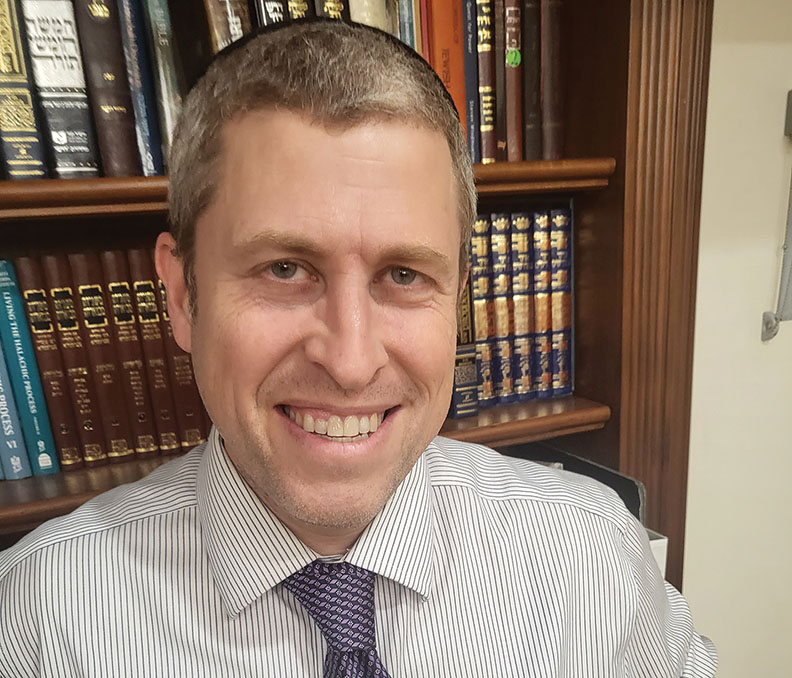
Lisa Ansell is the Assoc. Director of the USC Casden Institute and Lecturer of Hebrew Language at Hebrew Union College-Jewish Institute of Religion Los Angeles.