fbpx

May 27, 2026

When Everything Becomes a Product—Including Girlhood

Freya India learned the hard way that taking your emotions too seriously makes you feel worse, that the more you “edit” your body image through filtering apps, the more repellant you find your actual body, and the more time you spend uploading images from your life online, the less life you actually live. In her debut book, “Girls®: Generation Z and the Commodification of Everything” the 27-year-old British writer presents a stinging indictment against those she blames for having turned normal girls into GIRLS®, an ideal target market for the social media, pharmaceutical, beauty and online therapy industries.

India writes about these issues on her Substack GIRLS, as well as on Jon Haidt’s After Babel and The Free Press. “We were the first generation to learn to flirt on Instagram, to try to find teenage love by swiping … the first to have our faces and bodies ranked and reviewed on social media before we had even reached puberty, the first to document our adolescence for an online audience,” she writes in the book. This made typical adolescent insecurities “amplified and commodified,” exploited for profit through “a barrage of products, services, pills, and procedures that promised happiness but delivered dependency and dissatisfaction.”

Under all this pressure, India felt increasingly alienated and even ugly as a teen, suspecting she “wasn’t cut out for the modern world” and assuming everyone else was coping except her. “I needed more guidance and guardrails, more stability and security, something, anything solid to hold on to,” she writes, noting that her parents divorced when she was three and in her social circle, family breakdown was so common it didn’t bear mentioning.

In a chapter titled “Disconnected,” India expands on the cost of divorce on kids: lacking models of a healthy marriage; the need for extra support and validation that often isn’t available; and the fear that true, lasting love doesn’t exist, especially when divorce is often applauded simply because the marriage doesn’t feel right anymore.

She aims her ire at social media algorithms that track users’ activities and interests, as well as TikTok influencers selling cosmetic and skin care products to adolescents, who become fearful of “aging” skin. “Mental health” influencers dangled quizzes meant to convince girls they had anxiety, ADHD and other disorders. From there, online therapy and pharmaceutical platforms (some of which have been shut down) swooped in with offers of therapy sessions and mail order prescriptions. Having panic attacks and other anxieties became normalized, romanticized and overshared. Feelings of disconnection from real life followed.

India argues that this me-first and feelings-obsessed culture only leads to selfishness, such as viewing commitment and acts of kindness as an intrusion on one’s autonomy. She also notes the spiritual hunger among of Gen Z, who generally do not believe in God but in affirmations about their own power and worth, as well as healing journeys, astrology and sometimes, witchcraft.

“GIRLS®” follows in the path of other authors including Louise Perry, Abigail Shrier and Jon Haidt, who have all written on these issues for years. All agree that secular society’s promotion of looser sexual mores, disposable marriages, social media fixation and the “pathologizing of normal human emotions and behaviors” has not delivered the promised benefits of greater empowerment and security. Instead, young adults today may be the most anxious and fearful generation ever.

India is often eloquent and insightful. Unfortunately, the book suffers from repetitive data syndrome, where the bountiful examples of survey results and statistics begin to blur. The book would have benefited from offering more first-hand accounts from Gen Z women discussing what they experienced and how they began to resist and disengage from the warped thinking and habits. It is also simplistic to lay all the blame for Gen Z girls’ problems on corporations and other outside forces. Parents are meant to be the ultimate “influencers,” and someone took these 12-year-olds to Sephora or gave them a credit card to purchase needless or even damaging products and services online.

The insidious manipulation of young social media users has long been known. Why weren’t parents checking in on their daughters, setting limits on their phone use, saying “no” to another online beauty purchase? Why weren’t parents telling their daughters they were beautiful and worthy without any “edits,” helping them find alternatives to the toxic online world? Didn’t anyone go to church or synagogue, to dance or art class or have any diversion from this environment? India portrays a world in which parental guidance was totally AWOL and no one seemed to have healthy hobbies. “We never knew a childhood spent chasing experiences and risks and independence instead of chasing likes on a screen,” she writes. If so, parents are more culpable than Meta.

Secular book reviewers have dismissed “Girls®” as a “conservative” book because India notes the impact of divorce and lack of religion and community among the causes for her generation’s lack of rootedness. The type of surveys she cites, however, have shown consistent results over decades, linking a religious and conservative lifestyle with significantly greater happiness than a secular, liberal lifestyle. “Conservatives, on average, tend to have a more internal locus of control, while liberals lean more external — and the more external your locus of control, the more likely you are to feel anxious, hopeless and depressed,” she writes, adding that “whispering to the universe” is no substitute for the foundational moral guidance of religion.

Despite the book’s weaknesses, India offers an astute and unsettling portrait of a generation shaped by forces it barely understands. India ends on a hopeful note, tracking huge drops in the use of facial filtering apps, dating apps, and online participation. Women are also beginning to speak out about the damaging effects of antidepressants, which many now realize they never needed in the first place. It’s too bad they had to pay such a high price to detach from the unreality of their online lives.


Judy Gruen is an award-winning book reviewer and the author of “Bylines and Blessings” and other books. She is also a book editor and writing coach. www.judygruen.com.

When Everything Becomes a Product—Including Girlhood Read More »

Rebels, Superheroes and Family Ghosts: Three Skirball Exhibitions on Jewish Reinvention

Three fascinating exhibitions now showing at the Skirball Cultural Center stand on their own, yet together they trace unexpected threads of Jewish identity, memory and cultural reinvention. They span the rebellious energy of punk to the layered visual language of comics and the intimate reflections of “A Palace in Time,” a joint exhibition by Lisa Edelstein and her husband Robert Russell.

Russell paints highly realistic still life of everyday and ritual objects — porcelain cups, a Shabbat teapot, a yahrzeit candle, and small figurines. His attention to detail is so precise that the works can easily be mistaken for photographs.

In his porcelain figurine series, Russell paints objects originally produced by the Allach Porcelain factory, later run under the SS during the Nazi era and linked to forced labor and propaganda. Working from archival and auction images, he renders them with striking realism, turning visually appealing decorative objects into reminders of their complex and troubling history.

Curator Vicki Phung Smith initially considered presenting the work of Russell on its own. It was only after visiting their home studio and seeing the paintings of his wife, actress-turned-artist Lisa Edelstein (“House,” “Girlfriend’s Guide to Divorce”) that the direction of the exhibition shifted. Recognizing a shared emotional and conceptual vocabulary between the two bodies of work, she invited Edelstein to exhibit alongside Russell, creating a dialogue between their works.

Edelstein started painting during COVID, when the sudden pause of daily life and constant screen time led her to revisit a long-dormant creative passion. After watching films throughout the lockdown, she felt an urge to shift direction and return to something more tactile and immediate. What began almost casually with markers quickly developed into a deeper practice, especially after her husband encouraged her to move from drawing materials to watercolor and later oil paint.

Together, their works construct a shared space in which private memory, Jewish ritual and visual storytelling intersect, transforming the idea of home into a site of artistic and emotional reflection.

Drawing on her own family photographs from the 1970s, Edelstein captures scenes of everyday life from family meals to lighting the Sabbath candles. The result is a personal archive where domestic life becomes a site of reflection on identity and time.

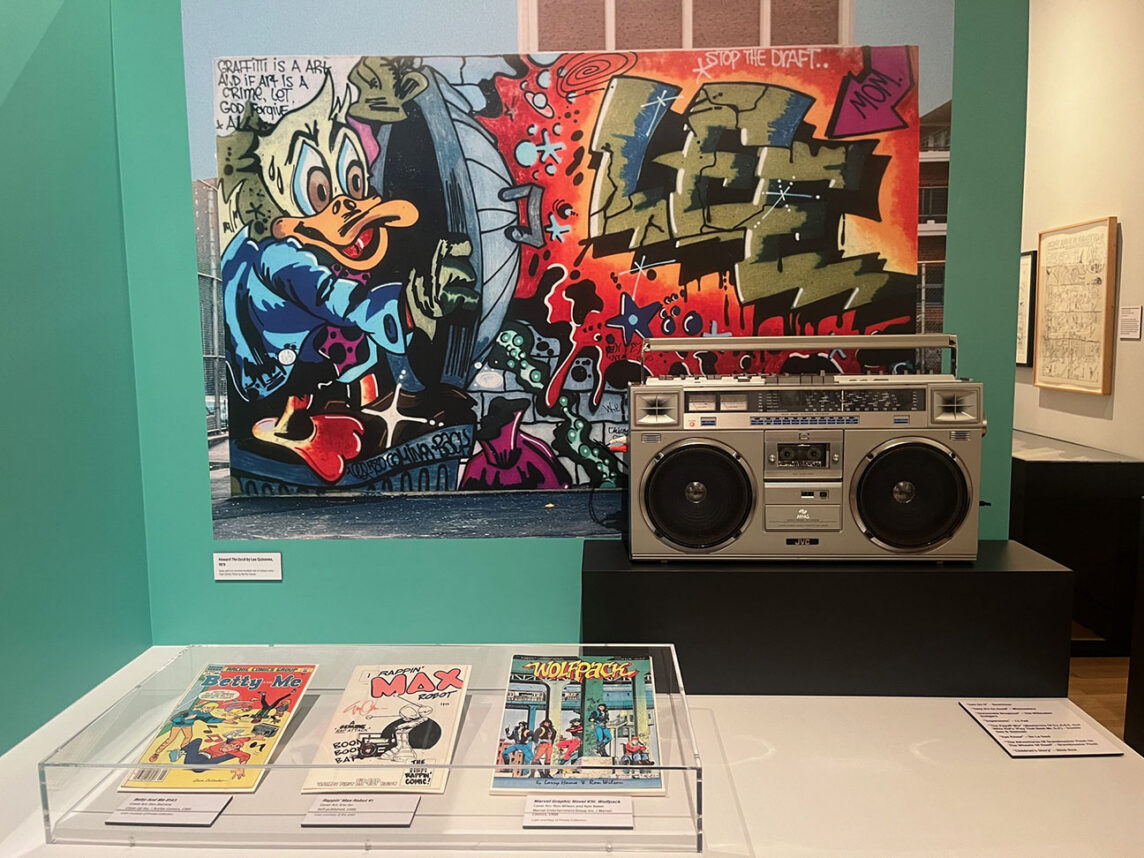
Down the hall, you’ll encounter a very different scene, one not usually recognized as “Jewish.” “Outsiders, Outcasts, Rebels + Weirdos: Punk Culture 1976–1986” traces punk’s rise from New York and London to Los Angeles and Washington, D.C., framing it not just as music or style but as an ideology shaped by refusal, contradiction and lasting cultural impact.

The exhibition also highlights the often-overlooked presence of Jewish musicians in the scene, including members of Bad Religion, The Dickies, The Pandoras and the short-lived band Jews from the Valley, which “was one of the first bands to have an explicit Jewish theme in their music,” curator Cate Thurston said.

She added that “anti-racist networks formed organically, with a clear line drawn: you are not welcome here,” describing how punk communities pushed out Nazi and extremist elements from the scene.

Rather than offering a single narrative, the show explores questions of visibility, identity and belonging within a movement that prized reinvention and frequently obscured personal backgrounds.

If punk tells the story of outsiders reshaping culture through sound and refusal, the comics exhibition, “Inventing America: The Comic Book Revolution,” reveals a parallel narrative rooted in ink, image and imagination.

Immigrants and first-generation Americans, many of them Jewish, were instrumental in building the comic book industry. Arriving in the United States with limited English and few economic opportunities, many found an opening during World War II, when established artists were drafted and publishers needed new talent. Comics, which relied heavily on visual storytelling, offered a rare entry point where language mattered less and identity was less of a barrier.

Drawing on experiences of displacement and reinvention, these creators helped shape a distinctly American mythology through dreams, fears, and aspirations. As the field became more diverse over time, so too did the nation reflected in its stories.

Take, for example, the story of Lily Renée, a Holocaust survivor and one of the first women to break into the comic book industry. Born in Vienna, her childhood was upended by the Nazi occupation of Austria in 1938. Sent to England as a teenager, she endured years of hardship before eventually reuniting with her family in New York. She was hired by comic book publisher Fiction House and became a full-time comic artist, lending her polished linework to adventure and romance titles. She is best known for Señorita Rio, about a Hollywood actress turned secret agent who hunts Nazis in Central and South America.

The exhibition also highlights artists whose lives reflected the upheavals of the 20th century, including Mac Raboy, who began his career with the Works Progress Administration during the Great Depression and later rose to prominence drawing patriotic wartime imagery.

Visitors also encounter the influence of Stan Lee, born Stanley Martin Lieber to Jewish-Romanian immigrant parents, who served as Marvel’s primary creative force for more than two decades. Together with artists such as Jack Kirby, he helped expand the superhero genre while steering it toward more socially conscious storytelling. Their collaboration helped introduce characters like Black Panther in 1966, one of the first Black superheroes in mainstream American comics, and shaped narratives that confronted racism, corruption and inequality. By the late 1960s and into the 1970s, Marvel further deepened this shift toward social commentary; in a 1970 Amazing Spider-Man storyline, for example, a politician is revealed to have ties to hate groups, reflecting a growing willingness within mainstream comics to engage directly with contemporary social realities.

Kirby – born Jacob Kurtzberg to Jewish immigrant parents – brought a personal history shaped by displacement and war. His work is often read through themes of outsiders, resistance to tyranny and the fight against fascism, reinforced by his service in World War II and his upbringing in a Jewish immigrant household.

Also on display are some of the most iconic artifacts in comic book history, including Action Comics #1, which introduced Superman, and Superman #1. Created in 1938 by Jerry Siegel and artist Joe Shuster, Superman is often seen as the quintessential American hero, yet his origins lie in the imagination of two young Jewish creators. Seen in this context, these rare comics underscore how deeply Jewish immigrants and their children helped shape the visual language and mythology of American popular culture.

The exhibition frames comic books as more than entertainment; they emerge as a cultural mirror of a nation in constant reinvention. That evolution was not without disruption. Following the Comics Code Authority in the 1950s, many publishers closed while others shifted toward safer genres such as romance, teen drama and adapted literary classics. Titles like “Walt Disney’s Comics and Stories” reached mass circulation, while “Classics Illustrated” and “Treasure Chest” brought literary narratives to wide audiences.


Collector editions on display underscore comics’ lasting cultural value, from a 1960 Mad magazine issue celebrating John F. Kennedy’s election, originally sold for 25 cents, to Gay Comics (Summer 1993), originally priced at $3.50, and the oversized 1978 Superman vs. Muhammad Ali, originally sold for $14.99 (approximately $75 in today’s money), now considered a landmark collector’s item.

The comics exhibition will run through Feb. 28, 2027, while both “Outsiders, Outcasts, Rebels + Weirdos” and “A Palace in Time” are on view through Sept. 6. 

Rebels, Superheroes and Family Ghosts: Three Skirball Exhibitions on Jewish Reinvention Read More »

Gabba Gabba Oy!

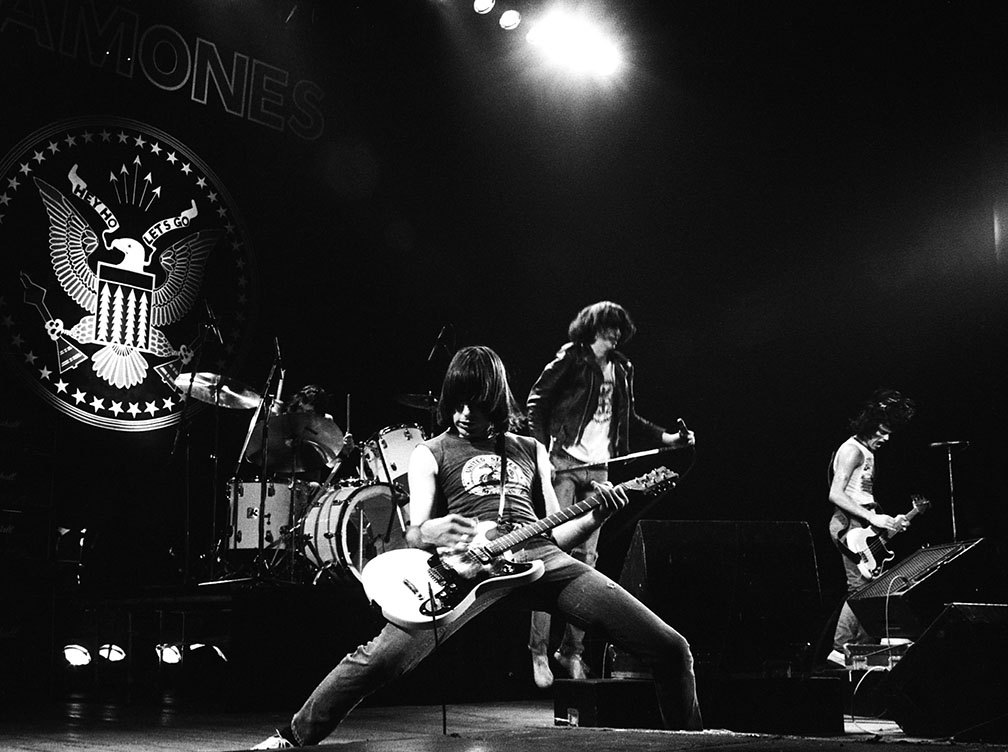
According to Tamás Erdélyi “People don’t associate Jews and punk.” The new exhibit at the Skirball Cultural Center, “Outsiders, Outcasts, Rebels + Weirdos: Punk Culture 1976-86,” wants to change that. And who’s this Tamás Erdélyi? The Budapest-born, Forest Hills raised son of Holocaust survivors is better known as Tommy Ramone, the original drummer for Ramones, arguably the most identifiable band that came out of the mid-70s CBGB scene, whose uniform of tight jeans, T-shirt and leather jacket became visual shorthand for “punk rock” (and, along with Jeff Hyman/Joey Ramone, the Jewish half of the band).

For Cate Thurston, the chief curator at the Skirball, the exhibit gives the museum a chance to “explore this sort of underserved story” about the Jewish relationship and participation and crafting the look of punk. She said the show was trying to “tease out an interesting diversity of voices that were cohesively contradictory.” One example, she said, is Jonathan Richman, “who said ‘you can hear parts of my uncles’ and Seders in my music,’ and Blondie’s Chris Stein, who insists it has nothing to do with anything.”

The handsomely mounted exhibit tells a mostly chronological story that focuses on New York, London and Los Angeles. It starts with New York, where two Jewish bar owners – Mickey Ruskin at Max’s Kansas City and Hilly (né Hillel) Krystal at CBGB – started featuring live music. Max’s, located just around the corner from Andy Warhol’s Factory, was known for its mix of the music and art worlds; Hilly wasn’t looking for his Bowery bar to become ground zero for a musical revolution, only to have some bands playing his favorite music: CBGB stood for Country, Blue Grass and Blues.

Krystal’s focus changed after guitarists Tom Verlaine and Richard Lloyd of the band Television walked by the club, and asked if their band could get a gig there. Joined by Jewish bassist Richard Hell (né Richard Lester Meyers) and drummer Billy Ficca, Television played its first show at CBGB on March 31, 1974. Within a year, Television, supporting the Patti Smith Group (featuring guitarist Lenny Kaye, né Kusikoff), had found an audience and CBGB became the place to hear new, unrecorded music.

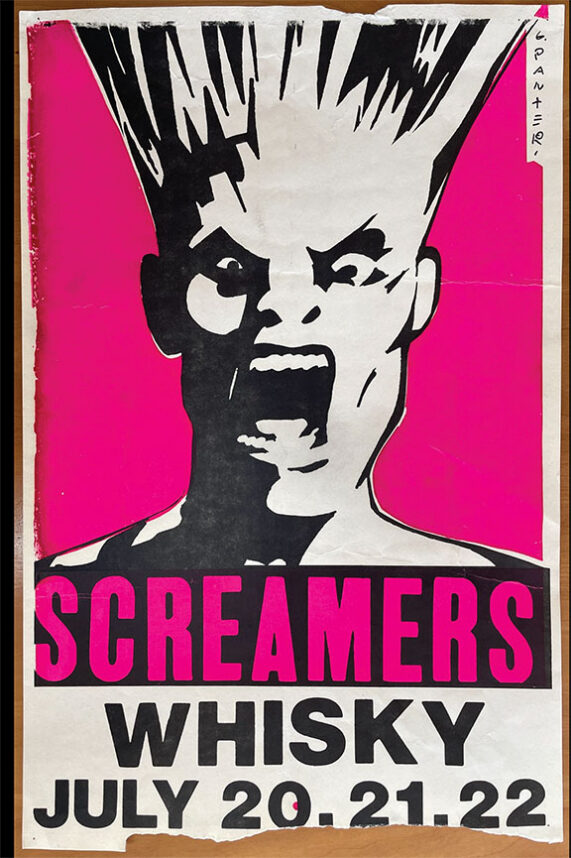
One of those who went down to the Bowery was Londoner Malcom McLaren, a nice Jewish boy working in the rag trade. McLaren was taken by the music’s energy and, especially, Hell’s ragamuffin style, with safety pins holding together his thrift shop clothes. Back in London, McLaren, who had an interest in the Situationists and their idea of public pranks as a form of protest, was looking for something new and exciting. He wanted something revolutionary, a sound that would reflect the youthful frustration with Britain’s economic malaise … and promote the new boutique he opened with designer Vivienne Westwood, Sex. Thus was born the Sex Pistols. Their first single, “Anarchy in the U.K.,” released on Nov. 26, 1976, is a stunning record, and one that sounds just as fresh and angry today as it did then. Its influence spread to Los Angeles, where bored suburban kids were taken with the record’s power and anyone-could-form-a-band spirit, and gave birth to the first wave of LA punk bands, including the Germs, the Screamers, the Bags and X.

As might be expected, the show does tilt towards the Los Angeles scene, even having a map showing the locations of Club Lingerie, the Anti-Club, Madame Wong’s and other venues. There’s also a section devoted to the LA Hardcore scene, including Black Flag, fronted by a Jewish singer, Henry Rollins (born Henry Lawrence Garfield) and the Circle Jerks (fronted by Jewish singer Keith Morris).


There was no music playing during the press preview, but even if you had no idea who any of the bands were, just looking at the posters, ephemera and photos could give an idea of how they sounded. The crude, bumptious and proudly handmade handbills (Xeroxed at the local copy store or, if you were lucky, on your job’s copy machine) were a visual correlative to the often crude, aggressive bands they promoted. Two of the most successful fanzines have multiple issues displayed: New York’s Punk, a gonzo combination of comics and Mad and Creem magazines that inadvertently gave the scene its name, and LA’s Slash (which later gave birth to Slash Records, home of the LA bands X, The Blasters and Los Lobos). There are live performance photos by Jewish photographer Jenny Lens, and a short film by Don Letts. The photos and film give an idea of how diverse the scenes were. Women and homosexuals were welcomed as performers and fans. “They made their own world for themselves where they did fit in,” Thurston said. “And I think that’s really interesting and that’s the commonality, that people view themselves as outsiders and then created this music and culture for themselves.”

You get a sense of how the scenes came at the music from different angles: New York’s art world cool (even the Ramones – who stripped rock and roll down to the bare essentials – shared some DNA with Jewish Minimalist composers such as Steve Reich and Philip Glass), the English bands’ political engagement and economic rage and LA’s sunbaked nihilism, but also of their congruences. For Thurston, one of the surprises was “how interconnected everything was.” Michael Worthington, a graphic design professor at CalArts who co-curated the exhibit, said that in the mid-’70s, “there was still a mainstream culture to push back against,” which was much less fractured and diverse than today, and the musicians in all three cities “were pushing back against that mainstream that they had in common.”

And it’s that sense of being on the outside that attracted Jews to punk rock. “They were choosing to be outsiders in a way,” Worthington said. “They were self-selecting to create their own community with different political views, different philosophical views. And also I think they had in common a kind of economic situation. A lot of these scenes were built around people doing things for themselves because they weren’t coming from necessarily a kind of privilege.”

One thing the exhibit had to navigate was the use of the swastika by some of the early British punks. Thurston was emphatic that the museum could not ignore it and “not remove it from the discussion … it was used in a way to try and shock people.” It was equally important  “to understand how it was used and how it was pushed back against,” mentioning the Rock Against Racism movement and the Dead Kennedys single “Nazi Punks F— Off.”  The only swastika seen in the exhibit is on a handbill announcing an anti-Nazi benefit. The exhibit includes two stories of individuals taking a stand: Siouxie and the Banshees were opening for the Clash at the Roxy in London, and the Clash – a band that took the communal tenets of the punk seriously – offered to let them use their equipment. When singer Siouxie Sioux showed up wearing a swastika, the band, then managed by the Jewish Bernie Rhodes, told her unless she took it off, the band would not allow her to take the stage. In New York, when the Dead Boys showed up to a session with their producer, Genya Ravan (née Genyusha “Goldie” Zelkowitz), she told them that there were people in the room who lost their families in the Holocaust, and they didn’t see it as a fashion statement.

“Punk changes every couple of years,” Worthington said, and like the music it covers, “the exhibit loses some steam after the initial explosion. The one-time outsider movement gets absorbed into the mainstream and the bands are courted by major labels. The posters get slicker, the graphics professionally designed. There are still great things to see, from a rare copy of Public Image, Ltd. “Metal Box,” and the Peter Saville designed sleeve for New Order’s “Blue Monday,” which ended up costing more than the record it held, so the label and band lost money on every sale, but it’s hard not to feel that something was lost.

But Worthington still sees the original energy in today’s music. “The thing (the musicians) continually have in common is the idea of rebellion, this sort of being an outsider, building a community and finding a place to put that kind of energy.”

Sounds like a Jewish story to me.

“Outsiders, Rebels + Weirdos: Punk Culture 1976-86,” is on view at the Skirball Cultural Center, 2701 N Sepulveda Blvd., in Los Angeles through Sept. 6. For more information, visit https://www.skirball.org/

Gabba Gabba Oy! Read More »

Antisemitism Isn’t Hiding— It’s Evolving on UC Campuses

As this school year comes to a close, it’s clear that antisemitic incidents across University of California campuses are not following suit, but escalating. From protests against former hostages to promoting suicide bombers, and targeting Jewish students online, antisemitism is alive and well, as it has been for years. Regardless of the different faces antisemitism wears, these are not isolated incidents. They point to a larger, more uncomfortable truth that antisemitism is not a relic of the past, but rather is adapting to the present.

Actions that are often framed as “anti-Zionism” on college campuses across America are increasingly showing up as a socially acceptable mask for antisemitism. These incidents are seeping into Jewish spaces and targeting Jewish students and identities in ways that are becoming concerningly normalized and dismissible.

Just last month, Omar Shem Tov, an Israeli hostage who survived 505 days of torture in Gaza, came to speak at UCLA and was greeted with a host of antisemitic protesters. He faced the hostility of crowds, treated as if he himself were a terrorist, not a victim of them. The UCLA Undergraduate Student Association council claimed that hosting a survivor of Hamas captivity was “obscuring the broader reality of ongoing state violence.” As if to say that offering students a chance to develop some empathy toward the suffering of Israelis caught in the middle of the war is somehow an attempt to spread prejudice against Palestinians. Ironically, their stance suggests that the exact opposite has already taken root.

Despite this reaction, Omar still pulled in his message that even after experiencing the unimaginable, his message promotes empathy and humanity. “You can’t fight darkness with darkness, you have to bring in the light.” Although the negative reaction at UCLA was widely publicized, other campuses greeted him with compassion and understanding.

In stark contrast with UCLA students’ problematic reaction, UC Berkeley thought it would be appropriate to host a failed Palestinian suicide bomber to deliver a speech to students for a “Palestinian Political Prisoners Day” event during the same week. It’s worth noting that she wasn’t some freedom fighter targeting a military site; the woman was arrested after attempting to ignite a car bomb near a civilian neighborhood and was heard shouting the Islamic Supremacist call to violence against infidels, “Allahu Akbar.” The mass murder attempt severely disfigured herself and the Israeli police officer who confronted her.

This clearly crosses from political discourse into moral distortion, and it raises questions like: Why is violence against Israelis, and by extension Jews, being normalized? Why are we praising martyrs? And how have we come to live in a world where suicide bombers are praised, and former hostages are shamed?

Meanwhile, throughout April, at UCSB, Hillel was busy promoting their most exciting event of the year, a Jewish prom. Despite promoting an event that was only meant to bring joy and fun to the community, Hillel was met with a host of online antisemitism. Comments like “Will there be a bomb dropping simulation?” It seems that the Jewish community can barely do anything without some anti-Zionist taking issue. The event went on as planned, albeit with unprecedented additional security and emotional distress placed on the student planning committee.

If anti-Zionism is not bigotry against Jews, what exactly does targeting a social for Jewish students have to do with Gaza? As most people are able to agree about bigotry, antisemitism does not need to be physical violence to produce real harm.

Universities are supposed to protect political free speech, but antisemitism stops being protected political expression when Jewish students are targeted, threatened, harassed, and blamed for the actions of the state of Israel. This line matters because free speech should encourage debate and protest, not cross the line into normalizing intimidation or hatred toward an entire group of people.

Whether it’s protesting against former hostages, justifying or celebrating violence, or online harassment and intimidation, antisemitism continues to embed itself into the culture of college campuses. The AMCHA Initiative has a database of over 11,900 incidents of antisemitism on over 700 campuses. This issue is much larger than three California campuses; it exists across the nation in every place that Jews do.

Despite this, it’s more important now than ever for Jewish students to remember Omer Shem Tov’s message: we need to bring in the light. We cannot afford to flinch as we face the abyss. Continue to host events, choose visibility over fear of bullying, and help build your community so that the next 1st year wearing a Magen David or an Israeli Flag yarmulka has a community to run to when chased across campus by “activists.” Jewish joy has become our strongest form of resilience and is itself an act of resistance. Jewish students belong on college campuses as much as anyone, and we aren’t going anywhere.


Lily Karofsky is a senior studying Communications and Journalism at the University of California, Santa Barbara, and a fellow of the Committee for Accuracy in Middle East Reporting and Analysis (CAMERA). Opinions expressed are those of the author and do not necessarily reflect those of CAMERA.

Antisemitism Isn’t Hiding— It’s Evolving on UC Campuses Read More »

Recognizing Jewish Heritage Month

On May 18th the Floor Session of the State Assembly began in prayer led by Rabbi Mona Alfi of Congregation B’nai Isreal, the oldest synagogue in California, founded during the Gold Rush, just down the street from the State Capitol where we were assembled on the meaningful occasion of the introduction of California Jewish Heritage Month, Bill ACR195.

To mark this occasion, 14 women and men were honored for their roles as community leaders. I traveled, with a small group of Angelenos, at the invitation of our friend, Karl Thurmond, one of the honorees, to support and celebrate him as he received this inaugural year honor for distinguished service to the Jewish community.

I was in the very same room a decade ago, accompanying another honoree, Michele Rodri z”l,  a Holocaust survivor and dear friend who was being honored along with an extraordinary group of survivor elders for their resilience, their lifetimes of service and as beacons of resilience and Jewish endurance. Since 2010, with Resolution 31, and with the creation of the California Legislative Jewish Caucus in 2013, these annual ceremonies were treasured by survivor elders, their families and the lawmakers who hosted them, and walked them, with dignity, ritual and respect, down the aisle.

In my years working with Holocaust survivors, I was often asked to nominate Holocaust survivor elders for this honor. Each year the invitation became harder to realize, my asks met with either “Thank you but I have been honored” or “I don’t think I can make the trip.” Each year it was clear there would come a day when that cycle, that rhythm, of honoring would become muted until the day when the legacy was finally an historic article and an indelible past.

On my first visit to the State Capitol, I was awed by the grandeur and history, as well as the vibrant emerald green carpet that I wasn’t expecting: somewhere between a shamrock, a newly mown lawn and a brand-new dollar bill. This time I expected that rush of green when I entered the room but was surprised that it was muted. Maybe the carpet was 10 years older? Maybe my eyes are older. This time it was a return to a sacred space, to an institution that held so much memory – I closed my eyes and imagined all the survivors I knew and didn’t know who progressed down this corridor, their district’s elected official holding their arm, supporting them physically and emotionally with their presence.

This May 18, with a calendar date “chai” dedicated to life and to Jewish service and leadership, I was touched by the power of ceremonial continuity. In the first piece I wrote for The Jewish Journal, 13 years ago, I explored the relay of history, passed dor v’ dor from survivor to child survivor to the generations who would follow them.

On this day, 14 remarkable honorees from across the state included Angelenos Julie and Jonah Platt and Karl Thurmond. Assembly member Jesse Gabriel (D-Encino), the bill’s co-author was joined by a long list of legislators who supported its proceeding. Gabriel lifted up the Jewish story over more than 175 years and expressed pride “that our Jewish community has contributed in deeply meaningful ways to the building of California,” citing contributions in building “not only synagogues and community institutions,  but  we have helped to build unions, universities, hospitals, film studios, tech companies, legal aid organizations and public institution that have strengthened American life for everyone.”

Karl Thurmon being presented with his honor

Many Assembly members shared potent words of allyship for their Jewish colleagues and constituents including Assembly member Isaac Bryan (D-Pico Robertson), who said: “I couldn’t be more honored to be here the first time that this floor is celebrating Jewish American History Month. Jewish American history is American history. It has made the world better. It has made our country better. It makes California better, and I respectfully ask for your aye vote”

On this morning, as the gathering commenced, Gabriel shared breaking preliminary news of the mosque shooting in San Diego. Three innocents murdered, two suspects dead and yet another community traumatized. A new tragedy to grieve and grapple with, in a line of incomprehensible and increasingly comprehensible tragedies where the preciousness of human life is subordinated to the brutality some humans will enact.

On this beautiful Sacramento morning,  in the face, perhaps in defiance of,  so much in the world that is painful, tenuous and deeply troubling, we convened and we lifted up what connects us–  the promise of growth and healing, and the potent ability for people to endure,  to create change, and to scaffold our communities in justice and truth. Rabbi Harold Schulweis z”l taught us that the memory of the Holocaust must be carried “as a flame and not a stone.” May the survivors, and their stories, memories and legacies , continue to light our way.

B’shem…..Michele Rodri z”l, Marie Kaufman z”l, Curt Lowens z”l, Armin Goldstein z”l, Freda Goldstein z”l, Idele Stapholz z”l, Maria Wida z”l. Peter Daniels z”l, Yisrael Zilberstein z”l, Lidia Budgor z”l, Joshua Kaufman z”l, Regina Lewin z”l, Jack Lewin z”l, Kalman Aron z”l, Henry Oster z”l, David Lenga z”l, Avraham Perlmutter z”l, Sarah Moskovitz z”l, Yitzchak Moskowitz  z”l,  Betty Cohen z”l, Dana Schwartz z”l, Vera Hirtz z”l and Estelle Laughlin z”l.


Samara Hutman is the co-founder of The Righteous Conversations Project, a program of Remember Us and Animate Possibility, a program of Second Nurture, where she serves as Associate Director.

Recognizing Jewish Heritage Month Read More »

From Antisemitism to Antizionism: Toronto Symposium Marks a New Era in Jewish Advocacy

For the first time, more than 700 attendees gathered in Toronto on Sunday, May 17 not to talk about Zionism, Israel, or antisemitism, but to examine antizionism as a distinct ideological phenomenon. The inaugural World Symposium Against Antizionism, hosted by Stop Antizionism, a newly launched educational initiative that I co-founded, and Tafsik, a Canadian organization, reflected a meaningful shift in how some Jewish thinkers and advocates believe the community should engage with the forces arrayed against it.

Conservative commentator Ben Shapiro delivered the keynote address with an argument that challenges a foundational assumption of pro-Israel advocacy: that Zionism still requires defense as a matter of legitimacy. Drawing on a simple analogy, Shapiro suggested that endlessly relitigating a nation’s right to exist is a category error. Nations are not granted existence through philosophical consensus; they earn and maintain it through persistence, will and action. Israel exists. That, he argued, should be the starting point of any serious conversation, not an open question requiring renewed justification.

By the close of the day, this thread was picked up in a fireside conversation between Shapiro and myself. I asked: “Zionism has fulfilled its purpose. How useful is this word for us?” Shapiro’s response framed the stakes clearly: “Antizionism is evil, it is wrong, it is predicated on lies and it requires violence to achieve the ends it seeks.”

The symposium was organized around a conceptual distinction that Stop Antizionism considers foundational: the difference between misinformation and disinformation. Pro-Israel advocacy has operated on the assumption that antizionism spreads because people lack accurate information, that correction and education are the appropriate remedies. The symposium challenged that premise directly.

Antizionism is not a collection of honest errors awaiting correction. It is a structured ideological system with roots in Soviet-era propaganda, designed not to inform but to subvert. Libels, by their nature, do not respond to factual rebuttal, they operate through emotional and moral channels that bypass evidentiary standards.

This framing was reinforced empirically at a panel on “Antizionism and Disinformation,” where researcher Zack Dulberg presented findings from a recent study. The data revealed that antizionism correlates with what the researchers termed “moral inversion”: individuals expressing stronger anti-Israel views also showed greater endorsement of Soviet and Nazi propaganda, more authoritarian political dispositions and more favorable assessments of governments with documented human rights abuses. The pattern suggests that antizionism is not simply a political position but may function as a marker of broader ideological distortion.

Shapiro’s assertion that antizionism is both immoral and untruthful points toward a broader cultural argument. Shapiro is correct because antizionism is a stress test. It tests whether a society, here the West, still believes that success itself is suspect. It tests whether narrative outweighs truth, and whether nationalism can still be understood as a virtuous force rather than an inherently immoral one. It tests whether false idols, such as a distorted notion of justice, i.e. social justice, have replaced a genuinely moral worldview.

The fact that antizionism has gained considerable purchase in mainstream Western discourse raises serious questions about the health of those conceptual frameworks, quite apart from the specific question of Israel. Writer Alana Newhouse’s recent essay in Tablet, “Zionism for Everyone,” offers a blueprint for how the West might regain its footing. She argues that Zionism should be embraced as a model of virtuous nationalism, pluralism and success. The broader argument animating the symposium, however, is more foundational. I would frame the task even more simply: the first step is to reject antizionism itself, an unethical and untruthful worldview that breeds moral corruption.

Rooted in my “Three-Era Framework” of Jew-hatred — anti-Judaism, antisemitism and antizionism — the symposium exposed antizionism as the contemporary mutation of anti-Jewish hostility and analyzed how it functions within modern political and cultural discourse. The event brought together scholars, journalists, legal experts, educators, policymakers and activists to discuss antizionism across academia, media, law, politics, and culture. Other speakers included former Soviet refusenik and human-rights activist Natan Sharansky, author and scholar Dr. Einat Wilf, evolutionary psychologist Dr. Gad Saad, and young voices such as Moderate Case, Nick Matau and Eyal Yakoby.

One of the symposium’s more arresting intellectual contributions came from Dr. Saad, evolutionary behavioral scientist and author of the recent bestseller “Suicidal Empathy.” Drawing on his signature method of applying evolutionary biology to cultural and psychological phenomena, Saad offered a model for understanding one of the more painful and perplexing dimensions of contemporary Jewish life: the participation of Jews in narratives that demonize Jews.

Saad’s analogy centered on the hairworm parasite, Spinochordodes tellinii, which infects the wood cricket and, in a process, gradually hijacks the insect’s central nervous system. The parasite reprograms it. The infected cricket, which would under normal circumstances avoid water, is compelled by the parasite to seek it out and leap in, an act of behavioral self-destruction that serves the parasite’s reproductive needs while killing the host. The cricket does not know it has been hijacked. From the inside, the compulsion feels like its own.

Saad’s argument is that certain social and ideological environments function analogously. When Jews adopt the framing of the antizionist worldview, amplifying narratives that demonize Israel, affirming libels that would have been recognizable to earlier generations as classic antisemitic libels, or lending their Jewish identity as a kind of moral credential to movements that traffic in the demonization of Jews, they are not exercising independent moral reasoning. They are, in Saad’s formulation, exhibiting the behavior of an organism whose motivational architecture has been captured by an external force.

What makes the analogy particularly apt is its emphasis on the involuntary quality of the behavior. Saad is not primarily making a moral accusation against individual Jews who have drifted into antizionism. He is making a structural and psychological argument: that sophisticated ideological systems can produce genuine belief in their hosts, and that the sincerity of a belief offers no protection against its being externally engineered. The cricket leaps into the water believing, in whatever sense a cricket can be said to believe anything, that it is doing what it wants to do.

The implication for the broader conversation at the symposium is significant. If antizionism operates as an idea pathogen rather than a good-faith political position, then the appropriate response is not simply to refute its factual claims; it is to understand its mechanism of transmission, identify the conditions that make certain individuals susceptible, and develop what Saad calls “ideological immune resistance.”

This first step in that process is appropriately naming the virus. It is called antizionism and has been terrorizing the West for at least two decades. Unfortunately, many within the established Jewish leadership and organizations are resistant to confronting antizionism, often hosting trainings on antisemitism guided by the principle that success means “Jews are liked.” This failing principle is not the answer to hate. Antizionism is a lethal hate worldview. The answer must not be pouring millions of donor money into how to bridge between communities, make better alliances or get a seat at the DEI tables. No, a new and bold approach must be taken: name, confront, and run a countersubversive campaign against antizionism. The symposium is the beginning. As one participant who attended the event said, “Wow, I did not realize I had been using an approach that is not helpful. I did not know that antizionism has its own history. I did not know about the Soviet origins. I am ready to fight back with the correct language.”


Naya Lekht is currently the Education Editor for White Rose Magazine and a Research Fellow for the Institute for Institute for the Study of Global Antisemitism and Policy.

From Antisemitism to Antizionism: Toronto Symposium Marks a New Era in Jewish Advocacy Read More »

AJU Honors Rabbi Bradley Shavit Artson at Gala Marking 25-Year Legacy

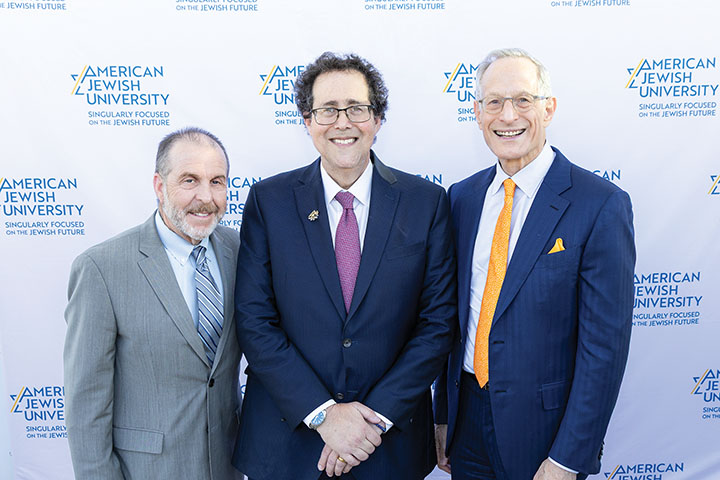
At American Jewish University (AJU)’s May 19 gala at Stephen Wise Temple, nearly 400 attendees rose in unison, their voices blending as they recited the ancient Priestly Blessing: “May the Lord bless you and protect you. May the Lord make His face shine upon you and be gracious to you.” The words carried a quiet power as they honored Rabbi Bradley Shavit Artson and celebrated his quarter century at AJU and the Ziegler School of Rabbinic Studies.

A leading voice in Conservative Judaism, Artson has long shaped Jewish thought and leadership far beyond the walls of AJU. He reaches thousands through his weekly Torah commentary and prolific writing, including 11 books and more than 300 articles.

Recognizing both his enduring influence and the opportunity to expand it, AJU President and CEO Jay Sanderson — who marks his first year at the helm — recalled waking in the middle of the night with the idea of creating a scholar-in-residence–type role. “And I realized it’s Brad,” he said, announcing the creation of the Goldstine Distinguished Scholar position in Artson’s honor, a role he will assume on July 1, allowing him to continue serving as a teacher and scholar across AJU’s many programs.

Jay Sanderson, Rabbi Brad Artson and AJU Board Chair Larry Platt. Photo by Jodye Alcon Photography

In a way, the evening was a tribute to Artson’s career, as well as a welcome into his new position. It is not every day that someone hears from colleagues and friends just how deeply they are appreciated and loved, and Artson appeared visibly moved as former students and longtime friends spoke about the impact he has had on their lives.

Actress Mayim Bialik initially declined to emcee the event due to a prior commitment in Tel Aviv. When that engagement was canceled, she immediately called back to say she would be able to attend after all and was glad to take on the role. A close friend of Artson’s, Bialik told the audience, “I’m not going to tell you funny jokes, I’m here to honor Brad,” adding, “they don’t make men like him anymore.”

Rabbi Cheryl Peretz, who has known Artson for more than 30 years, reflected on a relationship that has spanned her entire professional life. She was a student at the Ziegler School when she dared to approach the dean for a job. “I told him, ‘You should hire me,’” she said.

She added that she did not know whether it would work, but it did, and Rabbi Artson has been an important part of her life and work for the past 27 years. “He has been my teacher, my chavruta, and my friend,” she said.

On July 1, Peretz will assume the role of interim dean of the Ziegler School, where she will oversee academic leadership, faculty, curriculum and student development following Artson’s transition into the Goldstine Distinguished Scholar position.

The gala opened with an outdoor reception under the sky, featuring an abundant spread that included sushi, falafel, salads, fish and shawarma alongside an open bar before the formal program began. Musician Craig Taubman provided entertainment with a brief performance. He was introduced by Mayim Bialik, who lightheartedly admitted she had a childhood crush on Taubman.

After being presented with an award — an art piece designed by an Israeli artist — Artson offered reflections on his 25 years at the Ziegler School. He described the evening as “a combination of my wake and my bar mitzvah,” drawing laughter from the audience.

In his remarks, he also reflected on his life, saying that the best decision he ever made was marrying his wife Elana, whom he met when she was 19. The couple has twins, Shira and Jacob. He also offered heartfelt thanks to his mother, adding that he feels he has “the best family in the world.”

The gala, which raised more than $1.6 million in support of AJU’s future, capped a significant week for American Jewish University. On May 17, its Masor School for Jewish Education and Leadership celebrated commencement, marking an historic milestone as seven students received the university’s inaugural Doctor of Education (EdD) degrees in Early Childhood Education Leadership. Held at AJU’s Brandeis-Bardin Campus in Simi Valley, the ceremony also honored 28 graduates earning Master of Arts degrees in Early Childhood Education and nine graduates receiving Bachelor of Arts degrees in the field, each preparing to shape the next generation of Jewish learning and leadership.

The following day, the Ziegler School ordained the newest rabbis in the Conservative movement — Rabbi Brianah Caplan and Rabbi Cantor Malachi Kanfer — while also conferring honorary doctorates upon members of the Class of 2006 in recognition of their leadership and impact.

During the ordination ceremony on May 18, Artson told the congregation from the bimah of Sinai Temple, “It gives me great pleasure to present to this community the world’s newest rabbis!”

“This week was a powerful reminder that AJU is more than an institution,” said Sanderson. “It is a community built by people who care deeply about Jewish life, Jewish learning, and Jewish leadership.”

AJU Honors Rabbi Bradley Shavit Artson at Gala Marking 25-Year Legacy Read More »

Ancient Glory: Mediterranean Sea Bass

Bathed in the warm, golden glow of the afternoon sun, the ancient ruins of the Parthenon and the Acropolis stand sentinel above the city of Athens. Strolling through the narrow cobblestone streets, these ancient ruins draw my eye with their majestic beauty. Knowing that they are 2,000 years old thrills me.

We pass dusty parks with old marble monuments and old men hawking roasted nuts or ice cream bars or cold drinks from old fashioned carts. We pass streams of tourists perusing the many gift shops with brightly colored magnets and keychains, totes and t-shirts.

There are impossibly romantic outdoor tavernas with sun bleached walls, wooden lattices covered in pale pink and fuchsia bougainvillea and rustic tables. The air is filled with the sounds of musicians serenading the al fresco diners with soft guitar and the strum of the traditional Greek bouzouki.

As tempting as the smells of the grilled fish wafting from the tavernas, Alan, Shevy and I were headed to dine at the only kosher restaurant in Athens, Gostijo, a Ladino word meaning gifts of food offered to friends and neighbors.

Alas, no outdoor taverna for us. There was a burly security guard checking IDs, a strong metal door and thick walls with no windows.

(Not to spoil the romantic imagery, but we couldn’t help noticing all the ugly anti-Israel graffiti on the walls in Athens, the many Halal restaurants and the many Arabic speakers.)

As so often happens in kosher restaurants, we ran into friends from Los Angeles and had lovely conversations with people visiting from Boston and Chicago.

For dinner, we ordered a mezze platter with falafel and salads, Greek classics like Moussaka, souvlaki and Bifteda, grilled meatballs.

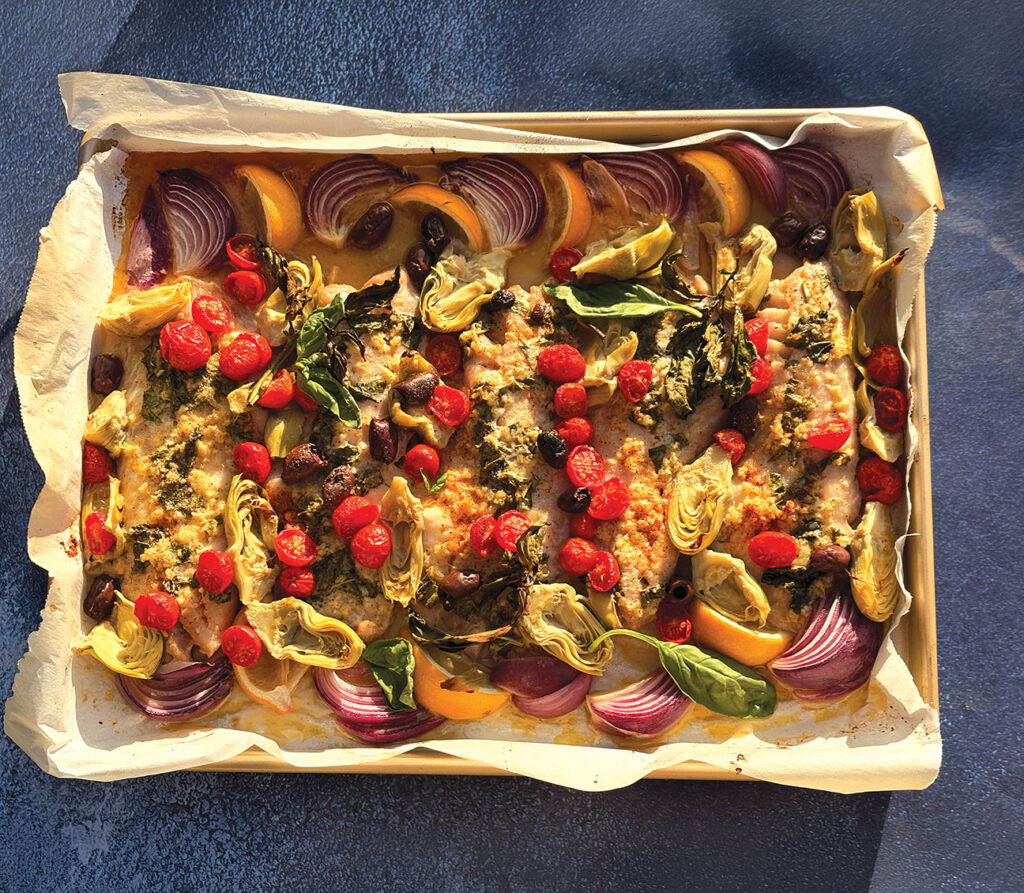
But memories of the tsipoura, a baked sea bream with cherry tomatoes and fresh herbs was the inspiration for this week’s recipe for Mediterranean Sea Bass. We made an herby sauce for the fish with extra virgin olive oil, freshly squeezed lemon juice, grated garlic and roughly chopped basil.

We placed lemon wedges and purple onion around the fish and layered artichoke hearts, cherry tomatoes, Kalamata olives and more basil over the fish.

The resulting dish looked like a work of art.

—Sharon

Did you know that Kalamata olives are named after the city of Kalamata in the southern Peloponnese, Greece? The deep, fertile soil and the warm Mediterranean climate are ideal for this special olive. Prized locally by the ancient Greeks, they became a valuable export commodity that fueled the region’s economy. Unlike common black olives, which are often picked early and artificially oxidized, Kalamata olives are handpicked in late autumn when they reach their signature deep purple color. The fresh olives are naturally bitter, so to make them edible, the olives are slit and naturally fermented in a brine of sea salt and red wine vinegar. (That’s why you need to buy special kosher brands.)

Kalamata olives are essential in my kitchen! I just love their plump, meaty texture and deeply savory flavor. Briny and salty but not overpowering, I always toss them into my green salad and Israeli salad. They have a distinct tang that cuts through rich foods, making them a great addition to charcuterie boards and cheese platters.

I especially love the way Kalamata olives play against fish, adding a perfectly intense and satisfying umami profile.

We hope you enjoy this special taste of the Mediterranean.

—Rachel

Mediterranean Sea Bass

2 lbs sea bass or red snapper fillets

1/3 cup extra-virgin olive oil

1 lemon, juiced

4 garlic cloves, minced

2 tsp kosher salt

1 tsp ground black pepper

1/2 cup chopped fresh basil

1 lemon, cut in wedges

1 red onion, cut in wedges

1 can artichoke hearts, drained and halved

1 cup cherry tomatoes, halved

1/2 cup Kalamata olives

Basil leaves, for garnish

Preheat oven to 400°F.

Place fish fillets on a parchment lined baking tray.

In a medium bowl, whisk together the oil, lemon juice, garlic, salt and pepper and basil to form a rough pesto.

Spoon the pesto over the fish fillets. Place the lemon and onions around the outer edges of the fish. Sprinkle the artichoke hearts, cherry tomatoes and olives on top of the fish fillets.

Bake in the oven for about 15 minutes, until the fish is flaky and the thickest part of the fillet is opaque.

Serve hot with roasted potatoes or white rice.


Sharon Gomperts and Rachel Emquies Sheff have been friends since high school. The Sephardic Spice Girls project has grown from their collaboration on events for the Sephardic Educational Center in Jerusalem. Follow them
on Instagram @sephardicspicegirls and on Facebook at Sephardic Spice SEC Food. Website sephardicspicegirls.com/full-recipes.

Ancient Glory: Mediterranean Sea Bass Read More »

Shalom Everybody ft. Lauren Kagan

This week on Schmuckboys, Marla and Libby catch up on life lately like Libby becoming a full-time dog mom after getting the world’s cutest mini cavapoo, Bamba. Marla also opens up about her recent breakup and shares an honest conversation about ending relationships when nothing is necessarily “wrong,” but something still doesn’t feel fully right. The girls discuss trusting your gut, navigating doubts in long-term relationships, communicating openly with partners, and the pressure people feel in their late twenties to settle down. I

Then, the girls are joined by creator and advocate Lauren Kagan, who shares the story of how a setup from mutual friends led to her current relationship and why she fully believes people need to stop being afraid of meeting through friends instead of dating apps. Lauren tells the hilarious story of attending her boyfriend’s family Seder before they were even officially dating, how she ended up relocating from DC to New York City, and why she believes women should prioritize their own goals and careers while dating.

The conversation shifts into Judaism, identity, and how October 7th reshaped Lauren’s perspective on dating Jewish versus non-Jewish partners. Lauren reflects on growing up as a proud Soviet Jew in Boston, attending Jewish day school, experiencing antisemitism at University of Massachusetts Amherst, and how her family’s Soviet roots continue to influence the way she approaches Jewish pride and advocacy today.

The girls also discuss Jewish representation online, navigating misinformation and antisemitism on social media, and Lauren’s work with Birthright Israel. Lauren shares how her content creation journey accidentally started during college after posting a “Jewish girl anthem” TikTok that unexpectedly went viral, plus the origin story behind her signature “Shalom everybody” intro.

You can follow Lauren on Instagram @laurkagan and the podcast @schmuckboysofficial.

Shalom Everybody ft. Lauren Kagan Read More »

Fakesgiving Desserts and Drinks

Fakesgiving is May 30. The holiday, which originated during the pandemic, is two-fold. It’s a reminder that gathering with friends and family over a big meal can be done any time of year. Jews who prepare feasts every Shabbat know this one well. It’s also a random reason to enjoy Thanksgiving cuisine as we enter the summer months.

Faith Kramer’s cranberry juice sorbet is delicious by itself or as a topping for pies or cakes.

“It is tangy, refreshing and parve, and doesn’t require juicing or cooking down a bushel of cranberries,” Kramer told The Journal. “It also doesn’t require an ice cream maker, [but you can use one].” She based the recipe on the fruit juice sorbet dessert in her “52 Shabbats: Friday Night Dinners Inspired by a Global Kitchen.” (The Collective Book Studio December 2021)

It is one of Kramer’s favorite desserts, especially after a heavy meal.

“For a tarter taste, use 100% cranberry juice,” she said. “For a sweeter dessert, use cranberry 100% fruit juice blend (usually includes white grape and or apple juices).”

Cranberry Juice Sorbet

1 1/4 cups water

1 1/4 cups sugar

1 1/2 cups bottled cranberry 100 percent juice or juice blend

2 Tbsp fresh lime juice or as needed

Simmer water and sugar in saucepan, stirring occasionally, until sugar is dissolved. Chill until cold.

Combine 1 ½ cups sugar syrup with the cranberry and lime juice. Stir well and taste. Add more lime juice or sugar syrup as needed. (Coldness dulls sweetness, so add a bit more syrup to compensate.)

If using an ice cream maker, follow the manufacturer’s instructions. After churning, pack airtight and allow to harden in freezer for 1 hour or freeze for up to 3 days. If frozen solid, remove from freezer 5 to 10 minutes before scooping.

If not using an ice cream maker, pour mixture into a 2-to-3 inch deep, 8-inch by 8-inch chilled metal baking pan. Cover with plastic wrap. Place flat in freezer. After 1 hour, use a fork to break up any ice clumps and stir. Return to freezer. After 2 hours, stir again. Stir again 2 hours later. Leave covered in freezer for up to 3 days. Remove from freezer 5 to 10 minutes before serving. Break up ice clumps with wooden spoon (or scrape a fork across the top of the sorbet to turn the sorbet into crystals), scoop and serve.


“Pumpkin and date phyllo tart is a favorite of mine for Rosh Hashanah, Purim, Halloween, Thanksgiving and now for Fakesgiving,” Kramer said. She created the recipe more than 15 years ago for a Purim potluck and keeps finding new variations and occasions.

“The tart reflects its Middle Eastern inspiration with its spicing and use of dates and nuts,” Kramer said.

She added, “If using canned pumpkin puree, be sure to not use one labeled “pumpkin pie filling” since it contains spices and other ingredients not needed here.”

Pumpkin and Date Phyllo Tart

Serves 8

2 cups plain canned pumpkin puree

4 large eggs, beaten

1 cup orange juice

½ cup sugar

¼ cup brown sugar

½ tsp ground cinnamon

½ tsp ground ginger

1/3 cup pitted, roughly chopped Medjool dates (about 8 large chopped into about a ¼” dice)

1/3 cup chopped walnuts

7 sheets of phyllo dough (if frozen, defrost according to package directions)

¼ cup or more of vegetable oil

Preheat oven to 350°F.

First make the pumpkin filling. In a large bowl combine the pumpkin puree, the eggs, juice, sugars, cinnamon and ginger. Mix well. Add the dates and walnuts and stir until evenly dispersed through filling. Set aside.

For the crust, have a package of defrosted phyllo leaves ready. Set seven aside, covered with a damp paper towel. Repackage and refreeze the rest. Brush the bottom and sides of a 9” round cake pan with vegetable oil. Take out one phyllo sheet (leaving others covered). Center in the cake pan and brush surface with oil. Take out another sheet, rotate it so the overhanging edges are offset with the first sheet. Brush with the oil. Repeat with four of the remaining sheets.Shred the seventh sheet and scatter across the bottom of the crust.

Fill the crust with the pumpkin filling. Fold the overhanging edges of the phyllo back over themselves and tuck into the tart. They should cover the edge of the cake pan and create a bit of an edge. Brush exposed phyllo with oil.

Place on center rack in oven. Bake for 5 to 10 minutes or until exposed filo crust has turned golden brown. Cover exposed crust with strips of aluminum foil. Bake tart for about 50 minutes more or until center is set and a knife inserted in the center comes out almost clean. Remove foil strips and let cool to room temperature before serving.


While Jessie-Sierra Ross’ apple and orange bourbon sour with allspice simple syrup may scream “turkey dinner apéritif,” her riff on a classic bourbon sour is light and invigorating even on a hot summer afternoon.

“The citrus juices do a lot of the heavy lifting,” Ross, founder of Straight to the Hips Baby and author of “Seasons Around the Table,” told the Journal.

“Freshly squeezed Cara Cara orange juice and fresh lemon juice play with the lighter notes of the unsweetened apple juice,” she said. “Combined with the smooth caramel flavors from the bourbon and allspice spiked simple syrup, you end up with a sophisticated and perfectly summery take on a fall cocktail.”

Apple and Orange Bourbon Sour with Maple Allspice Simple Syrup

Makes 1 cocktail

For the cocktail:

4 ounces filtered unsweetened apple juice

2 ounces bourbon

1 ounce maple allspice simple syrup

1/2 ounce freshly squeezed lemon juice

1/2 ounce freshly squeezed Cara Cara orange juice

Dash of Regans’ Orange Bitters

Citrus wheels, edible flowers or blackberries for garnish

1. Using the larger portion of a cocktail shaker cup, add the apple, lemon, and orange juices. Next, add the bourbon, maple allspice simple syrup, and a large handful of ice.

2. Close the shaker and shake vigorously for at least 30 seconds, until the outside frosts over.

3. Fill an Old Fashioned glass or large tumbler halfway with ice. Strain the drink into the prepared glass and then add a dash or two of orange bitters.

4. Garnish with a skewer of blackberries, an orange wheel or a lemon twist.

Recipe note: Whiskey can be substituted for bourbon. Be sure to opt for something smooth and mellow with citrus notes, rather than a smoky variety.

For the Maple Allspice Simple Syrup:

1/2 cup pure Canadian maple syrup

1/2 cup sugar

1 cup water

1/2 Cara Cara orange, sliced

3 dried allspice berries

1. Combine all of the ingredients in a small saucepan and stir to mix.

2. Place over medium-high heat and bring to a boil, stirring occasionally. Let boil for 10 minutes.

3. Remove from the heat and let cool slightly. Strain the simple syrup into a glass jar with a fitted lid, and discard the solids.

4. Refrigerate until ready to use.

Recipe notes: Makes about 1 cup. This syrup keeps refrigerated for up to 3 weeks. Dried allspice berries can typically be found in most grocery store baking or spice aisles. If none is available in your area, substitute 1/8 teaspoon of ground allspice instead.

Fakesgiving Desserts and Drinks Read More »