How does a Chabad rabbi raised in a deeply traditional Jewish household become the founder of Magen Am, one of the most visible community security organizations in Los Angeles?
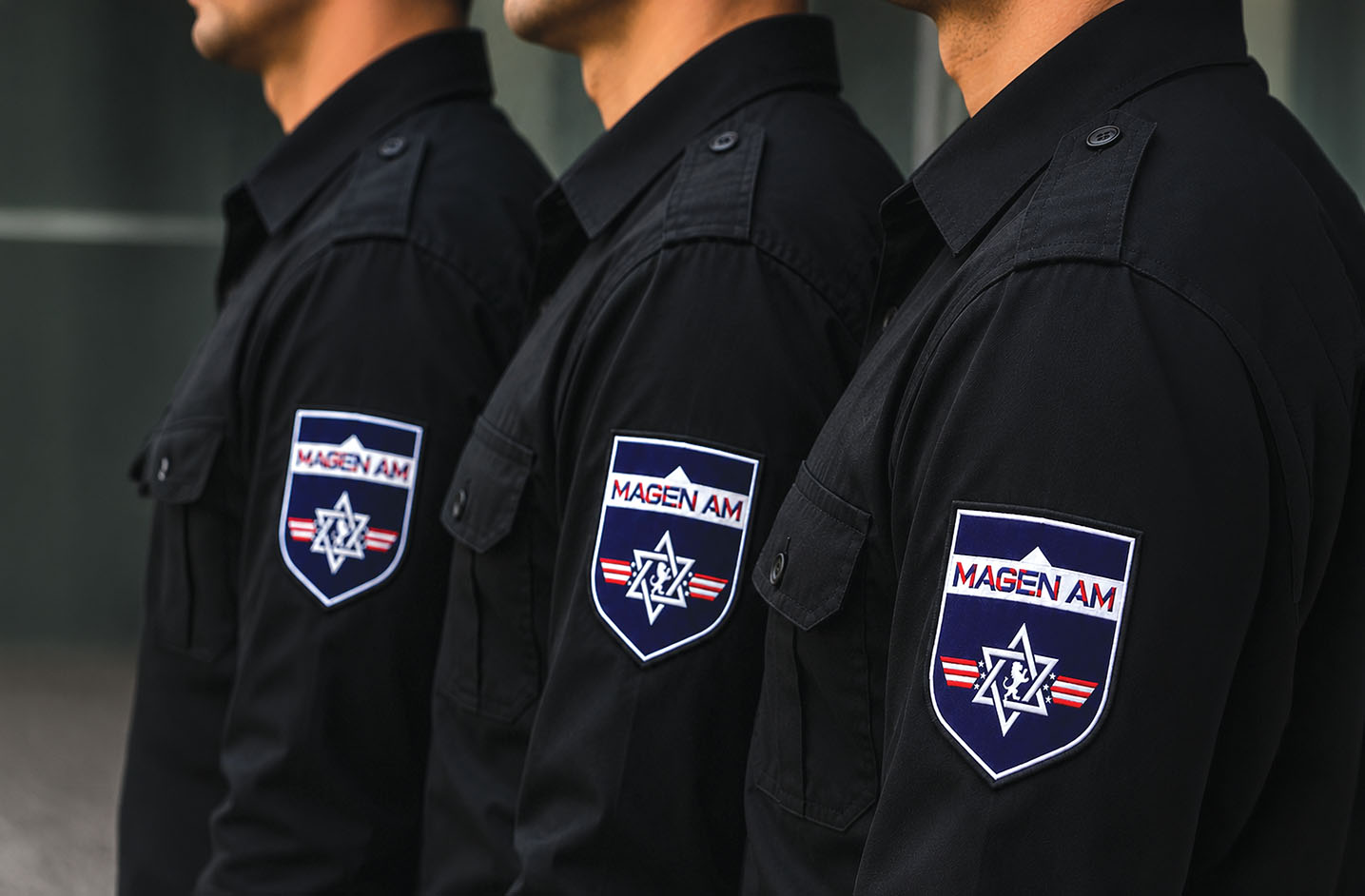
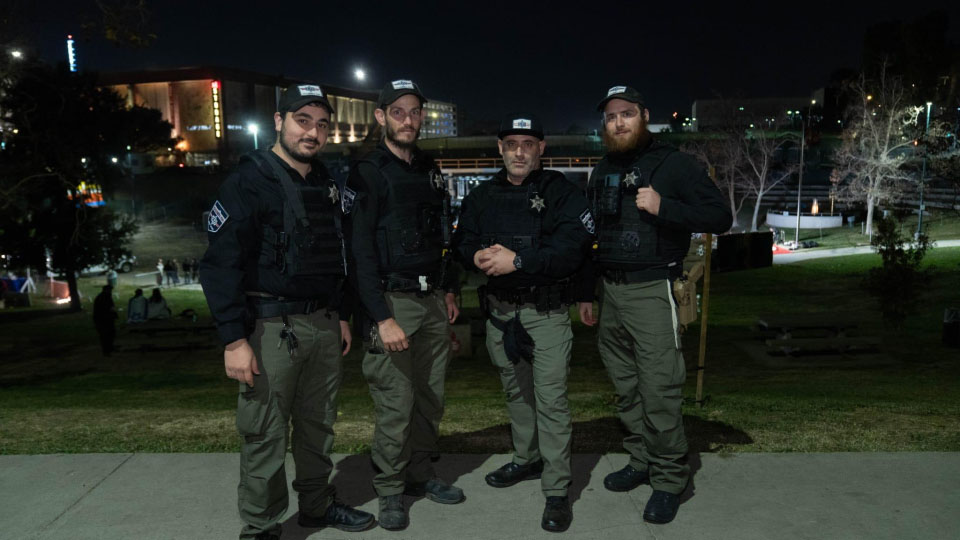
In recent years, Magen Am’s security teams have become a familiar presence at major Jewish events across Los Angeles. Their volunteers regularly patrol areas such as Pico-Robertson and other Jewish neighborhoods, and for many community members, they are often the first call when security concerns arise — whether responding to synagogue safety, reports of store break-ins or an attack on a Jewish man returning home from shul.
Rabbi Yossi Eilfort’s path to that role, however, began years earlier — and is far from predictable. Raised in San Diego, the son of a Chabad rabbi, it was widely assumed he would follow in his father’s footsteps. But even early on, Eilfort said he felt drawn in other directions, recalling how he constantly needed to move and gravitated toward sports.
“I was very active as a child. I loved movement, not public speaking,” he said. “Before I became a rabbi and got married, I ran a ranch, was a lifeguard and swimming instructor and was a gymnastics and martial arts coach,” he said.
The same year he received his rabbinic ordination, Eilfort was already training in martial arts at a local gym in San Diego. None of the other fighters were Jewish and had likely never met a Jew before. The gym owner, who saw potential in the young man, encouraged him to compete on behalf of the gym. Eilfort initially hesitated and declined, explaining that he could not compete on Shabbat.
“The gym owner tried to convince me and said, ‘What if you stay at a hotel on Friday and fight Saturday night?’” he recalled. Eilfort still wasn’t convinced this would work, but the gym owner didn’t give up.
“Finally, he found a fight on Sunday so I could compete without a problem. So, I called my rabbi and asked if I could, and he said that as long as it was for self-defense’s sake and not for the sport, it would be okay,” said Eilfort, who began training for three hours a day at the gym.
“It was an incredible and rewarding experience,” he recalled.
It may have been surprising to those competing against Eilfort to discover they were, in fact, fighting a rabbi, but his brief stint as a martial arts competitor didn’t last long. After publishing several articles on fitness and self-defense for the Orthodox community, he received an offer to move to Los Angeles, where he opened a children’s fitness and martial arts center and began teaching in local Jewish schools.
He was also working as a rabbi in Pacific Palisades when the idea of creating a community-based security organization began to take shape in 2015. It took a couple more years until it officially opened in February 2017.
At its inception, Magen Am focused primarily on providing security for synagogues. That quickly shifted in 2020, as the organization began receiving urgent requests from community members seeking protection, including outside private homes. With limited resources, Magen Am made a strategic decision: rather than responding to isolated calls, it would deploy patrols across Jewish neighborhoods. The organization concentrated its efforts in areas such as Hancock Park, while maintaining an active presence in Pico-Robertson and North Hollywood.
During that year, Eilfort moved with his family to Big Bear, to a property owned by Agudath Israel, where he helped run Shabbatons while continuing to build his security training program. He commuted back to Los Angeles twice a week to teach courses, including firearm training and to work with volunteers. Around that same period, a rabbi he was working with told him he needed to make a decision — whether to continue as a full-time rabbi or fully commit to Magen Am.
As he was weighing that choice, the unrest following the killing of George Floyd dramatically shifted the reality on the ground. Law enforcement was stretched thin, with too many incidents unfolding at once and not enough officers to respond. Into that gap stepped Magen Am, launching neighborhood patrols and responding in real time to threats. “We stopped a few home invasions in the first three days,” Eilfort said. “That’s when I understood I needed to make Magen Am my full focus.”
By early 2021, the organization secured its first sponsorships, allowing it to formally launch patrol programs and begin building a structured security model. In parallel, a pivotal partnership emerged when former IDF Lone Soldier Leibel Mangel, the son of a rabbi from Cincinnati, reached out to Eilfort with the idea of creating a support system for veterans like himself. Having experienced firsthand the challenges of returning home without structure, guidance or community, Mangel envisioned a program that would provide a “soft landing” for former Lone Soldiers. That vision became the Magen Am Lone Soldier Veterans Program, designed to help returning soldiers reintegrate through skills, resources and ongoing support.
That led to the recruitment of several Israeli veterans, who were trained and then employed as part of Magen Am’s growing security network. “It was a perfect match,” he said. “We were able to give them jobs, train them, and then place them in schools and community settings. It was good for them — and it was good for the community.”
Eilfort said his goal was not only to provide security for the community by the community, but also to teach people how to defend themselves and respond to antisemitism directly rather than with fear or helplessness. He believes one of the most critical shifts the Jewish community must make is psychological, arguing that attackers often look for perceived vulnerability and are more likely to be deterred by confidence and preparedness. That, he says, is exactly what Magen Am is trying to change, not only through training, but by reshaping how people instinctively respond to threats.
“If a dog barks and you run, what happens? It chases you. That’s because predators are wired to respond to movement and fear. Humans have that same wiring. So, when someone attacks and our instinct is to run and hide, it can reinforce that behavior.”
“What we’re trying to do is change that instinct,” he said. “When people have the training and the awareness, they don’t immediately go into panic mode. They understand they can stand their ground. And when a community as a whole projects that kind of confidence, it makes it much less attractive as a target.”
The message was heard loud and clear, especially after Oct. 7, 2023, which marked another turning point and dramatically accelerated Magen Am’s role within the community. Almost overnight, demand for training surged, as Jews across Los Angeles — many of whom had never previously considered owning a weapon — began seeking out firearm and self-defense courses with Magen Am.
The shift cut across every segment of the community: Orthodox and Reform, men and women, young adults and seniors, all united by a shared realization that passivity was no longer an option. “Oct. 7 created a massive spike,” Eilfort said. “Jews in this country and around the world realized they have to defend themselves. I want to make it clear, it’s not shomer am, it’s magen am. It’s a tool,” he explained. “Our goal is not just that people feel protected. I don’t want my kids growing up feeling protected — I want them to feel secure.”
That distinction, he said, is critical. Rather than relying on outside forces, Magen Am focuses on building internal strength within the community, giving people the tools and empowerment to understand that they don’t have to live in fear but can stand up for themselves.
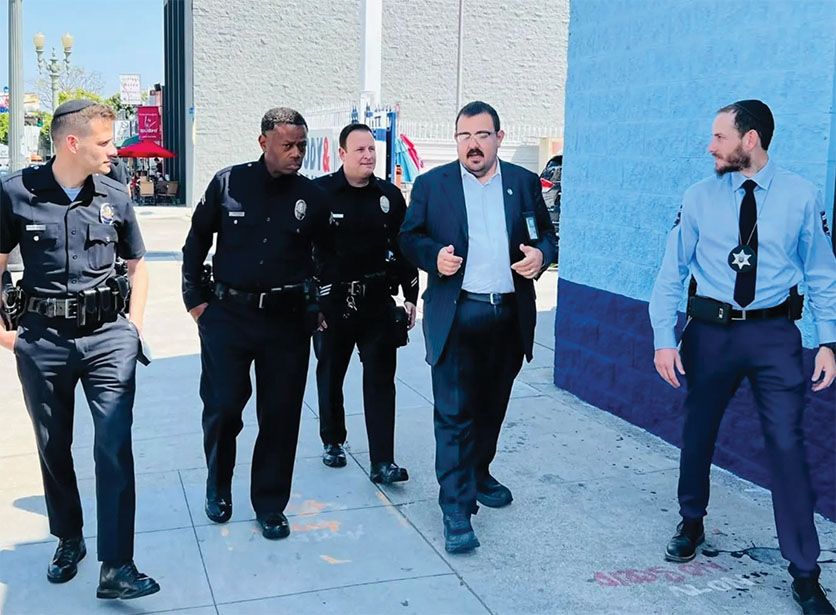
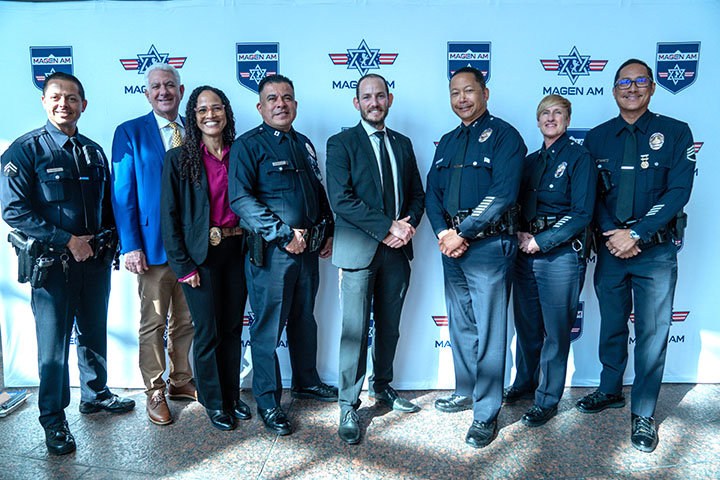
The Los Angeles Police Department and the Sheriff’s Department have increasingly worked alongside Magen Am as part of its community security efforts. Eilfort describes the relationship as one built on ongoing coordination and trust rather than transactional need. “I think they see us as a partner,” he said, adding that the emphasis is on being proactive: “It’s not just what can you do for me when I need help, but what can we do for you and how can we help you in advance.” He said that cooperation continues even outside moments of crisis, including regular communication and sharing information when concerns arise.
Eilfort views Los Angeles as a city that remains vulnerable to extremist threats, shaped by its size, geography and demographics. At the same time, he notes that despite those risks, it has so far avoided major attacks seen elsewhere in the United States, something he attributes in part to coordination with law enforcement and community preparedness.
“We know LA is a prime target for terrorist organizations — they’ve explicitly said it,” he said. “It’s the second-largest Israeli community in the world, and the second-largest in the United States. It’s close to the border, and there’s a large Iranian community. There are a lot of reasons it could be targeted. And thank God, we haven’t seen major attacks here like in other states. I’m hopeful that our work with law enforcement is part of the reason why.”
Beyond its coordination with law enforcement, Magen Am relies heavily on its volunteers to serve as its eyes and ears in the community, remaining alert to any potential threat or suspicious activity. The volunteer base is mostly men, but it also includes several women who take part in patrols and serve as firearms instructors — an especially important role for Orthodox women who prefer female instructors in sensitive settings. Their presence has proven particularly meaningful in specific situations, including calls to the mikveh when there were concerns about a potential break-in, as well as an event where a metal detector was triggered because a participant had metal implants following surgery. The rabbi said he would like to see more community members get involved, describing a strong sense of family among those who already volunteer.
“I encourage everyone to come and see the culture that we have, of secure Jews that are proud of themselves,” he said. “The strength of the community of like-minded people who are looking out for their own community — it’s beautiful.”
Eilfort is the father of four children with his wife Hadassah (Dassi) and is expecting his fifth. Between his work with Magen Am and raising kids, he doesn’t have much free time. “My wife is an angel. She understands how important this is to the community and how important it is to me,” he said. “I try to be there with family as much as I can, and Shabbat is an absolute lifesaver. It’s the biggest gift for me because then the phone is off.”
Fundraising for nonprofit organizations has become increasingly difficult in recent years, particularly after Oct. 7, as Jewish institutions across the United States find themselves competing for attention and support from many of the same donors. For Magen Am, the challenge is no different. Eilfort says building a sustainable funding base requires persistence and patience in a crowded philanthropic landscape. “It’s hard, it’s absolutely hard,” he said. “We started a few months ago working towards institutional foundation giving. We’ve seen some success with that, Baruch Hashem, where we’re being seen as more mainstream now.” He noted that the organization is still working to gain traction with larger, more established foundations, while continuing to expand its donor base. “It’s just the relentless forward pressure, continuing to push on the larger foundations and bigger potential givers,” he said. “I think it’s just a matter of the right person seeing it. A $1,000,000 given to us goes so much farther than most organizations because of our model.”
As part of that effort, Magen Am recently launched a Board of Trustees, a donor-based advisory group designed to support the organization’s expansion, alongside a separate board of directors responsible for ethics, compliance and governance. The structure, he explained, was intentionally designed to keep financial support distinct from oversight. “It’s rabbis and lawyers, and it’s unattached to the donors on purpose because I don’t want to mix the money and the ethics,” he said.
The newly formed trustees’ group, he added, includes a wide range of supporters. “Some of them are known names, and some of them are Hollywood personalities. Really an awesome, diverse group of people who understand why this is so important,” he said. While still in its early stages, he believes the structure will help Magen Am scale its funding base. “It’s only a matter of time before we really find the big support.”
Looking ahead, Rabbi Eilfort sees what exists today as only the beginning. With new chapters already in Arizona and Orange County, he believes Magen Am is poised to grow far beyond its local roots. “It’s still a baby organization—there’s so much more that we’re going to do,” he said, adding that he ultimately envisions it as “a national organization, maybe even a global organization.”
For now, he sees momentum and a clear path forward, driven by a community determined to take its security, and its future, into its own hands.