fbpx

April 13, 2022

Night of Spring Cleaning

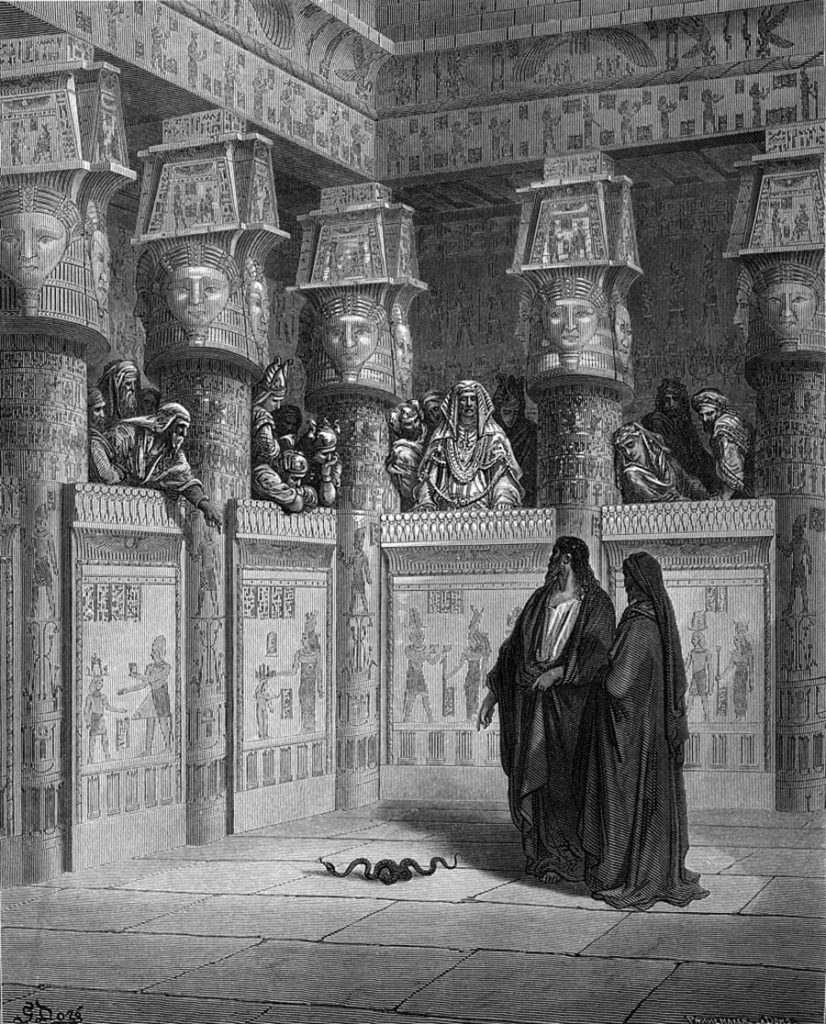
When God in Egypt killed all of the first-
born sons––it was the last of plagues, the tenth––
the panic that ensued was quite the worst
the land had ever seen, and proved God’s strength,
for after all the firstborn had been killed
respect of the Egyptian gods was earned
when blood of firstborn sons was spilled;
they tripped, and all of them were overturned,
fulfilling God’s prediction to be vin-
dictated against gods that came to fail
as they would fail the villains in Berlin

against whom Allies later would prevail.

Before God realized that Moses never
had circumcised his son, He very nearly
killed him, till his wife prepared to sever
the foreskin. God regarded most severely
his emissary’s very strange delay,
and therefore gave a serious reprimand
when he was in a lodging on the way,
avoiding what he could not understand––
a God who had appeared to him as fire
and told him: “I am what I am,” without
explaining why He strangely wished to hire
a man who in this Being had grave doubt.
God told him: “When you go to Pharaoh say:
‘My firstborn son is Israel. If you do
not let him leave the land where you have sway
I’ll kill your own as punishment for you.”
No other warning later would be given
before God killed Egyptian firstborn sons
in His surprise attack, still unforgiven
by pacifists and Protestants and nuns,
and bleeding hearts who’re constantly demanding
a higher standard from the God of Jews
than from competitors who’re less outstanding.
He totally ignored the liberal views
applied by them to Jews with a far higher
standard than the one that they apply
to other nations, preaching to the choir

against the people who their Christ deny.

The reason why the Pharaoh was not warned,
is he’d told Moses, following the plague
of darkness, words that proved how much he scorned
the Lord: “Do not return!” He was not vague,
explicit with his rude refusal
to meet once more with Moses. With this warning
the Pharaoh engineered his own recusal,
refusing an encounter in the morning
before the plague. He would not reconsider
his attitude to threats of any terror,
although such warnings are today de rigueur
before insurgents strike It is an error
to think that Moses should be blamed. How could
he warn the Pharaoh who had said: “Don’t ever
come back!” Blame the Pharaoh, for he should
have realized that Moses was more clever
than his magicians, trusted royal advisers,
and God more powerful than Ra and Aton.
Too autocratic, he would fall like Kaisers,
unwarned as was the US when Manhattan
was by Islamic fundamentalists
attacked when planes turned into firebombs.
Though names were on the FBI’s checklists
and hate was daily spewed out by imams
there was no warning, people at the wheel
asleep when some three thousand people died
because their leaders thought the threat not real,

and from reality preferred to hide.

We truly aren’t exaggerating, are we?
Before four planes were hi-jacked an arrest
was made of the Al Qaeda man, Moussaoui,
who says he would, if he’d been asked, confessed
that there were plans for him to crash a plane
into the White House, but the FBI
who questioned him took no steps to obtain

the data that then stared them in the eye.

At midnight God sent out His fell destroyer
called mash’hit, not battleship its meaning
but the force God uses as Employer,
while Israelites were occupied spring-cleaning
their houses from which leaven was removed,
and eating lamb with flat unleavened bread
and bitter herbs, while sprinkling blood that proved
that Hebrews lived indoors. There were no dead
among the Israelites since God passed over
each one of them, but for Egyptians all
the firstborn died at midnight, for Jehovah
was far more deadly than a cannonball,
and His destructive weapons more selective
than those we use today in all our wars;
his guidance system never is defective,
receiving from reporters great applause.
Only firstborn sons then died, all others
survived catastrophe, for God had mastered
the best technique for finding first of brothers,
this one legitimate, this one a bastard.
It happened in some houses one son died,
though not the firstborn of his mother’s spouse;
the secret that his mother used to hide––
she’d cheated on the master of the house,
and that son whom her husband had believed
to be his firstborn was a bastard who
had illegitimately been conceived––
the fact that he survived a major clue!
In other houses people known as first-
born sons survived because a bastard brother
preceded them. They only learned the worst
when they survived because there was another
with bastard precedence who died elsewhere,
the firstborn by the Lord’s destroyer found.
Legitimacy never was a care

that bothered God’s infallible bloodhound.

Because the Lord that night the Hebrews guarded,
they gave the night the name of “guarding night”.
With bloody doorposts Hebrews all were carded.
When posts weren’t bloody, people had a fright,
for no firstborn Egyptian on the stroke
of midnight, Passover, by God was spared.
The moment God’s destroyer saw the smoke
where lambs were roasting and the blood, God cared,
and all the Hebrews therefore celebrated
the first of all the festivals, the date
from sight of new moon always calculated,

not a moment earlier or late.

Among Egyptians dying on that night
were Pharaoh’s son and men who lived in chains,
in dungeons captive. God would even smite
the firstborn cattle, some with healthy brains
and others with mad cow disease they caught,
fifth plague, when some cows died and some survived.
Survivors’ brains with prions all were fraught,
a sickness that has recently revived,
which is not pleasant for a carnivore,
though many vegetarians may be pleased
that meat that they instinctually abhor

is sometimes microscopically diseased.

Many Jews consider eating meat
a mere concession God provided Noah,
for Adam never was allowed to eat
such meat: of cereals he was a grower.
True Abel was a husbandman, but Cain,
who killed his brother in a fit of pique,
produced fine vegetables and lots of grain,
the act of murder surely his critique
of Abel’s lack of pity for the beasts
he shared with God to whom he sacrificed;
never would he join him in his feasts,
nor was he by his barbecues enticed.
(It’s possible that we should think of Cain
as founder of societies like PETA,
the sort of man who also would complain
when God gave skins to Adam, though no eater
of meat, as we have pointed out above.
Descriptions of the way God liked to savor
the smell of sacrifices that He used to love

cannot obtain from ethicists much great favor.)

From Egypt there arose a mighty groan
because in every house some dead were lying.
Throughout the land of Egypt men would moan
and say: “The time has come to stop the dying!”
Then Pharaoh called for Moses and for Aaron,
and said: “It’s time for you to leave and serve
your God.” Such magnanimity was foreign
to Pharaoh, but he’d clearly lost his nerve.
He won it back again quite soon, indeed,
and tried recapturing his Hebrew slaves,
which proves that truly he paid far less heed
to God that to his people making waves.
An autocrat, the man would never listen
to all his people’s foolish, selfish wishes,
but this was Passover, the month was Nissan,
the time of year when Hebrews change their dishes,
and Pharaoh also changed his way of thinking––
a least for three days till his slaves had fled,
a period when his ego started shrinking

before his id came back and ruled his head.

So desperate was he, without confessing
his guilt, he let the Hebrews take their flocks
and herds, then asked if he could have a blessing
from Moses, Aaron. There were further shocks
when all of the Egyptian people gave
the Israelites their silver and their gold
and garments, asking if their slaves forgave
the way they’d held them in a stranglehold.
The gifts they gave were those that were foretold
to Moses when God met him at the Bush,
and very soon caused Egypt to make bold
pursuit of them, regretting shove and push.
A similar prediction of these gifts occurred
when God told Abraham that his descendants
would leave the land to which they had transferred
with wealth, before they gained their independence.
Predictably the antisemites claim
that Israelites ripped off Egyptians when
they took their gold and silver. What a shame
they didn’t also take their diamonds then!
Egyptians owed them big time for the toil
the Israelites in slavery had performed;
it was their wages that they took as spoil,

as antisemites ought to be informed.

Departing Hebrews took with them their dough
before it leavened, bound up in the sacks
they carried on their shoulders, most gung-ho
to move ahead, with no time to relax.
They had to hurry when they packed their bags
which they like rucksacks carried on their shoulders,
clad very lightly, wearing shmattes, rags,
since they’d been “intifadered” by the boulders
Egyptians used to throw at them because
they blamed them for the plagues that made them suffer
while Israelites were suffering no loss

in Goshen, their de facto state and buffer.

Six hundred thousand Israelites were there,
Egyptians too, a mixed-up multitude
who for the Hebrew laws did not much care
as much as for their women’s pulchritude.
They joined the Israelites just as much later
the Moabites would join them in Judea,
ereb, “mixture,” linking them, each traitor

resisting progress like Queen Boadicea.

They traveled fast and there were no delays,
and so the dough had little time to rise,
and all of them were forced for seven days
to eat unleavened bread, a great surprise
for people who were used to adding yeast
to dough to make it rise up and be puffy.
Unleavened bread in any humble feast
makes people feel less pompous and less stuffy,
and ever since, when Jews commemorate
the exodus escaping from the putzes
who’d even tried to stop them procreate

they eat unleavened bread which they call matzos.

Four hundred thirty years the Israelites
were slaves in Egypt, now they all were free.
They crossed the Reed Sea and then set their sights
on Canaan where God promised they would be.
But first He had for them a different mission––
to build a tabernacle as His slaves,
His chosen people by His definition,
who give Him the obedience that He craves,
for they exchanged their absolute obedience
to Pharaoh for the one that God demanded.
The trade was just a matter of expedience,
the deal the best one Moses, single handed,
obtained from God who got Himself a bargain,
emancipated slaves whom He’d compel
to follow laws expressed in Jewish jargon

in words they could not read or write or spell.

On the night of guarding history
begins for Israel, tale without an end,
which is indeed the greatest mystery
that Passover helps people comprehend,
for on it, it is possible to ask
at least four questions which quite possibly
have got no answer, though it is our task
to search for ones so we all may live free.

Gershon Hepner is a poet who has written over 25,000 poems on subjects ranging from music to literature, politics to Torah. He grew up in England and moved to Los Angeles in 1976. Using his varied interests and experiences, he has authored dozens of papers in medical and academic journals, and authored “Legal Friction: Law, Narrative, and Identity Politics in Biblical Israel.” He can be reached at gershonhepner@gmail.com.

Night of Spring Cleaning Read More »

Michael Jeser’s z’l Response to Nephew Eli’s 5th Question and Rabbi Yitz Greenberg’s Comment

Our youngest son, Michael z’l, former CEO of the Jewish Federation of San Diego County, passed away July 24th, 2021, at the age of 45, from Esophegeal Cancer.

Last year it was very important to us that the entire family come together for the Seder. Michael and his wife Laura’s attendance depended on how he felt and that the Seder would be held early enough for them to travel up to Sherman Oaks and return to San Diego the same day. Thus, since he was feeling up to it, we had a glorious, outdoor Seder in the afternoon.

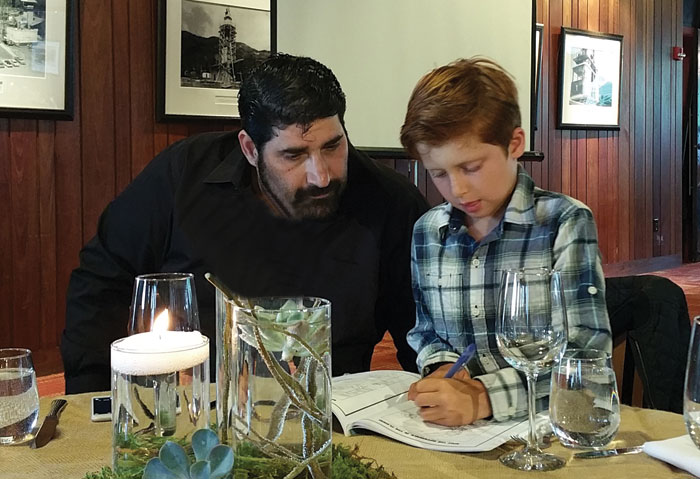
Michael’s nephew, 12-year-old Eli asked a fifth question: 

If there’s a God, why do bad things like Cancer, the Coronavirus and the Holocaust happen?

MICHAEL’S RESPONSE:

Eli,

Many people who are smart and curious like you ask the question why do bad things happen to people in a world where there is a God. Why would God allow things like the Holocaust, cancer, Coronavirus? 

There is a great movie you should watch called “The Quarrel.” It’s about two brothers who were separated during the Holocaust and only found each other on a park bench in Central Park in the 1970s. 

So, they got to talking and they figured out they were brothers. The interesting thing is that one brother was VERY religious, black hat religious, totally devoted to God. The other was not and didn’t believe in God at all. They both argued all night about whether there could be a God if the Holocaust happened. One brother argued that there couldn’t have been. The other argued that it was only because of his faith in God that he survived. The non-believer brother almost found that he was changing his mind given their very meeting on that park bench that night. 

For me, bad events have been happening throughout history. I don’t believe God gets involved in most cases. And when he or she does, God seems to get involved after suffering happens and then steps in to help (just like in the Passover story where Jews were slaves for 300 years before being freed). My opinion is that God doesn’t get involved with catastrophes in almost all cases. That’s mostly because God isn’t supposed to be a thing that controls all events.

Rather than stop cancer, God helps our world get the most amazing doctors, nurses and scientists to care for the sick.

God granted people free will and wanted to respect their choices and their gifts and their mistakes. Rather than stop cancer, God helps our world get the most amazing doctors, nurses and scientists to care for the sick. Think of your Uncle Marc and Aunt Elizabeth. I suppose it’s all miraculous in its own way. Only in extreme cases does it seem like God will get involved. 

Think of the few miracles like the one during Hanukkah where candles burned for eight nights, or like being saved from slavery. I believe God played a role in those disasters. I even believe God was the very thing that helped so many survive in the end. So, perhaps it’s a matter of perspective. 

The question to me is not how could there be a God when such horrible things happen, but why doesn’t God intervene sooner. In my own case, I could get mad at God for allowing me to get cancer. But I tend to be more appreciative that they keep finding it at times when I can be treated. Super religious people pray for these things. They believe God can help. But most people don’t pray. So, not sure that’s the best way, although speaking personally, prayers for health can’t hurt. I would rather live in a world where there is an imperfect God than no God at all. That’s the choice you get to make and think about that as you plan to prepare to become a Bar Mitzvah. I PROMISE that it will be way more interesting if there is a God involved. 

RABBI YITZ GREENBERG’S COMMENT:

(Yitz has been a family friend since the late 1970’s)

Eli’s question is good. Michael’s answer was remarkable.

I can only add two items.

1) The presence of innocent suffering in this world is the most troubling phenomenon for a believer. It is an argument against God’s Presence in our world. That is why Isaiah predicts that in Messianic times, there will be no evil or destructive events in the world and only then will people really “know” God, i.e., feel directly and really that there is a god and feel connected.

 To get there, we need to repair the world, cure all disease, end war, oppression, etc. That is the human calling according to our Tradition [tikkun olam] and we can/should do it in partnership with God. It will take more than one generation to get there. That is why we pass on Jewish Torah/tradition and the mission from generation to generation, until we get there.

 2) In my new (not yet published) book, I argue that there are three stages in our partnership [covenant/brit] with God for tikkun olam. In first stage [Biblical Judaism] God was the dominant partner — liberating us, fighting our battles, instructing us through prophets and heavenly revelation, making visible miracles so the good guys win.

In the second stage, God self-limits again and invites the human partner to take on more responsibility. No more prophets or heavenly revelation. Humans [mostly rabbis] study the past and apply it to today to establish what God wants us to do. Our behaviors and policies mostly decide the outcome. God does only hidden miracles to help but the natural process dominates. God comes closer but in hidden form and can be encountered in home, street, etc. Not just in the Jerusalem Temple.

 We are living in stage 3. Humans have developed and God self limits again to become totally hidden (also totally present everywhere but must be uncovered/sought out). Humans are given full responsibility to realize the covenant and goals. God works miracles only through natural laws and the qualities which God has inserted into the elements [which humans can study] and us. There are more miracles than ever but they are done through human agents using these natural laws. Humans are called to create good societies with no oppression or evil, and to cure diseases, anticipate earthquakes, tsunamis and take steps to prevent loss of life, etc.

As Michael said: God respects human free will and does not intervene like the cavalry in the old Westerns to save the day. God does accompany us, gives us strength, support, love to keep us going and to keep us working for tikkun. God also suffers in our suffering -so we must help God and fellow humans by/through tikkun olam.

 Unfortunately, the doctors have not yet found the cure for Michael’s cancer. Let’s hope they have found the cure for mine. We keep going until we get there some day. We are inspired along the way by people like Michael to try harder. Also, along the way, we have had moments of encounter with God (such as the exodus or the creation of the State of Israel) which give us hope and trust that we not alone. Of course, the holocaust or coronavirus or Michael’s cancer shake and challenge this faith but we live in the tension.

 Love to all, Yitz.

Michael Jeser’s z’l Response to Nephew Eli’s 5th Question and Rabbi Yitz Greenberg’s Comment Read More »

Agnon’s Seder

Imagine being at S.Y. Agnon’s Passover Seder. What would a Seder with Judaism’s modern-day master storyteller be like? How did Agnon explain the Haggadah to his family? While we have no actual information about the Seder in the Agnon home, in the spirit of Agnon’s own imaginative storytelling (and using his own Passover-themed stories as our guide), let’s take an imaginative journey through a Seder with S.Y. Agnon.

What would a Seder with Judaism’s modern-day master storyteller be like? How did Agnon explain the Haggadah to his family? While we have no actual information about the Seder in the Agnon home, in the spirit of Agnon’s own imaginative storytelling (and using his own Passover-themed stories as our guide), let’s take an imaginative journey through a Seder with S.Y. Agnon.

I imagine the Agnon family – Shmuel Yosef (S.Y.), his wife Esther, their daughter Emunah and their son Hemdat – sitting down to their Seder in their small Jerusalem home in Talpiot. The table is adorned for Passover, and the family eagerly awaits Agnon’s opening reflections. Agnon begins by sharing childhood memories of his Seder, all of which are told in his story “A Pleasant Tale about my Prayer Book”:

“Our home was filled with light, our vessels were polished and bright, and the smell of karpas and maror spread throughout our house. My father wore a white garment and seemed to like an angel standing before God, reciting songs of praise. Opposite him sat my mother with her head adorned in a beautiful silk scarf.”

Agnon proceeds to share a memory about his siblings at the Seder: 

We all sat between our parents, dressed in new clothing and shoes. The boys wore brand new hats on our heads, and the girls’ hair exuded the smell of fresh pure water with which they washed their hair in honor of the holiday.”

While pouring wine for Kiddush, Agnon recounts an insight sparked by his father’s recitation of Kiddush:

My father made Kiddush over wine, reciting the words ‘God who has chosen us from all peoples, and elevated us above all languages.’ I was amazed how a few words of Kiddush from my father’s mouth gave me the impression that the whole world was elevated, and that we, the Jewish people, were elevated above it.

Agnon breaks a matzah, lifts the broken piece and recites: “Ha Lahma Anya – This is the bread of poverty … let all who are hungry come and eat, let all who are needy come and share the Passover meal.”

These words trigger another profound childhood memory that Agnon shares with his family:

My father was a soft-spoken person, yet I recall him lifting his voice out loud when reciting the words ‘let all who are hungry come and eat.’ Why, I wondered, would such a soft-spoken person raise his voice for this sentence?

Given the abundance of poor people in the world who do not have what to eat, my father raised his voice and said ‘let all who are hungry come and eat,’ to assure that all poor people could hear and join us at our Seder.

This memory inspired Agnon to explore these themes in other stories, a few of which he chooses to share with his family. 

I imagine Agnon continues: “In my story HaSeder, I tell the tale of two ‘needy’ souls who meet on the night of Passover – Mikhel the Shamash (the caretaker of the synagogue) and Sara Lea. They are needy, not because of finances, but because they are both widowed and do not have anyone with whom to share the Seder. Their state of human loneliness brings them together on Passover, where they share the evening and then share the rest of their lives together.”

I imagine Agnon also relating one of his darker Passover stories, where the term “hungry” takes on an aura of fear and uncertainty:

“In my story HaBayit (The Home), I explore a family’s fear of eviction from their home. The husband and wife agree that a home from which one fears eviction is not really a home. Out of fear that the landlord may show up and evict them, they leave their home on the night of Passover, ultimately arriving to a hotel where the manager greets them with the words ‘let all who are hungry come and eat.’”

The rest of Agnon’s Seder must have been filled with questions and stories. Some of these stories would eventually earn Agnon a Nobel Prize in Literature, but on this Passover night, they are simply stories being shared with his family.

Agnon rewrote Had Gadya, and I imagine he ends his Seder by sharing his own creative retelling:

“This cat seems to have committed an evil deed by eating the kid!

Therefore… the dog did good by biting the cat, the stick did bad by hitting the dog, the fire did good by burning the stick, the water did bad by extinguishing the fire, the ox did good by drinking the water, the butcher did bad by slaughtering the ox, and the Angel of Death did good by slaughtering the butcher. This leads to a theologically problematic conclusion: that God was unjustified in slaughtering the Angel of Death! That can’t be! 

So, the story must go like this:

It’s true that the Cat committed an evil deed by eating the Kid

But when a Kid and a Cat fight with each other

We can assume they may have reconciled on their own and concluded in peace.

If so — what business is it of the Dog to get involved and play the judge?

If so — the Dog is equal to the Stick, and the Stick did good by hitting the Dog!

If so — the Fire misbehaved by burning the Stick!

If so — the Water was justified by extinguishing the Fire!

If so — the Ox misbehaved by drinking the Water!

If so — the Butcher did well by slaughtering the Ox!

If so — the Angel of Death sinned by slaughtering the Butcher!

In the end — God determines that the Angel of Death is evil — and slaughters him — 

And we conclude all’s well that ends well, with God being righteous in all His ways!

Hag Sameah from the Agnon home…and from my imagination.


Rabbi Daniel Bouskila is the Director of the Sephardic Educational Center and the rabbi of the Westwood Village Synagogue. 

Agnon’s Seder Read More »

A Look Back at Nickelodeon’s “A Rugrats Passover”

When sitting at a Passover seder this year, take notice of who and what you’re imagining as the story is retold. 

Are you thinking about the scenery from a visit to Israel or Egypt? Or perhaps you’re recalling one of the many dramatizations of the story of Passover that have hit movie theaters and televisions over the last century. Maybe you’re picturing Charlton Heston as Moses in Cecile B. Demille’s “The Ten Commandments,” or Dreamworks’ animated “The Prince of Egypt.” Some might be imagining Christian Bale as Moses in “Exodus: Gods and Kings.”

For many adults who grew up watching children’s television programming on Nickelodeon in the 1990s, the Passover episode of the animated series “Rugrats” was the first time they saw a depiction of the story of Passover. 

For many adults who grew up watching children’s television programming on Nickelodeon in the 1990s, the Passover episode of the animated series “Rugrats” was the first time they saw a depiction of the story of Passover. 

The series featured talking toddlers going on adventures while their adult parents remained oblivious. Their parents were only aware that the oldest of the Rugrats, the spoiled brat Angelica, was capable of talking. The parents’ story always echoed a bit of the kids’ main story, and the Passover episode was no exception.

The episode begins with an argument between the main Rugrat Tommy’s grandparents Boris and Minka, who are preparing to host a Passover seder. The two elderly immigrants from Eastern Europe bicker over whose family wine glasses they should use. The fight comes to a head with Boris storming out of the kitchen, leaving Minka in tears as guests arrive. 

While Minka thinks Boris has left the house for the night, he was actually in the attic getting Minka’s family wine glasses, conceding another argument to his beloved wife. The seder starts without Boris, and unbeknownst to adults at the seder table, the Rugrats snuck up to the attic to look for toys. 

Unfortunately, the attic door shuts behind them, locking Boris and the Rugrats inside for the duration of the seder. He passes the time by telling the kids the story of Passover. From there, the Rugrats imagine themselves in ancient Egypt, analogous to the enslaved Jews. Tommy is imagined to be Moses, and his cousin Angelica, fittingly, as Pharaoh. 

Originally, Nickelodeon wanted to do a Hanukkah episode as a companion to the Christmas episode. But the writers of “Rugrats,” many of whom were Jewish, insisted on doing a Passover episode instead. 

“Christmas is such an important holiday and it has so much story to it, and Hanukkah is not our big identity-religious holiday,” “Rugrats” writer Rachel Lipman told the Journal. “The whole commandment of celebrating Passover is to tell this story. So we really wanted to try something new, and  Nickelodeon being the creatively rebellious upstart network that they were, and I think still are, [was] completely supportive.”

Lipman, with co-writers Peter Gaffney and Jonathan Greenberg, as well as series creator Paul Germain, set out to squeeze many Passover story elements into the 23-minute episode. In fact, Boris and Minka were modeled after Germain’s own grandparents. 

Lipman said that they knew the story was great for little kids but also designed to be told to anyone of any age. 

“We thought in the [writers’] meeting, ‘Let’s find the right metaphor,’” Lipman said. “Here’s a story about people sticking up for who they are and their identity and establishing that against the ultimate bully, Pharaoh. So Angelica and the babies being a metaphor that we had already established in the show we thought was a perfect translation.”

The episode features plagues, pyramids and the parting of the Red Sea. There’s a debate amongst the adult characters on whether to pronounce the letter H in “bitter herb.” Tommy, as Moses shouts, “Let my babies go!” You even see the moment the Jews realize they’ve created matzah. 

One of the reasons the episode still resonates with adults is because it was not common for animated shows to depict Judaism-themed episodes, let alone an entire seder. In a world filled with countless Christmas episodes, it was gratifying to have one for Passover. 

“It’s really fun for me now when I see people who say, ‘I was a little kid watching the original shows, and I grew up and now I think about that at Passover or maybe show it to my own kids,’” Lipman said. “And that’s sort of who we always were writing for. It’s fun to have nostalgic recollections with people.”

The Passover episode of “Rugrats” originally aired in 1995 and earned a Primetime Emmy Award nomination. In the following year, a Hanukkah episode was created.  

Looking back, Lipman is proud of the work the entire team did in bringing an animated story of Passover to so many children. 

“Writing the Passover episode was a privilege with everybody on our team that really just showed how important telling stories and entertaining people are,” Lipman said. “When you have a classic story, it should last for many, many generations. I think that’s what Passover’s all about.”

A Look Back at Nickelodeon’s “A Rugrats Passover” Read More »

Connecting With God at Passover

The major theme of Passover is freedom. When God liberated the Jews from the hands of the Egyptians, the Jews weren’t going to have a free-for-all where they could go wild and do whatever they wanted. No, God liberated them so that they would be free to serve Him, as seen in this quote: “I am the Lord your God who took you out of the land of Egypt to be for you a God.” True fulfillment would come from worshipping God and following the holy Torah. 

When human beings are free to do whatever they please, it often leads to disastrous consequences. The people in Sodom and Gomorrah were “free”; they became so sinful and wicked that they had to be destroyed. The ancient Egyptians were “free,” and they were horribly cruel to the Jews. 

Today, you see people with seemingly endless wealth constantly getting into trouble because they live their life without any restrictions. How many celebrities get into car crashes or end up in rehab or get divorced many times over? A lifestyle of excess, without rules, is not a good life at all. When you have access to everything, you cherish nothing. 

I experienced this myself, though not on such a major scale. Before I converted to Judaism, I was an atheist. I’d never read any of the commandments or followed a set of morals and ethics for my life. I decided I was a good person according to my own standards. Did I ever give charity? No. Did I go out of my way to help others? Never. Was I into self-improvement? Not at all.

When I first started learning about Judaism, I thought, “Wow, there are so many rules. It’s so suffocating.” But the funny thing is, the more observant I became, and the more commandments I began to follow, the freer I felt.

When I started keeping Shabbat, I was free to relax, spend time with my family and friends, connect with God and shut off the outside world for the day. 

When I started keeping Shabbat, I was free to relax, spend time with my family and friends, connect with God and shut off the outside world for the day. When I joined the community, I felt free from the isolation and loneliness I experienced in my childhood. When I went from believing I was in complete control of my life to trusting that God was calling the shots, I was liberated.

That last one is the key to a happy life. As someone who has always suffered from anxiety, one of the ways I deal with it now is thanking God for the challenges I face. I don’t always know why my car breaks down, I get a very expensive bill in the mail or I have a panic attack, but I trust that God has a plan. There is some lesson I need to learn when I have a struggle. Perhaps God is giving me strength to face even bigger challenges in life.

I urge you to think about the challenges in your life and what’s keeping you from being free to connect more to God. What is stopping you from having inner peace? There are so many stressors and pressures in our modern world. We are overworked and underpaid, we are inundated with bad news on a daily basis and, on top of all that, we all have our day-to-day drama. 

But this Passover, we don’t have to let it bring us down anymore or feel oppressed. I recommend you take a moment to pause and to pray. Pour your heart out and do a trust fall. If you let God catch you, He will. 

Focus on what your soul really needs – a connection to God – and this Passover, you will truly feel free.


Kylie Ora Lobell is the Community and Arts Editor for the Jewish Journal. 

Connecting With God at Passover Read More »

Three Women to Watch

When Ketanji Brown Jackson was confirmed last week as the first Black woman to serve on the U.S. Supreme Court, the visual image of President Joe Biden flanked by Judge Jackson, Vice President Kamala Harris and House Speaker Nancy Pelosi was a vivid reminder of the how female political leaders have gradually increased their presence at some of the highest levels of our nation’ government. But three other female leaders, on three different continents, have taken steps in the last several days to impact U.S. and global politics to an even greater degree.

The first was Idit Silman, a previously little-known conservative member of Naftali Bennet’s Yamina party who by resigning her position in Bennet’s razor-thin majority coalition, has set the stage for the next upheaval in Israel’s government. Bennett’s coalition has been resting on pillars of sand since its inception, and it’s been reasonable to assume that at some point the precarious unity would crumble, once it was no longer possible to paper over differences on life-or-death issues like terrorism and security.

But few would have predicted that the issue that could lead to Bennett’s government falling would be Passover rituals. The precipitating event that drove Silman away from Bennett was a dispute over which types of food would be permitted inside hospitals during Passover. But her disconnect had been simmering for some time over cultural divisions such as access to the Western Wall and abortion, and her resignation leaves the Israeli government with no clear direction forward at a critical time in national and global politics.

Le Pen has little in common with either Silman or Cheney. But all three will play a vital role in world affairs at a time of great upheaval and uncertainty.

Meanwhile, here in the U.S., embattled Representative Liz Cheney has announced historically high fundraising numbers in her re-election campaign to hold onto Wyoming’s lone House seat. Cheney was one of ten Republican House members to vote to impeach Donald Trump, she serves as the co-chair of the congressional investigation into the events of January 6 and has called Trump a “clear and present danger” to American democracy. 

Trump is not a fan. He has endorsed challenger Harriet Hageman, who is also being supported by dozens of Cheney’s House colleagues and has shot ahead in early polling for the state’s August primary. But pre-Trump Washington Republicans have not only stuck with Cheney, they are using this race as their first attempt to regain control of the party that Trump hijacked from them. Cheney’s father, former Vice President Dick Cheney, has mobilized Bush-era Republicans on his daughter’s behalf, and the GOP establishment has poured immense amounts of money into the campaign. Add in the fact that Wyoming has an open primary, which will allow Democrats and independents to cross over to vote for Cheney over her Trump-backed opponent, and it’s clear that the outcome of this one campaign could have an outsized effect on the 2024 presidential election and the party’s future for years to come.

Then over the weekend came the news that Marine Le Pen, the nationalist conservative firebrand of France’s right wing, has advanced to that country’s runoff elections against current Prime Minister Emmanuel Macron. When the two faced off against each other five years ago, Macron crushed Le Pen by roughly a 2-1 margin. But on Sunday, Macron finished ahead by only a few percentage points and early polls suggest that Le Pen is very much within striking distance.

Regardless of the final outcome, Le Pen’s enhanced stature suggests that a populist isolationism and hostility toward international engagement is taking hold in France as it has in the U.S., Great Britain and other Western democracies in recent years. At a time when a battered NATO alliance is holding together in support of Ukraine in that country’s war with Russia, the possibility of a nativist France could be an immense blow to international cooperation against Vladimir Putin.

Le Pen has little in common with either Silman or Cheney. But all three will play a vital role in world affairs at a time of great upheaval and uncertainty. We’ll find out soon if and how they navigate these challenges differently than male politicians have for the last many millennia.


Dan Schnur is a Professor at the University of California – Berkeley, USC and Pepperdine. Join Dan for his weekly webinar “Politics in the Time of Coronavirus” (www/lawac.org) on Tuesdays at 5 PM.

Three Women to Watch Read More »

NuRoots’ Passover Exodus in the Desert

After two years of virtual Passovers, NuRoots is going back to basics for this year’s Collective Escape. From April 22 to 24, about 75 “wanderers,” ages 21 through 30-something, will descend upon Cuyama, CA, for three days of gritty Passover magic.

“This year we wanted to provide an opportunity, after years of isolation and virtual community, to come together in the flesh,” Chelsea Snyder, director of NuRoots’ Community Building, told the Journal. “Cuyama Valley means ‘Valley of Enchantment.’ That is what we hope to build: a community of enchantment, wonder and ritual.

NuRoots is the young adult engagement initiative of the Jewish Federation of Greater Los Angeles, mobilizing young adults to build a meaningful community and reimagine Jewish life through creative experiences. 

And what’s more creative than a weekend in the desert that corresponds with the end of Passover?

“Our choose-your-own-adventure experience will be a mix of small-group electives and large-group programming, so there’s a chance to really get to know people and also feel like you are part of something bigger,” Snyder said. 

There will be glamping huts, nourishing meals, creative workshops, festive Shabbat and Havdalah experiences, campfires and even a Moroccan Mimouna.  

“Mimouna is a traditional festival celebrated by Moroccan Jews at nightfall on the last day of Passover,” Snyder said. “It’s the start of the spring season, and a time to celebrate friendship, luck and good fortune. We will celebrate on our last night [with] music, dancing and brilliant food.” 

Collective Escape’s mission is to physically get back to that starting point – the desert, nature – for a personal and communal exodus. Each new season brings the opportunity to gather, renew old friendships and make new ones.

“This is a ritualized holiday of the human spirit with a chance to cleanse, rejoice, celebrate and become in beautiful ways.”  – Chelsea Snyder

“This is a ritualized holiday of the human spirit with a chance to cleanse, rejoice, celebrate and become in beautiful ways,” Snyder said. “We remix and reinterpret the ancient Passover story and give it a real present-day feel. During Collective Escape, we encourage participants to be part of it. We will examine where we are enslaved both personally and collectively and we will forge a path to freedom.” 

Collective Escape started in 2016 as a pop-up Passover experience with music, storytelling, arts, mixology and meditation. It has evolved over the years to offer reimagined experiences and gatherings, such as seders, salons and workshops. In addition to Passover, NuRoots reimagines Jewish holidays ranging from Sukkot and the High Holy Days to Tu B’Av and Hanukkah.  

More than anything, Snyder is thrilled to be back in person. 

“We have seen with our monthly offerings the energy in the air as young adults come together in community,” Snyder said. “The laughs, the hugs, the ‘can’t wait to see you at the next gathering’ means more to us than we ever knew. We are excited and building off the joy and high demand for meaningful gathering.”  

After two years of Zoom encounters, this year’s NuRoots experience was many moons in the making. 

“The opportunity to be able to hold space for our young adult community in a unique immersive way is radically exciting,” Snyder said. “This immersive weekend represents collective freedom, our freedom as a community, our freedom of self and an enduring understanding for what is possible.”

Learn more: NuRoots.org/collectiveescape.

NuRoots’ Passover Exodus in the Desert Read More »

Mad About Matzah

It’s oh so easy to get bored of matzah during Passover, but the wonderful thing about matzah is you can do anything you want with it. You just need to be creative and open to the possibilities.

“It can be really hard to change eating habits, especially for kids,” Marti Kerner, who runs the Everyday Jewish Mom blog and YouTube channel, told the Journal. “Having special foods that we only eat during Passover gives us all something to look forward to.”

Kerner has always loved Passover: the preparation, the songs and all of the symbolism of the seder. To keep matzah fun and interesting throughout Passover, Kerner’s family mixes up the classics, like matzah pizza and matzah brei, with more unique fare.

“We make matzah nachos, Kerner said. “We even break up matzah and eat it in a bowl with milk, like cereal.”

Since her mother-in-law is famous for her Chex Mix, Kerner created a matzah version for Passover. 

“It’s important to have good snacks,” Kerner said. “And this one works as a good substitute for popcorn on a movie night.” 

Passover Parmesan Snack Mix by Everyday Jewish Mom

5 cups broken matzah (any matzah
or matzah crackers work, use one
kind or a variety)
1 cup nuts (any kind of nuts or just
another cup of matzah)
1/2 cup (1 stick) melted butter
1 tsp. garlic powder
1 tsp. salt
A bit of paprika (mostly for color)
3/4 cup Parmesan cheese

  1. Preheat oven to 325°. Line a baking sheet with parchment paper or a silicone baking mat.
  2. In a large bowl, mix together your matzah chunks and nuts. Set aside.
  3. In a separate bowl, mix together the melted butter, garlic powder, salt and paprika.
  4. Fully coat the matzah with the butter mixture. Then stir in the Parmesan cheese.
  5. Spread evenly on a baking sheet. Bake for 20 mins or until brown and crispy. Stir several times during baking.
  6. Store in an airtight container on the counter.

Nina Safar, a kosher chef who runs the Kosher in the Kitch website, Instagram and YouTube channel, is also a fan of the holiday. 

“I’m a Pesach baby,” Safar said. “My mom went into labor right after taking a bite of maror, and ever since, mid-seder, my family stops and sings ‘Happy birthday’ to me when eating maror.”

“Think of your favorite sandwich fillings or even taco toppings and then just use matzah as your base instead.” – Nina Safar

To keep matzah fun and interesting throughout Passover, Safar said, “Think of your favorite sandwich fillings or even taco toppings and then just use matzah as your base instead. It almost always works and tastes just as tasty.” 

While Safar keeps the traditions she had growing up alive with her mother’s recipes, like sweet cheese blintzes and chocolate fudge brownies (both kosher for Passover and delicious), her favorite matzah dish is matzah brei.

“My mother would make it each holiday and we would eat it hot from the pan, with lots of sugar sprinkled on top,” she said. “It always amazed me how dry crispy matzah could be turned into something so delicious.”

Safar’s Bananas Foster matzah Brei has thick stacks of matzah brei layered under caramelized bananas and smooth chocolate sauce. Super yum! 

Banana Foster Matzah Brei

Bananas Foster Matzah Brei by Kosher in the Kitch

Matzah Brei
4 matzah
3 eggs
Salt
Black pepper

Caramelized Bananas
2 bananas, peeled and sliced into
thin rounds
1/2 cup of sugar

Chocolate Sauce
1 cup chocolate chips combined
with 1 teaspoon oil
Ice cream for serving

  1. Break matzah into pieces and soak in a bowl with water until softened.
  2. Whisk eggs together and season with salt and pepper.
  3. Drain water from matzah bowl and combine matzah pieces with eggs.
  4. Heat two tablespoons oil in a large frying pan and fry matzah batter in batches until golden brown on both sides.
  5. In the meantime, heat two tablespoons oil in a medium-sized frying pan over medium heat.
  6. Combine sliced banana rounds with sugar, then cook in the heated pan until bananas caramelize.
  7. Place chocolate chips and 1 teaspoon oil in a microwave-safe dish and heat in 30 second increments until chocolate has melted and is smooth.
  8. Serve cooked matzah brei with caramelized bananas, chocolate sauce and ice cream.

For Rin Russ, the creative entrepreneur behind Rin Out Loud, the Jewish lifestyle blog and Judaica shop, matzah didn’t become fun in her house until 2020. 

“When the pandemic hit, we were having a hard time finding matzah, so we decided to make our own,” Russ told the Journal. “Ever since then, we’ve discovered a new tradition of making matzah together as a family. Not only can we add silly colors, but it tastes so much better.”

Russ, who converted to Judaism in 2015, celebrated her first Passover the year before. 

“It was not my favorite holiday at all,” she said. “It was long and confusing and felt like a chore.”

A few years later, a conversation she had with a coworker changed Russ’ perspective. 

“She told me how her mother-in-law had recently hosted a taco-themed Passover seder,” Russ said. “Every year since then, we have hosted different themed Seders. It’s really allowed my family and [I] to sit down and think through the symbolic foods in a new way.”

Russ said if she had to pick a matzah favorite, it would be matzah lasagna. She just layers a bunch of cheese and sauce with the matzah and bakes it. 

“People think matzah is brittle and hard to manipulate, but with practice and technique, everything is on the table, from lasagna to cereal to cake,” she said.

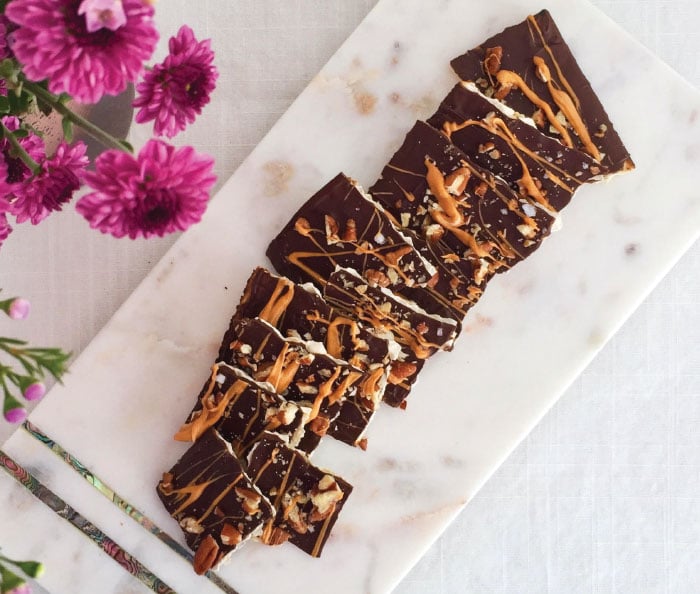
Through some very delicious trial and error, Russ created a matzah bark recipe that her husband loved so much, she named it after him: Ruckus’s Matzah Bark. This salty-sweet treat features dark chocolate, butterscotch chips and toasted pecans. 

Ruckus’s Matzah Bark

Ruckus’s Matzah Bark – Rin Out Loud

4 matzah
1 12-ounce Bag Semisweet Chocolate Chips
1/4 Cup Butterscotch Chips
1/4 Cup Pecans Toasted and Chopped
1/2 Teaspoon Coconut Oil
4 Pinches Course Salt

  1. Lay your matzah flat on two cookie sheets.
  2. Melt the bittersweet chocolate chips in a microwave safe bowl in 30 second intervals, stirring in between after each interval. Add coconut oil to the chocolate once it’s smooth.
  3. Spread the melted chocolate onto all four matzah.
  4. While the chocolate is wet, add the pecans. Sprinkle a pinch of salt over each piece of matzah.
  5. Melt the butterscotch chips in a microwave safe bowl in 30 second intervals, stirring in between.
  6. Use a spoon to drizzle the melted butterscotch over your matzah bark.
  7. Place the cookie sheets in the refrigerator for 5 minutes to allow the chocolate and butterscotch to set.
  8. Break your bark into pieces.

For more Passover recipes, check out EverydayJewishMom.com, KosherintheKitch.com and RinOutLoud.com.

Mad About Matzah Read More »

Iowa’s Antisemitism Bill and 101 Years Since My Grandpa Confronted Henry Ford

A headline with the words “Iowa” and “antisemitism” caught my eye and brought me back to the story of my grandfather. The headline declared that Iowa has become the first state in the country to pass a bill adopting the International Holocaust Remembrance Alliance definition of antisemitism when assessing the motivation behind illegal discriminatory conduct.

That headline took me back to the story of my grandfather, Max Barish, his car dealership in Iowa, Henry Ford, Sr. and the antisemitism of 101 years ago. As I write these words, I wonder if anyone would be interested in something that happened 101 years ago in the little town of Sioux City to a family of Jewish immigrants. It occurred so long ago in such an out-of-the-way place. But is it really so remote? In fact, the story could be an example of what Jews can accomplish when they take a stand on their Jewish heritage and identity, and their own self-respect.

Grandfather Max and his family settled in Sioux City at the turn of the last century. In 1916 they opened a Ford franchise there and were very successful. So much so that Henry Ford, Sr. himself complimented the Barish brothers calling them “The boys who do things.” That was in January 1921 when Ford was desperate for scrap metal to keep his assembly lines running. He reached out to the brothers for help, as reported in The Lion’s Roar, the Sioux City Jewish newspaper. Jews helping the well-known antisemite stay in business? Why not? In those days, his assembly lines employed thousands of workers, and franchise owners like my grandpa were profiting.

Ford bought the Dearborn Independent in 1919 and starting in May 1920 his antisemitic articles became a mainstay of the weekly newspaper, until he finally capitulated and shut it down in 1927. Yet even Iowa’s recently passed law could not have kept Ford from publishing his libelous views or led to the paper’s demise. This bill does not prevent antisemitic speech but rather focuses on defining antisemitism when assessing a discriminatory act.

So, what did convince Ford to shut down? The answer is simple. It was courageous people like the Barish brothers. When Ford took over the newspaper, he demanded that his franchise owners make it available for the customers in the showrooms. Well, okay, they thought. It’s just sitting there. Maybe no one will notice.However, by September 1921, Ford had changed his policy. He declared that the Dearborn Independent was a “Ford product” just like his cars and ordered his dealers to actively promote the sale of subscriptions to all who entered.

The answer is simple. It was courageous people like the Barish brothers.

It was one thing to ignore the newspapers lying unnoticed in a corner, but to encourage customers to buy the slanderous, antisemitic propaganda was another story. Grandpa Max and his family refused to comply. They put their pride in their Jewish heritage before their business, before profits. The brothers confronted Ford in a letter sent to the company, which they published on September 5, 1921 in a full-page ad in the Sioux City Daily Tribune. “Please consider this our notice of cancellation of the Ford Sales agreement to take place immediately.” They were calling out the antisemite and they wanted their loyal customers and the public to know why they were closing the business. Obviously, this act alone did not convince Ford to stop publishing his newspaper, but reactions like it and repeated protests by Jews and non-Jews alike kept the pressure up until a court case accusing the Independent of libel finally motivated more aggressive actions against Ford, including the boycotting of Ford products.

What took them so long? If an immigrant family could give up everything and start again, where were the rest of the Jews? What are our priorities today?

Laws defining what constitutes discrimination against Jews are important. But would we need so many bills and definitions if more Jews, and others who experience discrimination, learned to stand up and call it what it is? If my grandfather could, anyone can.


Galia Miller Sprung, who moved to Israel in 1970 to become a pioneer farmer, is a retired high school teacher, writer and editor.

Iowa’s Antisemitism Bill and 101 Years Since My Grandpa Confronted Henry Ford Read More »

Another Bloody Ramadan in Israel as “Partner for Peace” Incites Murder

This past Thursday, two Israeli men, Tomer Morad (28) and Eytam Magini (27), friends since childhood who were both planning to get married in the very near future, were together at a bar in order to celebrate Eytam’s recent engagement to his girlfriend, Ayala Arad. At that same bar was also Barak Lufan. Barak was a 35-year-old father of three: a husband, father and an Olympian. Like Tomer and Eytam, Barak had big plans and big dreams—including, I am certain, as a father of three myself, dreams of seeing his daughters’ Bat Mitzvahs, graduations, and weddings.

Horrifically, instead of weddings or other celebrations, the families and friends of Tomer, Eytam and Barak attended their funerals this past week. The funerals of these bright young men with their respective bright futures as a software engineer, mechanical engineer and Olympic kayaking coach happened because of another young man: Ra’ad Fathi Hazem, a 29-year-old from Jenin. Hazem was raised in a society known for worshiping those who murder Jews and offering government incentive compensation (“pay to slay”) plans. It’s also a society that boasts generations of hateful, ahistorical propaganda suggesting that Jewish sovereignty and self-determination in the land of Israel is no different from British control over India.

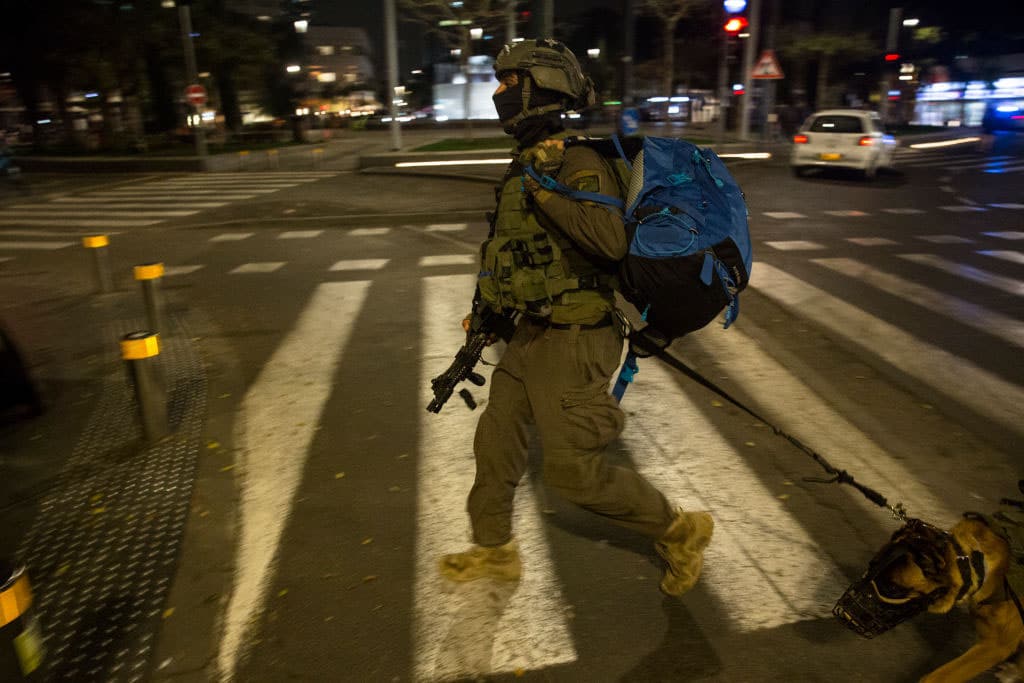
When Hazem walked up to the crowded sidewalk bar where Tomer, Eytam and Barak and dozens of others were enjoying a night out with friends, he coldly shot over a dozen rounds at the people eating and drinking fewer than two meters in front of him, wounding at least a dozen people, and murdering three young men—two of whom were about to get married, and one of whom was a father of three.

Hazem’s father, a senior “security officer” with the PA, did not mourn the news that his son was apparently so sociopathic, so lacking in normal human empathy, that he could stand behind dozens of unarmed people and gun them down. He did not even appear to mourn the news that a few hours later his son died in a gunfight with Israeli police. Instead, he appeared to celebrate the news of his son’s cold blooded murder of three and attempted murder of a dozen more people. He gave an interview the morning following his son’s murderous attack in which he said: “You will see the victory soon … God, liberate the al-Aqsa Mosque from the occupiers …”

In Jenin, Hazem’s home town, and in numerous other Palestinian Arab towns and cities, the news of Hazem’s murderous rampage inspired people to pass out candies while singing the murderer’s praises and dancing in the street. A father proudly celebrating his son both murdering and dying is depraved. A society that throws parties over the news that random innocent people were murdered is sick.

This depravity did not just happen overnight. This sick reaction to the mass murder of people enjoying a night out at a bar, walking their son in his stroller or eating pizza did not come out of nowhere. A common feature of brutal totalitarianism and murderous Jew-hatred is that both have rewritten or revised history without regard for the facts, and both have incited deadly hate based on that revisionist history.

We are presently seeing the danger of this strategy with Putin and his revisionist history and use of propaganda to incite the Russian people to support his ruthless invasion of Ukraine. And we have seen that same strategy for generations among Israel’s totalitarian enemies. Whether in the past with the Arab League dictatorships in Egypt and Syria, or the de facto Godfather of Palestinian Arab terrorism against Jews, Nazi collaborator Haj Amin el-Husseini (who, in order to incite violence against Jews, regularly used the lie about the Jews and al-Aqsa repeated recently by Ra’ad’s father) or with el-Husseini’s ideological heirs in Hamas, Hezbollah, ISIS or Fatah.

All of these organizations, including the so-called “moderate” Fatah, headed by Israel’s “partner for peace” Mahmoud Abbas (the “president for life” of the PA), teach their people to idolize truly heinous Jew murderers.

They have also all essentially invented a history of the region and of the Arab-Israeli conflict that is completely removed from reality. It is a fake history in which the Jewish people have no connection to the land of Israel, and where the Palestinian Arabs were somehow a separate and distinct people before the 20th century. In this same falsified history, Palestinian Arabs become the direct descendants of Jebusites or Edomites (or any other long extinct people who were in the land of Israel before the Jewish people had their ethnogenesis there). This is despite the fact that before the 20the century, there is no record of Arabs in the Levant making such a claim or denying the basic historical fact that Arabs in the Levant are largely there by dint of the Arab Empire’s 7th-century C.E. conquest, colonization, and Arabization of the region.

As if all this were not enough, for decades the de facto government of the Palestinian Arabs, the PA, has made Jew-murder more profitable on average than being an engineer, and at least six times more profitable than being a high school teacher. As just one example, the terrorists behind the 2001 Sbarro Pizza bombing, which murdered 15 people, including seven children, have already received over $1,000,000 from the Palestinian Authority (an entity that exists only due to international aid money).

To further exacerbate and add to the depravity and incitement to murder Jews, the PA also directly corrupts the Ramadan holiday to incite violence. Ramadan should be a time for all Muslims, including those living in the Holy Land, to fulfill the main and noble purpose of Ramadan, which is to grow spiritually and become closer to G-d. It should also be about fulfilling and enjoying the secondary purposes and benefits of Ramadan, which are to help those in need and spend more time with loved ones.

Sadly, as it is with history, governance and everything else it has touched, the PA exploits Ramadan, using it to corrupt and to incite violence.

In the month leading up to Ramadan this year, the PA intensified its false claims about the purported threats to al-Aqsa. And on the first day of Ramadan, the senior advisor to Mahmoud Abbas for religious affairs, Mahmoud Al-Habbash, called for Palestinian Arabs to engage in violent Jihad against Israelis.

It is no accident that since the PA began its latest Ramadan rhetoric and incitement that there have been dozens of attempted and successful attempts to mass murder Jews throughout Israel. Terrorist attacks resulting in dozens of wounded, two murdered Ukrainian guest workers, and 12 murdered Israeli Arabs, Druse, and Jews, including the three young men who were murdered last Thursday at a bar in Tel Aviv.

It is no accident that since the PA began its latest Ramadan rhetoric and incitement that there have been dozens of attempted and successful attempts to mass murder Jews throughout Israel.

For generations, the leadership of the Palestinian Arabs, starting with Haj Amin el-Husseini at least as far back as 1920, have pushed the toxic combination of lionizing Jew-murder and the denial of the Jewish connection to the land of Israel. Since Israel tragically agreed to the importation of the PLO into the land of Israel via the Oslo Accords and the creation of the PA, that toxic combination has received billions in international aid funding to support a “pay for slay” policy, as well as a religious and propaganda infrastructure designed to incite terrorism. This, in turn, has turned much of Palestinian Arab society into people whose fathers and mothers voice pride at their children engaging in cold-blooded murder and whose neighbors throw parties to celebrate those murders.

It’s long past time for both Israel and the so-called “international community,” or at least those that are democracies, and purport to oppose the murder of people eating in restaurants, sleeping in their beds, or stopping for gas to admit that the PA is a villain in this equation. It’s time to admit that the PA is not a “partner for peace” and to stop throwing aid money at this kleptocracy until it stops teaching hate, inciting violence, and paying people to murder Jews.

Another Bloody Ramadan in Israel as “Partner for Peace” Incites Murder Read More »