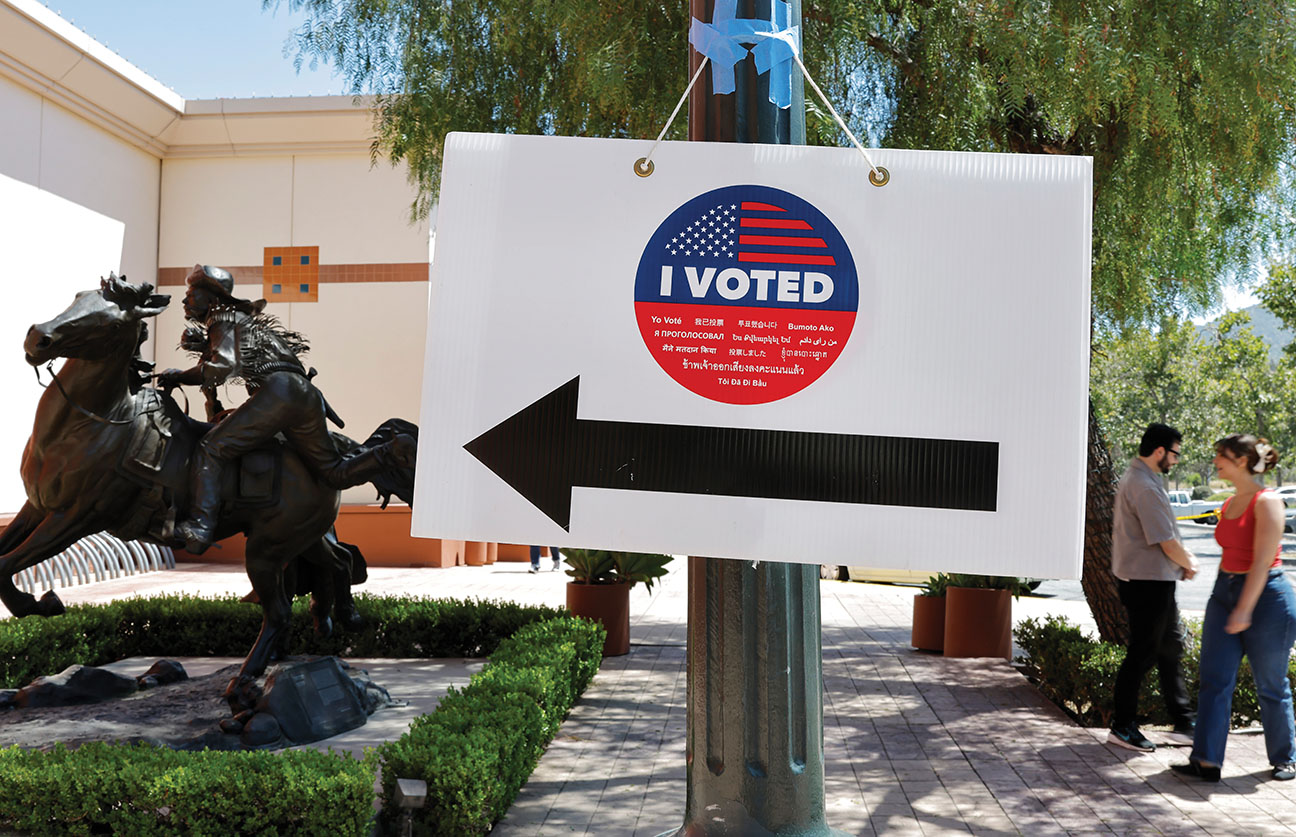
For some in the local Jewish community, California’s primary elections have become an opportunity to express frustration with political leaders and an electorate they feel has not always stood with Jews in the years since the Oct. 7 attacks.
The races have also highlighted how politically homeless many pro-Israel Jews feel today, with candidates from neither major party appearing particularly appealing in some of the state’s highest-profile contests.
Debbie Paperman, a Santa Monica resident who is active in local politics, frequently posts on Facebook about her anger with the Trump administration while also speaking out against antisemitism and anti-Zionist sentiment within the Democratic Party. She was particularly frustrated with the decision of mayoral candidate and city councilmember Nithya Raman to opt out of the recent Jewish American Heritage Month celebration at L.A. City Hall and instead appear on a podcast with political commentator Hasan Piker, a frequent critic of Israel.
“She is distancing herself from the Jewish community at large,” Paperman wrote in a recent op-ed that was critical of Raman’s candidacy.
With none of the three top-polling mayoral candidates likely to garner a majority in the primary, all three – incumbent Los Angeles Mayor Karen Bass; Raman; and outsider and former reality TV star Spencer Pratt – remain viable contenders to advance to the runoff.
Dan Schnur, the U.S. politics editor and an instructor at UC Berkeley, USC and Pepperdine, predicted it can be any two of the three who make the runoff. Asked his thoughts on the three mayoral candidates, Schnur described them as follows:
“Bass is Biden-minus – she’s had very longstanding relationships in the Jewish community, but it’s never been particularly strong,” he said in a phone interview. “Raman clearly sees a need to appeal to the most progressive voters in the city, which appears to have led her down this path. And Pratt is delivering an essentially MAGA, pro-Israel line. He’s saying the right things on Israel but is unacceptable to Jewish voters for a number of reasons.”
For many Jewish voters, the election is arriving during a period of heightened political unease. Since Oct. 7, 2023, debates surrounding Israel, campus protests and antisemitism have become central issues in California politics, particularly in Los Angeles, home to the world’s second-largest Jewish population outside of Israel.
At the same time, voter frustration with homelessness, crime, wildfire preparedness and distrust of government institutions has created new opportunities for outsider candidates, such as Pratt in the mayoral race and Steve Hilton, a Republican who has exceeded expectations in the gubernatorial contest.
Under California’s “top two” primary system, all candidates appear on the same ballot regardless of party affiliation, with the top two finishers advancing to the general election.
On the day before the election, a longtime Jewish professional leader voiced his frustration with the city’s leadership but also said he couldn’t bring himself to vote for Pratt. In an interview, he likened the mayoral role to running a business—a large, bureaucratic business—and said Pratt has no experience “leading anything.” Meanwhile, Raman, he said, would be “a disaster.” This person lives in Raman’s council district and has repeatedly found her inattentive to her constituents’ needs.
While this Jewish leader declined to share who he supported in the mayoral race, he was eager to speak about who won his vote for governor: San Jose Mayor Matt Mahan. Despite earning praise from some moderates for his approach to governance in San Jose, Mahan has largely failed to gain traction statewide. Still, this voter said, Mahan was the best choice of all the options.
In the days before the election, I called up my mom to discuss the election. Typically, we speak on the phone and fill our ballots out together, scouring websites like the Los Angeles Times for endorsements. This year, though, we didn’t do that.
“Honestly, honey, I’ve been so turned off by the sheer volume of political advertising and the negative tone of the campaigns,” my mom, who lives in Encino, told me, “that I just couldn’t vote for anybody.
“I just feel there’s so much lying out there,” she said. “They say stuff they think you want to hear, and I just don’t trust any of it anymore. And just the awful way they talk about each other makes you not want to vote for any of them.
“The nastiness and the hate have become a turnoff,” she continued. “I want better options. I would’ve voted if I had better options.”
The conversations reflected a broader tension among Jewish voters this election season: frustration with many of the available choices, but continued engagement with the political process. Whether backing long-shot candidates, weighing strategic votes or sitting races out altogether, many said they were still searching for leaders who reflected both their values and their concerns.