Fifteen years ago, Chabad of Pacific Palisades set up a summer camp on a sprawling two-acre estate located in Rustic Canyon. Originally, the estate belonged to American humorist Will Rogers, but had since traded hands, boasting an impressive list of tenants- from Rogers, to Dennis Wilson (drummer of the Beach Boys), to the Hormel Family (as in Hormel Food Corp., the manufacturer of Spam).
“The Hormel family owned the property. They lived there for a while, but it was vacant and they graciously allowed us to use it for a summer,” said Rabbi Zushe Cunin, head rabbi of Chabad Pacific Palisades.
When Cunin first visited the estate, he couldn’t tell you why, but something felt imbalanced. “In kabbalah,” said Cunin, “there’s both positive and negative energy working together.” So he conducted a spiritual “exorcism” on the property: carried a Torah around the grounds, affixed mezuzahs on the doorposts, and cleansed the space.
This was before he knew the history of the house.
14400 W. Sunset Blvd. If you Google this address, the first entries that pop up are real estate sites.
But if you scroll down, navigate a little deeper, the history of the house starts to unfold. Steven Gaines, author of “Heroes and Villains,” once described the property as a “palatial log-cabin style house.”
In the spring of 1968, Wilson — the Beach Boys’ drummer — picked up two female hitchhikers on the side of the road and brought them back to his house. Later that night, Charles Manson and the “Family” moved in.
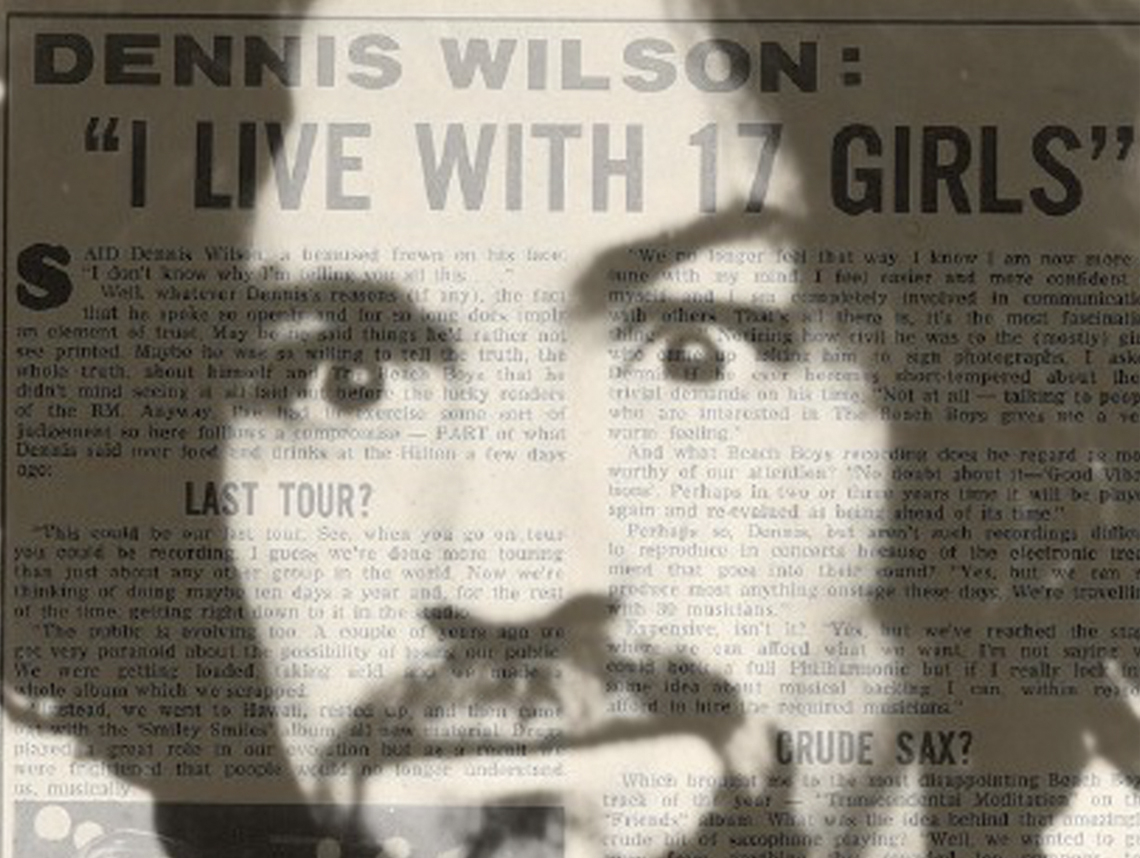
When the Manson Family moved in, Wilson scaled back his lifestyle, traded in his master suite for a modest bedroom. Meanwhile, the Manson members bunked in his spare rooms. At first, the arrangement was great. “I live with 17 girls,” Dennis Wilson bragged during a 1968 interview with Record Mirror. Wilson and the Family were getting on like a big, cultish Brady Bunch. But that ruptured quickly.
Soon, Wilson single-handedly was supporting the cult members, paying for virtually everything, from food to gonorrhea treatments (and there were lots of treatments). Wilson spent more than $100,000 on the Family before he decided enough was enough. So Wilson skipped town, stopped payments on the house and left the Family to face eviction. Manson was livid with Wilson. The members then opted to relocate to Spahn Ranch, a 500-acre property in western L.A. County, a longtime shooting location for Western films that later became the notorious plotting ground for the 1969 Tate-LaBianca murders.
When residents vacate a house, each leaves behind a residual fingerprint, something that connects all the tenants, energy swapping from one person to the next. That’s the strange quirk with real estate. It has the ability to connect a patchwork of people: from the satire of Rogers, the cult of Manson, the Spam of Hormel, to the Baal Shem Tov of Chabad.
“Spiritually, there were all kinds of energy going through that property,” said Cunin, decades after Manson and his Family were evicted. “The idea is, when you feel weird negative energy, there is also the potential for positive energy. It is up to us to redirect the energy.”
When Chabad used the house, the property looked like a time capsule, stuck in 1968. The cabin had shag rugs and sickly green walls. Bedrooms were stacked with bunk beds and zebra-print carpet. There was a pool on the premises, filled to the brim with dirt, and probably the most sinister relic left behind was a mannequin in the garden. By then, the mannequin was a fixture of the property. Sporting a lopsided wig and go-go mini skirt, her wooden body splintered from being left outside too long in the elements, not encased in a store window. Frozen in some faraway stare, a commercial smile paired with lidless eyes have witnessed residents, over the years, move in and out.
Eventually, a new family bought the house. “I met them once, but I don’t know their names,” Cunin said.