fbpx

November 21, 2017

The Matriarch of Beth Am: Rose Pilch Turns 100

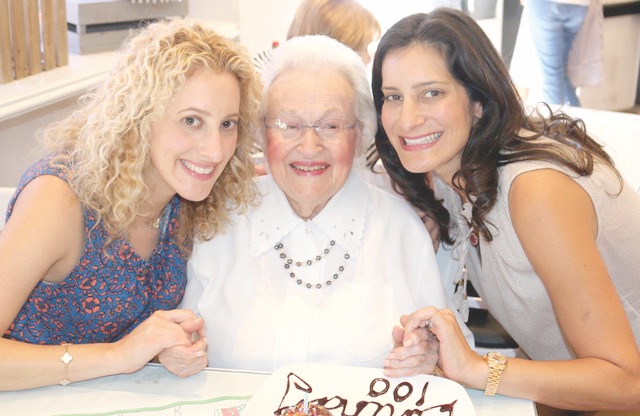
When Rose Pilch was called to the Torah one recent Shabbat at Temple Beth Am, the entire congregation stood up in admiration and celebration. Two of her granddaughters and one great-grandson joined her. Her voice was clear, her pronunciation distinct, her presence so very familiar.

It’s not every week that a congregant turns 100, as Rose did in October, and it seemed fitting to celebrate at Beth Am, her spiritual home for more than two-thirds of her life. To add poignancy, the Torah that was chosen was the Pilch Torah, a gift from Rose and her late son, Howard, to honor the memory of Rose’s late husband, Charles.

Rabbi Ari Lucas could not let the moment pass without words of Torah. He chose the passage from Proverbs about a woman of valor, words that were not only applicable but seemed to be an understatement. Rose is truly a rose, beautiful inside and out.

Rose Cohen was born in 1917 to recent immigrants from a small shtetl outside of Smolensk, Russia. They had immigrated to find a better life, free of pogroms and
anti-Semitism, first to Milwaukee and then to Chicago, where Rose and her twin sister were born.

By 1925, the family had moved to Los Angeles, settling in Boyle Heights, then the center of the Jewish community. Her father worked with a horse and buggy to deliver milk until, to use his words, “people stopped leaving a nickel on the doorstep.”

Rose and her sister rode in that buggy to school when it rained. On other days, they walked. Her father then became an elevator operator downtown. It was a modest beginning, but Rose had a rich family life, surrounded by her sister and cousins, aunts and uncles.

She graduated from Roosevelt High School in 1935. Five years later, at a dance in Venice Beach, she met Charles “Chuck” Pilch, who became her husband. Their marriage was a love affair of 55 years — they often strolled hand in hand. But the early years were interrupted by World War II, as Chuck went to Europe, where he fought in the Battle of the Bulge, the last desperate effort of Germany to halt the Allied advance from the West.

Like many women of her generation, Rose worked during the war but when Chuck returned, he became the breadwinner, she the traditional and supportive homemaker.

Family remained central to Rose and Chuck, and family always included synagogue and community. In 1950, they joined Temple Beth Am. It became their second home, the source of their friendships, the subject of their philanthropy and the place to which Rose dedicated her considerable energy and her vital personality.

Just outside Beth Am’s chapel is a wall of honor: plaques and pictures celebrating the men and women who have been essential to the community. Rose’s plaque describes her role in broad strokes: she held every position in sisterhood, served on the temple board and was active in University Women for the University of Judaism (now American Jewish University). She also was committed to Los Angeles Hebrew High School, was integral to Camp Ramah in California and was active in Hadassah and B’nai B’rith Women.

To each task she has brought energy and dedication, cheerfulness and the human touch. She reached out to welcome the stranger. She drove those who were ill, infirm or merely shy to meetings. She served not only with intelligence, generosity and warmth but with a unique ability to embrace everyone, old or young, stranger or longtime friend — consoling, enjoying and celebrating.

To each task she has brought energy and dedication, cheerfulness and the human touch.

She and Chuck were generous. They dedicated the Ziegler School of Rabbinic Studies offices and a garden at AJU. They endowed a scholarship fund at Camp Ramah. Beth Am’s Pilch Hall is named for them. It is a multipurpose room, the most used room in the synagogue, for daily minyans and for lectures, for classes and for kiddushes, for film screening and meetings. It reflects many of Rose’s qualities: Warm and completely unpretentious, it has a grace of its own because everyone feels comfortable in that room, just as everyone feels comfortable with Rose.

Rose is an active mother, grandmother and great-grandmother. She has always been there. She didn’t miss an event, a performance or a game, a recital or a party. She picked up her grandchildren from school and practices. They joined her for Shabbat dinners and for sleepovers.

Like many women of her generation, Rose stood alongside her husband, content to have him play the central role. But when he died in 1997, everyone in the family and the community understood that she was the glue that kept it all together. While for that generation Jewish life — public and familial — seemed to be a patriarchy, in widowhood, even with its sadness, the matriarchs of the Jewish community came forth ready to shine. Accustomed to leading from behind, Rose was ready to step forward.

Rose does the large things well. She does the small things even better. For years, she accompanied the late Rabbi Jacob Pressman to synagogue and to meetings. When Rose could no longer do that alone, her son Howard took over, working with his mother to ensure that the traditional Pilch commitments were fulfilled. After Howard died last year, his daughters Jessica and Rebecca stepped into the breach, fulfilling those tasks not as a burden, but as a privilege bequeathed to them because of who they are and because of the values instilled in them.

To this day, Rose is in synagogue week in and week out, never alone, always accompanied by one, two or three generations.

As I recently spoke with three generations of Pilches, the family members were able to complete each other’s sentences, speaking of the same values they had learned from Rose: that no child should be denied a Jewish education for financial reasons (“and she was prepared to act on it.”); that no one should feel like an outsider at the synagogue (and she welcomed them); and that family is the center but not the only concern — from that center should come forth an embrace of community and a celebration of all things Jewish. That strengthens the community and makes
the family stand for something terribly
important.

Rose, the Matriarch of Beth Am, truly has been blessed with extended years, years used proudly and graciously. We, in turn, have been blessed with her presence and strengthened by her values.

The Matriarch of Beth Am: Rose Pilch Turns 100 Read More »

Ruth Bader Ginsburg Wins ‘Jewish Nobel’ Foundation’s Lifetime Achievement Prize

The Genesis Prize Foundation awarded U.S. Supreme Court Justice Ruth Bader Ginsburg its first lifetime achievement award.

The foundation, which sponsors the annual $1 million Genesis Prize known as the “Jewish Nobel,” in its announcement Nov. 15 praised Ginsburg’s “groundbreaking legal work in the field of civil liberties and women’s rights.”

The five recipients of the Genesis Prize selected Ginsburg, 83, for the honor. In addition to this year’s winner, actress Natalie Portman, former New York City Mayor Michael Bloomberg, actor Michael Douglas, violinist Itzhak Perlman and sculptor Anish Kapoor weighed in.

“We honor Justice Ginsburg as an outstanding daughter of the Jewish people who made an enduring contribution to human civilization, who is an example of talent and achievement and who is committed to bettering the world,” the five said in a joint statement. “She is a source of inspiration not just for Jews but for people of all faiths and ethnicities around the world.”

“She is a source of inspiration not just for Jews but for people of all faiths.”

In 1993, Ginsburg became the second female justice on the Supreme Court. She is one of three Jewish justices currently serving on the high court and the longest-serving Jewish justice.

Ginsburg has often spoken about how her Jewish heritage has inspired her love and learning and concern for oppressed minorities.

“The Jewish religion is an ethical religion. That is, we are taught to do right, to love mercy, do justice, not because there’s gonna be any reward in heaven or punishment in hell,” she said during a surprise Rosh Hashanah appearance at a Washington, D.C., synagogue in September. “We live righteously because that’s how people should live and not anticipating any award in the hereafter.”

The former president of Israel’s Supreme Court, Aharon Barak, is slated to present the award to Ginsburg at a July ceremony in Tel Aviv.

“Ginsburg is an enormously distinguished judge, a trailblazing advocate for women’s equality, and a person who embodies, through her immense fortitude and moral steadfastness, the Jewish imperative to pursue justice,” Barak said Nov. 15 in a statement. “Justice Ginsburg has done so much to pave the way for generations of women and all those seeking to participate as equals in society.”

Ruth Bader Ginsburg Wins ‘Jewish Nobel’ Foundation’s Lifetime Achievement Prize Read More »

Arab League Denounces Iran, Hezbollah

In a Sunday meeting in Cairo, Arab League leaders denounced Iran and Hezbollah, although there have yet to be any actions to back up their statements.

Leaders criticized Iran for creating turmoil in the Middle East, specifically citing their backing of the Houthi rebels in Yemen’s civil war, and condemned Hezbollah as a terror organization.

“Iranian threats have exceeded all boundaries and are pushing the region toward the abyss,” said Arab League Secretary-General Ahmed Aboul Gheit.

Aboul Gheit also pointed out that “Iran is aiming to control many of the Arab capitals.”

Adel Al-Jubeir, the foreign minister of Saudi Arabia, noted at the meeting that the Houthi rebels have fired missiles at the Gulf Kingdom 80 times since 2015.

“Showing leniency toward Iran will not leave any Arab capital safe from those ballistic missiles,” said Al-Jubeir. “We are obliged today to take a serious and honest stand… to counter these belligerent policies.”

Additionally, Khalid bin Ahmed Al-Khalifa, the foreign minister of Bahrain, stated, “We want to hold countries where Hezbollah is a partner in government responsible, specifically Lebanon,” adding that the “terror group” is controlling Lebanon.

Al-Khalifa also stated that Bahrain would need to rely on Western allies if the Arab League didn’t take any action against Iran. The league didn’t take any action against Iran or Hezbollah despite their criticisms of them.

Iran’s foreign minister, Javad Zarif, claimed that the Arab League’s condemnation of them stemmed from “countries like the Saudi regime are pursuing divisions and creating differences.”

Lebanese President Michael Aoun defended Hezbollah as acting in self-defense from Israel.

The Arab League meeting comes amid escalating tensions between Saudi Arabia and Iran. The Gulf Kingdom has even accused Iran of committing an act of war against them.

Arab League Denounces Iran, Hezbollah Read More »

You’ll Be Seduced by Author’s Extensive Research for Book on ‘The Graduate’

When it premiered in 1967, no one predicted “The Graduate” would amount to much. It was, as Beverly Gray writes in “Seduced by Mrs. Robinson: How ‘The Graduate’ Became the Touchstone of a Generation” (Algonquin), “a small, sexy comedy based on an obscure novel by a first-time author.” But the movie captured the hearts and minds of the baby-boom generation, then in its teens and 20s, and it remains an important cultural artifact a half-century later.

“Today ‘The Graduate’ continues to serve as a touchstone of that pivotal moment just before some of us began morphing into angry war protesters and spaced-out hippies,” Gray explains. “Many who today carry AARP cards once saw ‘The Graduate’ as a sexy romp or as a rallying cry for the concept of self-determination.”

Gray brings some impressive credentials to her work. Rare among entertainment journalists and Hollywood biographers, she earned a doctorate in American literature from UCLA and spent a decade as story editor for the celebrated movie producer Roger Corman. She has written about the entertainment industry for the Hollywood Reporter and the Jewish Journal, among other publications, and she is the author of biographies of Corman and Ron Howard.

Above all, she was one of those unsettled baby boomers for whom “The Graduate” was nothing less than a revelation. “Hey, wasn’t that me up there on the screen?” she writes of her own reaction to the movie when she saw it for the first time.

What I admire most about “Seduced by Mrs. Robinson” is Gray’s penetrating investigation of how the movie was actually made, a behind-the-scenes saga that begins with Charles Webb’s 1963 novel.

The tale she tells fairly sparks with synchronicities. The publisher of the novel was David Brown, who would score his own Hollywood success as the producer of “Jaws.” The cover of the book was designed by Milton Glaser, a graphic artist who influenced the look and feel of pop culture throughout the ’60s. The young producer who optioned the book — for only $1,000 because no one else was bidding — was Lawrence Turman, whose sparse credits included a movie based on Gore Vidal’s “The Best Man,” and who now heads the Peter Stark Producing Program at USC.

By the end of the fascinating backstory that Gray tells, we understand exactly why the movie is called a classic.

A novice director named Mike Nichols, best known as a stand-up comedian (with Elaine May), had scored a hit on Broadway with playwright Neil Simon’s “Barefoot in the Park” and saw “The Graduate” as his opportunity to break into movies. When Nichols found himself commiserating with a fellow displaced New Yorker named Buck Henry at a Malibu beach party hosted by Jane Fonda, Nichols realized that he had found the screenwriter he needed. And studio mogul Joseph E. Levine, who broke into the movie business with “a cheap Italian sword-and-sandal epic called ‘Hercules,’ ” agreed to finance the movie.

The unlikeliest break came when Turman and Nichols were casting the lead role of Ben Braddock, a part they predicted would “make a star of the actor who is chosen.” Robert Redford, John Glover, Edward Herrmann, Harvey Keitel, Tony Bill and Charles Grodin all were considered — and rejected. The producer and director agreed that “Benjamin needed to be tall, blond and California handsome,” and the actor who played the role needed to be plausible as a 21-year-old. And yet Nichols offered the job to a 30-year-old Jewish actor who had grown up “hypersensitive about his ethnicity, his short stature, [and] his prominent nose,” Gray observes.

“This part is not for me,” Dustin Hoffman told the director. “An ethnic actor is supposed to be in ethnic New York in an ethnic Off-Broadway show. I know my place.”

Gray points out that Nichols — born Michael Igor Peschkowsky — “was, beneath his self-confident exterior, both the ultimate Jewish outsider and a funny-looking guy.”

The chemistry between these odd bedfellows is now a matter of history, of course, but Gray continues to enrich our understanding of how the movie came into existence. The soundtrack, for example, features several memorable Simon and Garfunkel songs, but Gray reveals that the song most closely associated with the movie — you know the lyrics: “And here’s to you, Mrs. Robinson” — was not fully written and recorded until the year following the movie’s release, when it appeared on the “Bookends” album. What we hear on the film’s soundtrack was “a little ditty with which [Paul] Simon had been toying,” and the “scrap of a tune” is used in the movie as “traveling music to accompany Ben’s drive up the California coast.”

Gray reminds us that the critics were not unanimous in their praise when the movie was released. “It’s a shame — they were halfway to something wonderful when they skidded on a patch of greasy kid stuff,” complained Richard Schickel in Life magazine.

But at least a few critics understood the deeper and enduring qualities of what they were seeing on the big screen. Charles Champlin, the film critic of the Los Angeles Times, wrote in 1971: “No small part of the phenomenal success of ‘The Graduate’ was that it gave expression — funny expression — to a youthful restlessness and dissatisfaction that was in the air like marsh gas, waiting to explode.”

By the end of the fascinating backstory that Gray tells, we understand exactly why the movie is called a classic.

“ ‘The Graduate’ lasts partly because it offers something for everyone: the restless youth; the disappointed elder; the cinephile who values the artistic innovation that’s the legacy of director Mike Nichols,” Gray writes. “And this film has also burrowed its way into Hollywood’s dream factory. The American movie industry, which worships box-office success, has learned from ‘The Graduate’ brave new ideas about casting, about cinematic style, about the benefits of a familiar pop music score.”

Perhaps the greatest compliment I can bestow on this accomplished and compelling book is to say that Gray will send you rushing to Netflix to watch “The Graduate” again, and when you do, you will see a familiar movie in an entirely new way.


Jonathan Kirsch, author and publishing attorney, is the book editor of the Jewish Journal.

You’ll Be Seduced by Author’s Extensive Research for Book on ‘The Graduate’ Read More »

Four Decades of Footage Capture a Changing Cuba

Cuba has always intrigued curious tourists — a heady mix of cigar smoke, percussive jazz, Spanish colonial architecture and artfully preserved vintage automobiles — but the native people’s attitudes have changed dramatically over the decades.

When filmmaker Jon Alpert first visited the island nation in 1972, he found a socialist country enthusiastic about the future and proud of its leader, Fidel Castro. On subsequent trips, he spoke to more Cubans who had lost faith in the revolution and were desperate for political freedom and economic opportunities.

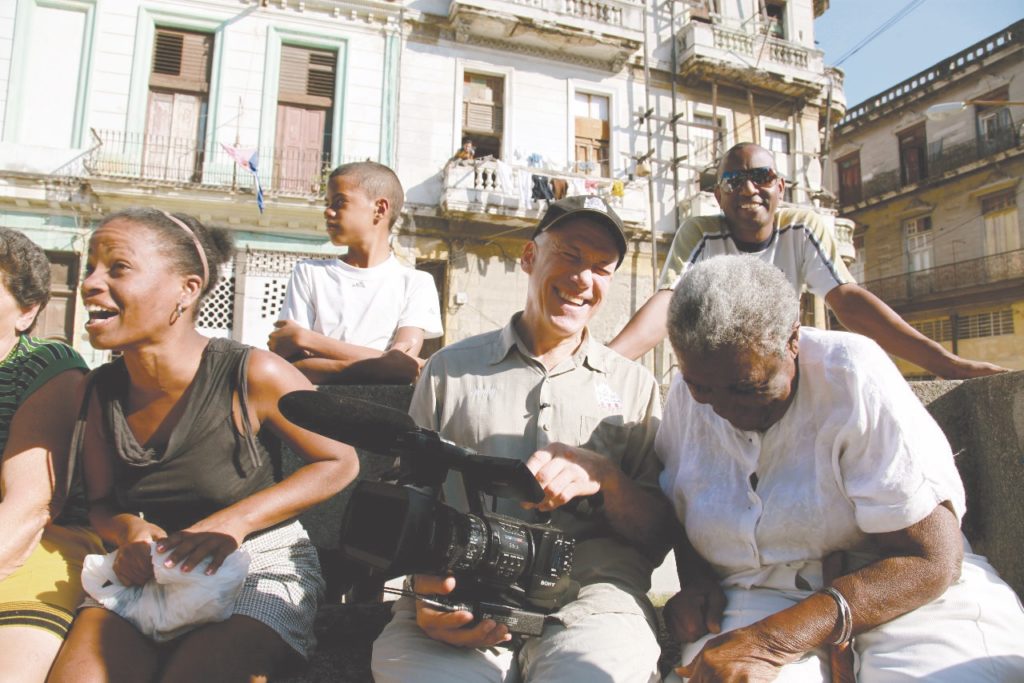
“Cuba and the Cameraman” is Alpert’s homage to a country that he fell in love with and kept visiting to track its progress. The film will be launching on Netflix and opening at the Laemmle Monica Film Center on Nov. 24.

Alpert (“Baghdad ER,” “China’s Unnatural Disaster: The Tears of Sichuan Province”) is a multiple Emmy Award-winning and Academy Award-nominated documentarian and a lifelong New Yorker. Along with his wife, Keiko Tsuno, he co-founded New York’s Downtown Community Television center (DCTV), now the country’s largest nonprofit media center.

Alpert’s guerrilla filmmaking style on display in “Cuba and the Cameraman” generally involves buttonholing strangers on the streets of Cuba to talk to him and show him around their neighborhoods while he walks with a single shoulder-mounted camera.

As the film progresses you see his style evolve. He first brought his daughter, Tami, to Cuba when she was 2. By the time she’s a teenager, she’s the cinematographer. In one surreal and hilarious scene, she asks for — and receives — a note from Castro to bring to her teacher explaining her absence from school.

“We probably hatched the idea together that the only way to keep her out of trouble would be to get Fidel to write a note, and it worked,” Alpert said with a laugh.

Alpert has made an unlikely career out of showing up in places most film crews would deem too dangerous. Name a country that’s seen mass violence in recent decades and Alpert has probably been there: Iraq, Afghanistan, Nicaragua, Vietnam, Cambodia, China, the Philippines and many others. He sold his footage to networks, which gave him the stability to keep traveling and documenting war zones.

His second visit to Cuba in 1974 lasted two months, and resulted in “Cuba: The People,” a well-received, one-hour documentary shown on PBS. By the late 1970s, Alpert was established as a reliable — and sometimes the only — Western reporter in the country.

“I was sort of the filmmaker-reporter of record. I could get my cameras into Cuba when other people couldn’t,” he said. “But this changed after the Mariel Bay boatlift.”

The Mariel Bay boatlift was a mass migration of refugees from the island in 1980, with the approval of the Cuban government. As many as 125,000 Cubans arrived in Florida in crowded boats, including a number of prisoners and mental asylum inmates. “Fidel was making sure that he emptied out these institutions and sent these folks to the United States,” Alpert said.

Alpert interviewed the inmates as they were preparing to leave the country, and that footage, he says, is what ended the boatlift. “It was the lead story on NBC Nightly News. Fifteen minutes after the story was broadcast, [then-President] Jimmy Carter goes on the air and stops the boatlift, and his speech is almost word for word from the content of my report,” he said.

The sudden end to the boatlift presented a problem for the roughly 300,000 asylum-seeking Cubans who had not yet left. They already had abandoned their jobs and homes, and renounced socialism and Castro, and now they had to be reabsorbed into society.

“The needed a scapegoat and evidently I became the scapegoat. On a subsequent trip to Cuba, I couldn’t film anything and was more or less kept in my hotel room with permission being denied to go to the places that I would normally be able to go film,” Alpert said.

The limitations placed on the fillmmaker actually provided a structure for “Cuba and the Cameraman.” Because he couldn’t go to schools, hospitals and community centers, he decided to focus on the lives of three families that he had befriended.

Alpert, who was able to enter the country as a journalist, regularly returns to visit three brothers — Cristobal, Angel and Gregorio — who own a farm and struggle to till the soil after thieves steal their oxen. He meets a young girl named Caridad and then comes back to find that she’s a mother with two grown children. And he meets a former wrestling champion named Luis who shows Alpert around his tough, working-class neighborhood of Havana.

“I was sort of the filmmaker-reporter of record. I could get my cameras into Cuba when other people couldn’t.” — Jon Alpert

Alpert’s fascination with Cuba stems from Castro’s charismatic personality and his unlikely victory over U.S.-backed leader Fulgencio Batista in a 1959 military coup.

“The story of that revolution is very romantic. It’s like the Maccabees. There’s a little bunch of guys that hold off a force that should have steamrolled them,” he said. “They succeed and they took the country over. And the things he was trying to implement, if you look at the things my family left Europe for — freedom to go to school, have a nice place to live, health care … at least on paper they were trying to implement these things in Cuba. It made me extraordinarily curious and made me want to meet the person in charge of that.”

In 1976, Castro was intrigued by Alpert and the reel-to-reel Portapak camera he lugged around in a baby carriage, and granted him exclusive interviews that were remarkably intimate. They chat like old friends, and one forgets Castro was an equally reviled and beloved dictator. On subsequent visits, Castro would joyfully greet “The Journalist.” Alpert was the last Western journalist to interview Castro before he died in 2016 at age 90.

“His staff seemed to be horrified,” he said. “They’d never seen anyone ask Fidel these types of questions. I want to see what’s inside the refrigerator. It’s sort of an equal-opportunity invasion for everybody. And I think Fidel liked it and enjoyed being part of that examination.”

Alpert’s family encompasses the range of Jewish experiences (“I’ve got a rabbi on one side and communists on the other”) and he credits his Jewish upbringing for how he treats his interview subjects.

“That’s what our tradition teaches us,” he said. “We’re all equal under the eyes of whomever you think is looking down on us. That’s how I was taught to go through the world and that’s how I interact with everybody. I want to make sure that when I report back to my audience that I really certified that this is the case.”

“Cuba and the Cameraman” launches on Netflix and opens at the Laemmle Monica Film Center,1332 Second St., Santa Monica, on Nov. 24.

Four Decades of Footage Capture a Changing Cuba Read More »

Bringing a Gay Love Story to the Screen

Veteran movie producer Howard Rosenman has long championed gay characters and gay themes in movies. His latest film, “Call Me by Your Name,” which made a splash at this year’s Sundance Film Festival and opens in Los Angeles on Nov. 24, is a tender love story about a teenage boy’s summer romance with a young man.

It’s set in the summer of 1983 in the north of Italy and focuses on an Italian-American family living in a 17th-century villa. Elio Perlman (Timothée Chalamet) is a precocious 17-year-old who spends his days swimming, reading, transcribing classical music and flirting with his friend Marzia (Esther Garrel).

Elio’s father (Michael Stuhlbarg) is a renowned antiquities professor who invites as a house guest Oliver (Armie Hammer), a charming but arrogant 24-year-old American doctoral student. Elio and Oliver don’t get along at first, but they bond over their shared Jewish identity. Over the course of six weeks, Elio realizes his desire for Oliver and seduces him.

The movie, directed by Italian director Luca Guadagnino, is based on a 2007 novel of the same name by André Aciman. Rosenman, who previously had enjoyed Aciman’s 1995 memoir, “Out of Egypt,” about his Jewish family in Egypt, said he was particularly moved by a scene in which Elio’s father sympathizes with his son and tells him to treasure the time he has with Oliver.

“When I read that in the novel, I said to myself, ‘I have to buy [the rights to] this book,’ because everyone wants a father like that — gay, straight, whatever,” Rosenman said. “I didn’t have a father like that. When I came out, he was very unhappy. We eventually reconciled but I knew that scene would resonate with everyone, which it’s doing.”

The 72-year-old producer, born Zvi Howard Rosenman, comes from a long line of Orthodox Jews.

Some critics have drawn attention to the age difference between Elio and Oliver, but Rosenman dismissed those concerns. “The movie is about the Elio character seducing Armie’s character, not the other way around, so it never felt uncomfortable to me,” he said.

The film also ran into some social media controversy when Sony Pictures UK tweeted an ad for the movie with a picture of Elio and Marzia looking passionately at each other. People were quick to ridicule the distributor’s seeming attempt to fool viewers into thinking it was a straight love story. But Rosenman said he has no doubt the movie will have mainstream appeal.

“It’s resonating with straight women and straight men. And millennials, they don’t give a s—. They look at love as love,” he said. “And this is a movie that’s not about victimization, it’s not about sickness, it’s not about feeling guilt. It’s about falling in love with someone and expressing sexuality. It’s not about judgment.”

The 72-year-old producer, born Zvi Howard Rosenman, comes from a long line of Orthodox Jews. His parents were seventh-generation Jerusalemites who were born in the ultra-Orthodox neighborhood of Mea Shearim. They became Modern Orthodox when they came to the United States and raised Rosenman in Brooklyn and Queens, N.Y.

“When I was growing up, to be gay and religious was awful. You couldn’t admit it and everybody was awful. The entire Modern Orthodox and ultra-Orthodox communities were awful,” he said. “Now I go to a Shabbat dinner here in West Hollywood with 300 gay guys wearing yarmulkes and singing ‘Shalom Aleichem.’ ”

Rosenman originally planned to become a doctor. He interrupted his medical school training to serve as a medic for the Israel Defense Forces in the Six-Day War.

“I met [composer] Leonard Bernstein, who told me, ‘You should leave medical school and go into the arts.’ And I listened to him, and he introduced me to Katharine Hepburn and Stephen Sondheim, and I worked for Katharine Hepburn on Broadway,” he said.

Thus began his long career in entertainment. Some of the more popular films that Rosenman has produced include “Father of the Bride” (1991), starring Steve Martin and Diane Keaton, Joss Whedon’s “Buffy the Vampire Slayer” (1992) and “The Family Man” (2000), starring Nicolas Cage.

In May, Rosenman received the Trailblazer Award from JQ International, a Jewish LGBTQ organization, for his work in drawing attention to gay characters and gay issues in film. These include the documentary “Common Threads: Stories from the Quilt,” which won the Peabody Award and the 1990 Academy Award for best documentary feature. His film “The Celluloid Closet” also won the Peabody Award and was nominated for four Emmy Awards.

Rosenman has been in Hollywood long enough to know there is a dark side to the industry. Ask him if the recent spate of sexual harassment allegations come up a lot in conversation and he’ll interrupt and correct you: “It’s the only topic of conversation.”

“The whole thing is tragic, for the women who have been assaulted, the men who have been assaulted, and the horrible things that these predators have done,” he said.  “It’s hard to wrap your brain around it. And every minute someone else comes out with another accusation. These careers are being ruined in a nanosecond now. People have spent 30, 40 years building up careers and because they were so stupid … this is what’s happening.”

The accusations of sexual assault against Harvey Weinstein, James Toback, Brett Ratner, Kevin Spacey, Louis C.K. and a widening web of powerful men in entertainment will “totally change the industry,” Rosenman predicted:

“It’ll change a lot of industries. It’s a sea change. This is a critical moment in the history of the culture, because this kind of stuff will not be acceptable anymore.”

Meanwhile, Rosenman is exploring a relatively new career — acting. He was cast by Gus Van Sant to act alongside Sean Penn and James Franco in the 2008 biopic “Milk” about gay activist Harvey Milk. He has since acted in eight other films, including one that he’s producing called “Shepherd,” about a German shepherd that saves a Jewish boy from a concentration camp.

But his focus still is very much on producing films that explore marginalized characters and themes, like the gay love story at the center of “Call Me by Your Name.” It’s one of several gay-themed movies hitting cinemas this year — including “God’s Own Country,” “BPM (Beats Per Minute)” and “Beach Rats” — and comes on the heels of last year’s Oscar-winning drama “Moonlight.” Had he tried to make “Call Me by Your Name” a decade ago, Rosenman doubts he would have succeeded.

“I could’ve produced it but it would have had a very small release and a very small resonance. But because the times have changed so drastically … a 6-year-old, 7-year-old kid today, when you say you’re getting married, the first thing they ask is, ‘Are you marrying a man or a woman?’ Kids today don’t have those judgments. It’s a different world.”

“Call Me by Your Name” opens in Los Angeles on Nov. 24.

Bringing a Gay Love Story to the Screen Read More »

Feast Your Eyes on Some ‘Bread & Salt’

At UCLA Hillel’s Gindi Gallery, Beverly Bialik’s playful sculpture of an oversized baked potato practically bursts with cartoony scallions and a pale yellow stack of tulle representing butter.

Wendy Sue Lamm’s color photographs depict moody close-up images of victuals that resemble portraits: A grid of nine photos of round-shaped foods (think: pita bread, a mushroom cap) is captured with dramatic chiaroscuro lighting against a dark background. These photographic prints on glass are taken from a cookbook she is now working on with Umami Burger and 800 Degrees restaurateur Adam Fleischman.

“I was trying to draw out the beauty of the food and what makes me hungry,” said Lamm, a Pulitzer Prize-winning photojournalist and the author of “From the Land of Miracles,” a 2005 book depicting Israeli and Palestinian life and strife.

The more than 20 artworks are part of the exhibition “Bread & Salt: The Art of Jewish Food,” which will be on display at the Gindi through Dec. 17. Pieces run the gamut from sculpture to painting to photography.

The show’s curator, Perla Karney, artistic director of the Dortort Center for Creativity in the Arts at UCLA Hillel, noted that recent conversations around Jewish culinary traditions have broadened past a focus on Americanized Ashkenazi foods. And yet, “I didn’t address regional cooking,” she said.

“I was trying to draw out the beauty of the food and what makes me hungry.” — Wendy Sue Lamm

Viewers won’t find representations of diasporic complexity or obscure, specific ingredients from around the globe. Instead, there are “images of food, some of which are Jewish — like a blintz with apple sauce,” Karney said. “Others are universal foods that Jews eat.”

The work includes Sarah Horwitz’s kinetic image of a pomegranate, spilling seeds meant to symbolize the 613 mitzvot.  Horwitz, a former professor at the School of the Art Institute of Chicago, based her print on images from one of her own oil paintings.

Textile artist Sandra Lauterbach makes use of the extensive collection of samples she culled over decades from her family’s fabric business. Her navy-colored challah cover is emblazoned with a delicate Star of David resembling a blooming flower. And her white afikomen cover incorporates material with which her grandmother sewed the artist a dress for Lauterbach’s graduation from Paul Revere Middle School in West Los Angeles.

Four of the five artists featured in “Bread & Salt” are women; given the connection between home and food, the exhibition falls into the context of what constitutes “women’s art” — including domestic themes that have been explored by feminist artists such as Judy Chicago and the late Miriam Schapiro.

“Bread & Salt” is part of a citywide cultural initiative exploring connections between Jews and food, managed by curators Georgia Freedman-Harvey and Anne Hromadka Greenwald. Karney’s project is among the first events related to the programming, which will extend through September 2018 at institutions including the Jewish Women’s Theatre gallery at The Braid in Santa Monica, USC Hillel and American Jewish University.

Lamm said the exhibition is happening at the right time.

“L.A. is in the midst of a food appreciation explosion, and there’s a real food scene,” she said. “Food is part of Jewish culture, and part of humor — it’s part of the whole Jewish way of looking at the world.”

“Bread & Salt” is now on display at the Gindi Gallery on the second floor of Hillel at UCLA, 574 Hilgard Ave., Westwood. For more information, call (310) 208-3081 or visit breadsaltexhibit.com.

Feast Your Eyes on Some ‘Bread & Salt’ Read More »

The Day-After-Thanksgiving Feast

You know how you wake up the morning after Thanksgiving trying to figure out how you could have eaten so much but still have a refrigerator bursting with leftovers? Well, in my case, this is exacerbated by the fact that I’m a chef and never quite know how many people are going to come to the Thanksgiving lunch in my restaurant in the American Embassy in Uganda.

You can imagine how my Jewish-mother gene gets activated during a holiday, especially when I know that I am cooking for many of our young Marines who are missing their moms’ cooking while on tour overseas. Inevitably, I spend a few hours after the meal is over portioning out care packages to anyone and everyone I see, yet I’m still always left with so much food that it begs for me to get creative with the remnants of America’s favorite food holiday.

Maybe it’s a good thing, then, that I never actually get to eat the Thanksgiving meal — I’m always too busy cooking with my team — so I’ve come up with some simple and tasty recipes for leftovers that I now look forward to eating the next day. I’m sharing three of my all-time favorites here so that they may become traditions in your household, too.

ORNA & ELLA’S YAM PATTIES
(Levivot Batata in Hebrew)

Orna & Ella is a small, cute café on Sheinkin Street in Tel Aviv. After I opened my first business in the city, I often indulged in these tender little treats when I was pushing myself too hard and needed a break. They spell comfort, and are a fantastic use of leftover sweet potato casserole. You can even throw in some leftover mashed potatoes if you have it.

3 cups mashed sweet potatoes (or a mixture of
sweet and regular mashed potatoes)
1 tablespoon soy sauce
1/2 cup flour
1/2 teaspoon sugar
1/2 teaspoon salt
1/4 teaspoon freshly ground black pepper
6 tablespoons olive oil
3 tablespoons unsalted butter (or margarine)

In a large bowl, mix the mashed sweet potatoes with soy sauce, flour, sugar, salt and pepper, and stir without over mixing. Set aside to rest and come to room temperature for 30 minutes.

Put a few tablespoons of olive oil and 1 tablespoon of butter into a heavy-bottomed frying pan over medium heat.

Transfer the mashed sweet potato mixture to a Ziploc bag and make a small cut at the tip for piping. When the oil is hot, squirt tablespoon-sized balls onto the frying pan and flatten into a patty with the backside of a tablespoon. Fry for about 3 minutes on one side and then flip, frying the other side until both sides are golden brown. Be careful flipping because the patties are fragile. Each time you add a new batch of sweet potato patties to the pan, add more oil and butter — but not too much; a thin layer will do. Transfer cooked patties to a plate lined with paper towels and continue frying until batter is used up. Serve with sour cream, yogurt or tzatziki.

Makes about 15  patties.

THANKSGIVING FEAST EMPANADAS

An Argentine woman named Sheila, who was a retired head chef at a large kibbutz in the north of Israel, once taught me an incredible recipe for empanadas, a deep-fried, stuffed hand pie. Over the years, I have made empanadas filled with ingredients ranging from the traditional meat, raisins and olives to mushrooms, cheese and sautéed shallots.

However, the day after cooking for 200 people is not the day to start making empanada dough, much less deep-frying anything. So I came up with a quick version of an empanada made from Thanksgiving leftovers and store-bought puff pastry. The only thing you have to remember is to take the puff pastry out of the freezer before you go to bed on Thanksgiving and pop it in the fridge to thaw for the next day.

1 package store-bought puff pastry, thawed
overnight in the refrigerator
1/4 cup all-purpose flour for rolling out pastry
1 egg, beaten
9 tablespoons turkey, chopped into cubes
6 tablespoons stuffing
6 tablespoons roasted vegetables,
chopped small
6 teaspoons cold gravy
6 teaspoons cranberry sauce

Preheat oven to 400 F. Line a baking sheet with parchment paper.

Remove Thanksgiving leftovers and puff pastry from refrigerator and cut the turkey and vegetables into 1/2-inch pieces.

Put a small amount of flour on a clean work surface and roll out the dough to half its original thickness. Keep moving the dough around the counter to ensure it doesn’t stick. Take a bowl that is 5 inches in diameter and use a sharp knife to cut around the bowl, creating as many pastry circles as you can.  Try to cut them close together so that you don’t waste too much pastry. This should yield about 6 pastry discs.

Place one pastry circle on your baking tray and use a pastry brush or your finger to paint a bit of egg wash on the bottom half of the disc. Place a few pieces of turkey, a tablespoon of stuffing, a tablespoon of vegetables, a teaspoon of cold gravy and a teaspoon of cranberry sauce on the bottom half of the circle. (Feel free to substitute other Thanksgiving leftovers, such as green bean casserole.) Bring the top half of the pastry circle down over the top and press gently to seal. Take a fork or the handle of a knife and press carefully to form a decorative edge on the seam. Continue filling the remaining empanadas and then brush with egg wash. Bake for 20 minutes or until golden brown.

Makes about 6 empanadas.

DAY-AFTER TURKEY SALAD

Another thing I never miss making after Thanksgiving is turkey salad. It’s fantastic on bagels, crackers or leftover toasted challah, but I love it scooped onto a big bed of crunchy salad greens. Truth be told, this is one of my go-to chicken salad recipes, but I like it even better with leftover turkey.

1/4 cup toasted slivered almonds
2 cups of turkey (white or dark meat or
a mix), chopped into 1-inch cubes
3 celery stalks, coarsely chopped
3 scallions (white and dark parts),
finely chopped
3 tablespoons finely chopped fresh tarragon
(or 1 1/2 tablespoons dry)
2 tablespoons crystallized ginger,
finely chopped
3/4 cup mayonnaise
1 tablespoon Dijon mustard
2 tablespoons cranberry sauce
1 teaspoon salt
1/2 teaspoon freshly ground pepper

Toast raw almonds in a dry pan for 5 minutes or until golden brown on all sides. Then, in a large bowl, mix together toasted almonds, turkey, celery, scallions, tarragon and ginger.

In a smaller bowl, whisk together the mayonnaise, mustard, cranberry sauce, salt and pepper, and then drizzle the dressing over the turkey. Mix to combine and chill covered in the refrigerator for at least 3 hours or overnight.

Makes 4 servings.


Yamit Behar Wood, an Israeli-American food and travel writer, is the executive chef at the U.S. Embassy in Kampala, Uganda, and founder of the New York Kitchen Catering Co.

The Day-After-Thanksgiving Feast Read More »

Philip Raucher: Performed Dangerous Work, Then Hid Among Corpses

Phil Raucher, nearly 18 and recovering from a cold and fever, lay on a bunk in the sick block as the SS began evacuating the Funfteichen concentration camp in western Poland. It was Jan. 21, 1945, and the Russians were closing in. Naked, he rose to get a uniform and shoes, “just in case,” he recalled, but he already had resolved to stay behind.

Phil gave away his shoes to one prisoner and his uniform to another and walked into a nearby room where corpses were piled high. He lay down, pulling a few bodies over him. Sometime later, two SS soldiers entered the room, searching for strays. “Forget them,” Phil heard one of them say, “they’re not going anywhere.”

Phil credits this decision to remain behind — which, he said, “came out of the blue” — with saving his life. “You had to learn what to do and what not to do,” he said. “But luck is the main thing.”

Born Pinkus Raucher on Feb. 1, 1927, in Czeladz, Poland, to Israel and Sarah, Phil had an older sister, Rachela, born in 1924, and a younger brother, Alter, born in 1930. His father operated a business that rented horses and wagons to local peddlers, and owned a hardware store in Radzionkow, 12 miles away.

Phil attended public school and cheder and was active in the Polish Scouts, where he encountered no anti-Semitism. “We had a lot of fun,” he recalled.

But the fun ended in November 1938, around Kristallnacht, when Jewish businesses in Zaglembie, the coal mining region bordering Germany, including Czeladz, were smashed and looted. Concurrently, Phil’s once good friends became his tormentors, bullying him and other Jewish boys.

In August 1939, with war looming, Phil’s parents sent him and Alter to their grandfather in Wolbrom, 40 miles east. The boys watched German soldiers march into town on Sept. 5, but a week later, with too many relatives in the house, they returned home.

Back in Czeladz, which, as part of western Poland, had been annexed to the Third Reich, Phil worked in the police station, cleaning up and shining shoes for the German officers.

In May 1940, as the Germans confiscated the houses and businesses of the town’s Jews, the Rauchers found another apartment. Phil worked unloading sacks of potatoes. When the ghetto was established in early 1942, the family was forced to move again, and Phil worked as an apprentice in a furniture factory.

In August 1942, with a change in the work laws, Phil’s parents hired a smuggler to take him and Alter back to Wolbrom, which was not part of the Third Reich. The smuggler could take only one boy at a time, and Alter went first. On Sept. 5, 1942, a large roundup took place in Wolbrom, and both 12-year-old Alter and the boys’ grandfather were sent to the Belzec death camp and murdered.

“You had to learn what to do and what not to do. But luck is the main thing.” — Phil Raucher

Phil was picked up two months later and sent to a transit camp in nearby Sosnowiec. Knowing a selection would occur, his parents smuggled a bottle of soapy water to him to drink, assuming he would begin vomiting and be sent home. But Phil refused. He didn’t know where the Germans would send him, but he didn’t want to return home or, more likely, be killed. So Phil was trucked to the Markstadt labor camp, about 113 miles northwest of Sosnowiec.

Arriving on a cold, rainy night, the prisoners immediately were taken to unload heavy sacks of cement and carry them to a warehouse. Inside, a prisoner running the cement mixer took a liking to Phil, instructing the newcomer to request working with him.

The next day, after roll call, Phil voiced that request. “I’m the one who decides where you go,” the kapo snapped, turning on Phil. “He beat me up like crazy,” Phil recalled.

Phil then was assigned to unload 8-foot-long pieces of wood and carry them, singly, to a Krupp factory construction site. The boards were heavy, but Phil, from his furniture factory experience, knew to select the drier, lighter pieces.

Several weeks later, the prisoners in Phil’s barracks were punished after their room leader disappeared. One by one, they were strapped down to a special table where two kapos dispensed 25 lashes across their backs. Phil was too small to be properly strapped down and so he jumped around. “I got hit worse than the others, on the head, everywhere,” he said.

The next day, as Phil was recovering, his father, newly arrived at Markstadt, entered his barracks, bringing food. “If he hadn’t come in at that moment, I wouldn’t be alive now,” Phil said.

The prisoners were transferred in 1943 to nearby Funfteichen. Phil was given a uniform and wooden shoes and continued at the same job.

When Phil’s father unexpectedly died a few months later — Phil never learned the cause —Phil was allowed to carry his body to a nearby field, where he dug a grave and said prayers. (Phil later learned that his mother was murdered at Auschwitz.)

Phil then worked unloading 35-foot girders with a crowbar from a railway car, which prisoners, up to 40 at a time, carried to the work site while guards shouted and struck them with whips. The prisoners often lost their grip, causing the beams to fall and crush people. “I don’t know how many got killed every day,” Phil said.

Later, after cranes had hoisted the girders atop the factory columns, a five-story height, Phil was one of the prisoners who walked along the foot-wide planks carrying 8-foot-long joists to cross brace them. Many of the prisoners “fell like flies” and died, Phil said.

One day, the camp commandant, observing the dangerous work they were performing, ordered a week’s worth of extra food. “A few days with food revived you,” Phil said.

Two days after Phil decided to hide among the corpses, on Jan. 23, 1945, the Russians liberated the camp, and Phil soon headed back to Czeladz, which he reached in early March.

He subsequently made two long trips into Germany, searching for his sister. When he finally returned to Czeladz in April or May 1945, he found Rachela and her boyfriend. The three decided to leave, making their way to Munich, where they rented an apartment and supported themselves on the black market.

In December, Phil, then 18, arrived in New York as a refugee. (Rachela later immigrated to Brazil, where she lived until her death in 2015.) He settled in Cleveland, where he found a job assembling machines and attended night school. He also studied drafting.

Around 1956, Phil moved to Los Angeles. He worked for an air conditioning company and attended night school and later UCLA Extension. On Feb. 5, 1967, he married Virginia Rosenthal, a Cleveland native whom he met at a Jewish singles dance in Beverly Hills. Their son, Steve, was born in November 1967, and their daughter, Debbie, in May 1969. They have two granddaughters.

For the past 25 years, Phil has been employed by Air Products and Services in Van Nuys, and, at 90, occasionally goes on inspection calls. He also speaks at the Los Angeles Museum of the Holocaust and participates in the museum’s L’Dough V’Dough program, which brings together students and survivors to bake challah and share stories.

“It’s luck,” Phil tells people of his survival. “I couldn’t have planned it any other way. You didn’t know in advance what was going to happen.”

Philip Raucher: Performed Dangerous Work, Then Hid Among Corpses Read More »

TABLE FOR FIVE: Five Takes on the Weekly Parsha

PARSHA: VAYETZE, Genesis 28: 10-12

“Jacob left Beersheba and set out for Haran. He came upon a certain place and stopped there for the night, for the sun had set. Taking one of the stones of that place, he put it under his head and lay down in that place. He had a dream; a stairway was set on the ground and its top reached to the sky, and angels of God were going up and down on it.”

Rabbi Adam Greenwald
American Jewish University

Western art has given us an image of angels as chubby, adorable children or majestic, winged warriors. The angels who ascend and descend the ladder in Jacob’s dream are neither. The word for these angels is malachim, which simply means “messengers.” In Jacob’s nighttime vision, he catches a glimpse of God’s postal service, as it were, carrying word back and forth between heaven and earth.

If you have encountered a person who spoke a painful truth that stirred you to change, or offered words of encouragement just when you thought about quitting, or communicated to you — with a smile, a hand, a hug — that you are loved and cherished, then you, too, have met one of these malachim. And, if you have done any of those things for others, then you have been one yourself.

Later, Jacob will wake from his dream and exclaim: “Amazing! God was right here and I had no idea.” When we think of God as an all-powerful Sovereign in the sky, or when we imagine angels as they appear on a Renaissance canvas, we participate in making heaven and earth very distant from each other. But when we recognize that the Divine works through us and through those we meet every day — that “angel” is just another word for friend, partner, therapist, rabbi, colleague or stranger on the street — we see how short the stairway connecting the two can be.

Rabbi Jason Weiner
Cedars-Sinai Medical Center, Knesset Israel Congregation

In these profound verses, as our forefather Jacob flees his brother’s wrath, he begins a process of intense transformation. As invariably happens during personal growth and spiritual awakening, Jacob is journeying alone, likely feeling betrayed, dejected and isolated.

As the sun sets and the deepest darkness begins to set in, instead of making a comfortable bed to sleep in, Jacob remains strong and focused in the moment, and chooses to sleep on rocks. This may be symbolic of the reality that spiritual growth and transformation most often occur when there is a lack of physical comfort, when things aren’t going well and we find ourselves “between a rock and a hard place.”

Jacob is in the difficult process of examining his actions and his life, and he manages to fall asleep and communicate with the Divine through an incredible dream. As the angels go up and down, representing the potential for spirituality inherent in the dramatic vicissitudes of life, God promises not to abandon Jacob, helping him to realize that he is never truly alone.

This is a message for all of us as well. There are times when we feel most afraid, most abandoned and mistreated. Hardships inevitably arise, but these moments can sometimes induce profound growth and spiritual realization. We can take comfort in our faith that we are in fact never alone.

Rabbi Jocee Hudson
Temple Israel of Hollywood

I can think of only a few experiences in my life when I have literally been brought to my knees. Looking back on each of them, I remember feeling a similar desperate gravitational pull, yanking me downward, before I felt my body buckle. What I’ve learned is this: In desperate moments, the mere typical contact between ground and feet feels inadequate. In some primitive way, feeling my body against the earth brought relief.

Jacob clearly isn’t seeking comfort when he selects a rock for a pillow and enters into transformational, dream-filled sleep. Adrift in the world, in search of a new future, fleeing for his life, and having to sit with the choices he made, I imagine Jacob fumbling for some sort of grounding. So he picks up a rock. And goes to bed.

Here’s the other thing that’s pretty much universally true about dropping to our knees: We all eventually have to get up. Even when it’s really, really hard.

Perhaps it is this impulse — the knowledge that he would have to finally wake and move and be — that explains the mystery of Jacob’s angels, which curiously ascend before they descend.

“Get up!”

The angels seem to be beckoning Jacob to rise from the earth and to start listening.

In this way, Jacob’s vision of the angels is ultimately a story of getting mired in life’s complexities, being felled by them, transcending a moment of despair, and moving on. It’s a story many of us have lived and all of us can learn from.

Rabbi Jill Jacobs
T’ruah: The Rabbinic Call for Human Rights

Fleeing home, Jacob heads toward an unfamiliar place and an extended family he does not know. Stopping for the night, he sets up a bed for himself: “And he took from the stones of the place, and placed it under his head.”

A stone doesn’t sound like the most comfortable pillow under the best of circumstances. Even more so once the rabbinic tradition saddles this stone with the weight of the past and future:

“Jacob took twelve stones, from the stones of the altar upon which his father Isaac had been bound, and placed them under his head in that same place, to indicate that in the future, twelve tribes would come from him. And they all became one stone to indicate that in the future, they would all become one people on the earth.” (Pirkei d’Rabbi Eliezer 35:1)

Imagine sleeping on the stones that survived your family’s greatest trauma! We might imagine nightmares about the Akedah — the binding of Isaac — keeping Jacob tossing and turning all night.

At the same time, the 12 stones offer a promise that Jacob will emerge whole from his perilous journey, and will become the father of an expansive and unified people.

It is easy to become paralyzed by the trauma of the past. And it may be equally tempting to shut out this past in order to move forward. Jacob challenges us instead to keep a multivalent stone under our heads — that is, to allow past trauma to be the base on which we build hope for the future.

Rabbi Daniel Bouskila
Sephardic Educational Center

What was this “place” where Jacob spent the night? According to Rashi, this “place” was Mount Moriah, commonly associated with the Temple Mount, the sacred site in Jerusalem where two Temples once stood.

To Jacob, Mount Moriah had a more personal connotation. It was the mountain where his father, Isaac, and his grandfather, Abraham, had walked up together as father and son, but on their way down, could no longer speak to each other. It was the place where his father, Isaac, was bound on an altar with a knife to his throat.

One can only wonder what it felt like for Jacob to be in the same spot that traumatized his father for life. Were there remnants of the altar and the ropes? Was the knife still there? Could he hear echoes of his father’s voice asking, “Where is the sheep for the burnt offering?” Could he feel his father’s “fear and trembling,” as Kierkegaard put it?

This frightening encounter with his father’s trauma all took place at night. “Never shall I forget that night,” Elie Wiesel said. I’m sure if asked about that night, Jacob would say the same thing. Like many who encounter terrorizing moments, Jacob turned to prayer. Indeed, it was at that place, on that night, when Jacob established tefilat arvit, Judaism’s nightly prayer service. At some point in life, we all stand in that “place.” We all experience that traumatic night. We all confront our past … and then we pray.

TABLE FOR FIVE: Five Takes on the Weekly Parsha Read More »