fbpx

November 21, 2017

Ambassador Danon Hopes to ‘Close the Gap’ at the United Nations

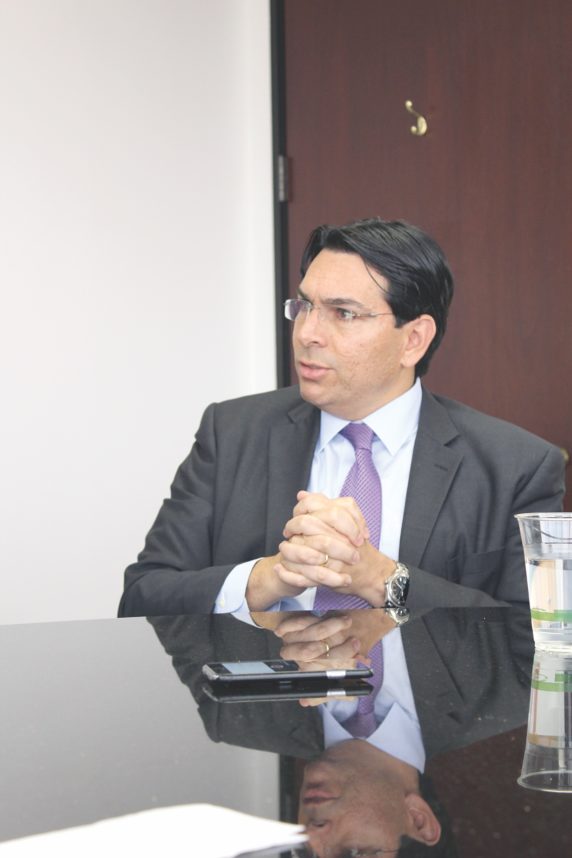
“You have a public U.N. and you have a private U.N.,” Israel’s United Nations Ambassador, Danny Danon, told a packed audience at Young Israel of North Beverly Hills on Nov 14. “My goal is to close that gap.”

Danon is all too familiar with that gap. In June 2016, he ran for office to head the U.N.’s Legal Committee, which deals with cases such as international terrorism. Election ballots usually are public, but secret ballots can be requested by U.N. members. In this case, the Palestinian representative requested a secret ballot, to avoid Israel influencing fellow ambassadors on how to vote. The tactic backfired.

“That was his mistake,” Danon told the audience. “Many countries told me, if we open [the ballot] and make it public, don’t count on us, yet. But if it’s a secret ballot, 100 percent we support you. You deserve it and it’s about time Israel will chair a committee.”

On that day, Danon became the first Israeli representative to be elected to a U.N. permanent committee, with 109 of 193 votes in his favor. “We broke the glass ceiling,” Danon told The Times of Israel after his victory.

One year and five months after that landmark ballot, Danon was recounting the little victories he and his team have worked to accomplish. Kosher food is now available in the U.N.’s New York cafeteria and, as of 2015, Yom Kippur became an officially recognized holiday. Previously, the U.N. observed 11 official holidays, including the Muslim holidays of Eid al-Fitr and Eid al-Adha and Christian holidays such as Good Friday and Christmas. Now, Yom Kippur has been added to the list.

“We got it done,” he told the audience, which broke out in applause.

Kosher food is now available in the U.N.’s cafeteria and Yom Kippur became an officially recognized holiday.

Danon made it clear that he’s aiming a lot higher. “What happened yesterday with the vote on the human rights violations in Syria, it is a sign that we are closing that important gap,” he said, circling back to issues between public versus private U.N. selves. Notably, the vote was not a secret ballot.

In May, Danon was elected as vice president of the 72nd Session of the U.N. General Assembly. As vice president, Danon chairs meetings of the General Assembly, takes part in setting the GA’s agenda, and oversees the rules and decorum during its sessions.

Before representing Israel at the U.N., Danon, who is in Israel’s right-wing Likud Party, was serving as a member of the Knesset, holding positions such as Minister of Science, Technology and Space and Deputy Minister of Defense. In 2014, Danon was fired from his position as Minister of Defense by Prime Minister Benjamin Netanyahu after he criticized the way the government handled Operation Protective Edge — namely, how Netanyahu accepted a truce with Hamas. Danon published a public response to his firing with the statement: “The prime minister doesn’t accept that there are other views in his party.”

Soon after, Netanyahu appointed Danon as U.N. ambassador. Critics went to town on this decision, dubbing it as the prime minister’s slap at the U.N. and at Danon, an all-in-one appointment. (Netanyahu served in the U.N. from 1984 to 1988.) Haaretz wrote, “The joke goes that in one move, we see how much Netanyahu hates Danon — hence his decision to send him far away and remove him from the cabinet table — and how much he hates the U.N. — because he sent them Danon.”

Still, Danon is proving to be a force to be reckoned with. He ended his lecture at Young Israel with a promise, speaking on behalf of Israel to the international community:  “We shall prevail.”

Ambassador Danon Hopes to ‘Close the Gap’ at the United Nations Read More »

The Power of Story

Jews always say that words create worlds.

I thought of this as I listened to Jewish-Guatemalan writer Eduardo Halfon speak at the Jewish American and Holocaust Literature Symposium in Miami last week.

Language is immensely important for Halfon. His grandfather — whose story Halfon tells in his novel “The Polish Boxer” — was taken to a concentration camp in 1939, and later to Block 11 to be shot. While there, he began to say Kaddish for his family and for himself, believing he would soon die. A man next to him recognized his Lodz accent. This man, a Polish boxer, was from the same town.

The boxer made it his business to train Halfon’s grandfather in the art of surviving the camp. But it wasn’t boxing that was the nature of this training. It was language. The boxer, whose skills made him a valuable entertainer in the camps — exempting him from being killed — trained him in what to say and what not to say. He trained with words, rather than fists.

Language, knowing when and when not to speak, saved Halfon’s grandfather’s life.

After the war, Halfon’s grandfather moved to Guatemala. And although Polish — his mother tongue and the language spoken between him and the boxer — essentially prevented his death, he stopped speaking it. “The Polish betrayed us,” he said.

He also said nothing about the camps until one day, when Halfon asked him about it. He spoke for six hours, his stories excavated and unearthed through language. There were “60 years of dust on his memories,” Halfon said.

For Halfon, an engineer, his grandfather’s story was a portal into Judaism, which he had pushed away. Halfon found that writing about his grandfather’s experience brought him unexpectedly closer to Judaism. It became the “entryway” to access his family story.

Halfon’s parents saw his resistance to Judaism as rebellion, but for Halfon it was about not wanting to claim what had been simply handed to him, passed down through generations, painted onto his genetic makeup. “If I wanted it back, it had to be by choice,” he said. “I had to find it on my own.”

“I’m working my way back through story, through my grandfathers. They are guiding me back slowly to that part of me I’ve been pushing away for so long. The only thing I’m interested in is story,” he said.

But story is all there is. That is what it means to be Jewish — to carry the stories of our mothers and fathers along with us, to protect and propel them into the future. Story and language are critical not just to our identity, but also to our survival.

“Still,” continued Halfon, “I’m resisting Judaism. … I push it away, but I look for it at the same time.”

To push and pull simultaneously — it’s an impulse passed down from biblical patriarchs and matriarchs who were pushed and pulled in different directions, whose internal struggles were no less intense than wars waged on battlefields.

As much as Halfon admits to being pushed away from Judaism, it is story that pulls him back and language that keeps him tethered to his identity. Story is always evolving. “My grandfather’s story keeps growing as I grow,” he said.

“My grandfathers are guiding me back slowly to that part of me I’ve been pushing away for so long. The only thing I’m interested in is story.” — Eduard Halfon

And isn’t this the way of Torah and the layers of commentary surrounding it? The Mishnah and later the Gemara prove our understanding that there’s more to every story. Halfon’s admission that each time he approaches his grandfather’s story he discovers more is the Jewish way of seeing story, of turning it and turning it to find everything within it.

Another scholar, David Patterson, recalled a midrash on Joseph, in which Pharaoh says: “I will see if you have wisdom, if you know the 70 languages of the nations.” It was knowing all these languages plus one more that saved Joseph’s life — while Pharaoh didn’t know Hebrew, Joseph did.

And it occurs to me: Maybe story is a language, and maybe Jews have known this all along. Yes, I think to myself, story will save us.


Monica Osborne is a writer and scholar of Jewish literature and culture. Her book, “The Midrashic Impulse and the Contemporary Literary Response to Trauma,” will be published in December.

The Power of Story Read More »

The Beauty of Yes

When you have a child with significant disabilities, you get used to hearing “no.”

From nationally recognized speech therapists who say, “Sorry, my cutting-edge techniques won’t work for your son,” after you have schlepped the family halfway across the country to work with them, to Jewish educators who will open their classrooms to some “higher-functioning” students with special needs but not to those who need one-to-one assistance. Not to mention navigating the world of special education in the public school system in which you need to become an expert on the governing federal laws in order to get the services to which your child is entitled.

Such was the case with Birthright. Although I have worked on and off as a Jewish community professional for many years, I never imagined that our son, Danny, now 23, would be able to go on Birthright — the program providing free Israel trips to adults between 18 and 26 — in spite of the fact that he would be the perfect candidate in many ways.

He grew up watching kids’ musical videos in Hebrew, understands a lot of Hebrew, attends Shabbat services weekly at a Conservative synagogue and has visited Israel with our family. He loves Israeli dances and enjoys flying on planes.  He has probably watched the documentary “Hava Nagila” more than anyone else in the world, and his older sister spent a Masa-sponsored gap year in Israel, speaks Hebrew fluently and has staffed two Birthright trips.

In my former position at The Jewish Federation of Greater Los Angeles, I sat in on many meetings with Birthright staff members and always enjoyed hearing all of their post-trip stories and adventures. But I couldn’t imagine a Birthright trip that would be able to accommodate Danny, who has limited mobility, not to mention a complicated medication regimen. The 10-day Birthright trips are known for their fast-paced, grueling schedules, including intensive physical activities and moving from hotel to hotel.

How could Danny ever participate in a trip like that?

Then in September, I received an email from the national Conservative-affiliated Camp Ramah Tikvah network. It was announcing the first-ever Birthright Israel: Amazing Israel-Ramah Tikvah trip for young adults ages 18-29 with disabilities. Ramah has organized previous Israel trips for Tikvah program participants and alumni, but this would be the first one being offered in collaboration with the international Birthright program, which has brought more than 600,000 young Jews to Israel since 1999.

The trip starts on Dec. 18 and will include classic Birthright Israel activities such as visiting Masada (by cable car) and Yad Vashem and spending Shabbat in Jerusalem, while also adding programming geared specifically for these participants, such as meeting Israeli soldiers with special needs.

Thanks to Elana Naftalin-Kelman, Tikvah director at Camp Ramah in California in Ojai, Danny has been an overnight summer camper there for the past nine years, always accompanied by a personal aide to help him with such everyday activities as dressing, eating and showering. Danny loves his time at camp, and we also love our “time off” from family caregiving. Last summer, Danny was able to gain vocational experience doing his favorite activity — being a DJ at the side of the pool, which also is his favorite place in camp.

I never imagined that our son, Danny, would be able to go on Birthright.

Elana helped me connect with Howard Blas, National Ramah Tikvah Network director, who is coordinating and leading the trip in partnership with Amazing Israel, the Birthright tour provider. Howard has led many trips to Israel with young adults with disabilities and fully understands the need to adjust the trip’s pace and intensity.

During our Skype call with him, Howard was very welcoming and open to the idea of having our personal aide from camp accompany Danny on this trip. He told us, “While we will all learn a lot from the explanations of our very experienced tour educator, Doron, each person will experience Israel differently. The trip takes each participant’s unique needs and learning style into consideration. We will experience Israel through all of our senses — riding a jeep in the Golan Heights, floating in the Dead Sea, planting trees, making chocolate and T-shirts, touching the Kotel and lots of singing, dancing and eating delicious Israeli foods!”

The word “yes” has never sounded so good.


Michelle K. Wolf is a special needs parent activist and nonprofit professional. She is the founding executive director of the Jewish Los Angeles Special Needs Trust. Visit her Jews and Special Needs blog at jewishjournal.com/jews_and_special_needs.

The Beauty of Yes Read More »

We Need to Communicate

Einstein once said, “We cannot solve our problems with the same thinking we used when we created them.” Although he wasn’t talking about Jewish communal infrastructure, he might as well have been.

When we apply his rubric to our modern-day infrastructure, we see a landscape that is woefully inadequate to address the paramount problem of tomorrow and, to a more alarming extent, today: the war of public perception.

Our communal failure to adapt rapidly enough to shifts in how information is created, sought out and processed is eroding our community’s ability to define ourselves and accomplish fundamental common goals — from promoting Jewish pride and identity to defining the value of anti-Boycott, Divestment and Sanctions laws.

This strategic communications vacuum enables detractors of Israel to leverage digital media to malign Israel and sow relentless doubt and division, even among increasing numbers of young American Jews, mainstreaming anti-Zionism and anti-Semitism.

Our challenge is not a lack of ideas. Rather, it is a dramatic misallocation of funding in our community.

The success of America’s Jewish community rests on a three-legged stool. The first leg, lobbying and politics, educates and builds relationships with decision makers, hopefully helping to turn ideas into legislation that’s good for America and good for Israel. We invest in this work at a high rate, in the hundreds of millions of dollars annually, with great effect.

Second are think tanks, crafting ideas to strengthen America and Israel — from Birthright and synagogues to Jewish Community Centers and social service organizations, all of which seek to enhance Jewish continuity. The vast preponderance of our philanthropic dollars, quite literally tens of billions, are invested here annually.

The third leg is strategic communications, increasingly critical to defining ourselves and conventional wisdom. If what we want to accomplish is falsely, but successfully, smeared as bad for America, we will lose. Today, everything our kids believe about Israel, what their peers think about Israel and Jews, and what Capitol Hill staffers believe is being defined and shaped in new, powerful ways.

This third domain is barely funded by our community: Less than $10 million a year is spent on strategic-communications efforts today. That figure must change if we plan to have any meaningful impact on our shared destiny.

Early in the 20th century, Jews in America were indigent — we couldn’t feed ourselves — so we built the infrastructure and organizations to thrive. After World War II, it was refugees and the nascent State of Israel. Later, the community came together and built the infrastructure to face down the threat to Soviet Jewry.

We should be proud. During the past 125 years, we have addressed the great existential problems facing our people and overcome incredible obstacles to build a foundation for thriving Jewish life.

Today, however, the threat facing Jewish peoplehood is again different and we do not have the infrastructure we need to survive. Our fight today cannot be solved through brick-and-mortar institutions. Instead, we must build a communications infrastructure designed to fight delegitimization and anti-Semitism hidden in anti-Israel sentiment.

Our challenge is not a lack of ideas, but a dramatic misallocation of funding.

Cisco estimates that by 2018, 86 percent of communications will be visual. More than 50 percent of Americans get all their news on Facebook. More people will watch video content online than on ABC, NBC and CBS combined.

Organizations like The Israel Project, which I run, are leading the way in using data-driven solutions and developing new platforms to fundamentally change public opinion on Israel and world Jewry.

Fortunately, the investment required to change course before it is too late is a fraction of what is already being allocated. With a few elite organizations like mine driving innovation and change, it is up to funders and philanthropists to step up and adjust their allocations to make room — at least 5 percent of annual distributions — to invest and expand this critical domain.

I recently asked a community leader if he agreed that our community and Israel face different threats than five or 10 years ago, and if those different challenges require different strategies. Yes, he said. So I asked him, “What is the definition of insanity?” Hearing himself give the answer, he understood immediately. It is critical for all of us to adjust and make room for this work, and make it a priority.


Josh Block is CEO and president of The Israel Project.

We Need to Communicate Read More »

My Rant Against Conformity

As I write, Facebook feeds me a story of a play at a prestigious university that satirized political correctness and was shut down for offending political sensitivities. It’s unclear why any political beliefs should be beyond mockery, but zealous indignation seems to be the spirit of the age.

The 1960s had their liberation, the ’90s their chemical utopianism, and today we have the tyranny of offense. It seems as if every week another speaker is shut down, bullied out of a college auditorium or drowned out by the shrill protests of pious 18-year-olds acting as our own morality police.

Enabled by feckless administrators, their inability to stomach ideas even mildly at odds with their facile dogmas is suffocating our public discourse. We’ve come to accept the shutting down of some discomfiting opinions as outright sacrilege, and the imposition of others as de rigueur. This, in the age of ISIS.

The yearning for soothing certitudes, for truths set in stone, is strong in our species. Our urge to organize around shared myths is hardwired in us, a product of evolution’s hardest-fought battles. But slavery to ideological idols is what characterizes the most shameful chapters of our past — as it does the worst societies of our present. The imposition of one group’s preferred ideology and the silencing of others by intimidation is what happens in dictatorships. It shouldn’t be happening on an American college campus.

Oceans of blood have been spilled and centuries devastated in humanity’s effort to extricate itself from the beguiling embrace of ideological conformity. The price of our evolution, of science and progress, is the ability to tolerate ideological diversity, slay taboos and brush off offense. Today, that sacred history seems to be forgotten, the 30-Year War eclipsed by the 30-second attention span, enlightenment with sanctimonious hypersensitivity and entitled imposition.

We are boldly going where man has been before, charging headlong into a past where truth is a slave to tradition, where humility and empathy are very much absent. Driven by those who would presume to impose morality on us, we are returning to where the most dysfunctional and repressive states on our planet still reside. How long before our fragile students start to riot in response to unflattering cartoons?

As in Middle Eastern tyrannies, some of our temples of learning are becoming the epicenters of the new, dogmatic obscurantism. College campuses have come to resemble inquisition courts. Rather than smashing idols as should be their calling, far too many professors seem instead to serve as high priests of the cult of conformity, sacrificing young minds on the altar of their dogmas. Brown has become our Riyadh, Berkeley our Karachi.

Enter stage left, the Antifa Intifada. In 2017 America, it is to be expected that people promoting the freedom to express unpopular ideas are routinely smeared as Nazis — the modern version of devil worshippers — and violently assaulted as heretics by masked mobs possessed by zealous righteousness.

And, not unrelated, university administrators are ever more eager to serve as guardians of gender virtue. The wave of revealed alleged assaults — by those Tinseltown folks most likely to be loudly preaching a new sexual morality to the rest of us — should not in any way be dismissed. It is a tragic thing to see so many women reputedly abused by so many men. But the answer to that abuse is not for the state to insert itself between men and women — in the bedroom, on campuses — as it has. Rather than teaching responsibility and respect to our young, we have let the state dictate how to manage youthful sexuality in our colleges. In an overreaction to the reported abuse of some, innocent flirting by the many becomes more risky, more threatening, more at odds with ever-narrowing and sanitized speech codes.

Undergirding this sorry spectacle is the new national pastime of collective schadenfreude, not unlike that of medieval mobs tossing rotten produce at the condemned or Middle Eastern imbeciles celebrating the murder of others by handing out oily sweets. So, too, today is it sport to watch from behind our monitors the others who crash and burn under public opprobrium, whether they deserve it or not.

And, of course, underneath this belligerent, subjective and arbitrary moralism is wall-to-wall anti-Zionism. In the East as in the West, attitudes toward Israel seem to be the litmus test for determining when people have lost their minds along with their humility.

Welcome to a Western caliphate, where good intentions buttressed by rigid dogma and moral posturing are turning disagreement into sin, sexuality into a minefield, and the future into the past.

And as in the past, the path to liberty and light must be paved but with deliberate desecration. For the only way to deal with those who fly into hysterics at any minor slight is to make them numb to offense by repeated exposure.

Those who love the freedom to think and feel as they wish would do well to find someone to offend, and quickly.


Philippe Assouline is a lawyer and doctoral candidate in international relations and political psychology at UCLA.

My Rant Against Conformity Read More »

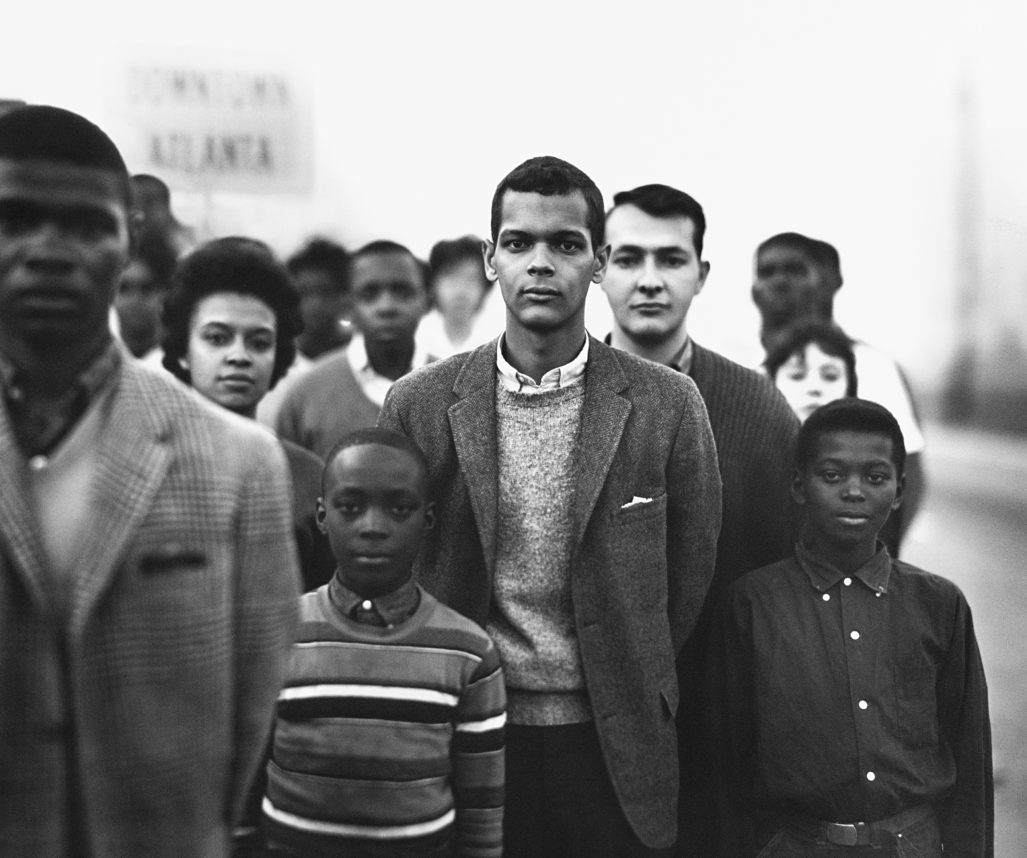
ARTIST OF THE WEEK: Richard Avedon

“Members of the Student Nonviolent Coordinating Committee,” Richard Avedon

This portrait (March 1963), led by a young Julian Bond in Atlanta, is part of “Richard Avedon:
Nothing Personal,” at Pace Gallery in New York City, through Jan. 18. In 1964, Avedon published “Nothing Personal” with an essay by James Baldwin; Taschen is releasing a new edition of the book.

Photo courtesy of the Richard Avedon Foundation.

ARTIST OF THE WEEK: Richard Avedon Read More »

Thanksgiving Spirit: Jewish Volunteers Step Up to Feed the Hungry

As the sun rose at close to 7 a.m. on Nov. 17, hundreds of people were gathered outside the Jewish Family Service (JFS) food pantry with empty shopping bags. The line extended half a block east on Pico Boulevard, wrapping south around Robertson Boulevard, and causing a stir at the busy intersection.

Many had lined up as early as 2 a.m. Some sat on newspapers spread out on the sidewalk. Others played cards to pass the time.

Inside the pantry, no one was standing around.

Dozens of volunteers, some busy since 4 a.m., pinballed around, shouting orders, pushing carts and unloading nonperishables from crates for JFS of Los Angeles’ annual Thanksgiving food drive.

“I love this day,” said Susan Wily, the pantry’s assistant manager, who donned a black shirt with skulls on it and worn worker boots. “It’s so great for the people outside as well as the people in here making it all happen.”

Susan Wily preparing care packages inside the pantry. Photo by Oren Peleg

JFS, formerly the Hebrew Benevolent Society, was founded in 1854 by Los Angeles’ Jewish community. It was the area’s first charitable organization.

Since 2001, the organization has distributed care packages of donated nonperishables and purchased frozen turkeys annually to thousands of people in need. The efforts are part of its SOVA Community Food and Resource Program, which also operates a pantry in Van Nuys. Sova is a Hebrew word meaning “eat and be satisfied.”

“We don’t just feed Jews. We feed everybody.” — Ruthanne Rozenek

The care packages included canned goods such as peas, carrots and cranberry sauce, plus instant mashed potatoes and gravy mix, as well as a frozen turkey.

“It’s pretty awesome,” Wily said, dodging a passing shopping cart filed with frozen turkeys. “These people can put together an entire Thanksgiving dinner with this and we’re helping them do that. It’s very heartwarming.”

A group of volunteers perused the line to offer warm greetings to people who had been waiting for hours in the dark. A security guard posted at the entrance controlled the flow in and out. Just inside at two tables, volunteers were handing out the packages.

Wily and her team distributed nearly 800 packages by noon. The Van Nuys pantry handed out nearly 900.

Both pantries operate Sunday through Thursday year-round and are closed on Shabbat. Businesses, schools, places of worship, community organizations and individuals contribute to the ongoing food drives. Last year, SOVA distributed 2.6 million pounds of food — over 100 tons each month.

Many of the volunteers at the Thanksgiving drive work at least once a week throughout the year, giving out groceries and toiletries. The pantries also offer a variety of services, including case management, vocational training, job-search assistance and legal counseling. Besides Thanksgiving, they also hold large drives to distribute meal packages on Passover, Rosh Hashanah and Yom Kippur.

“But today is by far our biggest, busiest day of the year,” said Linda Alter, JFS of Los Angeles’ client services manager, who stood near the entrance, where grateful care-package recipients streamed in and out. “It’s very gratifying to see all of this come together.”

Alter said the preparations for each year’s Thanksgiving drive involve serious long-term planning. A few days prior, scores of volunteers, including many high school students, had spent a day assembling the care packages at the Van Nuys pantry, which has an attached warehouse. They also stored over 1,600 frozen turkeys there. Before 4 a.m. on the big day, volunteer drivers transferred nearly half the care packages and turkeys to the Pico-Robertson location.

“It’s just amazing that we’re able to do it,” Alter said. “Getting it all in order is definitely the hardest part. It all comes down to the volunteers.”

Ruthanne Rozenek, a Fairfax neighborhood resident and longtime member of Temple of the Arts in Beverly Hills, was on the front lines inside the Pico-Robertson pantry in a hot-pink shirt and matching cap. A dedicated JFS volunteer, she has spent nearly every Monday morning and each Thanksgiving drive there for the last six years. When asked what keeps her coming back, she said it’s a combination of helping others and getting to see familiar faces.

“I just love it, love working here,” she said, distracted by a call for “More turkeys!” from down a hallway. “I love the camaraderie amongst the volunteers, and most of all I love the fact that we’re helping people. Here we feed all people. Even though this is a Jewish organization, we don’t just feed Jews. We feed everybody.”

Rozenek then apologized before rushing off to answer the call.

The line of people at the drive waiting on care packages came from all walks of life, including the neighborhood’s religious Jewish community. Inside, it wasn’t just Jews like Rozenek serving them. Several members from the Church of Jesus Christ of Latter-day Saints, mostly in their late teens and early 20s, helped out. They were easy to spot in bright yellow “Mormon Helping Hands” vests.

Elder Lira, 20, who lives in Santa Monica, said that he and his fellow church elders rescheduled a missionary meeting to make sure they could pitch in for the Thanksgiving drive.

“We just look for any kind of service,” he said. “This is a place that seemed to really need our help, so we just keep coming back. It’s so enjoyable here and everyone is so nice.

Alter said the pantry’s Mormon volunteers are an indispensable part of the operation.

“They’re here all the time. They’re incredible. We couldn’t do this without them,” she said.

Many other Los Angeles Jewish institutions also give back in the spirit of Thanksgiving. Among them is the B’nai David–Judea Congregation, which held its 13th annual Tikkun Olam Thanksgiving lunch on Nov. 23. Student volunteers from YULA Boys High School and Pressman Academy of Temple Beth Am cook and serve the food.

“It’s a really nice way to bridge these communities, these very different schools whose students volunteer, as well as the people who come for the lunch,” said Rabbi Chaim Tureff, Pressman’s school rabbi, who runs the Thanksgiving lunch every year.

Tureff added that he expected at least 60 homeless people to attend.

To make a contribution to the JFS of Los Angeles SOVA Community Food and Resource program, visit jfsla.org/donate.

Thanksgiving Spirit: Jewish Volunteers Step Up to Feed the Hungry Read More »

Roy and Al

So, now we know.

We know that credibility of accusers is less important than political identity of the accused.

We know that the extent of criminality is less important than how the accused criminal votes on matters of key importance. We know that standards don’t apply to our elected officials. That’s the clear and transparent message from elected officials and commentators of both political sides this month.

On the right, the refusal to hold Alabama Senate Republican nominee Roy Moore accountable for highly credible allegations of molestation of underage girls has captured national headlines. And it should: Top members of the party that suggested that Bill Clinton had to leave office thanks to his sexual misconduct are suddenly coy about whether Moore ought to step down.

Make no mistake: He should. His female accusers haven’t just told their stories, they’ve provided verifiable details, and Moore has offered no serious defense other than half-hearted accusations of forgeries and suggestions that he’s never even met the women.

Were the situation reversed, there’s little doubt that Republicans would be calling for Moore’s head.

In fact, the situations are reversed. Sen. Al Franken (D-Minn.), it turns out, was photographed years ago as he apparently groped a woman named Leeann Tweeden as she slept. He also used a rehearsal to allegedly ram his tongue down her throat. Franken, who has sounded off routinely on the evils of sexual harassment, allegedly wasn’t above engaging in some of that himself.

And the same Democrats who have called for Moore to step down are defending Franken — or at least tacitly letting him off the hook. Most Democrats have suggested a Senate ethics committee investigation, the political version of a toothless tiger: From 2007 to 2016, despite 613 matters referred to the committee, zero sanctions have been put in place by that body. There’s a reason Franken himself has called for such an ethics committee investigation.

The defenses for Moore and Franken are identical — they’re both too valuable to their parties to go. Moore’s defenders will sometimes admit, in moments of clarity, that they don’t care about the allegations against him; he’ll be a vote in favor of their priorities. And Franken’s defenders do the same. They say that if Franken goes, that may pave the way for the ouster of other Democratic politicians — and it’s not worth fighting sexual assault and harassment just to turn over the Senate to those Neanderthal Republicans.

On both sides, the only people we’re comfortable condemning are those who are no longer useful to us politically. You haven’t heard any right-wing defenses of former House Speaker Dennis Hastert or former Sen. Larry Craig lately. And on the left, it’s little trouble to admit that Ted Kennedy was evil in his treatment of women — eight years after his death. And it’s no trouble for Democrats to finally come around to the conclusion that Bill Clinton was a cad and a probable sexual assailant — he lost his utility right around the time Hillary Clinton lost her election bid.

Sure, Democrats of the time called Republicans puritanical for suggesting that Clinton had somehow mistreated Monica Lewinsky, and protested deafeningly when Donald Trump brought up Juanita Broaddrick during the 2016 cycle. But now we’re supposed to take them seriously — if they could do it all over again, they would have stood against Bill’s sexual malfeasance.

Are we defending politicians because we believe they’re innocent, or because it’s convenient for us to think they are?

Riiiiight.

So, what should we, Americans who purportedly care about morality, do? We need to examine our motives. Are we defending politicians because we believe they’re innocent, or because it’s convenient for us to think they are? Are we willing to take a temporary political hit on behalf of a better country — and, yes, better candidates? Or are we so ensconced in the false binary of momentary politics that we’re willing to have a Senate full of alleged child molesters and sexual assaulters?

The answer is probably the latter. If so, let’s be big enough to admit it, instead of using mistreatment of women as a club to beat our enemies, while ignoring it to suit our friends. Otherwise, we’re not just part of the problem — we’re hypocrites, to boot.


Ben Shapiro is a best-selling author, editor-in-chief at The Daily Wire and host of the conservative podcast “The Ben Shapiro Show.”

Roy and Al Read More »

The Privilege of Gratitude

About a decade ago, when I was trying desperately to conceive, I read an essay by a woman who was traumatized by the fact that her obstetrician had to use last-minute medical intervention during the delivery of her baby. She had spent months, she explained, taking every measure to ensure that she would have a natural childbirth. And then: She had to succumb to “Western medicine.” The fact that she ended up delivering a healthy baby was only one sentence in her 3,000-word essay.

At the time I read this, I hadn’t realized how her essay was emblematic of a much larger victimization culture. I just remember thinking: Wow, this woman is truly ungrateful.

Today, of course, victim status has become a privileged achievement. Forget innovation or helping to improve the world. What gets you published on the cool websites is being able to detail a horrible thing that “society” has done to you, and nursing those wounds for as much empathy (pity?) as you can get.

Leaving aside the potential harm to their targets, I have come to feel sorry for our modern-day victim junkies. For one, they have confused theory for reality. They appear to have learned — perhaps at an esteemed university? — that the world is divided into oppressors and oppressed, victimizers and victims, and every encounter can classify you — “privilege” you — as a victim, a revered member of the oppressed class.

What they don’t seem to have learned is that Marxism failed precisely because Marx forgot to take into account human nature. Human nature is complex. Life isn’t perfect. Bad things happen.

Victimization theory has been trying to create a fabricated world where humanity can be perfected. Humanity cannot be perfected, only improved. And, of course, one victim’s oppressor is often another person’s savior. The same “Western medicine” that this woman bemoaned enabled me to deliver a healthy boy two years later.

But there’s a more essential point: Why would you want to be a victim? My older brother tormented me for nearly 15 years. He caused my first set of stitches. I could have wallowed throughout my teens and 20s; instead, at 16 I started dating his best friend. That ended that.

My brother went on to become a successful doctor who loves and respects me. He also went on to go through two massive tragedies that put my childhood victimization instantly into perspective. His first wife was run over by a car. His second son died during delivery. He too could have wallowed in a victim state. Instead, he grieved deeply, and then gently moved on.

If we’re going to be honest about human nature, let’s acknowledge that embracing a victim status can be tempting. I was tempted myself recently, when I was working on a book project and someone tried to sabotage it. For months, I got so caught up in that mindset that I didn’t allow myself to fully enjoy the project, and the positivity it was generating.

When you wallow in victim status, there is no room to feel gratitude.

Which leads me back to my initial point: When you wallow in victim status, there is no room to feel gratitude, and it is the ability to feel gratitude that is one of life’s great privileges. It is the ability to stop for a few minutes each day and appreciate our children, our friends, the beauty of life. Even those of us who have not been brainwashed by victimization theory often forget to feel gratitude. Yes, we do after sickness or tragedy, but the elevated life is to find gratitude in the mundane.

I have a Facebook friend in India who sends me a meme of gratitude every night. Initially, I found it odd (I had never interacted with him), and then, when life wasn’t going well, I’d find it annoying. But I’ve come to think of these memes as welcome daily reminders.

And you know the funny thing about gratitude? When we allow ourselves to feel it, the fact that we and life are not perfect becomes an afterthought. Life, however messed up it is at times, is indeed beautiful, and each moment is indeed a blessing. And when you learn to look for the light, it will find you.

Happy Thanksgiving.


Karen Lehrman Bloch is a cultural critic and author of “The Lipstick Proviso: Women, Sex & Power in the Real World” (Doubleday). Her writings have appeared in The New York Times, The New Republic, The Wall Street Journal and Metropolis, among others.

The Privilege of Gratitude Read More »

Basketball Tournament Combines Jump Shots With an ‘Uplifting’ Shabbat

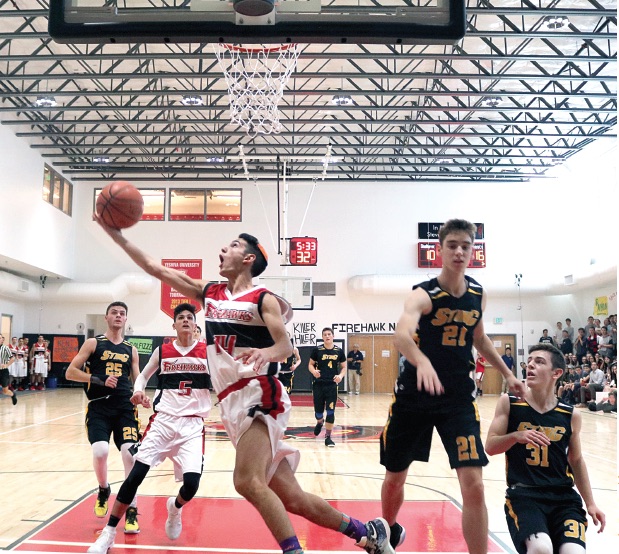
Photo credit: Zoey Botnick

More than 250 Jewish high school athletes, boys and girls, descended upon Shalhevet High School for the Steve Glouberman Annual Basketball Tournament on Nov. 8-12. Teams from local schools such as Shalhevet, Valley Torah, Harkham-GAON Academy and Yeshiva University of Los Angeles Boys and Girls high schools (YULA) competed, as well as teams from as far as Florida, New Jersey, Seattle and Israel.

The event, in its third year, is more than just a basketball tournament.

At most tournaments, visiting teams spend off-hours in their hotels. With the Glouberman tournament, volunteer hosts in the community house the teams. And there’s also a jam-packed Shabbaton schedule.

“A big part of the tournament is being part of the community, meeting people and bonding,” said Raizie Weissman, the Shalhevet administrator who runs the tournament. “All the teenagers bonding together is very important for us.”

“It’s about much more than wins and losses.” — Rabbi Ari Segal

More than 60 Jewish families — most from the Shalhevet community — housed visiting players, coaches and chaperones. Everyone associated with the teams also were invited to a barbecue on Shalhevet’s rooftop, Friday night dinners with host families and Shabbat services at Beth Jacob Congregation. They also had a chance to meet local Jewish hoops hero David Blu, the former USC Trojan who went on to star for Maccabi Tel Aviv.

“It’s obvious to anyone who participates in the Glouberman tournament that it’s about much more than wins and losses,” said Rabbi Ari Segal, the head of school at Shalhevet. “It’s about Jewish students converging from across the country — and in one case, across the ocean — to have an experience, to meet each other and to learn from one another and have a transformative and uplifting Shabbat.”

While the players bonded off the court, they were fiercely competitive on it. Capacity crowds crammed into the Shalhevet gym, filling it with the sounds of bullhorns and cheers. The tournament was an opportunity for local Jewish high school students to experience the kind of high-level Jewish basketball tournament that typically takes place only on the East Coast.

“Being part of a local tournament was a phenomenal experience,” said Lior Schwartzberg, the Valley Torah boys coach. “Our games probably had about half of our campus attending.”

Katz Yeshiva High School, a Boca Raton, Fla., team, won the girls division. Valley Torah, led by guard Ryan Turell, took down the team from New Jersey’s Frisch School. Playing despite an injured wrist, Turell scored 30 points on his way to winning Most Valuable Player honors.

“This was a unique and special experience,” the 6-foot-5 Turell said. “It allowed me to hang out with kids from across the country that I wouldn’t have known otherwise and establish friendships that will last a lifetime.”

Flora Glouberman, the widow of Steve Glouberman, created the tournament as a way to honor her late husband, who died in 2015 after a battle with cancer. She envisioned the tournament as a way to bring the Shalhevet and wider Jewish communities together.

Segal remembered Steve, a lawyer and YULA graduate, as “a bridge builder in the Jewish community.”

Flora and Steve’s three children, now adults, all attended Shalhevet, where Steve frequented the sidelines of its basketball games.

“I’m blown away by how big this has become,” Flora said. “It’s a testament to the people at Shalhevet who put this together and the community as a whole, opening up their homes.”

Flora was deeply involved in the tournament’s details, even hosting a Seattle team for Shabbat dinner at her Beverlywood home.

“That’s one of the aspects I really love,” she said. “These kids get to know our community and we get to know this school from Seattle.”

Just before the opening night’s tipoff, Flora was led into the gym for the unveiling of a new scoreboard bearing her husband’s name.

“I was very touched to see it,” she said. “It’s now a constant reminder to me of the love and support that the community shows to our family.”

Basketball Tournament Combines Jump Shots With an ‘Uplifting’ Shabbat Read More »