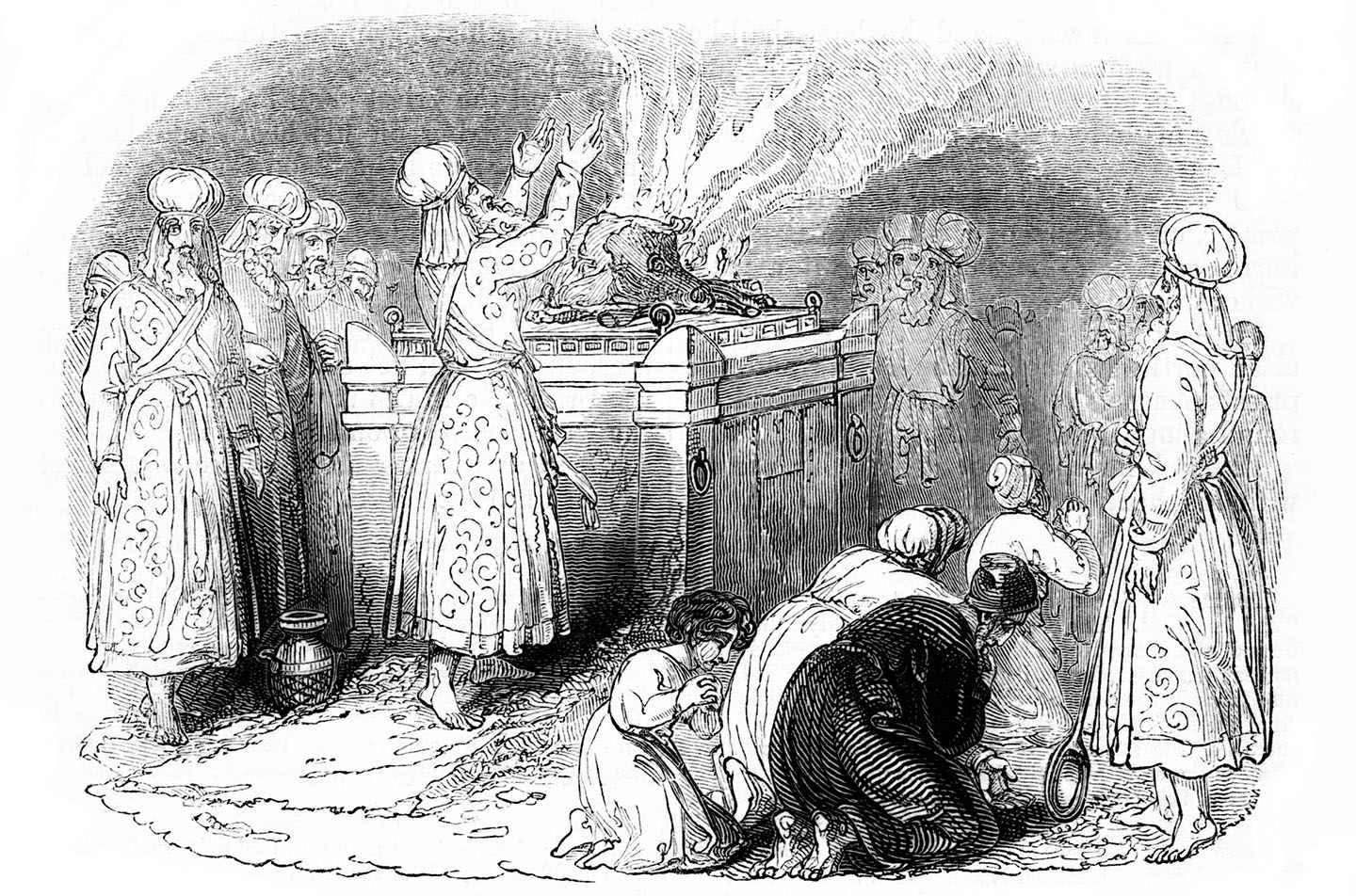
Will animal sacrifices return after the messianic redemption? In 1920, two prominent Religious Zionist rabbis, Rabbi Abraham Isaac Kook and Rabbi Chaim Hirschensohn, debated this question. Hirschensohn, a brilliant scholar who served a congregation in Jersey City, had written that animal sacrifices would not return. He explained that sacrifices would no longer serve any purpose if people perceived them as the opposite of spiritual and refined; the Tanakh itself makes it clear that sacrifices are worthless if they fail to inspire. And even though Ezekiel prophesied about future sacrifices, we should understand those passages as either a vision of the Second Temple or an allegory.
Kook took exception to this view and wrote Hirschensohn a letter affirming that all the prophetic statements were literal and that animal sacrifices would return in the messianic era. He explained that when the Messiah comes, a higher culture would arrive, one far more transcendent than “the European culture” of those opposed to animal sacrifice. In that ideal future, people would appreciate the inner meaning of animal sacrifices. Hirschensohn wrote back to Kook and said he agreed that certainly there would be a higher culture after the coming of the Messiah; but that is precisely why there would no longer be any animal sacrifices. The messianic era will bring with it a completely nonviolent reality where the lamb will lie down with the lion. Even the animal kingdom will no longer shed blood. It would certainly be strange if the Temple were the only place where animals are killed.
It is fascinating that in an earlier, and at the time unpublished, essay, “A Vision of Vegetarianism and Peace,” Rabbi Kook adopts the same view of animal sacrifices as Rabbi Hirschensohn. Kook explains that in the messianic era, all humans will become vegetarians. The sacrificial service will undergo a similar change: People will bring only flour offerings. Kook writes, “Regarding that time, the pinnacle of pure culture, the Sages declared: ‘All sacrifices will be abolished in the future.’” Why Rabbi Kook critiqued Hirschensohn two decades later for holding this very same opinion remains an open question.
Perhaps Kook’s critique of Hirschensohn has more to do with Hirschensohn’s methods than with his conclusion. Kook was concerned that Hirschensohn had simply accepted the indictment of contemporary Bible critics, rather than developing an organically Jewish understanding of sacrifices.
That possibility was an even larger concern for Kook. These Bible scholars had condemned sacrifices as barbaric. Kook said this critique of sacrifices was hypocritical. The very same scholars who denigrated sacrifices did not hesitate to eat meat, wear fur, and use leather. Kook argued that it is absurd for someone to consider their own needs worthy enough to justify slaughtering animals, but not God’s needs. Kook asks rhetorically, “Here, at the very place where the source of spiritual illumination for humanity should be opened, suddenly compassion appears, and the person refuses to offer an animal as a sacrifice?!”
To Rabbi Kook, for meat eaters to offer one-sided criticism of animal sacrifices reflected “intellectual and moral decline.” Even if he envisioned a future where there would no longer be any animal sacrifice, he found their denigration of a profound spiritual practice disturbing.
He felt that even if we abolish animal sacrifices in the messianic era, the foundational value of personal sacrifice must endure.
The Tanakh contains the earliest criticism of animal sacrifice. Verses in Samuel, Isaiah, Jeremiah, Hosea, Amos and Psalms all contain criticisms of their contemporaries’ sacrificial offerings. But the prophets were not criticizing sacrifices themselves; they were criticizing the people bringing them. When Isaiah says, “What need have I of all your sacrifices?” says the Lord, he immediately explains that it is “because your hands are stained with crime.” Isaiah is calling out hypocrites who attempt to curry favor with God by bringing sacrifices while oppressing the poor and violently assaulting their rivals.
Isaiah’s criticism is about more than hypocrisy. These corrupt community leaders corrupted the very institution of sacrifice. To them, a sacrifice was just another business deal, a way of paying for divine protection. They had reduced religion to a transaction and sacrifice to a soulless exchange.
What the prophets desired was authentic sacrifice, where, as an expression of devotion, the person offers the animal as a proxy for himself. The Maharal of Prague explains that sacrifice is a two-step process. First, it expresses that the person offering the sacrifice sees himself as insignificant in relation to God, unworthy of life itself. Second, by offering the sacrifice, the person creates a direct connection with God, and that connection now makes the person’s life meaningful.
By embracing humility and selflessness, the person offering the sacrifice sheds his ego. By doing that, he becomes capable of attaching himself to something larger and transcendent. Ironically, one finds a meaningful identity only through self-sacrifice.
By embracing humility and selflessness, the person offering the sacrifice sheds his ego.
Rabbi Kook’s point is significant for our time. Our discomfort with animal sacrifice is not that we love animals more, but that we value personal sacrifice less. Jean Twenge, the author of “Generation Me,” has written that what marks the current under-35 generation is that “they have never known a world that put duty before self.” Unsurprisingly, studies show that this generation is characterized by narcissism.
This self-focus has even influenced religion. The Prosperity Gospel, a theology that asserts that true faith will enable one to become healthy and wealthy, has become very popular in contemporary Christianity; a large percentage of megachurches are associated with this theology.
Kate Bowler, who has studied this movement, notes that the Prosperity Gospel has been called “baptized materialism.” The sermons of its pastors focus on helping congregants achieve personal success through faith. Among Jews, there are similar phenomena: crude appeals from rabbis who promise a multitude of blessings in return for a donation, and more sophisticated arguments about the Torah lifestyle being a helpful palliative for any ailment. Transactional religion goes hand in hand with materialism, with the service of God turned into something far more self-serving.
We simply don’t like sacrifices. We expect everything to pay off, even our devotion to God.
This is why the concept of sacrifice is particularly relevant in an era of individualism. The Talmud explains that after the destruction of the Temple, charity and acts of kindness can replace sacrifices. Even inviting guests to one’s dinner table can make it as sacred as the altar. But both are acts of selflessness and subordinate our own interests to something larger.
The Torah reading of Vayikra goes well beyond the Temple: It teaches the lessons of sacrifice and the holiness of authentic selflessness.
In the last two and a half years, we have seen remarkable people who put duty before self and reminded us what sacrifice is all about. The heroes who ran to the front lines to fight. The rescuers who saved lives on Oct. 7. The volunteers who helped the homeless, the hungry, and the heartbroken.
May God bless them, and may their spirit inspire our own.
Rabbi Chaim Steinmetz is the Senior Rabbi of Congregation Kehilath Jeshurun in New York.