There is a food holiday for everything!
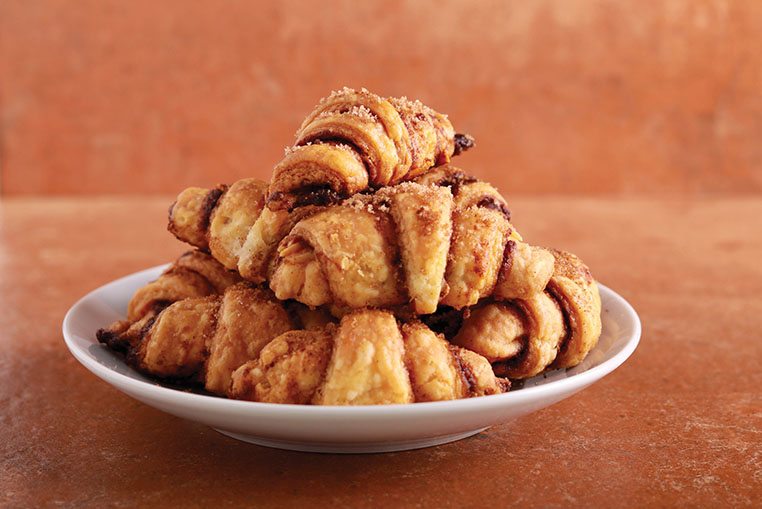
National Rugelach Day is April 29. The traditional, flaky, cream-cheese-based pastry is a classic example of a communal, cultural food. Like many enduring recipes – traditional rugelach dates back centuries in Eastern Europe – it was passed down, adapted and refined in kitchens through multiple generations. For more on rugelach, The Journal reached out to June Hersh, author of “Food, Hope & Resilience, Authentic Recipes and Remarkable Stories from Holocaust Survivors.”
 “Rugelach are a staple sweet treat, originating in Poland and an iconic Ashkenazi staple,” Hersh told The Journal. “If you’re a good baker, they are easy to make; if you are not a very good baker, make friends with one.” She added, “Some versions call for sour cream, others for cream cheese – I’m a cream cheese girl; I like the texture it imparts and the additional sweetness.”
Hersh’s book, which honors Holocaust survivors from Poland, Austria, Germany, Hungary, Czechoslovakia, Romania, Russia, Ukraine and Greece through their recipes, features Peri Hirsch’s rugelach. She writes:
“Peri’s rugelach are jam-packed morsels, tender and flaky, with a subtle sweetness. Felix, Peri’s late husband, credited the family rolling pin for the perfection of these little bites of heaven. He said, “it has worked magic for generations.” The beauty of this recipe is you can increase the sweet factor or nutty texture by adjusting the filling to your taste.”
Peri Hirsch’s Rugelach
Excerpted from “Food, Hope & Resilience, Authentic Recipes and Remarkable Stories from Holocaust Survivors” by June Hersh (Arcadia Publishing/The History Press).
Yields: 32 pieces (recipe can easily be doubled to make 64 pieces)
Start to Finish: Step one: Under 30 minutes then chill at least 4 hours or overnigh
Step two: Under 1 hour
For the dough:
1 stick (½ cup) butter, room temperature
2 Tbsp sugar
1 (4- ounce) package cream cheese, softened at room temperature
1 Tbsp orange juice
1 egg
1 cup all-purpose flour
1 tsp baking powder
For the filling:
½ cup apricot preserves, room temperature
½ cup sugar plus 1 to 2 teaspoons ground cinnamon, more to taste
½ cup raisins
1 cup (4 ounces) chopped nuts, more to taste
For the topping:
1 lightly beaten egg plus 1 Tbsp of water
Sanding sugar, optional
Step One
Prepare the dough by beating the butter, sugar and cream cheese until soft and combined. Stir in the orange juice and egg. In a separate bowl, combine the flour and baking powder. Stir the flour mixture into the cream cheese mixture and combine, creating a soft slightly sticky dough. Divide the dough into 2 pieces, flatten each into a disc and wrap in plastic wrap. Refrigerate at least 4 hours or overnight.
Step Two
Take one package of dough out of the fridge and let it rest for 10 minutes. Keep the remaining dough chilled. Flour a work surface, and roll the dough out into a 12-inch circle. With a spatula, spread half the preserves over the entire circle, and then sprinkle with half the sugar, raisins and nuts. Use the spatula to gently press the filling into the dough. Using a pizza wheel, cut the dough into fourths, then cut each fourth into fourths. You should have 16 pieces. Some might be larger than others, no worries; it will give your cookies personality. Roll the wedges up starting at the widest end. When rolled, you should have a nice crescent shape.
Chill the rugelach while you preheat the oven to 350°F.
Remove the rugelach from the fridge and brush lightly with the egg wash. You can sprinkle with sanding sugar for a nice shine and sweet crunch, or sprinkle additional cinnamon-sugar on top. Bake at 350°F for 25 minutes or until they are light brown. Repeat with the remaining dough.
Notes:
A good way to chop nuts is to use a serrated knife. Try rocking the knife back and forth over softer nuts like walnuts. Harder nuts, like almonds, might need the oomph that only a grinder or food processor can provide. Do not overprocess or you will have crumbs. 2 ounces of shelled nuts equal 1/2 cup chopped nuts