“President Called After the Beast Had Been Lassoed, But He Refused To Make An Unsportsmanlike Shot”
So read the Nov. 15, 1902 headline of The Washington Post. On what perhaps was a slow news day, the paper reported that on a hunting trip, President Theodore Roosevelt had refused to shoot a 235-pound black bear tied to a tree. The incident took place on the last day of a hunt Roosevelt had scheduled while surveying land that the states of Mississippi and Louisiana were each claiming as their own.
But the anecdote had legs. It would lead to the birth of a wildly popular toy and the project to revive the Jewish national homeland.
The renowned political cartoonist for The Washington Star, Clifford Berryman, who had been along for the hunt, picked up on the President’s refusal to shoot the bear, and used it as a metaphor for Roosevelt’s indecision over a Mississippi boundary dispute. Berryman’s subsequent cartoon depicted the Commander in Chief dressed in full Rough Rider regalia, turning his back to the frightened bear. It was captioned “Drawing the Line in Mississippi.”
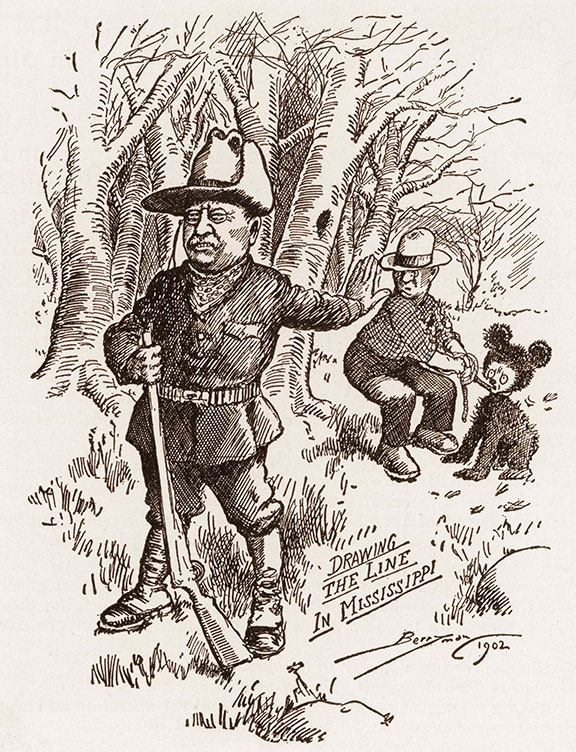
The story soon became well known throughout the United States and inspired Brooklyn candy store owners Rose (née Rachel) and Morris Michtom (né Moshe Michael Charmatz) who had hung the cartoon on their shop’s window. Marveling in admiration at TR’s behavior, Morris remarked “The Tsar was never that humanitarian.” The couple decided to make the first stuffed bear toy – that is, in America. Edmund Morris notes in his “Theodore Rex,” that “in one of the mysterious coincidences that yoke inventions, stuffed plush bear cubs with button eyes and movable joints began to issue from Margarete Steiff’s toy factory in Giengen, Germany.” New York City’s FAO Schwarz ordered 3,000.
“The competing bears soon fused,” “Theodore Rex” documents, “along with Berryman’s cub, into a single cuddly entity that attached to itself the nickname of the President of the United States. For decades, perhaps centuries to come, uncounted millions of children across the world would hug their Teddy Bears, even as the identities of Steiff, Michtom, Berryman and Roosevelt himself rubbed away like lost plush.”
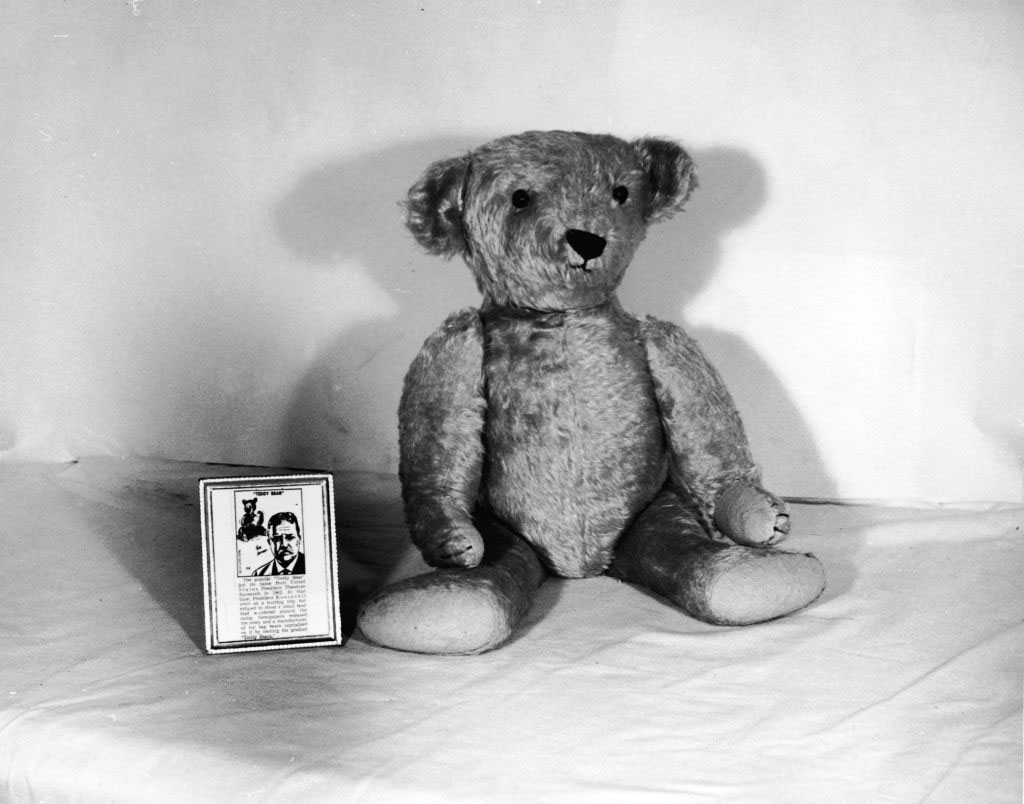
As the bear burst in popularity, family lore had it that before making additional copies, Morris Michtom had sent the original to the White House, along with a request to Roosevelt to allow for the new toy to be called “Teddy’s Bear.” His son, Benjamin Michtom, has said that although Roosevelt agreed to lend his name to the new invention he doubted it would be a hit.
But Morris, who had arrived in the U.S. from Russia in 1889 with 50 cents in his pocket, thought he was on to something. By 1903, he founded the Ideal Novelty and Toy Company of 23-10 43rd Avenue, Long Island City, which he built into one of the largest toy companies in the country. Five years later, the bear had become so popular nationally that a Michigan minister warned that replacing dolls with toy bears would destroy the maternal instincts of young girls.
As Michael Feldberg recounts in his “Blessings of Freedom: Chapters in American Jewish History”: “Because of the doll’s popularity, Roosevelt and the Republican Party adopted it as their symbol in the election of 1904, and Michtom bears were placed on display at every public White House function.”
Decades into the Teddy Bear’s runaway success and the Michtoms’ company’s flourishing, Benjamin, now president of Ideal Toy, reached out to Mrs. Alice Roosevelt Longworth, President Roosevelt’s daughter, and asked her if she might pose for a photo with one of the original bears. Mrs. Longworth reportedly responded, “I don’t want it … What does a 79-year-old doll want with a 60-year-old bear?”
Like his father, not one to be easily discouraged, Benjamin contacted Mr. Kermit Roosevelt, Teddy’s grandson. He asked if Kermit’s children would pose with it. They agreed, with the mutual understanding that the bear would then be gifted to the Smithsonian.
After the photo shoot, however, the kids, Mark and Anne Roosevelt, hid the bear from their parents. A letter from Mrs. Roosevelt to Benjamin said, “I was about to get in touch with the Smithsonian about presenting them with the original bear when the children decided they didn’t want to part with it yet.”
Eventually, however, the children relinquished the toy, and the bear arrived in the Smithsonian in January of 1964.
Morris Michtom, meanwhile, had passed away in 1938. The longest of the five paragraphs of his obituary in The New York Times documented his charity work. It read: “Active in Jewish philanthropic work, Mr. Michtom was a member of the board of directors of HIAS, the New York Council of the Jewish National Fund, the National Labor Campaign for Palestine and Beth-el Hospital in Brooklyn. He belonged to the Workmen’s Circle, the Brooklyn Jewish Center, the Jewish Teachers Seminary, the People’s University and the Jewish Workers National Alliance. He had been active in the Zionist movement.”
A president’s mercy had helped give the Michtom family the means of substantively supporting the eventual rebirth of the State of Israel.
Rabbi Dr. Stuart Halpern is Senior Adviser to the Provost of Yeshiva University and Deputy Director of Y.U.’s Straus Center for Torah and Western Thought. His books include the newly released “Jewish Roots of American Liberty,” “The Promise of Liberty: A Passover Haggada,” “Esther in America,” “Gleanings: Reflections on Ruth” and “Proclaim Liberty Throughout the Land: The Hebrew Bible in the United States.”