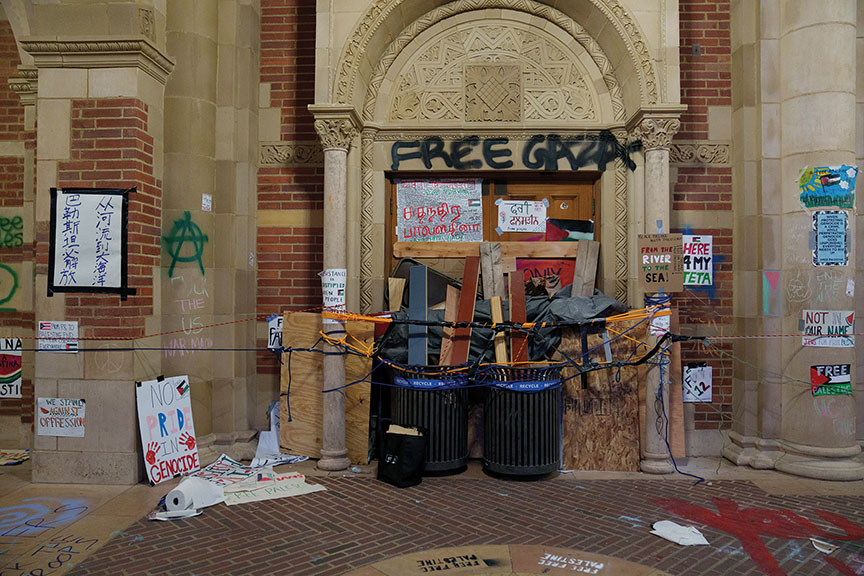
A few weeks after Oct. 7, 2023, UCLA no longer looked like the clean, orderly campus known to Professor Leslie Johns, who teaches political science and law. It had transformed almost overnight: walls were covered in graffiti, posters and signs denounced Israel and students arrived in classrooms wearing keffiyehs — some carrying Palestinian flags.
It kept escalating with each passing day. Some Jewish students reported they felt threatened. They were blocked as they made their way to class. Some removed their Star of David necklace; others were careful not to wear any shirts with Hebrew letters.
Things took a turn for the worse after Johns signed a faculty petition drafted by UCLA computer science professor Judea Pearl, calling on the university to condemn the Oct. 7 Hamas attack and respond to what signatories described as celebrations of violence on campus.
“It never even occurred to me that there is anything in that petition that would be considered offensive. It just said things like Hamas is a terrorist group — that’s not controversial. It also said that Jewish students should be protected,” Johns told The Journal.
“I don’t think people knew I identified with Judaism — I don’t have a Jewish last name, and I don’t have a mezuzah. But after I signed that petition, people started hanging flyers on my door that said, ‘killed by Israel,’ with a picture of a little kid and a Star of David drenched in blood.”
Johns said her classroom door was the only one in the building with a flyer on it.
The next time she came to teach, she walked from the elevator toward her office at the end of the hallway. As she moved down the corridor, she saw flyers covering the walls, each repeating the word “genocide.”
The line of flyers led directly to her office door.
She began experiencing panic attacks and said she felt physically sick before class, not knowing what she would encounter each day. She added that the hostility she experienced was shared by other Jewish students and faculty members who were labeled “Zionist.” The term had become a kind of foul word.
Johns said she initially tried to resolve the situation internally. She filed multiple complaints detailing the ongoing harassment, but said those concerns were not truly addressed. Instead, she received form letters offering general resources — such as guidance on where to seek help in cases of sexual assault, including rape crisis hotline numbers — which bore no relation to what she had been experiencing.
“They were just completely unprepared,” she said.
As the months went on, Johns said conditions continued to deteriorate. The atmosphere on campus grew increasingly hostile toward Jewish students and faculty. From the start, in the immediate aftermath, she told students they would not be discussing events in Israel because “the subject is too sensitive,” and she wanted the classroom to remain safe for diverse views. Despite that, one of the students wearing a black-and-white keffiyeh started asking her what she describes as “aggressive questions.”
“I could see out of the corner of my eye that people were filming me, trying to get me to say something offensive so they could post it on social media,” she said. “I became really worried, like what if I say something that the pro-Palestinian person would think is offensive, then file a complaint against me saying I’m Islamophobic.”
She raised these concerns with her department, telling colleagues she felt she was being set up. According to Johns, the response she received was brief: “Be careful and don’t get into trouble.”
By April 2024, Johns said she had reached a breaking point. She took medical leave and did not return until the end of the year. She said she fell into depression, went to see a psychiatrist and required medication.
Even when she felt ready to return to work in January 2025, she said she faced resistance and a difficult time reintegrating. Some of her colleagues told her in private that they felt sorry for what had happened to her and volunteered to be her witness if needed but then went back on it. “Initially I was able to maintain some friendships, but eventually over time those people just started falling out of my life. They would say things like, ‘I can’t get involved anymore, this is too complicated.’”
She described experiencing significant professional repercussions, including loss of research time, exclusion from a UC research grant, loss of professional esteem among colleagues and loss of a position she held at the Burkle Center. She was ultimately denied promotion and, she says, continues to experience emotional distress requiring ongoing medication and therapy.
After repeatedly complaining about the hostile work environment, and being told by campus police that what she experienced did not meet the threshold of a threat, Johns decided to sue. She met with attorney David M. Rosenberg-Wohl, who agreed to represent her. Johns understood the implications. While she could not be fired due to tenure, continuing to work at an institution she was suing was far from ideal.
First, she filed a complaint with the Equal Employment Opportunity Commission (EEOC), the federal agency that handles workplace discrimination claims and serves as the required first step before filing a lawsuit. The filing begins an administrative review process that typically leads to a “right-to-sue” notice, allowing the case to proceed to court.
However, Johns said her experience differed from the norm. According to her, individual complaints were placed on hold while the agency conducted a broader review involving UCLA, delaying the standard process for proceeding with litigation.
Following an interview with the U.S. Department of Justice in spring 2025, Johns said the EEOC issued a letter stating it believed there were grounds for the complaints and that there appeared to be a systemic issue at UCLA.
Rosenberg-Wohl also represents a group of 20 students and parents suing UCLA for failing to protect Jewish students on campus. According to the complaint filed in Maytal Sarafian v. The Regents of the University of California, plaintiffs allege that UC officials failed to prevent and adequately respond to antisemitism on UC campuses, particularly during and after Oct. 7, 2023. They claim that campus environments became hostile and intimidating for Jewish students through protests, speech and conduct they characterize as threatening and exclusionary, including incidents occurring in residential and academic spaces.
“While the most visible indication of discrimination, namely the ‘Jew-free’ zones of campus encampments, have been dismantled, the antisemitic attitudes and practices remain vibrant,” the complaint states.
It further alleges that UC leadership did not properly enforce existing time, place and manner policies to protect Jewish students from harassment, resulting in a campus climate that the plaintiffs describe as unsafe and discriminatory, and seeks both damages and injunctive relief.
The San Francisco attorney said he chose to represent these individuals because he felt compelled to take “whatever steps possible to defend Jews in today’s environment of resurgent antisemitism.” “I turned my practice to be doing just that,” Rosenberg-Wohl said in a phone interview with The Journal.
Rosenberg-Wohl and Johns said they had witnessed what they described as the life-changing impact on Jewish students and faculty at UCLA and on campuses across the United States. Johns estimated that thousands of Jewish faculty members and students were affected.
“I know some Jewish graduate students who have been working on their Ph.D.s and were training to become professors, and after what they’ve experienced at UCLA, they’ve decided to go and teach in Jewish day schools,” Johns said. “Some professors chose to go into other adjacent fields, some moved to other universities if they were able to get jobs elsewhere. Some people just left academia altogether.”
Despite what she and others described as widespread fear among Jewish students and faculty — who, she said, were targeted simply for being Jewish — relatively few chose to sue the Regents of the University of California.
Johns said there were students and faculty members who declined to join the lawsuit for both political and personal reasons. These included opposition to Donald Trump and reluctance to cooperate with federal agencies under his administration. Others cited fear of professional backlash.
Some simply wanted to put the experience behind them and move on. She added that there are also many faculty members who choose to keep their Jewish identity private.
Her attorney said he is aware of individuals who not only left campus but, in some cases, moved to Israel as a result of what happened. He described a broader impact that, for some, included a renewed fear of being Jewish in the United States.
“And these aren’t only people represented by me,” he said. “I’ve seen how this has affected so many of them in different ways. It’s not just about being distracted from their studies or shunned by their peers. There is a profound sense of betrayal.”
The cases represented by Rosenberg-Wohl are among several lawsuits filed against the Regents of the University of California. Like other universities across the country, UCLA has learned that silence in the face of discrimination can be costly.
The university has already settled one major lawsuit brought by a Jewish professor and Jewish students over its alleged failure to prevent antisemitic discrimination during campus protests in 2024. The case, Frankel v. Regents of the University of California, was settled for $6.45 million, including $6.13 million to the plaintiffs and $320,000 allocated to the UCLA Initiative to Combat Antisemitism.
Separately, the U.S. Department of Justice found that UCLA violated the civil rights of Jewish and Israeli students during the spring 2024 pro-Palestinian encampment, citing what it described as “deliberate indifference” to harassment on campus. Building on those findings, the Department later filed a broader civil rights lawsuit against the University of California system, including UCLA, alleging a hostile work environment for Jewish and Israeli faculty and staff following the 2023 attacks. That case remains ongoing.
Against this backdrop, a new legal effort is now unfolding. On April 14, 2026, seven Jewish faculty members and academic appointees at UCLA filed a motion to intervene in the federal civil rights case United States of America v. Regents of the University of California. Represented by the Holtzman Vogel Law Firm, they allege the university fostered a hostile work environment, echoing claims raised in earlier cases. The complaint describes a surge of antisemitic harassment on campus, including chants such as “Itbah El Yahud” (“kill the Jews”) and “death to Israel,” as well as hostile imagery and vandalism.
The suit alleges that Jewish students and faculty were excluded from areas of the UCLA campus in 2024 after refusing to denounce their faith, describing it as a violation of religious liberty protections. It further claims that university officials failed to intervene and allowed a campus environment marked by antisemitic harassment and extremist symbolism.
Dr. Kira Stein, one of the intervening plaintiffs, is a volunteer clinical faculty member at UCLA’s David Geffen School of Medicine and founder of the Jewish Faculty Resilience Group. “We started as a support group in November of 2023 and within a month it grew from 15 to 75 people, and after several sessions it turned into an advocacy group,” Stein said in an interview with The Journal. “We wanted to do something about the rising Jewish hate that was developing on campus.”
According to Stein, faculty and students turned to the group to report incidents they felt the University was not adequately addressing, prompting the creation of a structured documentation system compiling accounts from individuals and social media. “We wanted to help the University by providing clearly documented reports — but they kept ignoring them,” said Stein. After repeatedly reporting incidents, she said she was ultimately suspended. The suit alleges the action was retaliatory and based on false accusations. The suspension included removal of teaching duties and exclusion from core responsibilities, which Stein says damaged her professional standing.
Dr. Stein believes the retaliation serves as a cautionary example for others who might speak out, and that some faculty chose not to join the lawsuit out of fear for their job security. A longtime member of the UCLA community, she spent more than four decades at the university as an undergraduate student, resident and faculty member.
Many of those interviewed for this article expressed a sense of betrayal by the university they long regarded as more than just a workplace.
Prof. Pearl, who began teaching at the University of California in the late 1960s, said that while he acknowledges genuine efforts by the new Chancellor to combat antisemitism, the underlying problem remains unaddressed, particularly what he describes as antizionism on campus. “While demeaning rhetoric, harassment and exclusion are directed specifically at Zionists, as well as at anyone suspected of supporting Jewish self-determination, the administration continues to focus on traditional forms of antisemitism, refusing to confront what has become a new and virulent strain of racism,” he said.
For those involved, the lawsuits are not only about past incidents, but about whether they will lead to meaningful accountability and lasting change on campus — so that Jewish faculty and students can feel safe, visible and protected within the university.
A UCLA spokesperson provided the following statement in response to The Journal’s request for comment:
“Combating antisemitism is a moral imperative that is advanced through consistent leadership and serious action. Under Chancellor Frenk’s leadership, UCLA has reorganized our Office of Civil Rights and hired a dedicated Title VI/Title VII officer to ensure professionalized oversight and accountability, instituted strengthened Time, Place and Manner policies to protect both free expression and campus operations, and established an Initiative to Combat Antisemitism with a clear mandate and resources. These actions reflect a sustained commitment and institutional resolve to combating antisemitism.”