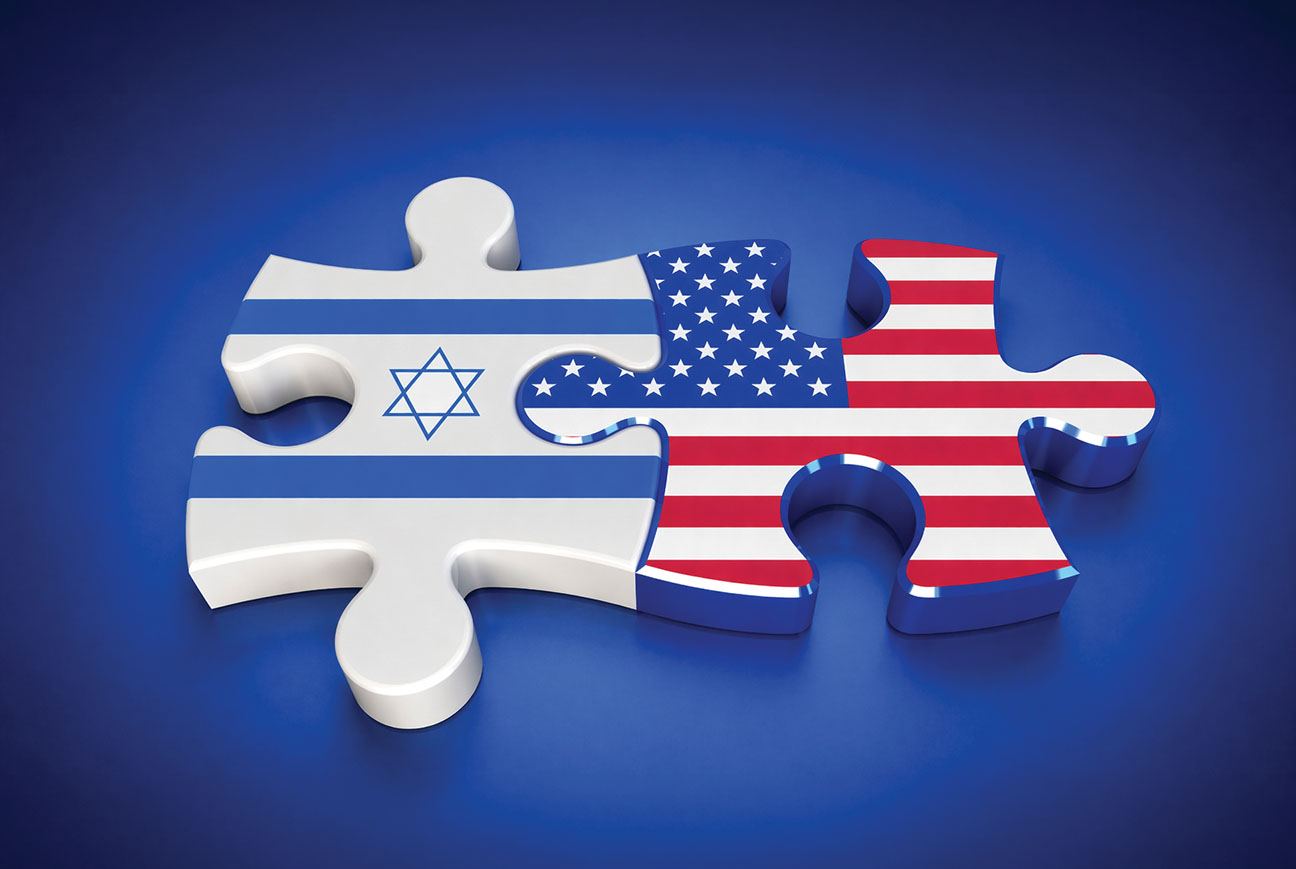
Many of the challenges facing Israel have not changed much in its nearly 80 years of existence. Names have been swapped, local and international players have come and gone and the global map has shifted more than once, but most of what troubles Israel’s captains today troubled them, in one way or another, in previous decades as well. A striking example is the insoluble tension between Israel’s need to lean on a great power and its desire to be as independent as possible.
Independence
In this 78th year of Independence, it seems that only a few Israelis feel the state possesses full political and security liberty. They identify the American thumbprint on every act or omission of their government. When Trump says “open fire,” they do. When he says “hold fire,” they do it again. Airplanes up, airplanes down, now Iran, now Lebanon. Perhaps they imagine this is a new state of affairs – that there was never a dependency or a dictate quite like this. But this is not a new situation; it is merely a new player, Donald Trump, in whose time the dependency and especially the dictate is particularly conspicuous because, for him, policy is primarily about public performance. The situation itself is quite old: Israel has been shackled by a superpower since the day of its founding and has not broken free of it to this day.
The situation itself is quite old: Israel has been shackled by a superpower since the day of its founding and has not broken free of it to this day.
Hold your breath: it will not break free of it in the near future, either. “If you are not a superpower, you must be part of an alliance to truly survive in this world.” These are the words of Prof. Eviatar Matania, former founder of Israel’s National Cyber Directorate in a conversation regarding Israel’s security doctrine. Israel is not part of a stable and reliable formal alliance, and therefore “we need the reliance on the superpower.” And what of our independence? It is certainly an important thing. Israel is independent to decide that it no longer wishes to lean on the U.S. It would pay a heavy price for such a decision, but its independence to decide as much exists. Obeying Trump’s dictates is a choice. A choice Israel keeps making. A choice Israel’s leaders keep making amid – sometimes – public frustration and protest. Because that’s often the wise choice.
Obeying Trump’s dictates is a choice. A choice Israel keeps making. A choice Israel’s leaders keep making amid – sometimes – public frustration and protest. Because that’s often the wise choice.
In fact, history teaches us that Israel has never decided to ignore a strongly worded and insistent U.S. dictate. Logic suggests that, at least for the foreseeable future, it will not decide to do so either. History also teaches that even in the past, Israeli independence was limited. Israelis remember bombastic declarations by bombastic prime ministers along the lines of “we will not be a banana republic.” They forget that at every juncture in which the Americans decided to assert authority with sufficient determination, Israel retreated.
Examples? In late 1948, David Ben-Gurion told an American State Department representative: “We will not bow to America or Russia – we will go our own way.” Eight years later, he received a resolute message from U.S. President Dwight D. Eisenhower, stating that Israel must immediately withdraw from the Sinai Peninsula, which it had captured in the 1956 Sinai Campaign (Operation Kadesh). Ben-Gurion, who just a day earlier had proclaimed the “Third Kingdom of Israel,” accepted the dictate without much hesitation.
This, of course, does not mean one must accept every dictate as written, or that one should respond to every demand in the same manner. Unlike Ben-Gurion after the Sinai Campaign, Golda Meir waged a struggle – a stubborn trench war – nearly 20 years later, when Israel received instructions from the U.S. to halt the war after encircling the Egyptian Third Army in Sinai. The confident 1956 Israel – following a short, surprising victory – could afford to withdraw without fear. The battered Israel in 1973 – following a murderous surprise attack – was more stubborn, more recalcitrant. Golda refused to withdraw.
But she also understood that she could not keep the war going, and that she had to restrain the IDF, which was not strictly adhering to the ceasefire orders. On Oct. 24, 1973, she summoned the minister of defense and the chief of staff. “There is a limit. The government cannot say it accepted a ceasefire while simultaneously forces are moving and firing,” she said. Hagai Tsoref’s research on Israel’s struggle against American pressure in those days describes the atmosphere in the prime minister’s room as one of “exhilaration.” The speakers in the room, Tsoref wrote, “allowed themselves to express arrogance toward the Americans.” This is a familiar ailment that has afflicted senior Israeli officials in closed rooms in recent weeks as well, in light of the U.S. forces’ performance in the Middle East.
This arrogance reflects a lack of understanding: the Americans can afford less-than-stellar performance. They can afford less-skilled, mostly less experienced, combat pilots. They can afford less precision, less lethality in the mission, and less effectiveness in every action. They are a great power that has enough reserves to err and correct, to absorb and retaliate. They are a superpower that can agree to a ceasefire and then return to the fighting. Because there is no one who can tell them not to return to the fighting. But Israel does have someone who sometimes says enough is enough: the Americans.
Ben-Gurion deliberated back and forth until he decided to tilt Israel sharply toward the West. He preferred neutrality but understood that in a polarized world, it was impossible. He needed economic aid and identified where it could come from. He had fellow Israeli leaders, some of whom were deep in the political left, but he knew the Soviet Union was not a worthy ally for Israel.
So he wisely chose to rely on the U.S., fully understanding the risks involved. “A nation must trust itself,” he told an American diplomat in 1951. “One cannot predict what the world is going to look like after the next war. … The U.S. might no longer be interested in the Middle East, it might decide to exit this region, but we [Israel] will remain here and the Arabs will remain here.” Benjamin Netanyahu would not dare saying similar words to an American diplomat today, but had he said them, his position would be as correct today as Ben-Gurion’s was 75 years ago.
Dependency
A trickle that turned into a downpour of depressing news regarding Israel’s image in the U.S. has birthed, as is common in such times, a wide array of umbrellas whose primary purpose is not to stop the rain, but to prevent it from soaking the one holding the umbrella. The many umbrellas are meant to guards their bearers from being blamed for the downward spiral of goodwill.
In right-wing circles, the umbrella is the “it’s not us, it’s them” umbrella. That is to say, it is not Israel, its policy, its government or its actions that lead the Americans to demonstrate impatience and sometimes hostility to Israel. What is the cause of the negative trend? It is them – the Americans. They have gone mad, they have changed, they do not understand what is good for them or for the world.
Rotem Sella, one of the wiser minds in Israel’s right-wing circles, wrote something quite strange this week: “Democrats under 50 loathe Israel more than Iran. This is bad news for Israel, and worse news for America.” If it continues this way, he determined, the U.S. “will lose its greatness.” In other words: it’s not us, it’s them. And one must hope they – Americans – realize their wicked ways and repent; otherwise, they will suffer even more than we will. So the implied solution to Israel’s image problem is an educational move: to maintain Israel’s dependency on the U.S., Israel needs to “reeducate the U.S. public and put it back on the right path. For the U.S.’ own good, of course – just as any parent explains to any child.
In other circles, pundits and analysts hold different umbrellas that tilt the rain in another direction. Nadav Eyal, one of the wiser minds in these other circles, wrote recently that “the problem is not ‘Hasbara’ [PR] but policy. Actions.” By policy, he means Jewish terror attacks in the territories, the expansion of settler farms, the humiliation of monks in the Old City of Jerusalem, or the irresponsible declarations of ministers that preach to commit what amounts to war crimes in Gaza.
Eyal is correct, of course, in everything he writes about the unnecessary and ugly actions he describes. To those, one could add a few more – like the IDF soldier smashing a religious symbol sacred to most Americans just a few days ago (the PM vowed that the soldier will be severely punished). But like the assumption that America will be the main casulty if its citizens keep having their views on Israel – the assumption that Israel can change policy and thereby fix the historical trend of eroding American sympathy is also a case of “begging the question.” In this case: the assumption that if the policy were more similar to the policy advocated by the writer, Israel’s image in America would necessarily improve.
Let us recall the numbers: According to the latest Pew survey, only about a third of Americans (37%) have a positive view of Israel. And this is not a sudden change; it is a continuation of a steady decline lasting several years. It has some connection to Israel’s conduct, but also a tight connection to processes occurring in America that have no relation to whether Israeli ministers do or do not declare intentions to commit war crimes.
Israel’s status among Democrats, according to Gallup polls, has been in a nearly continuous decline since 2014, and among Republicans, since around 2020. Among Independents, since roughly 2013. That is to say, in all cases, it began long before Minister Amichai Eliyahu spoke nonsense, long before the proliferation of unrestrained violent actions by Jewish rioters in Samaria and long before the ugly spitting at monks in Jerusalem hit the headlines.
So let us close the umbrellas to try and understand the true situation. A fundamental rule we will declare as a given that cannot be nullified: Israel is dependent on the relationship with the U.S. and will continue to be. Therefore, it must invest effort in preserving it and decipher what erodes its image. This, of course, does not mean Israel cannot try to reduce the dependency on the U.S. – for instance, by strengthening its ability to produce ammunition quickly so as not to be dependent on American supply during an emergency. It does mean it is better for Israel to quickly sober up from dangerous illusions of an Israel without dependency or without an alliance. It means it is better to sober up from delusions of grandeur in the vein of “it doesn’t matter what the Gentiles say, what matters is what the Jews do” (words by Ben-Gurion – we will soon revisit his speech). Such delusions do not lead to independence, but to destruction.
So the dependency will continue, and the challenge is clear: American public opinion is turning against us. For this, one can suggest two types of solutions. One is the solution of “improvement”: the Americans changed their minds about Israel for the worse, and we will change their views back for the better. How? The proposals are varied and usually politically colored: reeducating Americans, reeducating Israelis, vigorous social media activity or appointing eloquent ambassadors. Of course, there is also the possibility that the Americans will change their minds regardless of Israel’s efforts and actions. Just as they favored Israel for many years and then began to change, they might return to favoring Israel for reasons we may not necessarily understand.
This solution is based on a widespread assumption that there is only one possible format for state reliance on the U.S. Except that is not the case: Saudi Arabia has leaned on the U.S. for years, and its image among Americans is nearly never positive. In the group of countries supported by the Americans, one can identify many types of reliance tactics. Some countries build on public sympathy. Others build on economic influence, strategic vitality, security cooperation. It is possible – though not the desired situation – that Israel too will need to identify new ways to strengthen its ties with the U.S. that are not dependent on the affection of the masses.
This will be less pleasant, because Israelis love to be loved in America. But – as Ben-Gurion said in that above mentioned famous speech – “The real concern that should fill our hearts … is not declarations and statements of foreign statesmen … but the defects, the flaws, the corruptions and the weaknesses within. Our fate and our future will be decided not on the international political front, but on the internal front – on the front of security, immigration, settlement and the unification of the people in Israel.”
Avoid weaknesses within. Unify the people. This is what he meant when declaring that the most vital ingredient for success is what “we” – Israelis – will do.
Shmuel Rosner is senior political editor. For more analysis of Israeli and international politics, visit Rosner’s Domain at jewishjournal.com/rosnersdomain.