
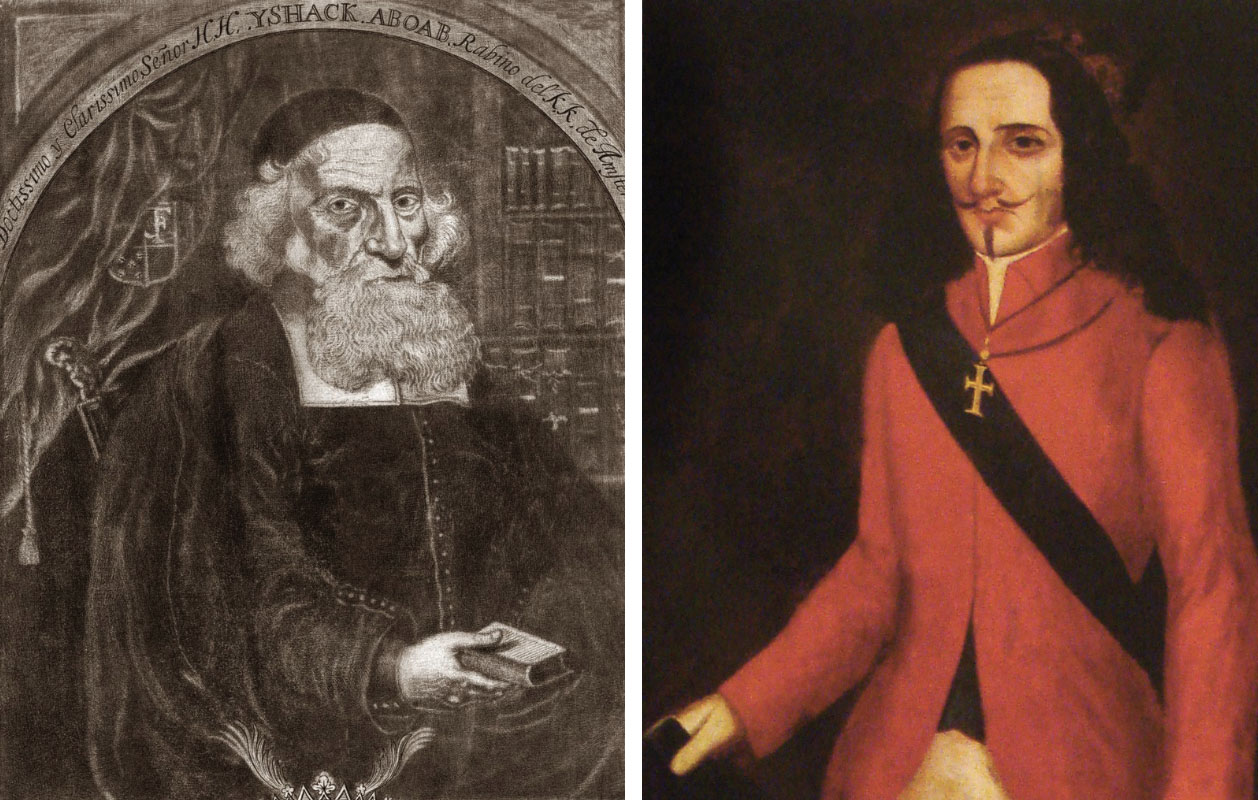
In 1646, the villain from the Book of Esther arrived in Brazil.
During the decades prior, Crypto-Jews who had avoided the Inquisition settled in the Spanish and Portuguese colonies. There they were finally able to practice their Judaism proudly and openly. In the city of Recife, on the northeastern Atlantic coast of what would become known as South America, immigrants from Amsterdam formed the first Jewish community in the New World.
The community’s leader was Rabbi Isaac Aboab da Fonseca. When he was six years old, his family fled from Portugal and the clutches of the Catholic Church and arrived in Amsterdam. A rabbinic prodigy who led the city’s largest synagogue by the time he was 21, da Fonseca’s rabbinic colleagues included Menasseh ben Israel, the internationally renowned scholar. As da Fonseca’s leadership skills and learning further developed (he had a particular knack for Kabbalah), he landed himself a coveted gig in the Americas. He beat out Rabbi ben Israel for a pulpit in Recife at age 36, and quickly cultivated the flourishing of an over 1,000-member strong Jewish community.
Unfortunately for the rabbi and his flock, in 1645, the Portuguese sought to take the city from the Dutch and set a naval blockade. Starvation became rampant. So too was the fear among the local Jews that under Portuguese rule their newfound religious freedom would be forgotten. The dire situation stretched for years.
So da Fonseca turned where so many Jews throughout history have when oppressive laws aimed at the destruction of the Jews loomed — to the story of Purim. He composed a poem in the early 1650s, “Zekher asiti leniflaot Kel” (“I made a memorial to the wonders of God”). In it, he encouraged his coreligionists to repent and seek the mercy of God. And he lambasted the villainous actions of João Fernandes Vieira, a local military leader supportive of the Portuguese, as being like that of a modern-day version of the conniving vizier Haman.
As Laura Leibman and Adriana Brodsky detail in “Jews Across the Americas,” da Fonseca structured the poem’s format on the medieval poet Judah HaLevi’s “Mi Kamokha,” itself a lengthy retelling of the Purim tale. Whereas his predecessor had lyrics like “Immediately after all these things, Ahasuerus lifted Haman up, and exalted him over all the princes,” da Fonseca wrote of “Remember, O God, the king of Portugal… from the dung heap he elevated him [João Fernandes Vieira] to protect and strengthen him … A descendant of Amalek worked against me … He gathered large amounts of silver and gold … to stand against me with trickery.” In these lines, da Fonseca alludes to the rabbinic tradition that Haman was a descendant of ancient Israel’s long-time tormentors, the Amalekites. Legend has it that Haman began his career as a humble stable-cleaner, before he rose to political power and cunningly bribed king Ahasuerus to allow for the destruction of the Jews.
The rabbi also looked inwardly, blaming his own failings for the enemy afflicting his community. “The serpent and the evil inclination led me astray … the oppressor hunted my steps and my soul is bitter.” In these lyrics, da Fonseca hearkened to the Talmudic tradition that the adversary in the Book of Esther comes from the same dastardly spirit that motivated the Garden of Eden’s tempting snake in Genesis’ opening chapters.
The poem is also replete with heartfelt prayers for God’s salvation. One pleads, “Your arm is not too short to save, so I will remind Your beloved nation, that even if You are long in coming, they should await You.”
Alas, Rabbi da Fonseca and Recife lost. The Portuguese took over in 1654 and the Jews fled. Haman, in this round, had been victorious.
Da Fonseca returned to Amsterdam, where he was appointed Chief Rabbi for the Sephardic community. Two years later he was faced with another challenge in the form of a young man named Baruch Spinoza, who was challenging rabbinic authority. Over the next few years, da Fonseca got caught up in the fervor surrounding the Messianic pretender Sabbatai Zevi until the latter’s conversion to Islam in 1666.
In the rabbi’s struggles against the Brazilian Haman, salvation for his people did not come from another place. It would have to wait for another time. For a few of his former congregants, that opportunity would arrive sooner than for others. Those who didn’t return to Amsterdam migrated to other ports in the Americas, including Newport and New Amsterdam, later renamed New York. There they would found new synagogues with names like “Salvation of Israel” and “Israel’s Remnant.” Though more Hamans would continue to arise, the Jewish people would survive and celebrate countless Purims in a new Promised Land.
Rabbi Dr. Stuart Halpern is Senior Adviser to the Provost of Yeshiva University and Deputy Director of Y.U.’s Straus Center for Torah and Western Thought. His books include “The Promise of Liberty: A Passover Haggada,” which examines the Exodus story’s impact on the United States, “Esther in America,” “Gleanings: Reflections on Ruth” and “Proclaim Liberty Throughout the Land: The Hebrew Bible in the United States.”