fbpx

March 12, 2025

Campus Watch March 12, 2025

UCLA Chancellor Announces Initiative to Combat Antisemitism

UCLA Chancellor Julio Frenk announced an Initiative to Combat Antisemitism on March 10.

Stuart Gabriel, a professor at the UCLA Anderson School of Management, will be leading the initiative and will report directly to Frenk. “Through this initiative, UCLA will implement recommendations of the Task Force to Combat Antisemitism and Anti-Israeli Bias, which was chaired by Professor Gabriel,” Frenk said. “These recommendations include: enhancing relevant training and education, improving the complaint system, assuring enforcement of current and new laws and policies, and cooperating with stakeholders.” He added: “UCLA is at an inflection point. Building on past efforts and lessons, we must now push ourselves to extinguish antisemitism, completely and definitively. The principles on which UCLA was founded — and which we continue to advance — point us toward a clear course of action: We must persevere in our fight to end hate, however it manifests itself.”

UCLA Hillel Executive Director Dan Gold told The Journal, “We welcome Chancellor Frenk’s formation of an Initiative to Combat Antisemitism at UCLA and look forward to working alongside UCLA and Prof. Stuart Gabriel to achieve the goals of the Initiative. Chancellor Frenk’s strong leadership inspires, in our community, a feeling of deep appreciation and hope for the future. We share his vision that UCLA will become a place where all students, faculty and staff can learn and express themselves without fear or discrimination.”

Trump Announces Arrest of “Radical Foreign Pro-Hamas” Columbia Graduate

President Donald Trump announced in a March 10 TruthSocial post that Mahmoud Khalil, who Trump described as “a Radical Foreign Pro-Hamas Student on the campus of Columbia University,” is being detained by Immigrations and Customs Enforcement.

“This is the first arrest of many to come,” Trump wrote. “We know there are more students at Columbia and other Universities across the Country who have engaged in pro-terrorist, antisemitic, anti-American activity, and the Trump Administration will not tolerate it. Many are not students, they are paid agitators. We will find, apprehend, and deport these terrorist sympathizers from our country — never to return again. If you support terrorism, including the slaughtering of innocent men, women, and children, your presence is contrary to our national and foreign policy interests, and you are not welcome here.” A federal judge barred the administration from deporting him March 10; a hearing will be held on March 12. 

According to CNN, Khalil is a recent graduate from Columbia and that the State Department is revoking his green card. The university had investigated allegations against Khalil over his involvement in the Columbia University Apartheid Divest (CUAD) coalition that was behind the anti-Israel encampment in the spring. Khalil told the Associated Press he acted as a spokesperson for the protesters, but was not involved in the group’s leadership or social media posts. Some groups, like the Council of American-Islamic Relations (CAIR), contend that the Trump administration is targeting Khalil for “his peaceful anti-genocide activism” in violation of the First Amendment.

Trump Admin Revokes $400 Million from Columbia

The Trump administration is revoking $400 million from Columbia University, with the rationale being that the university has been unable to adequately address antisemitism on campus.

“Universities must comply with all federal antidiscrimination laws if they are going to receive federal funding,” Education Secretary Linda McMahon said in a March 7 statement. “For too long, Columbia has abandoned that obligation to Jewish students studying on its campus.”

University Interim President Katrina Armstrong said in a statement that day to alumni, “I want to assure the entire Columbia community that we are committed to working with the federal government to address their legitimate concerns. To that end, Columbia can, and will, continue to take serious action toward combatting antisemitism on our campus.”

Trump Admin Investigating 60 Universities Over Antisemitism

The Trump administration announced March 10 that it is investigating 60 universities over their handling of antisemitism on their respective campuses.

Among the universities being investigated include Columbia University, Cornell University, Brown University, UC Davis, UC Berkeley, Stanford University, and USC, according to Fox News. 

“The Department is deeply disappointed that Jewish students studying on elite U.S. campuses continue to fear for their safety amid the relentless antisemitic eruptions that have severely disrupted campus life for more than a year. University leaders must do better,” Education Department Secretary Linda McMahon said in a statement. “U.S. colleges and universities benefit from enormous public investments funded by U.S. taxpayers. That support is a privilege and it is contingent on scrupulous adherence to federal antidiscrimination laws.”

Campus Watch March 12, 2025 Read More »

Confusing Haman and Mordechai

Rava said: A person is obligated to drink on Purim until he is so intoxicated that he does not know the difference between “cursed is Haman” and “blessed is Mordechai.” (Megillah 7b) 

I will never forget how it felt to watch videos of ordinary people across the United States tear down posters of Israeli hostages in the months immediately following Oct. 7. 

No hostage was spared. It did not matter if the picture showed a man or a woman, an adult, a child or even an infant. All the posters met the same fate — ripped from telephone poles and bulletin boards, then tossed in the garbage.

When confronted, the culprits responded without shame, utterly convinced that they were acting morally and that the long arc of history would come to vindicate Hamas’ massacres, as well as their own acts of petty vandalism. 

This phenomenon is just one of countless ways in which moral discernment — the ability to tell good from evil — has been conspicuously absent since the start of the war.

Human rights advocates have cheered or dissembled when faced with Hamas’ weaponization of sexual violence. Bodies sworn to defending the international order have openly aligned themselves with belligerent terrorist groups. Students at America’s most venerable institutions of higher learning have made no distinction between a state — however imperfect — that goes to great lengths to defend its people with military force, and a terrorist group that goes to great lengths to protect its military with human shields.

From a biblical perspective, the ability to discern good from evil is synonymous with the human condition itself. Eating from the Tree of Knowledge of Good and Evil is what ended Adam and Eve’s stint in Eden and began the long saga of human history. 

It is thus both a superpower — a divine gift snatched from heaven by our misbehaving ancestors — as well as a curse, a symptom of our fallen, exilic existence. 

Seen one way, life was better before we ate the forbidden fruit. We were naked and unafraid. We lived in harmony with ourselves, with one another, and with all of creation. We were innocent like children, as it says in Deuteronomy, “your little ones … your children who do not yet know good from bad, they shall enter [the land]” (1:39). 

Seen another way, it was a dangerous time, when we lacked the capacity to distinguish friend from foe and blithely followed the advice of snakes in the grass without ever suspecting that not everyone has our best interests at heart. In other words, it was a period of untenable and reckless naivety. 

Perhaps the injunction to drink away our moral discernment on Purim is motivated by a thirst for redemption — a yearning to cast off the shackles of exile and claw our way back to Edenic consciousness. 

Or perhaps this is a mystical practice. As the Hasidic masters have suggested, the duality of good and evil conceals the deeper unity of God Himself. As it is written in the Kedushat Levi, “from all of Haman’s evil came goodness … this causes us to realize that everything comes from the Creator… and that even things that appear to be evil, when one rejoices in them and says ‘this too is for the good,’ they are transformed into good. Such a person will fear nothing.” 

This is an intriguing teaching, but it is also a frightening one. What does it mean to suggest that good and evil are superficial distinctions that conceal a deeper unity? What does that say about the entire project of religious life? What does it mean to those who have experienced evil — who have been victims of cruelty, oppression, and violence? 

Watching the world fail one test of moral clarity after the other, Jews have clung ever more intensely to our convictions about right and wrong. There are, however, spiritual risks involved in this. A fixation on evil may leave us feeling more embattled, paranoid, and isolated. We may also succumb to self-righteousness, so bewildered by the evil of our enemies that we fail to hold ourselves to account for our own moral failings. 

In life, it is rare to find anyone as purely righteous as Mordechai or as purely wicked as Haman — though there are exceptions. And so perhaps the heart of this commandment is an injunction to shatter our moral idols — our caricatures of the other and our simplistic notions of the world as a place divided cleanly between light and dark like a black-and-white cookie. 

Or possibly the sages just want us to have some fun on Purim — to forget ourselves, to forget the cosmic battle of good and evil, to forget the poster-tearers and the hypocrisy of the international community, and to lay aside our sense of embattlement. If we do, perhaps we can return to that state of Edenic innocence for just one day — like children who neither know good or evil, who assume, naively, blessedly, that the world is safe.


Matthew Schultz is a Jewish Journal columnist and rabbinical student at Hebrew College. He is the author of the essay collection “What Came Before” (Tupelo, 2020) and lives in Boston and Jerusalem.  

Confusing Haman and Mordechai Read More »

The Forgotten Victims: Hamas’ Brutal Treatment of Women Hostages

All of the remaining female hostages who were held in Gaza have been released. It’s a long-overdue sigh of relief, but also one that should give us pause about what happened to all of the women held by Hamas over the course of the fifteen months.

As an American Jewish woman and mother, I have watched the plight of the female hostages held by the terrorist group Hamas in Gaza with horror. Unspeakable abuses have been perpetrated on these women and girls, not only during their capture during the Hamas invasion of Israel on Oct. 7, 2023, but in the subsequent long months of their captivity, and now — for the lucky ones who survive this nightmare — during their release. Time and again,we waited for advocates against trafficking and sexual violence to voice their outrage and for women around the world to stand up for these sisters in need, and too often, we have been disappointed. Why the double standard? Why wouldn’t all women, and certainly those who champion women’s rights in other contexts, stand up for these suffering innocents?

Hamas’s 1988 founding charter has a circumscribed role for women’s role in society, stating that Muslim women are important in that they “manufacture men and play a great role in guiding and educating the [new] generation.” Hamas has long enforced a harsh dress code for women in Gaza, and women in Gaza are prohibited from traveling without the permission of a male relative, such as her father or husband, which must be registered with a court.

When Hamas attacked Israel on Oct. 7, we saw a new level of barbarity with their treatment of women that they consider “enemies” in the State of Israel. Of the over 1,200 innocents that Hamas murdered on that day, the largest massacre of Jews since the Holocaust, many of the female victims were “twice murdered” — raped and suffering genital mutilation before their execution. Hideous videos have emerged of women being taken captive by Hamas operatives on Oct. 7, with the captors commenting: “Here are the girls who can get pregnant.”

We now know that the abuse that many of these innocent women endured over the long months of their captivity in Gaza included sexual violence. Amit Soussana, who was released several months ago, has testified about being forced to perform a sexual act on one of her captors at gunpoint. The United Nations has admitted that “There are reasonable grounds to believe that conflict-related sexual violence — including rape and gang-rape” occurred on Oct. 7. Teenage hostages who have been released were forced to perform sexual acts on each other and were sexually abused by their guards. Hamas guards also whipped the genitalia of minors. One released hostage, Karina Ariev, testified this week to being sexually harassed while in captivity. 

What has the response of the world’s appointed defenders of women’s rights been to these atrocities? All too often, it has been silence or even denial. 

The United Nations Entity for Gender Equality and the Empowerment of Women (U.N.-Women) released a statement on Oct. 13, 2023, equating Hamas’ brutalities with Israel’s self-defense. International movements like #MeToo and the U.N. Committee on the Elimination of Discrimination Against Women have ignored the plight of Hamas’ female victims. In response, a group of Israeli women created a viral hashtag and global campaign in protest: #MeToo_Unless_Ur_A_Jew. 

Hamas committed to releasing the surviving female hostages as part of its Jan. 15 ceasefire with Israel. However, the release proceedings have been horrifying in their own right. Hostages have been forced to appear with masked men at military-style rallies in Gaza prior to handover, wearing special uniforms and certificates provided by Hamas and holding “gift bags” from their captors. These events have been so chaotic, with mobs swarming the cars holding the female victims, that the Israeli government feared for their lives and was forced to delay release of the terrorists who are being set free in exchange for the hostages’ safe return.

During what was supposed to be the release of her body after she and her two young children were murdered in captivity, Hamas held a parade and boisterous ceremony. It turned out Hamas had released the body of a random Gazan woman, and only due to intense pressure did it finally turn over the real body of Shiri Bibas. 

Frankly, this should not be a difficult position for any feminist, human rights advocate, or friend of women. More need to follow the brave example of Meta’s Sheryl Sandberg, whose documentary film “Screams Before Silence” reveals the inhumanity of Hamas attackers toward female victims during the Oct. 7 attacks. 

Female victims must not be dehumanized and othered by those who should be their champions merely because they are Jewish. It’s time for the women of the world and our friends and allies to step up and unequivocally advocate for the safety and protection of women everywhere, regardless of religion, race, or ethnicity. Why have international women’s rights and human rights organizations stood aside or applied a double standard while this vileness is ongoing?


Rochel Leah Bernstein is a child protection and mental health advocate, investor, founder, and international speaker. She is the co-founder and CEO of Spark Family Offices.  

The Forgotten Victims: Hamas’ Brutal Treatment of Women Hostages Read More »

A Bisl Torah~Purim People, Passover People

Some people are Purim People. They enjoy spontaneity. Purim people read the story, page by page, excitedly experiencing the twists and turns of each presented character. Likewise, in their own lives, Purim people find joy in the unexpected; the wonderment that accompanies surprise, not knowing who you might meet with each waking day. Purim people love noise, laughter, costumes, and silliness. These are people that can see the light of the sun even during the darkest of days.

Some people are Passover People. They enjoy order. Passover people sigh a breath of relief knowing each step of the Seder and assigning each part to a designated guest. Passover people are comforted by schedules, routine, seasonal cleaning out of closets, and scrubbing of the refrigerator. They hate surprises. Passover people feel inspired by looking at the calendar and seeing ways they can better their soul through the reliability of the Jewish months and holidays. These are people that know with a sense of determination, rigor, and follow-through, even the toughest of problems can be worked through.

In the Megillah, Mordecai reminds Queen Esther, “And who knows, perhaps you have attained to royal position for just such a crisis.” Queen Esther discovers much later in life one of her greatest purposes: to save the Jewish people. In the Haggadah, we read, “In each and every generation, a person is obligated to see himself as if he left Egypt.” Just like our ancestors left Egypt, we retell the story, year after year, to remind ourselves of our constant striving for renewed freedoms. One holiday that teaches us life’s lessons are always unfolding. Another holiday that teaches us our past is just as relevant to our present and our future.

Some Purim people need to be more like Passover people. Some Passover people need to be more like Purim people. Whichever you are, let us not be afraid of refining who we are and who we are meant to be.

May your Purim and Pesach be filled with meaning, reflection, self-understanding, and perhaps a bit more chaos. Or, perhaps a bit more order.

Chag Sameach and Shabbat Shalom


Rabbi Nicole Guzik is senior rabbi at Sinai Temple. She can be reached at her Facebook page at Rabbi Nicole Guzik or on Instagram @rabbiguzik. For more writings, visit Rabbi Guzik’s blog section from Sinai Temple’s website.

A Bisl Torah~Purim People, Passover People Read More »

Are the Campuses Getting Better? The Journal Speaks to Students at the StandWithUs Conference

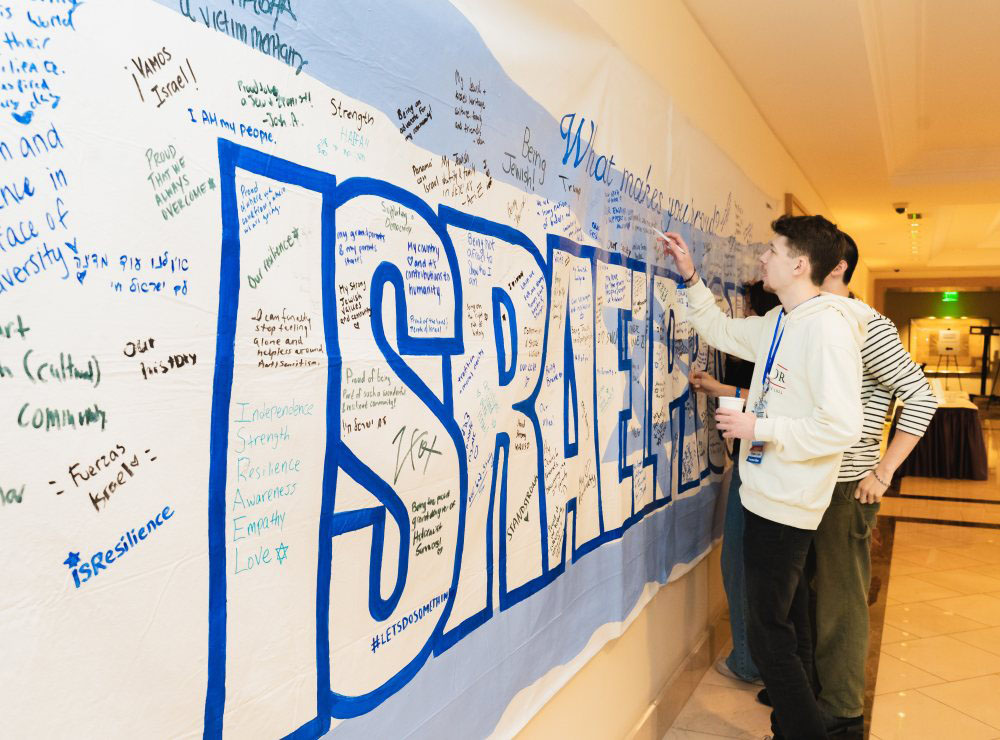
With its focus on Jewish students, the 2025 StandWithUs International Conference was a prime opportunity to talk to students and ask, has the climate on campus improved for the students?

“It’s about the same as last year,” StandWithUs CEO and Co-Founder Roz Rothstein told The Journal, explaining that the organization did survey on the matter. “It’s not like, oh it’s better because there are no encampments, there was a climate change at the university,” Rothstein said. “And according to our statistics, they’re facing a similar level of hostility without encampments necessarily because the seeds were planted.”

Judea Pearl, who spoke at the conference on Feb. 27, told The Journal that he believes it’s getting better at UCLA. “We have a new chancellor, the chancellor is listening … he wants to learn what is going on, and the faculty is in an uprising mood,” he said, adding that the relationship between students and faculty is improving. In the past, Pearl felt like he could only communicate with the students through an op-ed in The Journal, but now he feels like he can communicate more with students directly. “We have somebody at Hillel who is trying to embrace faculty and vice versa.”

“As far as the Jewish forces … we are more united, we are acting together, we are in the open,” he added.

The Journal interviewed various Jewish students at the conference who said they felt like the climate had improved on their respective campuses. “They’ve done a good job of enforcing the new rules and restrictions like time and place, and especially with the new chancellor, who came in this quarter, I think he’s done a good job,” Eli Sanchez, a third-year student at UCLA, said. “He suspended SJP [Students for Justice in Palestine]. We’ve seen some protests, but none have gotten out of hand. I can only speak for myself, but I think Jewish students feel safer. I personally feel safer. I think that most people are over all the disruptions and most students on campus, they want to return to normal.”

Photo courtesy SWU

“The biggest thing is that students are tired of noise,” Jaden Penhaskashi, another third-year student at UCLA, said. “And you can tell on both sides, the students don’t want to hear anything. So I think it’s an interesting approach from even a pro-Israel side because they see everything as the same noise, and they don’t want to hear anything. So truly, the solutions we view to show students the Israel side is through a cultural way.” Sanchez and Penhaskashi are the president and vice president of Bruins for Israel.

Victoria Zang, a third-year public health student at Brown University, told The Journal that her university has taken actions to make her feel more safe on campus, such as suspending the campus SJP chapter when its members protested at a meeting held by the university. “That was instrumental,” she said. “No rallies being held and all that stuff.” The university also rejected the divestment resolution proposed by SJP. “We as students felt validation that the university supported us, and that made me feel safer … things have been a lot more calm,” Zang said. “I can go to the dining halls, I can walk to my dorm, I can walk to my classes and not have to see the swamp of pro-Palestine propaganda on campus, which has been really nice.”

Dan Gotesdyner, a third-year data science student at De Anza College, told The Journal that “it’s gotten better because of us.” For instance, Jewish students met with the dean of equity at the college “to amend the rubric they’re operating under to include Jews as a prioritized affinity group” and they will be meeting with the dean of college life to disband the recently formed SJP chapter. “Throughout the year, we’ve been talking to the administration, but also publicly hosting events that appeal to the campus community,” he added.

Justin Herbert, a law student at the University of Windsor (Ontario, Canada), told The Journal that “it’s not so much a question of better or worse, it’s a question of normalization … a lot of these student pro-Palestinian organizations are still fighting to have change effectuated on campus. We don’t have that necessarily because our school already capitulated to the demands of the student encampment … they’ve already won. So what we’re seeing now is measures to reinforce anti-Zionist sentiment on campus.” One example is that the encampment agreement with the university created an advisory committee where students are tasked with upholding the principles of the Boycott, Divestment and Sanctions (BDS) movement on campus. “So Zionism is not just something that’s frowned upon, BDS is predicated on the belief that Zionism is evil, that it’s wrong, and that people who support it are essentially immoral or unethical, and the agreement that our school made reflects that,” Herbert said. “So if you’re in a position like mine, where you are a fierce and open advocate not just for Israel, but the rights for Israeli and Jewish students on campus in Canada, you have a target on your back. You open yourself up to so much undue criticism and backlash from other students and faculty.”

“This is the largest conference we’ve ever had,” SWU’s Rothstein told The Journal, as “specifically pointing to how more high school students participated than ever before. The students at the conference “have each other,” she added, and they have a sense that “they are not alone.” “Before they can do anything, they have to feel stronger. And that’s what they got here.”

Are the Campuses Getting Better? The Journal Speaks to Students at the StandWithUs Conference Read More »

Montana Tucker, Dan Ahdoot Highlight StandWithUs Conference

Montana Tucker, Dan Ahdoot, Zach Sage Fox, John Ondrasik and Judea Pearl were among those who spoke at the StandWithUs International Conference at the Hilton Los Angeles Airport from Feb. 27-March 2.

Speaking to the 650 conference attendees on Feb. 28, Tucker, an actress, singer and social media influencer, said: “Look around this room. This is what I call resilience. This is what I call strength.” Tucker, the granddaughter of Holocaust survivors, declared that she is “a proud Jew and I stand with Israel.”

Tucker acknowledged that “this past year-and-a-half hasn’t been easy for all of us” and that since the Oct. 7, 2023 massacre, “we have seen antisemitism explode in ways that I don’t think any of us have even imagined.” “And yet all of you are here,” added Tucker. “You’re not backing down but instead you are showing up. I am so proud of each and every one of you.”

Tucker recounted how she has been to Israel five times over the past year-and-a-half, where she has met with hostage families and released hostages. She also made a documentary, “Children of October 7th,” where Tucker interviewed children age 11-17 whose parents were murdered in the massacre or were taken hostage; she also interviewed the children of hostages whose bodies have been released . “Their strength, to have to recount their experience a year later … I told them that I would do everything that I can to make sure that this is getting out there and people hear their testimonies to never forget,” Tucker said. The documentary will premiere on Paramount Plus on April 23.

The social media influencer also recalled wearing a dress at the Feb. 2024 Grammys with a giant yellow ribbon to show support for the hostages. Tucker said that she was told that the Grammy’s communications department was “disappointed” in her wearing the ribbon because “it was too political.” Tucker refused to take it off, and was told that the Grammys couldn’t share her content. But, Tucker claimed, someone from The Recording Academy told her how awesome the dress was and asked to take a photo to share. She added that hostage families thanked Tucker, telling her “we finally feel seen outside of our echo chamber” and that little girls wore dresses like hers for Purim.

 Ahdoot, a comedian and actor known for his roles in “Cobra Kai” and “Kickin’ It,” applauded everyone in the room for fighting antisemitism, which he said is getting out of control. “Jews are getting guns now?” he said, recalling how he was recently at a gun range and quipped that “it looked like a freaking Chabad”; when he pointed his arm out to shoot, a rabbi started wrapping it in tefillin. He told the audience how he performed eight shows in Israel, and one show in Dubai, where he was paid three times more than all of the Israel shows combined. Ahdoot, an Iranian Jew, said he visited the Arab Quarter of Jerusalem while in Israel and attempted to enter the Temple Mount. However, an Israeli soldier stopped him from entering the area, and that the soldier said he knew Ahdoot is not a Muslim because “your nose is too big.”

Ahdoot said that he wore a hostage necklace while on the red carpet for Cobra Kai and that he believes in Israel’s right to exist. He joked that the anti-Israel chants “intifada revolution” and “from the river to the sea” as being fun to sing like “from the window, to the wall” … “Sure it’s a little genocidal, but the beat slaps,” he quipped, adding that pro-Israel chants get too bogged down in minutia and facts rather than catchy slogans.

Zach Sage Fox, an actor, producer, writer and comic, warned that “Hamas and their allies have used the tools of social media to amplify antisemitism in a way we have never seen before.” Fox explained that he runs a television and film studio in New York and does a lot of advertising on social media. Fox explained how he used a hidden camera in his social media video “Gaza Graduation” to talk to students at Columbia University and get their unfiltered thoughts. Fox said he was able to catch a female humanities major outside of Barnard College saying that she thinks that rape and terrorism are “nuanced.” Fox declared this is “the next generation of students,” adding he hopes that the video will go viral so that student will never be able to get a job when she graduates.

His response to critiques that pro-Israel content is fringe is that it needs to be made “sexy and cool” and that “satire is one of the best tools we have” to expose the other side. Earlier, Fox had mentioned that his video “Wild West Bank,” where he interviewed Palestinians in the West Bank expressing open Jew-hatred and support for eradicating Israel, had an extra layer by adding a western-theme. Fox said “our stuff has to be more entertaining and interesting” because we’re outnumbered.

Pearl, chancellor professor of computer science at UCLA, National Academy of Sciences member and Daniel Pearl Foundation president, spoke about how he coined the term “Zionophobic” and uses that word instead of “antisemitism.” University administrators love it when the word “antisemitism” is used because it gives them an excuse to form a task force that will write a “wishy washy” report. He argued that Zionophobia is worse than antisemitism because Zionophobes wish for Israel to be destroyed, taking away the Jewish people’s refuge from antisemitism.

Judea Pearl and Roz Rothstein (Photo courtesy SWU)

Ondrasik, a musician who performs as Five for Fighting, recalled giving out his cell phone number to attendees at last year’s conference, and was glad he did because he “heard from many students from colleges all around the world.” Ondrasik said the students “feel abandoned … and that’s because they have been.” He lamented that in some places, “the song remains the same.” But there has been positive change, as Ondrasik pointed out how Hamas has been “decimated,” Hezbollah is “a shadow of itself” and Iran “neutered.”

Ondrasik also pointed out that some presidents at college campuses “have been forced to resign.” He recently spoke to the president of Cornell University, and that while Professor Russell Rickford — who infamously referred to the Oct. 7 massacre as “exhilarating” — is still teaching at the university, Cornell’s president is “holding students accountable” and providing a blueprint for other Ivy League schools to follow.

The singer believes that comedy and music are how to win over youth, and while it broke his heart that students have been “on the front lines” of the battle for civilization, he’s glad they are “because you are brave” and that “you and Israel are literally saving the world.” He later broke out a rendition of his hit song “100 Years” on piano.

Another speaker was Luai Ahmed, a Yemeni-Swedish journalist. Ahmed, born and raised in Yemen, heard prayers “may Allah kill the Jews, may Allah kill the Zionists,” was taught “that Jews were evil and that Jews wanted to kill me,” “were all evil” and controlled the world, the media and wanted to kill Arabs as well as destroy Islam and thus “we had to get rid of them.”

But Ahmed overcame his antisemitism in three phrases. The first was meeting an Israeli Jew named Tal in Sweden in 2016, who caused Ahmed to realize that “the hate was one-sided.” Ahmed also saw friends and family members celebrate the Oct. 7 massacre, a traumatizing experience. The third phase involved Ahmed visiting Israel; he “could not remember a time in my life when I was so scared”  while traveling to Israel. He was afraid he would be shot for being an Arab Muslim. But when he arrived, he saw a Bedouin Muslim holding sign calling for the freeing of the hostages; Ahmed also met Jonathan Elkhoury, a Lebanese Christian Israeli who defends Israel. “It felt surreal,” Ahmed said. “Like a fever dream.” And he met an Arab Israeli who told him that the onus is on them to speak the truth because the Arab world will never believe it if it comes from the Jews.

“Even if it might not seem so, there are so many people out there who see you, who know you and who love you,” Ahmed said, adding that he’s learned that if you give the Jews a little bit of love, they’ll give you 10 times as much love back. “Because that’s what the Jews are all about: love,” he said.

The conference also debuted workshops and sessions from RabbisUNITED . “We are delighted to offer the full range of free SWU educational resources and programs that Rabbis can adapt to their local needs,” RabbisUNITED Executive Director Matthew Abelson said in a statement.

Montana Tucker, Dan Ahdoot Highlight StandWithUs Conference Read More »

Norman Rockwell and the Half-Shekel

Upon being described as a “friend of the working classes,” George Bernard Shaw insisted he “had no other feeling for the working classes than an intense desire to abolish them and replace them by sensible people.” The quip raises a question asked by many current politicians, especially with the reshuffling of the electorate: How does one befriend the working classes? Do they want government to put more cents (or dollars) in their pockets, or to respect their sensibilities?

This week’s Torah portion Ki Tissa has much to teach on the subject. Everyone is commanded to bring a half-shekel to help construct the mishkan: “The rich shall not give more and the poor shall not give less.” [Ex. 30:15] Economists would object to this as regressive taxation; in California, by contrast, the wealthiest one percent pays half of all income taxes, whereas the bottom half pays less than 1%.

But such economic dependence can foster political paternalism. The wealthy exercise disproportionate influence on public policy, with politics’ golden rule being “Whoever has the gold makes the rules.” If, as Nobel Laureate Bob Dylan observed, “Money doesn’t talk, it swears,” then failing to pay taxes removes one from public discourse. One British journalist made the point explicitly: “I am not arguing we should be careless of the needs of struggling people [but we] should be careless of their opinions.” In others words, the rich should put food into the mouths of the poor — and then ignore the words that come out of them.

The Torah favors a different model. R. Yerucham Levovitz (1873-1936) explained the commandment reminds us “there is no difference” between the rich and poor, who are fundamentally equal. And Dr. Rachel Anisfeld, a contemporary scholar, connects the role of the half-shekel to the need of Adam (and by extension, all of us) to connect with another to become whole, and fulfill our purpose.

Foxhole egalitarianism

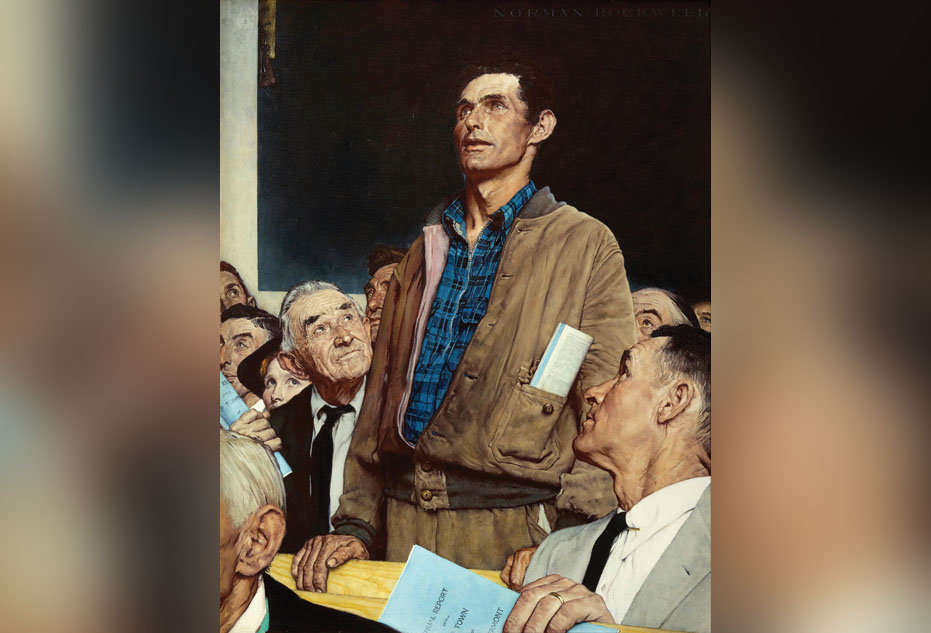
Social equality and interdependence were celebrated in the World War II-era, when millionaires and orphans shared foxholes, tanks and planes, and trusted one another with their lives. Norman Rockwell’s iconic 1943 painting “Freedom of Speech” depicted a man with a blue collar (and leather jacket) standing to speak before a town hall; two men with white collars (and jackets and ties) twist their heads to listen, because they care about his opinions and consider them worth hearing. Many working-class voters value and desire that respect — recognition that their opinions matter — more than the figurative offer of free pizza so long as they keep quiet while elites make all the decisions.

Rockwell’s speaker does not wear the same clothes as the listeners, and likely drives a cheaper car and lives in a smaller house. But he stands as their civic equal. As David Goodhart, the author of “The Road to Somewhere” explained, “People are prepared to trade economic gain for political agency and the prospect of a society that takes them more seriously.”

Rockwell’s speaker does not wear the same clothes as the listeners, and likely drives a cheaper car and lives in a smaller house. But he stands as their civic equal. 

Franklin Roosevelt thus advertised his party as the one that “believed in the wisdom … of the great majority of the people, as distinguished from the judgment of a small minority of either education or wealth.” In 1945, the Supreme Court likewise confirmed that public policy was a communal endeavor, finding that “right conclusions are more likely to be gathered out of a multitude of tongues, than through any kind of authoritative selection.” This confidence in the wisdom of the crowd has eroded in the last 80 years.

Predistribution or Redistribution?

Many contemporary Democrats believe the path to electoral success is to restore the principles not of Roosevelt’s New Deal but Lyndon Johnson’s Great Society, with higher taxes for the rich and more transfer payments to the poor. But the working class really prefers Roosevelt’s version of liberalism. More than 800 years ago, Maimonides wrote that the highest form of charity is a job, and evidence shows that workers agree.

A recent study, “‘Compensate the Losers?’: Economic Policy and Partisan Realignment in the U.S.,” indicates that redistributive taxation policies are (and always have been since polling began in the 1940s) less popular among high school graduates than among those with college degrees. Instead, the supposed beneficiaries of redistribution actually prefer “predistribution,” policies designed to provide opportunity and self-determination. Specifically, they favor the New Deal’s promise of guaranteed employment. They want the civic standing and social connections they derive from work, not the financial reward of a government-issued check.

Working conditions also matter. During the New Deal, “independent contractor” status was available to any Californian who decided how to complete his work projects (whether blue- or white-collar), even if someone else prescribed which work to do. But when the Legislature recently narrowed the range of independent work, it created exceptions only for those whose work is “original and creative” or “predominately intellectual.” But mechanics as well as screenwriters want the scheduling flexibility that enables them to bring their kids to after-school activities.

The shift from predistribution to redistribution in student loans likewise alienated the working class. The GI Bill enabled veterans to choose how to allocate their benefits; they could use them to pay college tuition, or to start a business. By contrast, the more recent policy of canceling student loans would help future professionals but exclude the gardener who is paying off his truck loan (as well as the graduates who dutifully paid back what they owed).

The closing of the American town hall

Perhaps the most pernicious change since the 1940s is the exclusion of the working class from public debate. The real-life analogue to Rockwell’s speaker was Grace Marsh, who was arrested in 1943 for distributing pamphlets against the wishes of the corporation that owned the town — and its sidewalks. The Supreme Court ruled in her favor, insisting that her right to speak could not be lost “simply because a single company has legal title to all the town.”

But today’s workers have no chance to speak at — or even attend — a Rockwellian meeting discussing important questions. Contemporary Grace Marshes have been banished from the “sidewalks” of corporate-owned internet sites (what the Supreme Court has deemed “the modern public square”), often at the urging of governmental officials, and state censors demanded (and achieved) the removal of truthful information on the ground that the public could not be trusted to evaluate it properly.

Due to that distrust (the opposite of Roosevelt’s belief in the “wisdom … of the great majority of the people”) COVID policy disregarded their needs. Families with backyards and pools hardly noticed shuttered playgrounds and beaches, but those in cramped apartments suffered. Private schools remained open while public ones stayed closed. And almost 70% of graduate-degree holders could work from home, and lost their commute; only 17% of those who never attended college could do so, so they lost their jobs — and the social connections derived from them.

The lesson of the half-shekel is that everyone contributes to a mission in which everyone shares. Under FDR, everyone was expected to work (even if the government had to create the job) and everyone was expected to join the war effort. As with the half-shekel contribution, there were no class-based exemptions. LBJ, by contrast, offered separate deals for rich and poor. Unlike the 1930s, there was no universal expectation to work; Johnson exempted the poor from work through loose welfare policies. But unlike the 1940s, there was no universal expectation to serve, as Johnson exempted the student class from military service. The Torah imperative, neither to favor the poor nor defer to the rich (Lev: 19:15), but to treat all according to the same standard, would do much to restore our national community.


Mitchell Keiter is the author of “Forum for the Common Man: How Robins v. Pruneyard Integrated the Marketplace of Ideas with the Marketplace of Goods.”

Norman Rockwell and the Half-Shekel Read More »

When Haman Came to the New World

In 1646, the villain from the Book of Esther arrived in Brazil.

During the decades prior, Crypto-Jews who had avoided the Inquisition settled in the Spanish and Portuguese colonies. There they were finally able to practice their Judaism proudly and openly. In the city of Recife, on the northeastern Atlantic coast of what would become known as South America, immigrants from Amsterdam formed the first Jewish community in the New World.

The community’s leader was Rabbi Isaac Aboab da Fonseca. When he was six years old, his family fled from Portugal and the clutches of the Catholic Church and arrived in Amsterdam. A rabbinic prodigy who led the city’s largest synagogue by the time he was 21, da Fonseca’s rabbinic colleagues included Menasseh ben Israel, the internationally renowned scholar. As da Fonseca’s leadership skills and learning further developed (he had a particular knack for Kabbalah), he landed himself a coveted gig in the Americas. He beat out Rabbi ben Israel for a pulpit in Recife at age 36, and quickly cultivated the flourishing of an over 1,000-member strong Jewish community. 

Unfortunately for the rabbi and his flock, in 1645, the Portuguese sought to take the city from the Dutch and set a naval blockade. Starvation became rampant. So too was the fear among the local Jews that under Portuguese rule their newfound religious freedom would be forgotten. The dire situation stretched for years.

So da Fonseca turned where so many Jews throughout history have when oppressive laws aimed at the destruction of the Jews loomed — to the story of Purim. He composed a poem in the early 1650s, “Zekher asiti leniflaot Kel” (“I made a memorial to the wonders of God”). In it, he encouraged his coreligionists to repent and seek the mercy of God. And he lambasted the villainous actions of João Fernandes Vieira, a local military leader supportive of the Portuguese, as being like that of a modern-day version of the conniving vizier Haman. 

As Laura Leibman and Adriana Brodsky detail in “Jews Across the Americas,” da Fonseca structured the poem’s format on the medieval poet Judah HaLevi’s “Mi Kamokha,” itself a lengthy retelling of the Purim tale. Whereas his predecessor had lyrics like “Immediately after all these things, Ahasuerus lifted Haman up, and exalted him over all the princes,” da Fonseca wrote of “Remember, O God, the king of Portugal… from the dung heap he elevated him [João Fernandes Vieira] to protect and strengthen him … A descendant of Amalek worked against me … He gathered large amounts of silver and gold … to stand against me with trickery.” In these lines, da Fonseca alludes to the rabbinic tradition that Haman was a descendant of ancient Israel’s long-time tormentors, the Amalekites. Legend has it that Haman began his career as a humble stable-cleaner, before he rose to political power and cunningly bribed king Ahasuerus to allow for the destruction of the Jews.

The rabbi also looked inwardly, blaming his own failings for the enemy afflicting his community. “The serpent and the evil inclination led me astray … the oppressor hunted my steps and my soul is bitter.” In these lyrics, da Fonseca hearkened to the Talmudic tradition that the adversary in the Book of Esther comes from the same dastardly spirit that motivated the Garden of Eden’s tempting snake in Genesis’ opening chapters. 

The poem is also replete with heartfelt prayers for God’s salvation. One pleads, “Your arm is not too short to save, so I will remind Your beloved nation, that even if You are long in coming, they should await You.”

Alas, Rabbi da Fonseca and Recife lost. The Portuguese took over in 1654 and the Jews fled. Haman, in this round, had been victorious.

Da Fonseca returned to Amsterdam, where he was appointed Chief Rabbi for the Sephardic community. Two years later he was faced with another challenge in the form of a young man named Baruch Spinoza, who was challenging rabbinic authority. Over the next few years, da Fonseca got caught up in the fervor surrounding the Messianic pretender Sabbatai Zevi until the latter’s conversion to Islam in 1666.

In the rabbi’s struggles against the Brazilian Haman, salvation for his people did not come from another place. It would have to wait for another time. For a few of his former congregants, that opportunity would arrive sooner than for others. Those who didn’t return to Amsterdam migrated to other ports in the Americas, including Newport and New Amsterdam, later renamed New York. There they would found new synagogues with names like “Salvation of Israel” and “Israel’s Remnant.” Though more Hamans would continue to arise, the Jewish people would survive and celebrate countless Purims in a new Promised Land.


Rabbi Dr. Stuart Halpern is Senior Adviser to the Provost of Yeshiva University and Deputy Director of Y.U.’s Straus Center for Torah and Western Thought. His books include “The Promise of Liberty: A Passover Haggada,” which examines the Exodus story’s impact on the United States, “Esther in America,” “Gleanings: Reflections on Ruth” and “Proclaim Liberty Throughout the Land: The Hebrew Bible in the United States.”

When Haman Came to the New World Read More »

A Case for Multigenerational Living in Los Angeles

Winston Churchill once famously observed that Americans “will always do the right thing, only after they have tried everything else.” Indeed, this astute observation is as true to broken American housing policies as it is for wartime strategy. Many of the proposals to mitigate our catastrophic housing shortage fall woefully short of matching the scope of meaningful housing reform. What we need is to maximize space in ways that solve multiple societal challenges at once — namely the three-level townhome. 

In Los Angeles, the disappearance of the starter home has been exacerbated by decades of restrictive zoning and excessive California Environmental Quality Act (CEQA) regulations. This has resulted in an affordability crisis so acute that the only way to own a home in today’s real estate market is to either make a minimum salary of 300K a year (most doctors don’t even make this) or to have bought in decades ago when economic conditions were much more favorable to first-time homebuyers. Moreover, with only 13% of Los Angeles households able to afford the average home of $1.2M, outmigration and permanent rentership edging higher and higher up the income ladder will continue to dominate the housing landscape of this highly broken market. The value of a three-level townhome can be understood both in terms of its spatial utility and its unique potential to solve several of our most pressing issues connected to our dwindling labor force and caring for our aging population. As people live longer, the need for the “sandwich generation” to both raise their children while caring for older family members becomes more acute especially in urban centers like Los Angeles with an aging population that is far outpacing inbound migration. 

As Joel Kotkin, Professor of Urban Futures at Chapman University observes, “High housing prices, relative to incomes, are having a distinctly feudalizing impact on our state of California, where the primary victims are young people, minorities and immigrants.” Further, the move toward globalization, and the economic and cultural changes that have occurred incrementally since the end of World War II have resulted in drastic changes in domestic migration patterns, leading to the fragmentation of what were once cohesive families and communities. This pattern, without significant course correction, will only increase with the extreme unaffordability of life in urban centers as well as the epidemic of loneliness that plagues much of America. In simplest terms, people are being forced out of their communities by the aggregate effects of unaffordable housing, massive student loan debt and lack of economic opportunities in once thriving urban centers. This will have devastating effects on our local economy and our ability to care for our aging parents and grandparents without significant innovation beyond the limits of the insufficient limited density projects proposed thus far.

One could argue that the image of the single-family home as the apex of the American dream has directly led to the fragmentation and loneliness that people are experiencing across all sectors of society having in effect been cut off from the nature and nurture of community. This feeling of isolation by generation has only been amplified by the Covid pandemic. By contrast, the townhome is a physical manifestation of “it takes a village” where not only are children raised in multigenerational households, but elder care is assisted by programs such as In Home Supportive Services that allow family members to care for their aging relatives reducing the need to hire external caregivers. Further, absent robust long-term care insurance, elder care can cost upwards of 10K a month. Over 10 years, the cost will significantly diminish, if not eradicate the life savings and equity that people worked a lifetime to create for their families.  

One could argue that the image of the single-family home as the apex of the American dream has directly led to the fragmentation and loneliness that people are experiencing across all sectors of society having in effect been cut off from the nature and nurture of community. 

This is not to say that multigenerational living is for everyone. I am sure that having one’s mother right there to remind you to eat your veggies or one’s father knocking on your door to fix his broken cell phone that he just forgot how to charge is less appealing than renting a swanky studio in Silverlake. However, ask anyone who has lost a parent what they would give to have that back even for one day and suddenly the illusion of the grandeur of self-reliance vanishes like the once-attainable dream of homeownership in our city.


Lisa Ansell is the Associate Director of the USC Casden Institute and Lecturer of Hebrew Language at Hebrew Union College-Jewish Institute of Religion Los Angeles.

A Case for Multigenerational Living in Los Angeles Read More »

Fall In Love with the Problem

In 1897, 200 participants From 17 countries gathered in Basel, Switzerland, convened by Theodor Herzl, the father of modern Zionism.

In 2025, 150 Jews gathered in Haifa for the Voice of the People’s Council, an initiative and vision of Israel’s president, Isaac Herzog. Fifty Jews from Israel, 50 Jews from North America, and 50 Jews from the rest of the world, coming together to embrace the Jewish world’s greatest challenges. 

As President Herzog wrote in the most recent SAPIR Journal, the diversity of Zionism is its greatest strength. The time for conversation must not wait.

As I looked around the room, this is who I saw;  a top Israeli AI professional, a doctor from Sweden, a Chabad Rabbi from Russia, a leader in the world of Christian-Israel relations,  an actor from the United States, a recent Jew by Choice from an Arab country, IDF veterans, academic professors, and more, only to name a few.

 As we gathered for the opening plenary, the same questions crossed our minds. 

How are we all in this space together?

Voice of The People’s Council is data driven. From the 10,000 responses to a survey sent out to the Jewish world, we were presented with today’s greatest challenges.

Antisemitism, diaspora-Israel relations, internal polarization, and Jewish and non-Jewish relations. While Jews from almost every location on earth face these difficulties, there was one fact that almost all respondents agreed. The Jewish people have a shared destiny, and Israel must be the central place in that story. 

The president reminded us we were not there to bring solutions back home. We were there to be inspired by the problems.

Rabbi Erez Sherman with President Isaac Herzog

It is with this approach that we visited the Madatech museum in Haifa, and met with CEOs of Israel’s greatest startups. Instead of defining their end goals, they described the failures it took to allow them to succeed. Whether it was BeeHero in agriculture, Belkin Vision helping cure glaucoma, or the Iron Dome missile defense, each success derived from failure as the CEOs embraced the process. 

Our tradition teaches “It is not your duty to complete the work, but neither are you free to desist from it.” 

On our first day of meeting, we toured the Nova site. After reciting the traditional memorial prayer on that hallowed ground, we continued to Sapir College, and listened to two Oct. 7 attack survivors describe in harrowing detail the events of that day. How could we move on from those atrocities? 

That is when a young man, a council member and an advisor to the mayor of Sderot, stood up and excitedly described the new developments of the south, including a partnership with Berklee College of Music. He said while Hamas desired our removal from the land, victory will arrive when we turn 40,000 residents into 250,000 residents of this area. 

Before the Voice of the People Council commenced, I spent Shabbat with my family outside of Tel Aviv. As we walked to the synagogue, my cousin pointed out a few homes. Her neigbor’s house is under renovation, as one of the children is now an amputee from war. The next home is in mourning, losing a son to battle in Gaza. The next home is the aunt of Eitan Mor, still held captive in Gaza, with recent news that he is alive. 

When we arrived for Shabbat services, I saw a rabbi a few years younger than me. I was told he was hired 18 months ago, but had a delayed start as he too was called up for reserved duty.

After Shabbat, I visited two families in shiva: Lifshitz and Bibas. These were tragedies that I witnessed on television, 7,000 miles away, and now I was expressing condolences on behalf of us all.

After hearing story after story of loss and destruction, it felt strange at first to sit with 149 strangers and intellectually ponder the world’s greatest Jewish challenges. Yet, day after day, deep in conversation, I saw the sparks of light that will lead to a brighter tomorrow.

After hearing story after story of loss and destruction, it felt strange at first to sit with 149 strangers and intellectually ponder the world’s greatest Jewish challenges. Yet, day after day, deep in conversation, I saw the sparks of light that will lead to a brighter tomorrow.

At the closing gala, President Herzog exclaimed that it is about time we see that diversity within Zionism is a source of strength and a key to our future as a nation.

As President Herzog sat at his table, his vision came to life. Four individuals came up on stage. One from Israel, one from the United States, one from Morocco, and one from Russia. They recited a poem that a council member had written, inspired by the conference. It was read in English, Hebrew, Arabic and Russian, yet all with the same intent of expressing our shared destiny as a Jewish people. 

I watched as President Herzog smiled from ear to ear.

The vision was now a reality.

The solutions are stil very far away, and the problems are now before our eyes.

The converation has begun. It’s time for us all to join in.

Am Yisrael Chai.


Rabbi Erez Sherman is Senior Rabbi of Sinai Temple. 

Fall In Love with the Problem Read More »