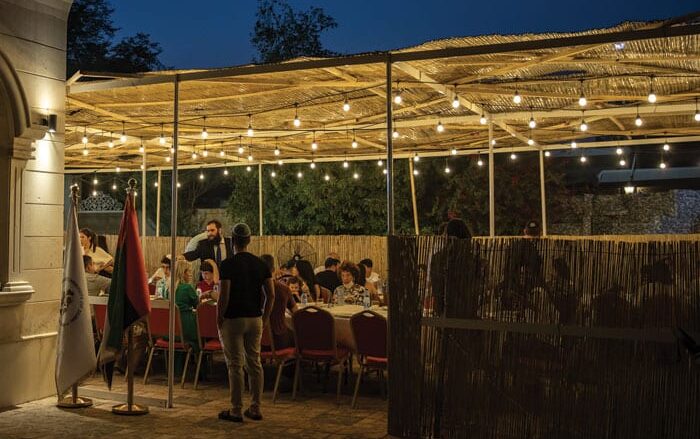
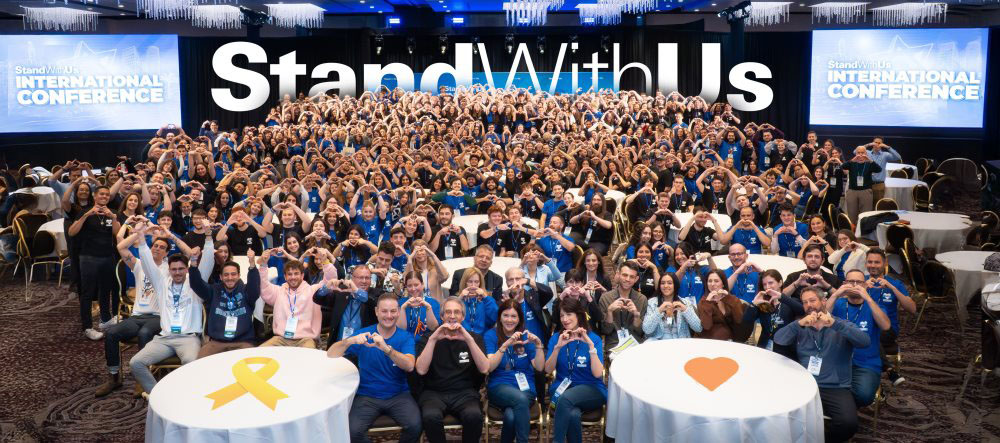
With its focus on Jewish students, the 2025 StandWithUs International Conference was a prime opportunity to talk to students and ask, has the climate on campus improved for the students?
“It’s about the same as last year,” StandWithUs CEO and Co-Founder Roz Rothstein told The Journal, explaining that the organization did survey on the matter. “It’s not like, oh it’s better because there are no encampments, there was a climate change at the university,” Rothstein said. “And according to our statistics, they’re facing a similar level of hostility without encampments necessarily because the seeds were planted.”
Judea Pearl, who spoke at the conference on Feb. 27, told The Journal that he believes it’s getting better at UCLA. “We have a new chancellor, the chancellor is listening … he wants to learn what is going on, and the faculty is in an uprising mood,” he said, adding that the relationship between students and faculty is improving. In the past, Pearl felt like he could only communicate with the students through an op-ed in The Journal, but now he feels like he can communicate more with students directly. “We have somebody at Hillel who is trying to embrace faculty and vice versa.”
“As far as the Jewish forces … we are more united, we are acting together, we are in the open,” he added.
The Journal interviewed various Jewish students at the conference who said they felt like the climate had improved on their respective campuses. “They’ve done a good job of enforcing the new rules and restrictions like time and place, and especially with the new chancellor, who came in this quarter, I think he’s done a good job,” Eli Sanchez, a third-year student at UCLA, said. “He suspended SJP [Students for Justice in Palestine]. We’ve seen some protests, but none have gotten out of hand. I can only speak for myself, but I think Jewish students feel safer. I personally feel safer. I think that most people are over all the disruptions and most students on campus, they want to return to normal.”
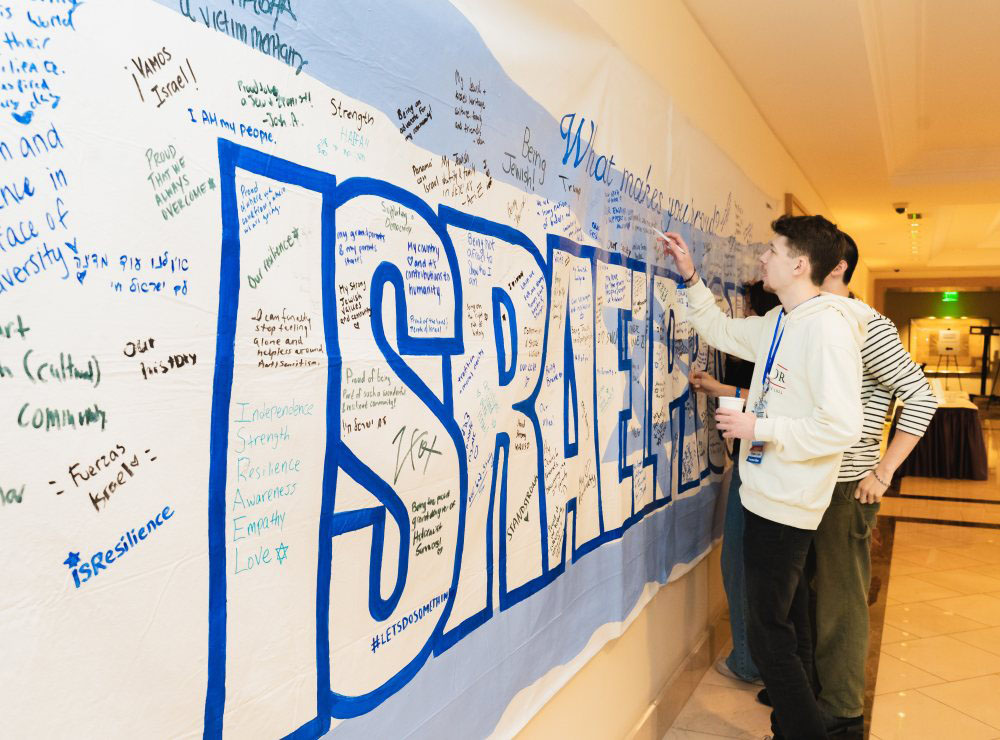
“The biggest thing is that students are tired of noise,” Jaden Penhaskashi, another third-year student at UCLA, said. “And you can tell on both sides, the students don’t want to hear anything. So I think it’s an interesting approach from even a pro-Israel side because they see everything as the same noise, and they don’t want to hear anything. So truly, the solutions we view to show students the Israel side is through a cultural way.” Sanchez and Penhaskashi are the president and vice president of Bruins for Israel.
Victoria Zang, a third-year public health student at Brown University, told The Journal that her university has taken actions to make her feel more safe on campus, such as suspending the campus SJP chapter when its members protested at a meeting held by the university. “That was instrumental,” she said. “No rallies being held and all that stuff.” The university also rejected the divestment resolution proposed by SJP. “We as students felt validation that the university supported us, and that made me feel safer … things have been a lot more calm,” Zang said. “I can go to the dining halls, I can walk to my dorm, I can walk to my classes and not have to see the swamp of pro-Palestine propaganda on campus, which has been really nice.”
Dan Gotesdyner, a third-year data science student at De Anza College, told The Journal that “it’s gotten better because of us.” For instance, Jewish students met with the dean of equity at the college “to amend the rubric they’re operating under to include Jews as a prioritized affinity group” and they will be meeting with the dean of college life to disband the recently formed SJP chapter. “Throughout the year, we’ve been talking to the administration, but also publicly hosting events that appeal to the campus community,” he added.
Justin Herbert, a law student at the University of Windsor (Ontario, Canada), told The Journal that “it’s not so much a question of better or worse, it’s a question of normalization … a lot of these student pro-Palestinian organizations are still fighting to have change effectuated on campus. We don’t have that necessarily because our school already capitulated to the demands of the student encampment … they’ve already won. So what we’re seeing now is measures to reinforce anti-Zionist sentiment on campus.” One example is that the encampment agreement with the university created an advisory committee where students are tasked with upholding the principles of the Boycott, Divestment and Sanctions (BDS) movement on campus. “So Zionism is not just something that’s frowned upon, BDS is predicated on the belief that Zionism is evil, that it’s wrong, and that people who support it are essentially immoral or unethical, and the agreement that our school made reflects that,” Herbert said. “So if you’re in a position like mine, where you are a fierce and open advocate not just for Israel, but the rights for Israeli and Jewish students on campus in Canada, you have a target on your back. You open yourself up to so much undue criticism and backlash from other students and faculty.”
“This is the largest conference we’ve ever had,” SWU’s Rothstein told The Journal, as “specifically pointing to how more high school students participated than ever before. The students at the conference “have each other,” she added, and they have a sense that “they are not alone.” “Before they can do anything, they have to feel stronger. And that’s what they got here.”