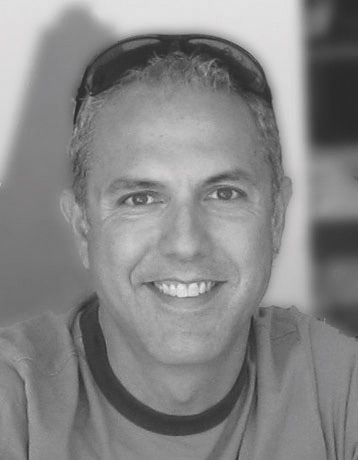
Well, we’ll suppose the best way for a couple of rabbi’s sons to talk about why, as guys, they created a universe dominated by women — would be to start with a quote from a friar discussing the ramifications of a gospel of Jesus.
“[Sometimes] it’s useless to try to change things. You can be open to reconciliation, but you have no control over whether someone will reconcile with you. Part of this process is embracing your own powerlessness. Letting go is paramount.”
The good friar (best-selling author, James Martin, SJ) was talking about Jesus’ “turn the other cheek” doctrine. He also adds that contrary to popular belief, it doesn’t mean allowing yourself to be victimized – au contraire. Rather it means you should strive for an “unconquerable benevolence.” All of which can ultimately lead to freedom and happiness.
Right — but what’s all that got to do with the women of The Unincorporated universe? Turns out, a lot — especially with regards to freedom and happiness. Any writer will tell you that a good story practically writes itself. Leaving aside all the blood, sweat and tears that came before the “writing itself” part, we’d say, that’s true. But what happens when your story’s written itself into a glass jar and then sealed itself off with a couple of pissed-off scorpions (the protagonist and antagonist) trapped inside? That’s what happened to us by the time we pushed past our first novel, The Unincorporated Man and found ourselves at the end of our second, The Unincorporated War.
In short, male thinking was incapable of moving our story forward. And arguably our kick-ass Fleet Admiral J.D. Black, introduced in book two, was more guy-like than girl; certainly in her methods if not her motives. If we ever wanted to arrive at the promised land of freedom and happiness for the Unincorporated universe we were going to need some of that unconquerable benevolence the good friar was referring to. Sadly, that’s a trait woefully lacking in men in general and ours in particular (see: scorpions above). Women, on the other hand, seem to have it in abundance.
All this begs the question: can you create a J.D. Black or David Weber’s Honor Harrington without their necessarily being labeled “guys with boobs”? We honestly had no idea. We did, however, recognize that because women tend to think about and resolve conflicts differently than men, we’d need at least one to figure out how to get our trapped scorpions out of the jar before our story spiraled into nothing but an interstellar slug fest. Don’t get us wrong, slugfests are good, we dig Military SF; just not when it comes at the expense of the Unincorporated universe’s overarching theme of freedom and personal responsibility.
So, having resolved to introduce a strong female protagonist into our universe (and for good measure, equally dependable female support) we showed her the jar with the fighting scorpions, stood back and waited to see what her “unconquerable benevolence” could do for us. We didn’t have to wait long — she kicked in the glass. (Now why didn’t’ we think of that?)
It was love at first write. Suddenly we were no longer confined to the sort of jarhead mentality that necessitates even bigger and more badass weapons, because we now had the ultimate weapon at our disposal — unpredictability. It’s not a jab at women; it’s a compliment. Whereas a male commander, especially in time of war, brooks little or no disagreement, a woman similarly situated not only brooks it, she tends to encourage it. Certainly all the great ones did. We studied Eleanor of Aquitaine, Elizabeth I, and Margaret Thatcher to name but a few. We were less interested in their politics than we were in how they managed to make things work. All were wartime leaders, all ruled over a group of cantankerous, scheming ideologues (mostly with oversized egos) and all succeeded admirably where lesser men had failed. We also delved into the history of Celtic woman — fearsome warriors and learned Druidesses venerated for their beauty as much as their brains. We think it’s safe to say that the women who emerge in The Unincorporated Woman are a combination of all of the above.
As a final denouement, we made the main female protagonist a skeptical agnostic, figuring that it might be good to have one around in the midst of what was threatening to become a religious crusade. Thus situated, the story began to once again, “write itself.”
The funny thing is, even if in the end we got our women wrong, just trying to think like one helped us immeasurably. We believe the characters to be richer, deeper and ultimately more interesting than those that preceded them. Are they badass? Yes — in some ways, even more than the men they’ve replaced. Are they men with boobs? Decidedly not; for the simple fact that they’d never let us write them that way.
There’s an old saying that behind every great man is a woman. We disagree. Behind every great man is usually another trying to best him. But behind every great woman, we discovered something quite extraordinary — a group of friends (of both sexes) working together to make her even greater. We can work with that