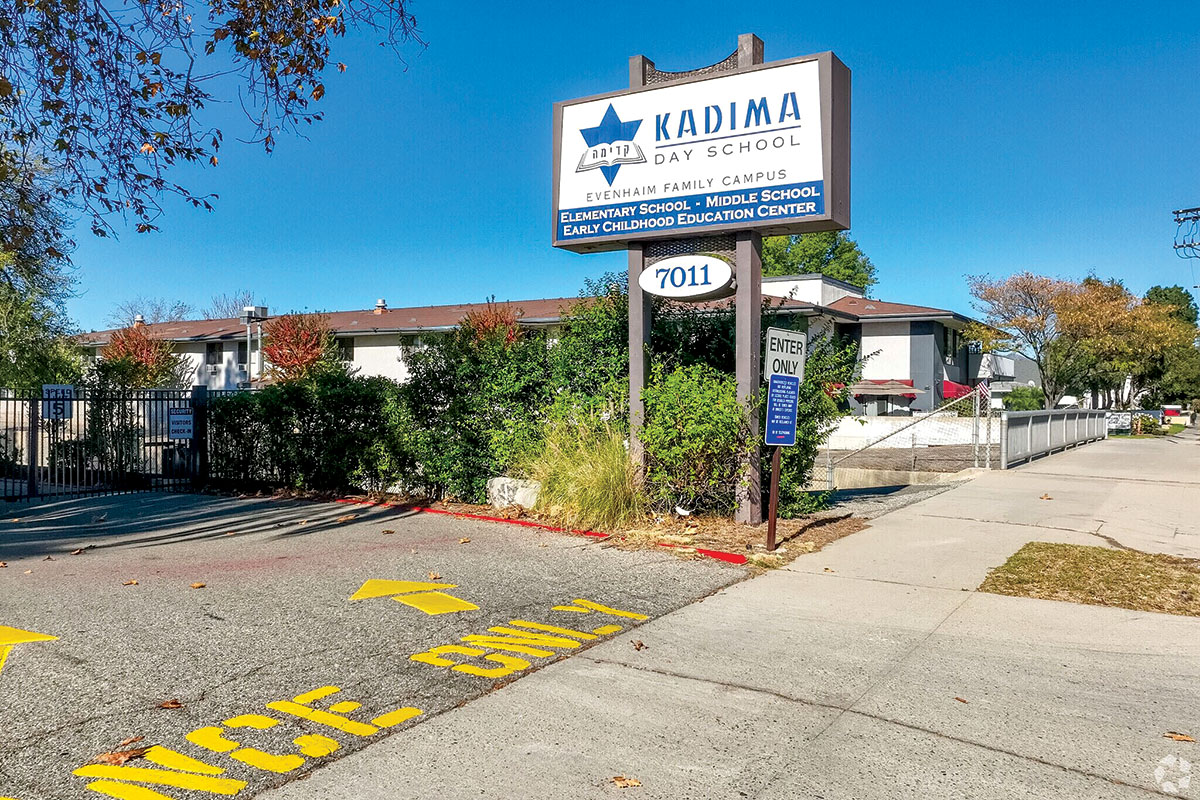
Fifty-six years after it was founded, Kadima Day School will close its doors at the end of this school year. The announcement follows a difficult year in which the school struggled to raise funds to ensure its continued operation.
In an email sent to staff and parents, the Board of Trustees explained that the decision followed an extended period of financial strain tied to the withdrawal of its long-time bond guarantor, as well as an ongoing need to cover both a multimillion-dollar bond obligation and a significant operating shortfall. The school noted that the community had previously rallied to raise close to $900,000 in a matter of weeks, but those efforts ultimately fell short of what was needed to stabilize the institution long-term, despite continued attempts to secure a new guarantor, major donor support or a merger with another school.
The financial crisis traces back to May 27, 2025, when the school received a letter from Shawn Evenhaim, its longtime supporter and bond guarantor, informing leadership that he would no longer continue in that role.
The Israeli-American developer wrote that the decision came after many years of involvement. “No school or community institution should be dependent on a single family for two decades,” he wrote. “The decision was not made lightly – it comes with great emotion, deep sorrow and immense gratitude.”
Following his decision, the school launched emergency fundraising efforts through GoFundMe, PayPal and private events. However, the total was not enough to fully secure operations for the 2025–2026 school year.
Over the years, Evenhaim and his wife Dorit donated more than $10 million to the school and also provided over $6 million in interest-free loans. According to Evenhaim, those funds helped cover salaries, utilities and other operating expenses. Once he stepped away from continued financial support, the school struggled to sustain itself.
Some teachers told The Journal that resources had become increasingly strained in recent months. Salaries were reportedly reduced by 8% before later being restored, and some staff were let go while others began seeking employment elsewhere amid growing uncertainty.
“Many teachers started looking for other jobs,” said one teacher who asked not to be identified. “We don’t have enough supplies, and parents need to help out. Some teachers even used their own money to purchase supplies they needed.”
Meanwhile, with the bond guarantee in question, Evenhaim reportedly began receiving calls from the bank regarding the outstanding debt tied to the property in West Hills.
In the meantime, the Jewish Federation of Greater Los Angeles provided a $500,000 loan to help the school remain open through the end of the school year. However, sources indicate that this may not be enough, and middle school operations could end as early as May.
Evenhaim had cautioned the school last year that he feared it would not be financially sustainable. He also suggested that another Jewish school might take over the property, but that never materialized.
“The entire situation is very stressful for us because many of us don’t know what we will do,” said the teacher. “Overall, it’s very sad that it has come to an end like this.”
Kadima was founded in 1970 by Rabbi Eli Schochet of Congregation Beth Kodesh as a community Jewish day school. In its first year, the school enrolled seven boys and one girl. Over time, it expanded, adding students and classes that serve children from early education through middle school. It moved several times before settling in 2004 at its current four-acre Evenhaim Family Campus in West Hills.
Head of School Jerry Isaak-Shapiro called the closure “a deeply sad and troubling moment” for students, families and the broader community. “The closing of a Jewish day school is a deeply sad and troubling moment, for those students and families affected today, and for all of those who would have experienced Jewish learning in the years to come.”
Shapiro emphasized the centrality of Jewish education, citing the traditional teaching that “Talmud Torah k’negged kulam”— that Jewish learning is paramount. He expressed hope that students would continue their education in other Jewish day schools and retain “the passion and love for Judaism and Zionism” cultivated at Kadima.
He also offered a personal reflection, noting it was “a pleasure and a kavod” to work with the school’s staff and teachers, adding that the closure is also a loss for them.