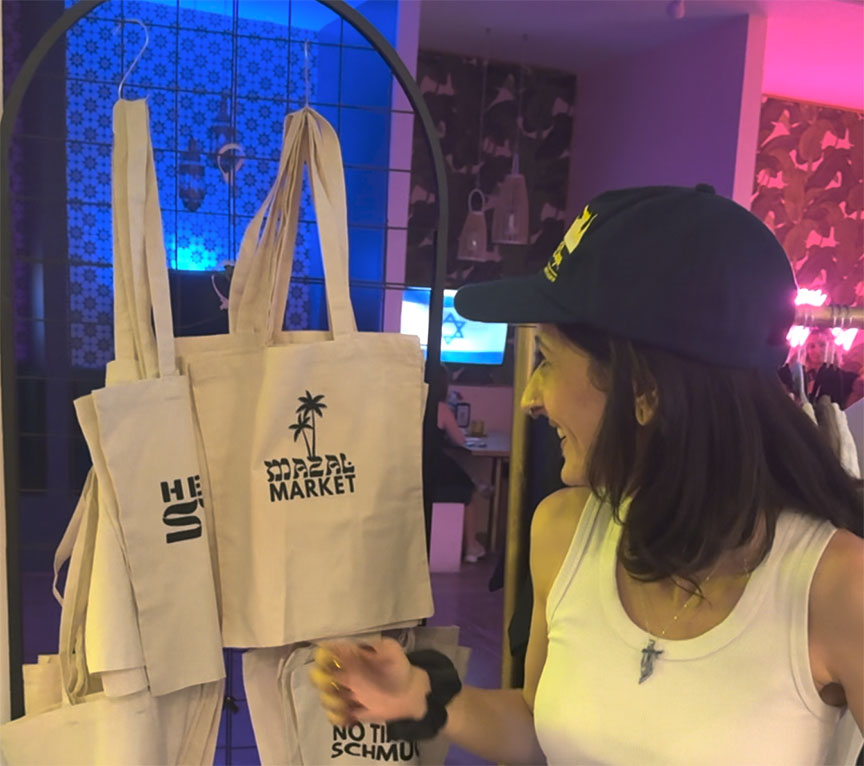
The theme of the first Mazal Market in 2024 was, “shop, eat, schmooze, connect.” Hundreds attended, still raw from the Oct. 7, 2023 attacks nine months earlier. For the fifth iteration of Mazal Market on March 22, the theme was “renewal,” since it was the first since Mazal Market since all captive hostages and bodies of Israelis have been returned home. The day of this particular Mazal Market was chosen to be a collective exhale, an Exodus, right before Pesach.
“I lost a huge part of myself after Oct. 7,” Mazal Market founder Shayna Chalom told The Journal. “I wanted to gift our community a place to experience all the healing, all these different little things that made the Nova Festival special. The Jewish people, we got our hostages back. We can finally heal, move forward and build.”
The Mazal Market takes place at an unassuming event space in Hollywood. Security from Magen Am stood on alert when a few agitators appeared across the street. Inside the market were jewelers like Lital Odelia of Nadiandlo Jewelry, and Guy Kochlani of KochLaNi Jewelry. Artist Jessica Sydney sold her acrylic Jewish pride-themed paintings, photographer Michael Cannon showcased dallies from his next documentary about art and healing with The 8 Project. Making their return were Kaylin and Kaylin Pickles, and Hamsa Kosher, which sells kosher-certified THC edibles.
Scattered around the market were several dozen hand-made red poppies — Chalom made them herself. They have come to symbolize renewal at exact spots in Israel where Oct. 7 victims were found dead.

Among the constant stream of hundreds of new faces checking in at the door was a couple, Shaked Salton and Evan Miller, who first met at Mazal Market in 2024. Returning to the market, they took a moment to get some kiss photos in front of an Israeli flag. Shaked’s friend, Maya Puder, was murdered at the Nova Festival.
Jessica Haber, a first time attendee, told The Journal, “I’m here because I want to be around my people and support my people.” She came with a friend, Daniel Benaderet who is new to town.
“I wanted to explore more about the community here in LA and, well, meet new people,” Benaderet said.
Mazal Market is deliberately set up with an array of spaces to stand and sit so attendees can meet and really connect. There were plenty of places to sit and lean, people brought their dogs and one attendee even brought her pet pigeon named Marcus.
Val Jackler, another Mazal Market first-timer said that it feels “tough to engage with people in Los Angeles.
Everybody is always in their own bubble, they talk to you for a few minutes and that’s it they’re on their way,” she told The Journal. “But there’s something in the Jewish community, when you try to engage or push something for your business, all of a sudden everybody’s like, ‘Oh yeah, let me do something to try to help you.’”
Shlome Hayun, an artist and gallery owner, sold his work at the first two Mazal Markets in 2024. Though he wasn’t selling anything this time, he took part in one of the communal art installations that encouraged attendees to write or draw something. Hayun kept it simple and effortlessly drew a hamsa.
“This feeds your inner child, which is the essence of every person,” he told The Journal. “How often does an adult get the opportunity to draw? Even if it’s just to do a little Star of David or whatever it is, just to feel like you’re a part of something. That’s what art does. When I put on collaboration shows, I try to incorporate the crowd.”
When Hayun lived in Israel, he was a regular at the shuk HaCarmel in Tel Aviv. He said that there aren’t many places in the Diaspora that channel the feeling of connecting with a high-volume of Jewish vendors. Mazal Market, he said, is one of them. Elliot Reissner, a vendor and founder of the new Shlita Clothing Company, has only sold his streetwear online. Mazal Market was his first face-to-face customer experience.
“It’s a slice of what the mesh of Israeli culture is, here in Los Angeles,” Reissner said. In the vendor stand next to Reissner was his friend, Arianna Brody of The Bagel Factory — a local family-owned business. Brody shared a vendor table with Westwood-based Driply Coffee. Poet Lisa Shalom sat at a small table with a 1950s-era Hermes Rocket typewriter, and a sign, “permit me to pen you a personalized poem, by voluntary contribution.”
In the indoor sector of the event space at previous Mazal Markets, a corner featured comedy shows and a virtual reality gun safety demonstration led by Magen Am. This time, that space contained the most moving feature of this year’s Mazal Market: a meditation lounge built to emulate the dance floor from the Nova Festival. Concentric circles of velvet chairs, white bean bags and tiny tables were situated on carpet, under fabrics hung from the rafters overhead. The lighting and those fabrics were the exact hues of blue, red, orange and purple as featured at the Festival. The designer, Tal Margalit, is an alternative therapist, recently returned from Israel where they did healing work with Nova Festival survivors and bereaved friends and families of victims.

Attendees moved through the meditation lounge throughout the day. There would be no music though pumping through the headphones, instead it was a three-minute meditation led by Margalit. Several people told The Journal that the meditation lounge was an emotional trigger back to the Nova Exhibition.
“We intentionally made the meditation short to give their bodies a second to wind down so that you can continue on with your day here at Mazal Market,” Margalit told The Journal. “The beauty of event production specifically is that there’s so much rush, and if you really just take three minutes of time for yourself and it’ll connect with your breath and you connect with the energy within yourself, it’s just a quick reset.”
The sun set just after 7 p.m. and with an hour of Mazel Market remaining, comedian Elon Gold made an unexpected visit. He wasn’t there to perform. Gold said other entertainers need to make an effort to come.
“Get out there, show your face,” Gold told The Journal. “If I have a night off and I don’t have a gig, I either take my wife, or in this case my best friend, and we go out for a fun night of unity and community. How do you not support our community in these times? How could you not go out, schmooze, mingle, have a nosh, a drink, and a laugh? It is incumbent upon all of us to support all of us.”
Chalom said that getting away from online communication and business needs to be a priority for the Jewish community to heal.
“Mazal Market will exist as long as there is a need for it,” Chalom said. “It’s a place where everyone feels like they’re Jewish enough together. The Jewish people all need these healing spaces, and I can’t stop.”