fbpx

April 1, 2026

Order, Please – A poem for Passover

Ahoy! I have been to the supermarket –
There is matzah on the end caps

and this time it’s not because
it’s Hanukkah or Rosh Hashana!

It’s Passover and they got it right!
The moon is full in the month of Nisan.

Everyone is flying in.
The matzah has been balled.

Our comfy pillow budget
is out of control.

We knew when our eyes saw
the sea take the Egyptians away

we’d be getting together to
talk about it on an annual basis.

Here we are! There’s an order
to this madness. We’ve been following it

since our parents said you’re the
youngest, you must have questions.

We’re going to dip and make
Jewish sandwiches named after

our wisest teacher. (No offense
Shamai people.)

Four cups of wine? Bien sur!
That’s how the French do it.

A recounting of the miracles?
Just one of them would be enough.

Gather round the seder table,
my friends, the doors are open for you,

Elijah, and anyone who needs.
This story of freedom

isn’t going to recount itself.
Next year in these very seats.

You couldn’t be needed more.


Rick Lupert, a poet, songleader and graphic designer, is the author of 29 books including “God Wrestler: A Poem for Every Torah Portion.” Visit him at www.JewishPoetry.net

Order, Please – A poem for Passover Read More »

Why the Seder Is the Oldest Classroom in Human History

Every year, we come to the same moment in the Haggadah.

We have eaten the matzah. We have drunk the wine. We have told the story. And then we read these words:

In every generation, they rise up to destroy us.

Is that paranoia? Is it trauma encoded in ritual?

What if, instead, it is the single most important thing we could teach our children right now?

Something is happening in our community that we need to name.

Our children are on the front lines of something we did not prepare them for. Through their phones, on their campuses, in their classrooms, they are encountering accusations that feel new but are, in fact, very old.

“Zionism is racism.” “Israel is apartheid.” “Jews are committing genocide.”

Criticizing Israel’s government is, of course, not antisemitic. It’s Israel’s national sport and it’s an important part of what it means to love Israel and to be a Zionist. That’s not what those phrases are for.

These accusations bombard our children. They are not meant to inspire moral reflection or make Israel more just; they are designed to make us feel shame. Confusion. Doubt. And for many of our kids, for many of us, it’s working.

One reason: We have not given our children a framework—a way to understand what they are experiencing. The Passover story has been trying to give us that framework for three thousand years.

The Torah shows us how lies take root: they often begin with a kernel of truth: The Children of Israel were fruitful and multiplied, swarming across the land, growing strong—exceedingly strong.

And yet Pharaoh saw that truth and twisted it. He turned their blessing into a threat, saying: We must act against them. The story he told about us was a lie.

So why in every generation, do they rise up to try to destroy us?

A useful place to start is a question posed by Dr. Dara Horn, who has spent years studying antisemitism: Why did monotheism matter?

We hear the words God is one and we think: that is a spiritual idea. A theological claim.

But in the ancient world, it was a political statement.

In ancient Egypt, in Rome, in every empire of the ancient world, the ruler and the god had a special relationship. The king derived his power from the divine. His authority was sacred. To challenge the ruler was to challenge god himself.

So when the Jewish people stood before Pharaoh and said: there is one God, and you are not him, they were making a radical claim. They were saying: your power is not ultimate. You are not divine. You cannot own us.

That is what the Exodus was. Not just liberation from slavery. It was the founding act of an anti-tyrannical movement.

The Passover story also teaches that societies can change. Pharaoh can fall. The seemingly impossible can happen. Slaves can be free. It is a liberation narrative.

Nor did Jews receive a ruler who tells us what to think. We received Torah, a system of law that invites questioning, interpretation, argument, and debate. The rabbis did not hand down truth from above. They argued about it. For centuries. The Talmud is a record of that argument. Dissent is not a betrayal of our tradition. Dissent is our tradition.

These ideas – one God above all rulers and human despots, societies can change, and questions are a source of wisdom – have shaped civilization. And they have made us, in every era, a perceived threat to those who need everyone to conform.

The accusation changes. The structure never does. Someone with power feels threatened. They identify what their society values most. Then they take a truth and create a lie and use it to say: the Jews are destroying us!

Jewish life after Gaza is a complicated moment. Tal Becker teaches, “[I]n the era of the blood libel, we were powerless and obviously innocent. Today, the accusations remain outrageous—but we are not entirely innocent either.” Judaism and Zionism call us from within to serious moral self-scrutiny, and to resistance to lies from without. Learning to see a lie for what it is doesn’t free us from honest moral reckoning; it helps us tell the difference between truth that calls us to grow and lies that would steal our story.

The seder may be the oldest classroom in human history. Every year for three millennia, Jewish families have gathered around a table to remember. To retell. To ask: what does this story mean for us right now?

We do this not because we are paranoid or perfect. But because we are the people who said, three thousand years ago, that no human ruler is God. And tyrants have never forgiven us for it.


Rabbi Daniel Greyber serves as the spiritual leader of Beth El Synagogue in Durham, North Carolina and is a Senior Rabbinic Fellow at the Shalom Hartman Institute in Jerusalem.

Why the Seder Is the Oldest Classroom in Human History Read More »

Rabbis of LA | Rabbi Shapiro Wants Music in All Aspects of Temple Life

According to Rabbi Zach Shapiro, Spiritual Leader of Temple Akiba in Culver City and a lifelong musician, the way Reform and Conservative congregations pray underwent a seismic change in the 1970s. That’s when Debbie Friedman, the hugely popular Jewish musician who died in 2011, “began to transform the way we pray.”

The change, he told The Journal, started in camp. Then synagogues realized that the rabbi, the cantor and the choir were active, but the congregation was just sitting there.  “Now, when you go into a synagogue, you won’t see an organ anymore. You’ll see a piano, guitars, other kinds of instruments that might form a band. But the encouragement of congregants to open their souls and to actively allow their voices to lift — that has made a big difference. “When we sing,” he said, “it’s as though we pray twice.”

There never was a question that combining music and Judaism would drive his rabbinate. “I always knew they would be intertwined,” he said. “Around the time I was a rabbinic student, it was almost expected that students come in playing guitar. We grew up in that generation. It’s a real asset that I am able to lead musically.

“But as I said earlier, I know my limitations.” One example: when he came to Temple Akiba in 2006, “we had a very dedicated lay cantor who led us once a month and helped us with the High Holy Days, Ilbert Phillips, who now is in Cleveland.”

Rabbi Shapiro lauded him as a “formidable, wonderful presence. But we also recognized that he was limited. He could read music and lead music, but he wasn’t trained in teaching cantillation. As soon as I got here, we began to bring on Lonee Frailich, who was just about to enter cantorial school. She began to intern for us and eventually became our first fulltime cantor. She has taught all of our children how to chant from the Torah.”

Rabbi Shapiro said Cantor Frailich “has infused this place with a love of music. Now we have junior choirs and junior-junior choirs, intergenerational choirs.” This, he said, is part of his project “to bring music into every aspect of the congregation, to help with prayer, to help with Akiba’s youth program and to make sure people were actively loving Jewish music – both the classics as well as everything that is contemporary, a mix of all of that.”

And with that has come innovative musical services – Beatles Shabbat, Simon and Garfunkel Shabbat, Reggae Shabbat, Broadway Shabbat and Nefesh Mountain making multiple appearances. “We care about having a budget to bring in people who can help us,” said Rabbi Shapiro.

When he was younger, “it was the music of Debbie Friedman that inspired him. “One of the crowning moments in my rabbinate was when I left University Synagogue, we had a tribute evening with Debbie Friedman as our guest artist. As a surprise added guest, Theodore Bikel was there  — may their memories be a blessing. To share a bimah with both of these luminaries was really wonderful.” Friedman’s music had a major influence in how he writes his music, he said, “along with ‘Rabbis’ Paul Simon and Art Garfunkel. They influenced my folk music style.”

And the way he looks at music has transitioned. “My musical repertoire has broadened,” he said. “A big part of it is that my husband, Ron Galperin, is a Renaissance man. He’s given me an appreciation for (certain) music I did not have before I met him.”  Something that not many people know about Ron is that he is from a rabbinic and cantorial dynasty. “His father, his grandfather, his great-grandfather – going back to the giant, Rabbi Levi Yitzchak of Berditchev,” who lived from 1740-1809.

His husband, he said, is the kind of person “who can go into a synagogue anywhere in the world, pick up either a siddur or a machzor and lead the davening. And he does it with a voice where one might think he was going back to 19th-century Europe, the time of the great hazzans.” Active in the community for three decades, Galperin is currently interim director of the American Jewish Committee/Los Angeles.

The rabbi had news for his new employer when Akiba hired him in 2006. “The community thought they were going to get a two-for-one,” he said. “They thought they were going to get a rabbi and a cantor together. I said ‘No way.’ We would kill each other if we worked together all of the time.” But a few times a year, when they get a chance to lead services together, it “really is beautiful.”

Looking back at the start of his two decades leading Akiba, “Ron was very much of a cornerstone for me.” It was a golden time for the couple. “Not long after I began, Ron became the elected controller of Los Angeles. In that time period, we gave birth to beautiful twins. While Shapiro is at temple Friday nights, Galperin is home with the kids until they are old enough to be here more often.” The twins are now six and a half. With a smile, Shapiro noted that “we have a long journey in front of us.”

Bringing his thoughts into the present, he said that when he walks into Temple Akiba, “I am the luckiest rabbi in the world. I love the community I serve, the staff I serve. We are in a congregation bursting at the seams because Culver City is transforming. I am so fortunate. I feel as if we are on the precipice of growing stronger, more committed.”

Rabbis of LA | Rabbi Shapiro Wants Music in All Aspects of Temple Life Read More »

Antisemitism, Deicide, and Revolution

One hundred years ago my wife’s uncle owned a small shop in Slovakia. He and his family were among the 90 Jewish families that lived in the largely Catholic village of Zborov. Every year during Holy Week (the week preceding Easter Sunday) he had to close and board up the shop because it was a common practice for the Catholic neighbors to attack and sometimes burn down Jewish property. The perpetrators rationalized their violent antisemitic behavior as just punishment for the Jewish people who crucified Jesus 1,900 years earlier. This mythical collective guilt was normative Catholic theology for more than 1,500 years. During the long painful experience of Jews in Christian Europe, no idea was more responsible for the humiliation, persecution, and murder of Jews than this toxic charge of deicide

Easter is approaching, antisemitism is reaching tsunami proportions, and some of it still emanates from self-identified Catholics. Tik-Tok, X, YouTube, and Instagram provide convenient platforms for personalities like Candace Owens, Nick Fuentes, and Carrie Prejean Boller, all of whom parade their Catholic bona fides to justify their noxious rants about Jews and Israel. Worse still, their public antisemitism has boosted their popularity: They now have almost 9 million followers. Being publicly antisemitic is now chic and profitable. Is anything “new under the sun”? Is Esau—the symbol of Christianity in rabbinic writings—indelibly programmed to hate Isaac for all time?

Yet we no longer live in the Middle Ages—or even in the Slovakia of 100 years ago. Many Jews are oblivious to the fact that the Catholic Church has changed its teachings about Jews and Judaism in a fundamental way. After the Holocaust the Church began to realize where its anti-Jewish teachings led, and it came to grips with its past. Nearly all the bishops at the Second Vatican Council in the 1960’s approved Nostra Aetate, a magisterial document that rejected any teaching that blames the Jewish people for deicide, condemned “any hatred, persecutions, displays of anti-Semitism, directed against Jews at any time and by anyone,” asserted that the covenant between God and the Jewish people is still alive and valid, acknowledged that Jesus was Jewish and that Christianity “draws sustenance from the root of that well-cultivated olive tree”—that is, Judaism. All these salutary beliefs now have the highest authority in the Catholic Church. Nor is Nostra Aetate a one-off: Since the Council, the Vatican has published four subsequent major documents emphasizing correct Catholic teachings regarding fraternal Catholic beliefs about Jews and Jewish-Christian relations. And in 1993 the Holy See established diplomatic relations with the Jewish State of Israel. So fundamental is this sweeping change toward Judaism and the Jewish people that historians have dubbed it “the Copernican revolution in Christianity.” This dramatic step is a sincere spiritual act of heshbon ha-nefesh (soul searching) and repentance.     

All of which leads us back to today’s Catholic antisemites. Realizing the dangers of rising antisemitism and responding to those who hate Jews in the name of the Catholic faith, the United States Conference of Catholic Bishops (USCCB) did a remarkable thing: The USCCB issued a memorandum to all American Catholic bishops urging them to prepare their teachings carefully during this Easter period and ensure that they accurately present the Church’s positive teachings about Jews. Citing authoritative Vatican documents, the memo detailed these teachings as (1) “the Jews” didn’t kill Jesus, (2) God’s covenant with the Jewish people has not been revoked and continues, (3) Catholics should appreciate the Jewish People’s ties to the land of Israel, and (4) Catholics must recognize and combat antisemitism.

The USCCB also released a powerful video by Archbishop Alexander Sample of Portland urging Catholics to reject the conspiracies and lies against the Jewish people and noting that Jews are by far the most targeted group of religious prejudice in America.

Clearly, the Catholic Bishops are not content to rely on official theological pronouncements from Rome, which unfortunately only a few Catholics study. The Bishops understand that the moral imperative of the day is to be active and teach all Catholics—clergy and lay alike—to reject and combat antisemitism. They feel obligated to dispel the hate spread by the populist faux Catholic hucksters like Fuentes, Owens and Prejean Boller. As Pope Francis said many times, “A true Christian cannot be an antisemite.”

There is a lesson for Jews in all this, at this time of rising hatred toward, attacks on, and naked vulnerability of our people. We no longer live in the Middle Ages, when Christians more often than not wanted to convert us or kill us. Jews have agency and we are not alone.  We have allies in faithful Catholics, and it behooves us to understand, appreciate, and partner with these friends in fighting the antisemitism, the hatred, and the violence that are so pervasive today. Surely we will be more successful when we fight evil together rather than fighting it separately.

If we cannot realize Agnon’s miraculous transformation of turning “enemies into ones who love us,” we certainly can strive to become partners with Christians who in the past rejected our people and our faith but today seek to understand, defend, and support Jews, Israel, and Judaism.    


Eugene Korn holds Orthodox rabbinic ordination and earned a PhD. moral philosophy from Columbia University. He is the former Director of Interfaith Affairs at ADL and Executive Director of the Center for Catholic-Jewish Understanding at Sacred Heart University. His recent books are “To Be a Holy People: Jewish Tradition and Ethical Values” and “Israel and the Nations: The Bible, the Rabbis and Jewish-Gentile Relations.” Rabbi Dr. Korn lives in Jerusalem.

Antisemitism, Deicide, and Revolution Read More »

Ruth Wisse Challenges Americans to Live American, Jewish and Zionist Values

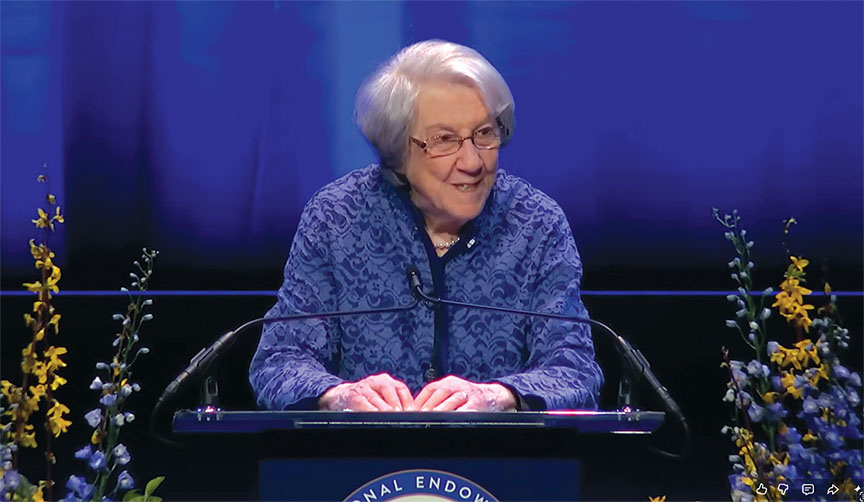
On March 25, Professor Ruth Wisse, the legendary Yiddish literature and Jewish culture scholar, used an all-American platform to inspire Americans with Jewish, Zionist and quintessentially American, lessons: Champion your identity – while defending it, and yourself! Wisse contrasted America’s current transmission troubles, with the enduring “Jewish message” of “endurance.” Americans must affirm our values by telling our story to the next generation – while being vigilant against our enemies.

The Jefferson Lecture in the Humanities is the federal government’s highest honor “for distinguished intellectual achievement in the humanities. Choosing an Eastern-European-born Yiddishist, who built her career at Montreal’s McGill University …  sounds crazy, no? One could justify the decision by credentialing – two decades at Harvard, pathbreaking books, Wall Street Journal op-eds celebrating America. More important, simply watching or reading “A Message from the ‘Blue and White’ in the ‘Red, White, and Blue’” – hailing identity, continuity, democracy – thoroughly justifies the honor.

Wisse praised her adopted country, while affirming: “The more I cherish all the good that it does, the less I understand those who take it for granted. This makes me increasingly protective of what can only remain the land of the free if we are determined to conserve it.” Seconds into this tour-de-force, the crowd could have risen, shouted “Dayenu,” that’s enough, and gone home enlightened.  That timely message anticipating America’s 250th, resonates particularly now as America and Israel fight a justified war that too many Americans refuse to appreciate as countering a Jihadist regime threatening them.

Ruth – a cherished mentor and dear friend – delivered the lecture in Washington, DC. I read the transcript the next morning in Jerusalem, having awoken –  again – to sirens.

Part one demonstrates Wisse’s academic chops as a lyrical, insightful interpreter of text, bringing Yiddish alive. Imagine standing before a packed Trump Kennedy Center crowd, enjoying the highest of American honors. Within minutes, Wisse recites a Yiddish poem by Abraham Sutzkever.  Born in Polish Lithuania in 1913, he lost dear relatives in the Holocaust, fought as a Partisan, reached Moscow, then Israel – and testified at the Nuremberg Trial “on behalf of Jewry,” standing, refusing to sit and normalize the atrocities he recounted.

Through Sutzkever, Wisse evoked the rich Yiddish-speaking, Jewish civilization she’s helped generations of students discover, while celebrating Jews’ forever-resilience and the post-Hitler Zionist resurrection. Navigating those broad, often brutal, historical forces, Wisse the literature prof decodes this devastated poet’s images of permanence.  “Who will last? And What?” he wonders, mentioning a “blind man’s blindness,” the sea’s “thread of foam,” and “a bit of cloud snarled in a tree.”

As I read Wisse’s emphasis on the world’s ethereal yet eternal power, in the Jews’ eternal capital, thunder crashed. My first thought, using Israelis’ filter for everything these days, was “oh-oh, if it’s pouring like this in Jerusalem, it must be miserable for our kids fighting up north” (and most personally for my son-in-law there). Then stretching, trying to be a good Zionist, I thought, “oops, yes, of course, rain blesses our parched promised land …”

Wisse’s rhetorical magic drew me back. “For Sutzkever,” she teaches, “poetry is the death-defying power that resists” tragedy, reflecting people’s “transformative power … over circumstance.” Then, dismayed by America’s growing godlessness and nihilism, she reads Sutzkever’s conclusion, finding reassurance from “the heavens.” His examples pushes “past Holocaust memorials and cemeteries,” seeking “the source of regeneration.” Wisse insists: “Trust in eternity can be sought only in the eternal.”

As a great lecturer, Wisse breaks the tension by going “Tinker Bell,” saying: “like the good fairy in many a folktale, I bring this as the first message of endurance.” It’s on the dollar bill: “May God in Whom We Trust become the true coin of this realm.”

Defying today’s Jew-hating epidemic, refuting those mourning the end of American Jewry’s “golden age” – America’s 52nd Jefferson Lecturer read Judaism’s most foundational prayer, the “Shema” – “Hear o Israel.” Generously recalling reciting the Lord’s Prayer in her Canadian high school – “and I am the better for it” – Wisse underscores the human need to follow “a strong, God-inspired moral path.”  But fearing an America approaching its 250th anniversary buffeted by partisan debates demeaning and cheapening American history, she bridges from faith to education. The one-line prayer’s “substance is brief while the instructions are lengthy and intricate” – to “Teach them to your children,” to “speak of them” at home and “outdoors,” from morning till night, and even hang them as proud, outward signs on your “doorposts.”

In short, you need literacy to spawn constructive, democratic pride.

This affirmative, eternal message, cultivating generations of thoughtful patriots, clashed with the “accent of grievance over gratitude” Wisse witnessed at Harvard. Sometimes she felt like shouting at faculty meetings: “What are we doing to reinforce the most successful government system ever crafted by so few for so many? Let’s remember that our republic depends for its perpetuation on teachers who instill its God-inspired history and tenets diligently, patiently, and persuasively …”

Instead, academics – and their gullible students – traded “Marx for Madison, Lenin for Lincoln and, lately, the Islamist incursion for the American Revolution.”

Thus, Wisse’s second message. Democracy must raise citizens to “respect and confidently to perpetuate their precious inheritance.”

Finally, as American tankers refuel Israeli jets mid-air, as Israelis fight this war in English with clocks set to the American military’s Greenwich time, Wisse harmonizes America and Israel, Americanism and Zionism.

This American greenhorn captures The Federalist Papers’ genius, highlighting “their sobriety,” and “the conservative approach to doing no harm rather than undertaking to ‘repair the world.” And, defying most Woke-blinded historians today, Wisse recognizes that the “core argument for federation was built on the need for a common defense, with armed forced being the guarantor of a sustainable union.”

Regretting that many founding Zionists remained addicted to the Jewish exile’s “politics of accommodation,” Wisse says Israelis learned they “had to pick up their sword and shield … if there was to be any hope of waging war no more.”

Today, America must learn from Israel, whose “moral confidence is manifest in its defense.”

Israel is small. Only America has “the power to enforce its moral authority over those who elsewhere rule by threat.” Then another gem: “How much brighter the world becomes when liberty’s standard-bearer is equally determined to ensure that our civilization survives.”

Wisse’s formula for endurance emerges. Souls reflect faith in God. Spines express democratic pride. And we bear arms when necessary, while being vigilant always. “This is our country, sweet land of liberty, and of thee we do not sing enough,” she rhapsodizes.

Validating the National Endowment for the Humanities’ mission to transcend today’s vulgarians, she concluded: “instilling intellectual and moral confidence in our civilization rests with the humanities.” And returning to Sutzkever’s – and the Jews’ –secret of survival, she anticipated America reaching “its 2,500th anniversary,” if we all “acknowledge before whom we stand.” Then, fusing Abraham and Sarah with Abraham Lincoln, and implicitly encouraging the American-Israeli fight for Iranian freedom, Wisse urges: “May these messages from the Blue and White forever help to strengthen and to secure the Red, White, and Blue.”

Ruth Wisse posed the challenge. America’s citizens have to answer: Are today’s Americans ready to learn the lessons of Jewish history – and of American history too?


Gil Troy is an American presidential historian and a senior fellow in Zionist thought at the Jewish People Policy Institute in Jerusalem. Last year he published To Resist the Academic Intifada: Letters to My Students on Defending the Zionist Dream and The Essential Guide to October 7th and its Aftermath. His latest E-book, The Essential Guide to Zionism, Anti-Zionism, Antisemitism and Jew-hatred, was just published and can be downloaded on the website of JPPI – the Jewish People Policy Institute.


Ruth Wisse Challenges Americans to Live American, Jewish and Zionist Values Read More »

Shuk-style Mazal Market Returns with Pre-Passover ‘Renewal’

The theme of the first Mazal Market in 2024 was, “shop, eat, schmooze, connect.” Hundreds attended, still raw from the Oct. 7, 2023 attacks nine months earlier. For the fifth iteration of Mazal Market on March 22, the theme was “renewal,” since it was the first since Mazal Market since all captive hostages and bodies of Israelis have been returned home. The day of this particular Mazal Market was chosen to be a collective exhale, an Exodus, right before Pesach.

“I lost a huge part of myself after Oct. 7,” Mazal Market founder Shayna Chalom told The Journal. “I wanted to gift our community a place to experience all the healing, all these different little things that made the Nova Festival special. The Jewish people, we got our hostages back. We can finally heal, move forward and build.”

The Mazal Market takes place at an unassuming event space in Hollywood. Security from Magen Am stood on alert when a few agitators appeared across the street. Inside the market were jewelers like Lital Odelia of Nadiandlo Jewelry, and Guy Kochlani of KochLaNi Jewelry. Artist Jessica Sydney sold her acrylic Jewish pride-themed paintings, photographer Michael Cannon showcased dallies from his next documentary about art and healing with The 8 Project. Making their return were Kaylin and Kaylin Pickles, and Hamsa Kosher, which sells kosher-certified THC edibles.

Scattered around the market were several dozen hand-made red poppies — Chalom made them herself. They have come to symbolize renewal at exact spots in Israel where Oct. 7 victims were found dead.

Hand-made red anemone coronaria flowers at Mazal Market. They symbolize renewal at exact spots in Israel where Oct. 7 victims were found.

Among the constant stream of hundreds of new faces checking in at the door was a couple, Shaked Salton and Evan Miller, who first met at Mazal Market in 2024. Returning to the market, they took a moment to get some kiss photos in front of an Israeli flag. Shaked’s friend, Maya Puder, was murdered at the Nova Festival.

Jessica Haber, a first time attendee, told The Journal, “I’m here because I want to be around my people and support my people.” She came with a friend, Daniel Benaderet who is new to town.

“I wanted to explore more about the community here in LA and, well, meet new people,” Benaderet said.

Mazal Market is deliberately set up with an array of spaces to stand and sit so attendees can meet and really connect. There were plenty of places to sit and lean, people brought their dogs and one attendee even brought her pet pigeon named Marcus.

Val Jackler, another Mazal Market first-timer said that it feels “tough to engage with people in Los Angeles.

Everybody is always in their own bubble, they talk to you for a few minutes and that’s it they’re on their way,” she told The Journal. “But there’s something in the Jewish community, when you try to engage or push something for your business, all of a sudden everybody’s like, ‘Oh yeah, let me do something to try to help you.’”

Shlome Hayun, an artist and gallery owner, sold his work at the first two Mazal Markets in 2024. Though he wasn’t selling anything this time, he took part in one of the communal art installations that encouraged attendees to write or draw something. Hayun kept it simple and effortlessly drew a hamsa.

“This feeds your inner child, which is the essence of every person,” he told The Journal. “How often does an adult get the opportunity to draw? Even if it’s just to do a little Star of David or whatever it is, just to feel like you’re a part of something. That’s what art does. When I put on collaboration shows, I try to incorporate the crowd.”

When Hayun lived in Israel, he was a regular at the shuk HaCarmel in Tel Aviv. He said that there aren’t many places in the Diaspora that channel the feeling of connecting with a high-volume of Jewish vendors. Mazal Market, he said, is one of them. Elliot Reissner, a vendor and founder of the new Shlita Clothing Company, has only sold his streetwear online. Mazal Market was his first face-to-face customer experience.

“It’s a slice of what the mesh of Israeli culture is, here in Los Angeles,” Reissner said. In the vendor stand next to Reissner was his friend, Arianna Brody of The Bagel Factory — a local family-owned business. Brody shared a vendor table with Westwood-based Driply Coffee. Poet Lisa Shalom sat at a small table with a 1950s-era Hermes Rocket typewriter, and a sign, “permit me to pen you a personalized poem, by voluntary contribution.”

In the indoor sector of the event space at previous Mazal Markets, a corner featured comedy shows and a virtual reality gun safety demonstration led by Magen Am. This time, that space contained the most moving feature of this year’s Mazal Market: a meditation lounge built to emulate the dance floor from the Nova Festival. Concentric circles of velvet chairs, white bean bags and tiny tables were situated on carpet, under fabrics hung from the rafters overhead. The lighting and those fabrics were the exact hues of blue, red, orange and purple as featured at the Festival. The designer, Tal Margalit, is an alternative therapist, recently returned from Israel where they did healing work with Nova Festival survivors and bereaved friends and families of victims.

Meditation Lounge at Mazal Market on March 22

Attendees moved through the meditation lounge throughout the day. There would be no music though pumping through the headphones, instead it was a three-minute meditation led by Margalit. Several people told The Journal that the meditation lounge was an emotional trigger back to the Nova Exhibition.

“We intentionally made the meditation short to give their bodies a second to wind down so that you can continue on with your day here at Mazal Market,” Margalit told The Journal. “The beauty of event production specifically is that there’s so much rush, and if you really just take three minutes of time for yourself and it’ll connect with your breath and you connect with the energy within yourself, it’s just a quick reset.”

The sun set just after 7 p.m. and with an hour of Mazel Market remaining, comedian Elon Gold made an unexpected visit. He wasn’t there to perform. Gold said other entertainers need to make an effort to come.

“Get out there, show your face,” Gold told The Journal. “If I have a night off and I don’t have a gig, I either take my wife, or in this case my best friend, and we go out for a fun night of unity and community. How do you not support our community in these times? How could you not go out, schmooze, mingle, have a nosh, a drink, and a laugh? It is incumbent upon all of us to support all of us.”

Chalom said that getting away from online communication and business needs to be a priority for the Jewish community to heal.

“Mazal Market will exist as long as there is a need for it,” Chalom said. “It’s a place where everyone feels like they’re Jewish enough together. The Jewish people all need these healing spaces, and I can’t stop.”

Shuk-style Mazal Market Returns with Pre-Passover ‘Renewal’ Read More »

Israeli Entrepreneurs Fuel California’s Economy with High-Paying Jobs

On March 16, the United States Israel Business Alliance (USIBA) released an independent report quantifying the economic relationship between California and Israel. The findings highlight the significant impact of Israeli-founded companies in the state: they generate more than 22,650 jobs, $4 billion in compensation and nearly $9 billion in total economic output, with average salaries exceeding $175,000.

The alliance works to strengthen economic ties between U.S. states and Israel. It organizes economic development missions to Israel for governors, higher education officials and business leaders and helps connect Israeli technology solutions to local challenges in the United States.

Aaron Kaplowitz, president of USIBA, who ordered the report, emphasized the mutual benefits of this relationship. “Israeli companies benefit from being part of California’s robust tech ecosystem, where strong local companies provide opportunities for partnerships and collaboration, and in turn, California companies gain from the significant Israeli presence,” he said.

Aaron Kaplowitz

The report came shortly after Governor Gavin Newsom described Israel as an apartheid state, a comment he retracted a few weeks later. He claimed that he meant to refer to Israel’s potential future direction, said he supports Israel but quickly added his opposition to Prime Minister Benjamin Netanyahu.

Kaplowitz noted that feeling welcome in California is essential for Israeli entrepreneurs. “Israelis, like many people in the world, want to feel welcome. If political discourse is overly critical, they might look for a place that embraces them,” he said. “While California remains open to Israeli business, leadership — whether in business, political or cultural spheres — is essential to ensure these companies feel truly welcomed.”

California has long been home to Israeli entrepreneurs and companies spanning tech, cybersecurity, custom software, financial services and full-service restaurants. These businesses generate jobs and strengthen the state economy. Breaking down the numbers by county and Congressional District, the report shows the scale of their influence: Santa Clara County accounts for 11,000 jobs, San Francisco 2,300, and Los Angeles nearly 2,700. “When you look at these numbers, it’s clear how integral these companies are to the local economy,” Kaplowitz said.

Speaking with The Journal from his home in Miami, Kaplowitz highlighted the collaborative environment that draws Israeli startups to California. “There’s a lot of collaboration with universities, companies and government programs. That’s one of the reasons so many companies are drawn here,” he said. “California has the largest state economy in the U.S., and Silicon Valley’s infrastructure is world-class. Tech companies can embed themselves in this ecosystem for partnerships, customers and collaborations.”

The report also underscores the high quality of jobs created. Average earnings of positions generated by Israeli companies are nearly double the California state average. “These companies create high-skilled jobs and drive local revenue,” Kaplowitz said. “When salaries are that high, the downstream impact on the state and communities is significant.”

“Four out of the top five industries are in tech,” he added. “The only one that’s not tech is full-service restaurants. We have AI firms, software companies and financial services companies. These businesses are real anchors in Silicon Valley.”

This is USIBA’s fourth report, following studies in Florida, Virginia and New York. The California report provides a detailed analysis of the economic, social and technological footprint of Israeli-founded companies, highlighting their role in driving innovation and supporting the state’s economy. USIBA’s mission is to foster economic opportunities between U.S. states and Israel, including organizing economic development missions for governors.

Looking ahead, Kaplowitz highlighted opportunities for collaboration in security technology, particularly with major events on the horizon. “California will host two FIFA World Cup matches this summer and the 2028 Olympics in Los Angeles. These are complex events, especially for security. Israel is a world leader in certain technologies, and Israeli companies should have a seat at the table. Their involvement will not only keep Californians safe but also create jobs and generate revenue.”

With 32 Israeli-founded unicorns  — privately held startups valued at over $1 billion —  in California — the most of any U.S. state — these companies shape the Silicon Valley technology landscape, offering high-paying jobs and contributing substantially to the state’s innovation ecosystem. From cybersecurity to lifestyle sectors, Israeli entrepreneurs are leaving a lasting mark on the economy while fostering collaboration between Israel and California’s business and academic communities.

Kaplowitz also emphasized the entrepreneurial spirit that distinguishes Israeli-founded companies. “Where Israelis stand out is their chutzpah — they don’t give up easily. There’s no such thing as ‘no’ to an Israeli founder. It’s part of their dynamism, and it helps them succeed in a competitive tech ecosystem.”

When asked what California business leaders should take away from the report, Kaplowitz stressed the importance of data-driven policy. “The first thing we want is for them to know the actual data, so policies reflect what’s real, not just assumptions,” he said. He also noted California’s incentive to continue attracting Israeli entrepreneurs, particularly to maintain its edge in Silicon Valley.

Kaplowitz highlighted the role of academic collaboration in the research, mentioning the involvement of volunteer students from UC Berkeley who helped identify companies for the study. “Their contributions helped provide a more complete picture of the Israeli business presence in the state,” he said.

“California should keep promoting itself to Israeli founders,” Kaplowitz concluded. “These companies are not only driving innovation and high-skilled jobs, but they’re also strengthening the local economy and sustaining the state’s competitive advantage in technology and entrepreneurship.”

Israeli Entrepreneurs Fuel California’s Economy with High-Paying Jobs Read More »

Israel Bachar on Antisemitism, Hollywood and Mobilizing Global Support for Israel

Israel Bachar, Consul General of Israel to the Southwest, did not expect his diplomatic posting in the United States to unfold the way it did. Just one month after his arrival in Los Angeles, Hamas launched its Oct. 7, 2023 attack on Israel, upending any notion of a routine or relatively smooth service. Instead of the anticipated diplomatic engagement, he found himself at the center of an intense battle over public opinion.

Bachar faced multiple, simultaneous challenges: large parts of the media adopted a critical tone, Hollywood distanced itself from Israel and its officials and he was confronted with a troubling rise in antisemitism. Working tirelessly, he addressed narratives as they emerged and represented Israel’s position during a moment of profound crisis.

Prior to his appointment, Bachar was not a career politician but a marketing strategist and political advisor. He played a key role in the ultra-Orthodox Shas party’s election campaigns and worked with senior Israeli figures, including Aryeh Deri, leader of Shas, and Benny Gantz, former defense minister, building a reputation in messaging and political consulting.

In an interview with The Journal, Bachar said that despite the criticism against Israel, all in all, we are witnessing historic days. He emphasized that the current reality is fundamentally different from past conflicts, with the United States acting alongside Israel rather than Israel standing alone in the Middle East. While some voices on the far left and far right attempt to portray Israel as dragging the U.S. into war, Bachar stressed that this is not the reality, noting that the United States is acting based on its own strategic interests.

“If I had told you three years ago that the U.S. would join Israel in a war against Iran, you would have thought I’d lost my mind. There was no way — and the Iranians thought so too. This was also President Biden’s perception; no one thought the U.S. would take military action. Today, however, we are in a very strong position. The military campaign is progressing effectively. There may not be an immediate regime change in Iran, but the campaign is going well.”

Over the past two and a half years, Bachar witnessed something remarkable. Even during wartime, Israeli men living or vacationing in the U.S. were eager to return to Israel and join their units, while others continued making Aliyah. This, he said, is a phenomenon particular to Israel. He attributes much of this desire among Americans to move to Israel to the rising tide of antisemitism.

“It goes against survival instincts to move to a country at war, but there is a growing antisemitism worldwide, and people understand that if you want to live openly as a Jew, Israel is where you can do that.”

Bachar said that there are many more antisemitic incidents happening than people realize. Those that make headlines are mostly violent in nature, but verbal harassment, discrimination and intimidation occur regularly. What frustrates him most is how those are being handled.

“We need a change in policy — the police and FBI need to be proactive, and there needs to be more prosecution of hate crimes. It’s not a positive sign when Jewish kindergartens feel like compounds; it’s a failure of the system.”

He points to an event held at Wilshire Boulevard Temple in Koreatown in December 2025. A group of about 15 protesters – their faces masked with keffiyehs – harassed attendees arriving for a lecture meant to promote bridge-building between the Israeli, Jewish and Korean communities. Despite police presence, nothing was done to stop the demonstrators from shouting at synagogue goers: “Zionist pigs” and “baby killers.”

People bringing their kids to daycare at the temple needed to face those pro-Palestinian demonstrators, while the police stood aside and didn’t do anything to stop them, because of “Freedom of Speech.”

Bachar emphasizes that, time and again, those involved in incidents that clearly qualify as hate crimes against Jews are not punished or tried as such. He saw this during the encampments at UCLA, where Jewish students were blocked from reaching their classes, and chased or attacked both physically and verbally — yet the perpetrators faced no legal consequences. In a more recent incident in San Jose, three young men who brutally attacked two Israeli men were arrested and then released, facing charges only for assault rather than a hate crime.

“We need to ask ourselves: if other minority groups faced those attacks against them, would they have been considered hate crimes?” he said. “If people knew there would be real consequences, things wouldn’t escalate like this.”

Bachar took a unique approach to give prosecutors a firsthand understanding of Israel. He organized a five-day visit to Israel for several district attorneys, seeing it as an important way for them to gain perspective on the country and its people.

“Policy affects everything, how the law is enforced, how incidents are handled. You need to prosecute to the full extent of the law. We need to be clear with policymakers, either you are with us, or against us. The Jewish community has enough voice and influence to demand this.”

Israel is at a disadvantage when it comes to shaping public perception, while Palestinians are backed by significant resources and support, which is clearly reflected on social media. Considering that Jews make up only 0.2% of the world population, compared with roughly 25% for Muslims, the imbalance becomes easier to understand.

Living in Los Angeles for the past two and a half years, Bachar had witnessed how much Hollywood had turned its back on Israel. He noted the silence of many celebrities in reference to the terror Israel faced on Oct. 7. Many in the industry form judgments based on what they see in headlines or short social media clips, rather than on deeper understanding or facts. He finds this both frustrating and disheartening.

“The hypocrisy is staggering. When the issue is Palestinian, it’s ‘human rights.’ When it comes to Iranians, they don’t care. They stay silent when tens of thousands of Iranians living under oppression are killed in Iran during protests. People in Hollywood say things they have no real knowledge of, they are very superficial.”

A few months ago, Bachar organized a remarkable delegation of 1,000 pastors to visit Israel, flying in on three separate airplanes. The five-day trip took them to Yad Vashem, kibbutzim, Shomron (Samaria) and Jerusalem. Bachar sees these delegations as an important way to strengthen Israel’s image and provide context about what is really happening on the ground.

He also initiated the Mobile Museum project, an exhibit designed for Christian communities, including churches and universities. The museum will consist of seven tents each covering a different theme, such as history, Israel, Judaism and Christianity and the events of Oct. 7, and includes a book for pastors. “In the first six months, we plan to take the museum to five states and then expand to others,” Bachar said.

At the end of the summer, Bachar will conclude his service and return to Israel with his wife, Rachel. He said that what touched him most during his time in Los Angeles was seeing the Jewish and Israeli community rally to help Israel in her time of need.

“I have nothing but admiration for the community — it warmed my heart. They set aside disagreements and focused on helping Israel and the victims. You see a unity that’s hard to explain, a deep, almost spiritual connection. Everyone stepped up, contributing in every way — making donations, hosting families of hostages. The community revealed itself in all its glory.”

Israel Bachar on Antisemitism, Hollywood and Mobilizing Global Support for Israel Read More »

Chametz Is More than Crumbs in the Corners of our Homes

Chametz is something that our tradition teaches must be removed from our homes in order to prepare for Passover. It is all the tiny particles of anything that is sourced from leaven/yeast that adds air for expansion, the way our bread puffs up with lots of tiny little holes giving it the expanded, soft texture we all love. It is also particular grains that when wet can sour, expand, and can be described metaphorically as “growing on their own”; something we lose control over. The tradition requires we become detectives, searching every crevice and corner of our physical environments, gathering all these particles and preparing them the next day to be burnt. The search is done the night before Passover begins, using a feather to sweep them up and a spoon to collect them. For families it is the treasure hunt children crave, navigating their homes by candlelight, gleefully calling out,”We found some more!” And when our children are grown, we discover there can be new ways to mine for hidden treasures of enlightenment and self-discovery.

As times have opened to new and creative interpretations of our customs and traditions, we now see those little crumbs as not only physical and edible chametz, but something deeper and more spiritual. Even traditionalists now see this as an important part of Passover preparation. Beyond cleaning and purifying our environments for the Passover holiday, it is an opportunity to also look within, searching for those places in our souls, in our hearts and in our minds. With intentional and focused examination, it is a way to begin the first Seder cleansed, renewed and ready to immerse oneself in the history of our people, in identifying with one of the most awesome moments of liberation.

Chametz is also something that gathers in the corners of our being, the spiritual chametz that, like the physical particles we gather the night before Passover, can infect, wither, influence and sabotage us as we engage with others, at work, in families, in friendships and our own intra-psychic life. We search our minds, hearts, souls, for the parts of our lives, the chametz that fills us with false pride, inaccurate perceptions, inordinate judgments. They prevent us from moving forward or fulfilling our dreams; they can undermine our behavior and/or the ability to feel pain, grief, or fear. We search for those unresolved issues or emotions that prevent us from being free and liberated: the psychospiritual particles that puff us up, inflate the false self, our egos, our stubbornness and/or arrogance or the inner Pharaoh we sometimes hold, totally unawares. What about the chametz of fear and insecurity, of regaining strength, courage and purpose. These too are important in these moments when confronted with uncertainty, chaos, and war. We begin with purpose, before we sit at our seders, just like our ancestors did in Egypt, by preparing an offering.

Not unlike the work we do during the coming seven weeks when we “Count the Omer,” a deep dive into the Kabbalistic inner workings of our “middot,” qualities of character and behavior, and the work we do before the High Holy Days, with “Cheshbon haNefesh,” accounting of our soul, this is another time in the Jewish calendar for focused and intentional searching and personal growth. The Jewish calendar is one of the greatest journeys of transformation and a pathway to sanctification and elevation available to us.

This time we write down on small pieces of paper that which we want to discard, clear out and/or change, then fold them into tiny pieces, an offering we burn along with the physical chametz by noon of the first Seder. It can be a welcome and renewing moment that prepares us for receiving and reigniting our tradition’s greatest gift, freedom, in a very wholistic and “holistic” way. Here is the blessing one says upon burning the Chametz: “Blessed are You, our God, Ruler of the world, who sanctifies us with mitzvot and calls upon us to remove chametz.” “Baruch atah Adonai, Eloheinu Melech haolam, asher kid’shanu b’mitzvotav v’tzivanu al biur chametz.”

May this Passover support all forms of liberation, physical and emotional/spiritual to move forward with pride, resilience and joy.


Eva Robbins is a rabbi, cantor, artist and the author of “Spiritual Surgery: A Journey of Healing Mind, Body and Spirit.”

Chametz Is More than Crumbs in the Corners of our Homes Read More »

Kugel Kugel Everywhere

Most of the year, the kugel conversation revolves around sweet versus savory. At Passover time, all kugels are welcome. Here are some savory and sweet versions — one which can skew either way — to add to your seders this year.

Gwen Wolken, founder of the food blog ASweetThyme.com, has a carrot kugel that is perfect for Passover … or any holiday meal. The recipe works just as well with potato starch, flour and gluten-free flour, as it does with matzah meal.

“It is a sweet and warm spiced casserole made with fresh carrots, cinnamon and eggs, then topped with a crunchy pecan streusel,” Wolken told the Journal. “Bake it in a casserole dish or a Bundt pan, and enjoy it warm or at room temperature.” She added, “It can be made ahead of time, stored in the fridge, or frozen for later!”

Carrot Kugel

Prep Time: 20 min

Cook Time: 45 min

Total Time: 65 min

Serves 8 but can be doubled

Casserole Base:

1 pound carrots

3 eggs

½ cup brown sugar

4 Tbsp butter, melted

3 Tbsp matzo meal

1 Tbsp baking powder

1 Tbsp vanilla extract

1 tsp cinnamon

½ tsp nutmeg

¼ tsp kosher salt

Topping:

½ cup brown sugar

½ cup pecans chopped

2 Tbsp butter, melted

¼ cup matzah meal

Casserole:

1. Preheat the oven to 375°F. Grease an 8×10 casserole dish. Set aside.

2. Peel and cut the carrots into 1-inch rounds. Place in a stockpot and cover with water. Bring to a boil. Simmer until the carrots are easily pierced with a fork. About 20 minutes. Drain.

3. Place the carrots into a food processor. Process until roughly chopped.

4. Add the eggs and process until the mixture is fully combined and the carrots have processed fully.

5.  Add the brown sugar, melted butter, potato starch, baking powder, vanilla, cinnamon, nutmeg and salt. Process in the food processor until pureed.

6. Pour into the prepared casserole.

Topping:

1. In a medium mixing bowl, add the brown sugar, chopped pecans and melted butter. Mix to combine.

2. Using a spoon or your hands, place the topping on the top of the casserole.

3. Bake for 40 minutes or until the center is done.

Notes:

I love a good pecan topping. So I tend to double the topping recipe. However, if you don’t like your carrot kugel to be sweet, I would either omit the topping or only use pecans.

You can use any nut that you would prefer. I prefer pecans, but walnuts or almonds work just fine in this recipe.

Store covered in the refrigerator for up to 4 days.

You can freeze the casserole after it has cooked. Defrost and gently rewarm the casserole in a 250°F oven.

To make this in a 9×13 casserole, you will need to double this recipe.


Pam Stein’s savory matzah farfel mushroom kugel adds a fun southern twist to a traditional Passover dish.

“Softening the farfel in vegetable broth lets it soak up extra flavor, giving the kugel a deep, satisfying richness,” Stein of In Pam’s Kitchen, told The Journal. “As it bakes, it becomes something between a cozy casserole and a Southern holiday dressing; one of those dishes people inevitably return to for seconds.”

This is an excellent make‑ahead dish, since the flavors deepen overnight. It reheats beautifully without losing its texture, travels well and is completely flexible.

“It works at a meat meal, a dairy meal or alongside a vegetarian entree,” she said. “This kugel’s savory profile fills a gap on the Passover table that’s often dominated by sweet kugels and traditional sides.”

Mushroom Matzah Kugel

Yield:  Serves 6-8

3 cups matzah farfel

1 cup low-sodium vegetable broth

2 Tbsp avocado oil

1 cup sweet onion, chopped

¾ cup celery, diced

1 cup white mushrooms, sliced

3 large eggs

¼ cup vegetable oil

1 tsp garlic powder

1  tsp dried parsley

½  tsp dried dill

½  tsp dried thyme

½  tsp smoked paprika

¼  tsp ground black pepper

1. Preheat the oven to 350°F. Grease an 8×8 baking dish and set aside.

2. Place the matzah farfel in a large bowl. Pour in the vegetable broth and gently stir to allow the broth to soften the farfel, about 1 minute. Set aside.

3. In a skillet set over medium heat, warm 2 tablespoons avocado oil. Add the onion and celery. Sauté until they just begin to soften, about 3-4 minutes. Add the sliced mushrooms and sauté for an additional minute. Remove from heat and set aside.

4. In a medium bowl whisk together the eggs, oil, garlic powder, parsley, dill, thyme, smoked paprika and black pepper.

5. Pour egg mixture over the matzah farfel. Add the sautéed vegetables and gently stir to combine.

6. Spread evenly in the prepared baking dish. Bake 40-45 minutes, until the top is golden brown and the edges are crisp.

7. Serve warm or at room temperature.

8. Cover and refrigerate for up to 3 days.

9. To reheat: Preheat the oven to 325°F. Cover the kugel with foil and heat for 20-30 minutes, until warmed through.


For those seeking a sweet kugel for their seder, look no further than this one from Adaeze and Lenny Rosenberg, owners of NYBD & Bakery in Santa Monica..

“Every time we bite into a moist and fluffy apple matzah kugel, we feel the epitome of liberation,” the Rosenbergs told The Journal.

Apple Matzah Kugel

Yields two 8-inch pans

7 sheets standard square matzah

½ cup raisins

6 whole large eggs

1 cup half & half

1 tsp vanilla extract

1 cup granulated sugar

½ cup sliced blanched almonds

1 pinch cinnamon

½ teaspoon baking powder

1. Preheat the oven to 300°F.

2. Crush the matzah into small penny sized pieces in a bowl.

2.  Pour the rest of the ingredients into the bowl and mix up by hand.

3.  Grease two 8-inch baking pans.

4. Pour mix into both pans and bake for 45 to 50 minutes, until golden brown on top.

Kugel Kugel Everywhere Read More »