fbpx

April 1, 2026

Joan Nathan’s Passover Favorites

What renowned food writer Joan Nathan likes best about Passover is the tradition. And, like so many things with Nathan, it’s a family affair. “My family always looks forward to making the dishes — each has a favorite,” Joan Nathan, author of “My Life in Recipes” and “A Sweet Year,” among others, told The Journal. “My daughter Daniela makes the matzah balls, my son David chops the apple nut American haroset – one of at least five from around the world that adorn our table — and my daughter Merissa prefers to set the table.”

She added, “My grandchildren make the place cards for our guests, help Merissa with the seating and this year will help me make Pharoah’s cake from the Rady Schoenberg family, as well as help roll Sephardic haroset into balls.”

Nathan’s family holidays go back 46 years with rotating guests and a community that forms around her ever-changing table. Brisket is a Jewish holiday staple. Her flourless chocolate cake is another special dish. Those recipes are below.

“I have many incarnations of a flourless chocolate but like this one that came to me at a dinner party at Ingy Lew’s home in Chilmark, Massachusetts,” Nathan said. “It is delicious but even better it is so very easy that it can be made at Passover and all through the year.”

Happy Passover.

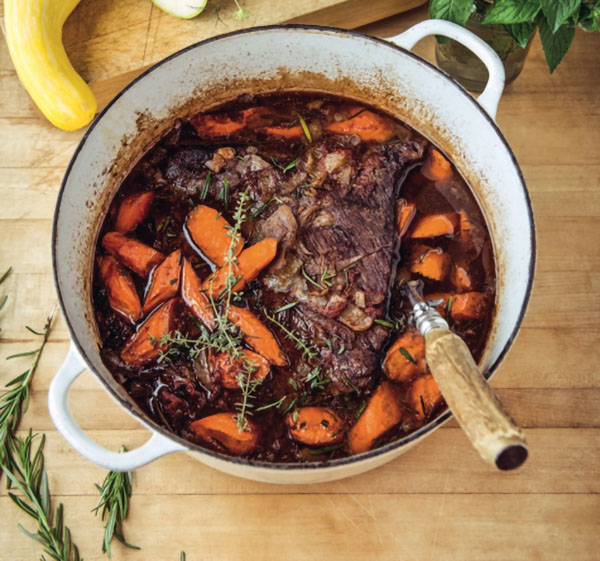
My Favorite Brisket

Serves 8 – 10

3 onions, cut into chunks

1 5-pound (2.6 kilogram) brisket of beef, shoulder roast of beef or chuck roast

2 tsp kosher salt

Freshly ground black pepper to taste

2 cloves garlic, peeled

One 15-ounce (425-gram) can diced or crushed tomatoes

2 cups (473 ml) dry red wine

2 stalks celery with leaves, chopped

1 bay leaf

1 sprig fresh thyme

1 sprig fresh rosemary

1⁄4 cup chopped fresh Italian parsley

6 to 8 carrots, peeled and sliced on the diagonal

1. Preheat the oven to 350°F, and scatter the onions in a 9-by-13-inch Pyrex pan.

2. Sprinkle the brisket with salt and pepper, and rub it with the garlic. Lay it, fat side up, on top of the onions. Top this with the tomatoes, red wine, celery, bay leaf, thyme and rosemary. Cover and seal with foil, and bake for about 3 hours, basting every 1⁄2 hour with the pan juices.

3. Add half the parsley and the carrots, and bake, uncovered, for about 30 minutes more, or until the carrots are cooked. To test for doneness: Stick a fork in the flat (thinner or leaner) end of the brisket.

4. When there is a light pull on the fork as it is removed from the meat, it is fork-tender. Bring the meat to room temperature, then remove it to a cutting board and trim all visible fat from the brisket. Place the brisket with what was the fat side down, on a cutting board. Look for the grain — the muscle lines of the brisket — and, with a sharp knife, cut slices across the grain.

5. Return the sliced brisket to the roasting pan with the sauce, and refrigerate overnight or freeze. When you’re ready to serve, reheat it in a preheated 350°F oven for 20 minutes. Some people like to strain the gravy, but I prefer to keep the onions, because they are so delicious. If the gravy needs reducing, put the meat on a serving platter and reduce the gravy in a saucepan until it has the correct consistency. Pour some over the meat, and put the rest in a gravy boat. Cover the meat with the carrots and the remaining parsley, and serve.

Flourless Chocolate Cake from Joan Nathan

Recipe courtesy of Joan Nathan “King Solomon’s Table.”

Yields 8 to 10 servings

8 ounces (226 grams) good bittersweet chocolate such as Callebaut or Guittard

8 Tbsp (1 stick/113 grams) unsalted butter or coconut oil

6 large eggs, separated

3/4 cup (150 grams) sugar

Pinch of salt

1 tsp vanilla

Unsweetened cocoa powder for dusting

Raspberries and blueberries for topping

Whipped cream or ice cream (optional)

1. Preheat the oven to 350°F and butter a 9-or 10 inch spring-form pan with spray, or a little of the butter or coconut oil.

2. Melt the chocolate and the butter or coconut oil in a double-boiler or in a microwave for a little more than a minute. Let cool.

3. In the bowl of an electric stand mixer using the whip attachment, beat the egg whites with 1/2 cup (100 grams) of the sugar and the salt until soft peaks form. In a separate bowl, whip the yolks with the remaining 1/4 cup (50 grams) sugar and vanilla. Using a spatula, slowly stir in the chocolate in the egg yolk mixture. Then carefully fold in the egg whites. Don’t overmix or it will deflate.

4. Pour batter into prepared pan. Bake for 28 to 35 minutes, or until the cake is fully set around the edges. You want it to be slightly gooey in the center.

5. Let cool in the pan for a few minutes, then remove from the pan and cool completely, and dust with cocoa.

6. Serve topped with berries and, if you like, with whipped cream or ice cream.

Joan Nathan’s Passover Favorites Read More »
Magic of Mimouna and a Walnut Cookie Recipe

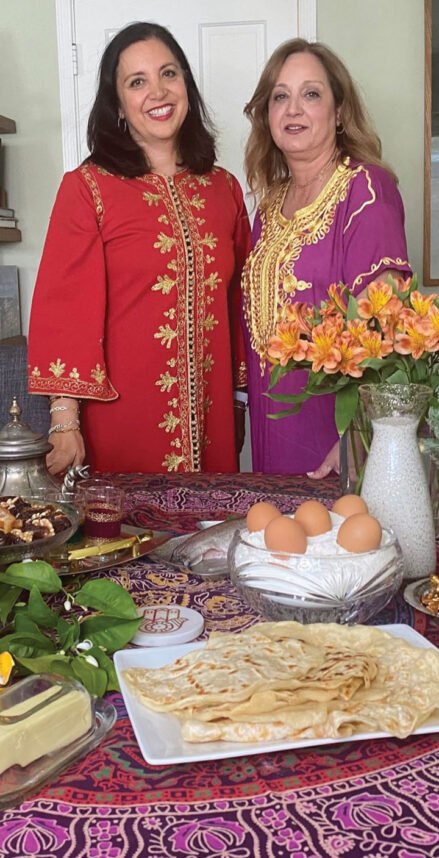
Mimouna is the joyous celebration of springtime and good fortune, of friends and family. It’s a huge party to mark the conclusion of Passover and to invite blessings for the beginning of the agricultural season. In Morocco, the doors of Jewish homes were opened wide and everyone was welcomed with the Judeo-Arabic blessing “Tirbah u’tissad,” may you prosper and succeed.

Traditionally, the Mimouna table is adorned with talismans of luck, fertility and prosperity. A whole fish on a platter. A green tree branch. Five gold coins in a bowl of flour and five fava beans arranged on a pastry.

Scholars don’t know the exact origins of the name and holiday. Does it mark the anniversary of the death of Maimon ben Yosef, the father of Maimonides? Does the name come from the Hebrew word for faith, “emunah”? Is it derived from the Arabic word for wealth “ma’amoun”?

Mimouna has become a widely celebrated and wildly popular event on the Jewish calendar in Israel and all over the world. The mimouna table overflows with sweet treats like whole oranges cooked with syrup and cinnamon sticks, eggplant jam, marzipan and meringues, as well as colorful cookies made with almonds, pistachios, walnuts and coconut. Of course, no celebration is complete without the famous moufleta, thin crepes served with butter and honey.

In Morocco, the flour used in moufletas was brought to Jewish homes by Muslim neighbors after sundown, proof of the level of friendship and cooperation that existed between the two faiths.

My father’s youngest brother, Uncle Albert, emigrated from Israel to America in the early 1970’s, after his marriage to a beautiful American airline hostess. With his help and encouragement, my family came from Casablanca to Los Angeles in late 1973. For many years, he was my father’s best friend and his lunch partner, especially after my mother passed away.

He was always at Shabbat and holiday meals at my parents home. Now I am blessed to host him at my table and he is beloved by my children and my nieces and nephews.

He is young at heart, a bit of a ladies’ man and an excellent story-teller. Many times, he will have us crying with laughter, regaling us with tales from his early days as a restaurateur in Los Angeles, when he was one of the owners of Le Petit Bistro, the very popular French restaurant that was once on La Cienega Boulevard.

He is a class act. Always perfectly dressed, with a subtle smell of cologne and a lot of quiet charm. He is a great cook and a fabulous baker. He is a lover of wine and good food and always up for a wonderful night out. Ladies, he’s a catch!

Every so often, he will spoil us with his homemade Linzer torte, packaged in a bakery box tied with grosgrain ribbon.

For Shabbat dinners, he will bring his amazing walnut cookies, packaged in a cellophane bag tied with a bright red ribbon.

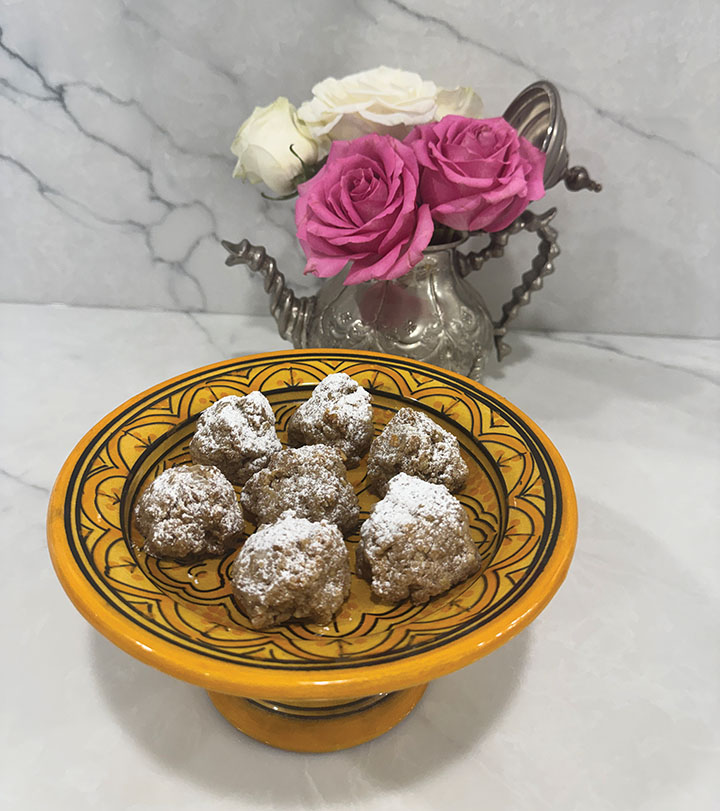
Recently, I asked him to explain how he makes these Moroccan walnut cookies because they are so moist and delicious and chewy in the middle. They are perfect for a Mimouna table because they are flourless and can be baked during Passover, before Mimouna.

We hope you try my Uncle Albert’s fabulous walnut cookie recipe.

—Rachel

Moroccan Walnut Cookies

3 cups raw shelled walnuts

1 or 2 eggs

1 cup white sugar

1 tsp ground cinnamon

¼ tsp ground clove

½ cup powdered sugar, for rolling

Preheat the oven to 350°F.

Grind walnuts finely, leaving some pieces.

Place the walnuts, sugar, cinnamon and clove in a medium bowl.

In a small dry bowl, beat one egg with a fork until foamy.

Using a soup spoon, add the egg to the nut mixture, one spoonful at a time.

Mix the nut and egg mixture by hand. When a handful of the dough sticks together, stop adding egg.

Form the nut dough into small balls and place on a baking sheet lined with parchment paper.

Place in oven and bake for about 8 minutes. Use a knife to gently lift a cookie. If the cookie is firm and stays together and the bottom is golden, remove the tray from the oven. If the cookie is still too loose, continue baking for 2 more minutes, then check again.

Do not walk away as these cookies bake very quickly and once over-baked they will not have the desired chewy consistency.

Allow cookies to cool.

Roll the cookies in a small bowl filled with powdered sugar for a powdery coating.

Store cookies in an airtight container.

– Sharon


Sharon Gomperts and Rachel Emquies Sheff have been friends since high school. The Sephardic Spice Girls project has grown from their collaboration on events for the Sephardic Educational Center in Jerusalem. Follow them
on Instagram @sephardicspicegirls and on Facebook at Sephardic Spice SEC Food. Website sephardicspicegirls.com/full-recipes.

Magic of Mimouna and a Walnut Cookie Recipe Read More »

Alpine Flavors—a Crunchy Granola Recipe

One of the most breathtaking experiences in my life was flying over the Italian Alps.

In 2013, my 17-year-old niece Devorah was studying at the Chabad seminary in Milan, Italy and Alan was kind enough to let me go visit her.

Devorah met me at the Malpensa Airport and we drove 230 miles to Florence. The springtime scenery along the way was incredibly picturesque.

Upon arrival, we headed straight for the terrace of the Piazzale Michelangelo where we enjoyed panoramic views of the city and the surrounding hills.

We visited the iconic Duomo with Brunelleschi’s dome and its green and white marble facade.

At the Uffizi Galleries, we sighed at the perfection of Botticelli’s masterpieces “Primavera” and “The Birth of Venus.” We gasped at the perfection of Michelangelo’s magnificent “David” at the Accademia Dell’arte.

We walked across the Ponte Vecchio, a medieval bridge crowded with jewelry shops on the Arno River.

At the Great Synagogue, we celebrated a Shabbat Chatan and a special kiddish meal in the lush garden. This 19th-century masterpiece was built as a symbol of Jewish emancipation and is renowned for its Moorish Revival architecture, with a distinctive green copper dome and a facade of pink and white stone.

Upon our return to Milan, we were joined by my cousin Sarah (a children’s book author on Instagram @sarahsassoonwriter) and her one-year-old son Refael. We ate glorious meals of potato gnocchi and fresh pasta, grilled fish, smoked salmon and fresh Italian bread. We drank lots of cioccolata calda con pane, a wonderful thick, rich, creamy hot chocolate. We visited the Milano Duomo and the Brera, the ancient Roman part of town that is now an upscale shopping area. We drove to the medieval city of Verona and we visited the Swiss city of Lugano on the stunning Lake Como.

When it was time to return home, I drove by myself to the airport. In search of a gas station, I exited the highway. It was eerie to drive on the empty roads through early morning fog. Surrounded by thickets of trees and the occasional farmhouse, I was haunted by thoughts of Primo Levi and his time as a partisan in the northern Italian countryside during the Second World War.

I made it to the airport and I boarded my Lufthansa flight to Düsseldorf. As we flew over the snow-capped Alps, it felt as though they were close enough to touch. The incredible grandeur of the rugged mountains and crystal blue lakes was mesmerizing.

Perhaps it was the incredible scenery that has made the plane food — a simple breakfast of Bircher muesli — stick out in my mind. I can still remember the wonderful combination of rolled oats, fresh apple, dried fruits and tart yogurt.

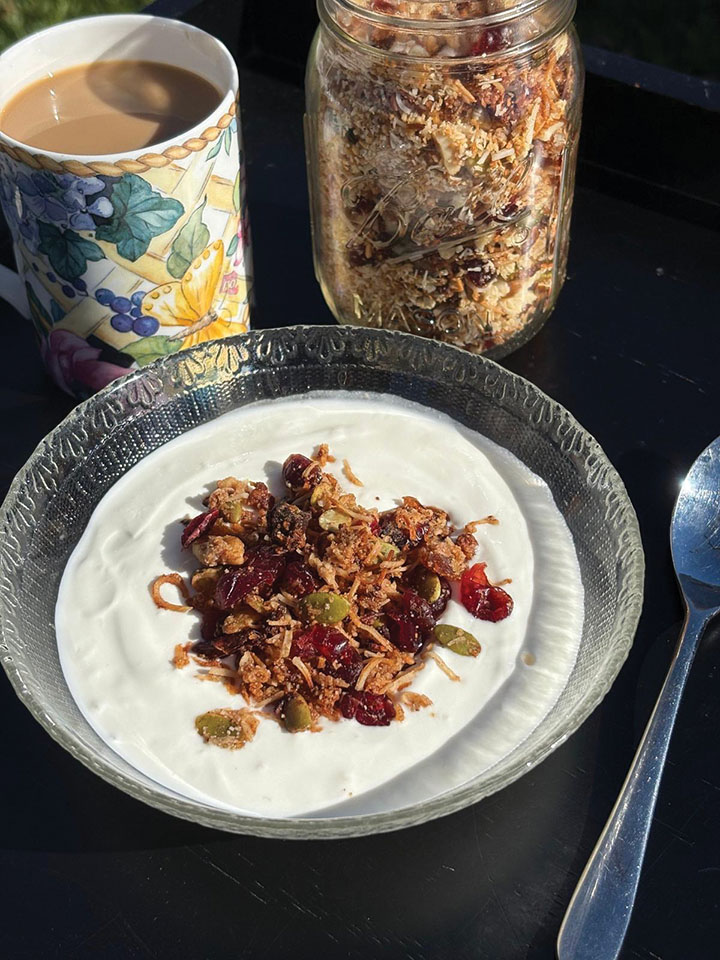
Every Passover since then, I prepare a truly delicious gluten-free granola. I use lots of nuts and seeds (pistachios, walnuts, almonds and pumpkin seeds) and dried fruits (apricots, dates and cranberries). I use almond flour and coconut and I bind it with egg whites, maple syrup, honey and a little Silan. I throw in a little cinnamon and vanilla for added flavor.

Of course, you can adapt the recipe by using your favorite nuts and dried fruits. Add a dollop of creamy yogurt and fresh berries for a wonderful, healthy, fiber-filled Passover and (all year round) treat.

Scenery not included.

—Sharon

Dried Fruit and Nut Granola

2 cups coconut

1 cup almond flour

1 cup pistachios, chopped

1 cup walnuts, chopped

1/2 cup almonds, chopped

1/2 cup pecans, chopped

1 cup apricots, chopped

1 cup dates, chopped

1 cup cranberries

4 Tbsp maple syrup

2 Tbsp honey

2 Tbsp Silan

3 Tbsp vegetable oil

3 egg whites

2 tsp vanilla extract

1 tsp ground cinnamon

Preheat oven to 350°F.

Place the coconut, almond flour, pistachios, walnuts, almonds, pecans, apricots, dates and cranberries on a parchment-lined baking tray and mix well.

Drizzle in the maple syrup, honey, Silan, oil, eggs, vanilla, and cinnamon, then toss well to coat.

Bake for 13 to 15 minutes, until golden brown.

Let cool completely.

Store in an airtight container.


Sharon Gomperts and Rachel Emquies Sheff have been friends since high school. The Sephardic Spice Girls project has grown from their collaboration on events for the Sephardic Educational Center in Jerusalem. Follow them
on Instagram @sephardicspicegirls and on Facebook at Sephardic Spice SEC Food. Website sephardicspicegirls.com/full-recipes.

Alpine Flavors—a Crunchy Granola Recipe Read More »