The revolution unfolding in the streets of Iran is a marvel to behold. I pray that the freedom fighters win.
But I am witnessing a lot of confusion and outdated thinking, as people debate these developments. Almost everyone gets key facts wrong about the Middle East. And these mistakes make it harder for western outsiders to truly grasp the incredible promise of this moment.
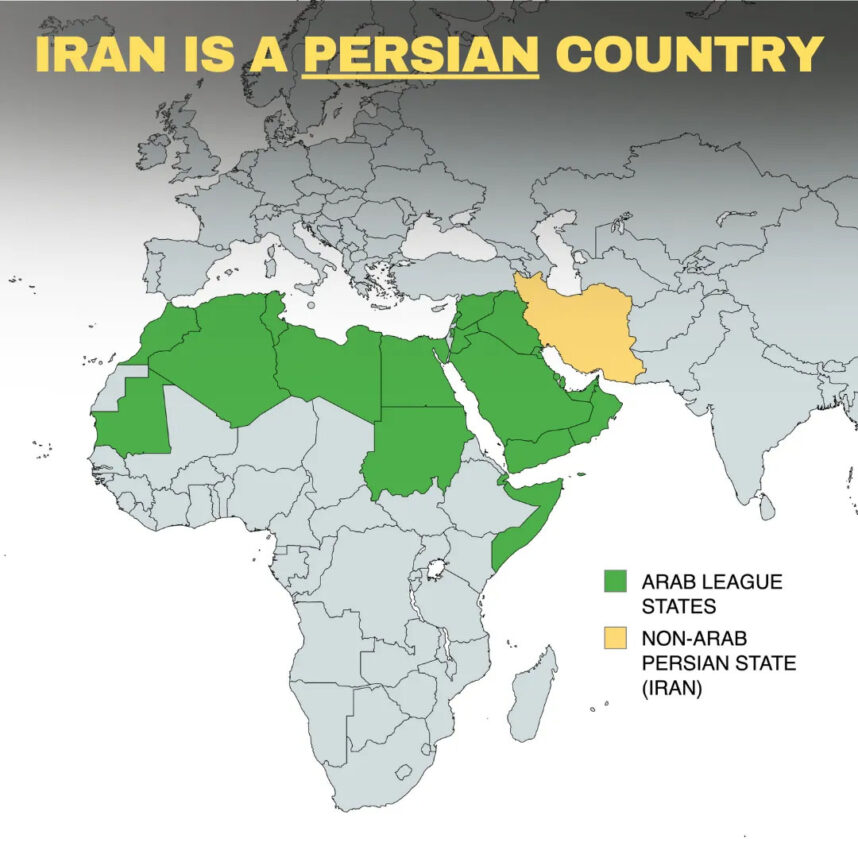
For example, Iran is not an Arab country. It’s a Persian country.* And tucked inside that distinction is real hope for true peace in the Middle East.
Let me explain.
People still speak about the Arab-Israeli conflict. That phrase once made sense – a long time ago. But today that description no longer accurately captures the circumstances in the region.
Those facts taken together offer real hope for regional transformation – as soon as the Iranian people shake off their dictators and hold free elections.
The preconditions for peace are already there. The landscape has changed dramatically in recent years.
Just to be clear – I am not saying all Arabs love Israel. Not at all. Far from it.
- There is deep Arab resentment, anger and frustration toward Israel, especially toward the Netanyahu government.
- The Palestinians continue to fight for dignity, and they enjoy broad Arab support.
- Unfortunately there remain death cults like the ISIS-remnants and ISIS-wannabes, also in the mix.
But these facts overshadow a more complex reality emerging on the ground.
Most Arab nations have begun quietly waving the white flag; they seek no more military conflict with Israel. Even states that once waged war against Israel have moved on. They are no longer working to wipe out the Jewish state.
The major Arab League nations that no longer seek Israel’s destruction include:
Other Arab states and forces have stood down, been beaten down or backed off.
Bottom line: Israel’s adversaries want no more smoke. They’ve stopped betting on Israel’s disappearance. They know their oil will run out long before a nation like Israel falls. Most now choose reality and prosperity over jihadist fantasy and permanent war.
As a result: no Arab state is openly, actively seeking Israel’s destruction anymore.
None.
Sit with that.
This shift toward normalization is only accelerating and deepening. Egypt and Israel just announced a multi-billion-dollar natural gas deal a few weeks ago. Smart business ties between Arabs and Israelis are slowly becoming the rule, not the exception.
Iran’s Ayatollahs still want to wipe Israel off the map; they still lead chants of “Death to America! Death to Israel!” In the fight for peace and stability in the region, the Islamic Republic of Iran is the “final boss.”
But here’s the key point: In Iran, the dictators are mainly subjugating Persians, not Arabs.
Why is that fact so important – and encouraging? Because Persians and Jews do not typically fight each other. To the contrary: the alliance between Persians and Jews dates back for thousands of years, since King Cyrus of Persia.
They have lived together in relative peace for centuries. (Many Jews ARE Persian!) While the governments of Israel and Iran have tangled for decades, the historical norm between the Jewish people and the Persian people is thousands of years of predominantly peaceful coexistence.
It seems normal to us to see Israel fighting Iran-backed Hamas, Iran-backed Hezbollah and Iran-backed Houthis. But historically, sustained “Persian versus Jew” conflict has been rare and highly atypical.
Therefore, a free, democratic Iran would almost certainly stop funding terror, normalize ties with Israel and become a more peaceful, trade-based partner for prosperity.
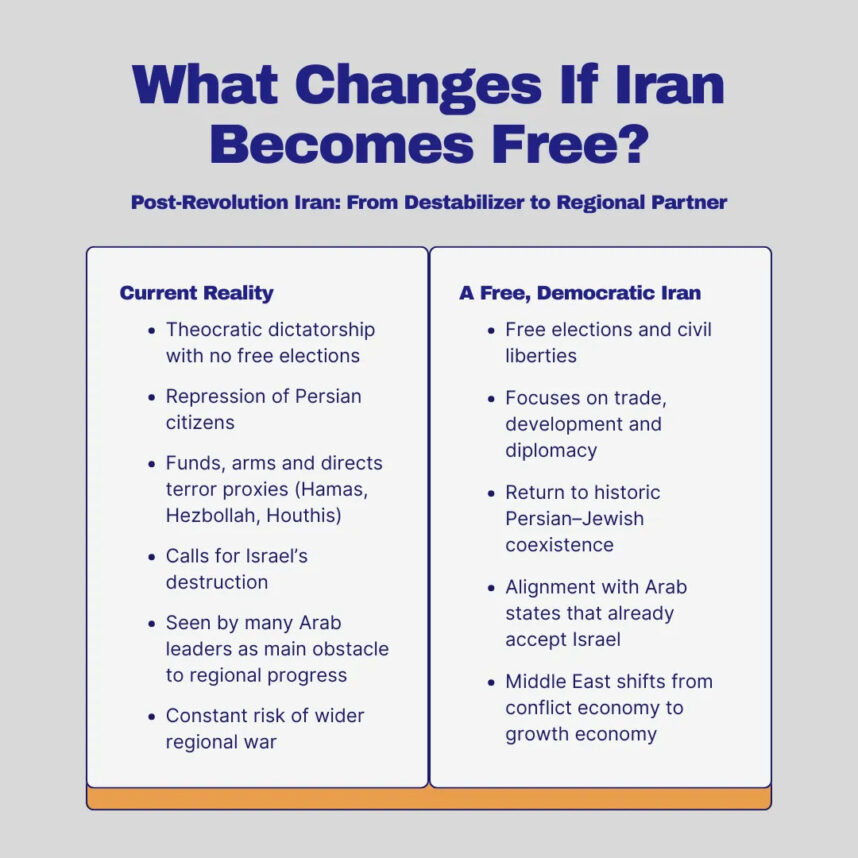
Nobody would be happier to see a new regime in Tehran than the leaders of the Arab states.
Here’s the open secret: most Arab leaders are fed up with Iran. They see the biggest obstacle to progress in the region as the Islamic Republic of Iran. (Not Israel!)
The reason: Iran’s rulers have funded terror proxies throughout the region, which have destabilized the entire Middle East.
That’s one reason that Arab governments backed Israel (!!!) and the United States against Iran, during recent military clashes. (Yes, that really happened!)
Translation: the most important fault line in today’s Middle East conflict is not the idea of “Israelis versus Arabs.” That’s outdated thinking.
The defining conflict right now is “Israel versus the Iranian regime + its proxies.” Given the long love affair between Persians and Jews, that’s an absurd reality.
That absurdity points to a hopeful possibility: a free Iran is almost certain to join the Arab states in accepting Israel’s existence – either expressly or tacitly.
The minute that happens, a regional settlement — including real dignity and freedom for Palestinians — becomes far more achievable. More Israelis would welcome a Palestinian state, if they knew Iran wouldn’t turn it into a staging ground for its terror proxies.
The people of Iran are not genocidally anti-Israel or anti-Jewish in the way Iran’s rulers are.
- A free, democratic Iran would not pose an existential threat to Israel.
- It would not brutalize its own people.
- And it could become a credible, constructive advocate for Palestinian dignity and freedom – rather than an enabler of extremist fantasies that only prolong fear and suffering.
Arabs and Israelis are finding a way to coexist – begrudgingly, but peacefully and productively.
If Persians and Jews return to their historic partnership, they can do the same thing – and more! If that happens, the entire region could blossom and bloom in ways not seen in centuries.
* NOTE: I am using the terms Arab state, Persian state and Jewish state colloquially – with no intention of erasing the incredible diversity inside each country.
In reality, few countries are made up of only ONE ethnicity. For example, the 22 “Arab League states” and the one “Jewish state” contain many other ethnicities besides Arabs and Jews. And while Persians are by far Iran’s largest ethnic group (around 60 percent) – other significant minority groups include Azerbaijanis (20 percent), Kurds (10 percent), Lurs (six percent) and others. Additionally, many Jews come from Iran (and also from Arab League countries).
It’s an ethnically and religiously complicated region. That’s one reason why the reductionist and didactic conversations we have about the Middle East fall so flat – and do so much harm.
Van Jones is a three-time New York Times bestselling author, a CNN host and contributor, and an Emmy Award winner.


Hope After Revolution: Iran + Israel = BFFs?
Van Jones
The revolution unfolding in the streets of Iran is a marvel to behold. I pray that the freedom fighters win.
But I am witnessing a lot of confusion and outdated thinking, as people debate these developments. Almost everyone gets key facts wrong about the Middle East. And these mistakes make it harder for western outsiders to truly grasp the incredible promise of this moment.
Persian ≠ Arab
For example, Iran is not an Arab country. It’s a Persian country.* And tucked inside that distinction is real hope for true peace in the Middle East.
Let me explain.
People still speak about the Arab-Israeli conflict. That phrase once made sense – a long time ago. But today that description no longer accurately captures the circumstances in the region.
Quick context for readers who are new to this conflict & region:
Those facts taken together offer real hope for regional transformation – as soon as the Iranian people shake off their dictators and hold free elections.
Arab states are quietly making peace with Israel.
The preconditions for peace are already there. The landscape has changed dramatically in recent years.
Just to be clear – I am not saying all Arabs love Israel. Not at all. Far from it.
But these facts overshadow a more complex reality emerging on the ground.
Most Arab nations have begun quietly waving the white flag; they seek no more military conflict with Israel. Even states that once waged war against Israel have moved on. They are no longer working to wipe out the Jewish state.
The major Arab League nations that no longer seek Israel’s destruction include:
Other Arab states and forces have stood down, been beaten down or backed off.
Bottom line: Israel’s adversaries want no more smoke. They’ve stopped betting on Israel’s disappearance. They know their oil will run out long before a nation like Israel falls. Most now choose reality and prosperity over jihadist fantasy and permanent war.
As a result: no Arab state is openly, actively seeking Israel’s destruction anymore.
None.
Sit with that.
This shift toward normalization is only accelerating and deepening. Egypt and Israel just announced a multi-billion-dollar natural gas deal a few weeks ago. Smart business ties between Arabs and Israelis are slowly becoming the rule, not the exception.
If Arabs can trade with Israel, Persians DEFINITELY can. The last big holdout in the region is Iran.
Iran’s Ayatollahs still want to wipe Israel off the map; they still lead chants of “Death to America! Death to Israel!” In the fight for peace and stability in the region, the Islamic Republic of Iran is the “final boss.”
But here’s the key point: In Iran, the dictators are mainly subjugating Persians, not Arabs.
Why is that fact so important – and encouraging? Because Persians and Jews do not typically fight each other. To the contrary: the alliance between Persians and Jews dates back for thousands of years, since King Cyrus of Persia.
They have lived together in relative peace for centuries. (Many Jews ARE Persian!) While the governments of Israel and Iran have tangled for decades, the historical norm between the Jewish people and the Persian people is thousands of years of predominantly peaceful coexistence.
It seems normal to us to see Israel fighting Iran-backed Hamas, Iran-backed Hezbollah and Iran-backed Houthis. But historically, sustained “Persian versus Jew” conflict has been rare and highly atypical.
Therefore, a free, democratic Iran would almost certainly stop funding terror, normalize ties with Israel and become a more peaceful, trade-based partner for prosperity.
Arab leaders secretly hate the Islamic Republic of Iran.
Nobody would be happier to see a new regime in Tehran than the leaders of the Arab states.
Here’s the open secret: most Arab leaders are fed up with Iran. They see the biggest obstacle to progress in the region as the Islamic Republic of Iran. (Not Israel!)
The reason: Iran’s rulers have funded terror proxies throughout the region, which have destabilized the entire Middle East.
That’s one reason that Arab governments backed Israel (!!!) and the United States against Iran, during recent military clashes. (Yes, that really happened!)
Translation: the most important fault line in today’s Middle East conflict is not the idea of “Israelis versus Arabs.” That’s outdated thinking.
The defining conflict right now is “Israel versus the Iranian regime + its proxies.” Given the long love affair between Persians and Jews, that’s an absurd reality.
When the Persian people overthrow the Ayatollahs, everything could change.
That absurdity points to a hopeful possibility: a free Iran is almost certain to join the Arab states in accepting Israel’s existence – either expressly or tacitly.
The minute that happens, a regional settlement — including real dignity and freedom for Palestinians — becomes far more achievable. More Israelis would welcome a Palestinian state, if they knew Iran wouldn’t turn it into a staging ground for its terror proxies.
The people of Iran are not genocidally anti-Israel or anti-Jewish in the way Iran’s rulers are.
Arabs and Israelis are finding a way to coexist – begrudgingly, but peacefully and productively.
If Persians and Jews return to their historic partnership, they can do the same thing – and more! If that happens, the entire region could blossom and bloom in ways not seen in centuries.
* NOTE: I am using the terms Arab state, Persian state and Jewish state colloquially – with no intention of erasing the incredible diversity inside each country.
In reality, few countries are made up of only ONE ethnicity. For example, the 22 “Arab League states” and the one “Jewish state” contain many other ethnicities besides Arabs and Jews. And while Persians are by far Iran’s largest ethnic group (around 60 percent) – other significant minority groups include Azerbaijanis (20 percent), Kurds (10 percent), Lurs (six percent) and others. Additionally, many Jews come from Iran (and also from Arab League countries).
It’s an ethnically and religiously complicated region. That’s one reason why the reductionist and didactic conversations we have about the Middle East fall so flat – and do so much harm.
Van Jones is a three-time New York Times bestselling author, a CNN host and contributor, and an Emmy Award winner.
Did you enjoy this article?
You'll love our roundtable.
Editor's Picks
Israel and the Internet Wars – A Professional Social Media Review
The Invisible Student: A Tale of Homelessness at UCLA and USC
What Ever Happened to the LA Times?
Who Are the Jews On Joe Biden’s Cabinet?
You’re Not a Bad Jewish Mom If Your Kid Wants Santa Claus to Come to Your House
No Labels: The Group Fighting for the Political Center
Latest Articles
Can a Day of Political War Be a Day of Prayer?
The Jewish Grandparents Network Learning Fest to Take Place in January
Democracy Is Built Before Election Day
Au Revoir, France
To Begin Again
Abraham’s God in the Age of Atheism
AJU Reopens Ziegler School Admissions, Seeks to Reimagine Rabbinic Education
The Ziegler reopening reflects AJU’s broader goal of helping create a sustainable pipeline of future rabbis.
Show Us How It’s Done – A poem for Parsha Lech Lecha
This is not the party I want to be at.
Weinberg: The Secret German Life of a Jewish Last Name
It’s no coincidence that American Jews generally don’t know that at some point the German language slithered its way into their last names.
The Anti-Zionist Agenda at the Heart of UC Ethnic Studies
The classroom becomes an instrument for advancing political causes rather than a place where those causes are freely examined and debated.
The Beauty of the Slow and Steady
What could our lives look like if we embraced the infinitesimal as infinite?
Ziegler School Welcomes Prominent Rabbi, O.C. Federation Names CEO, Pico-Robertson Cleanup
Notable people and events in the Jewish LA community.
A Moment in Time: Beyond the Chuppah
A Bisl Torah ~ The Company You Keep
Does the company we keep enable our name to be a blessing? Are we doing enough to make our name as great as God intends?
Because We Can
Print Issue: The View From Israel | October 23, 2026
Three years after Oct. 7, a country trying to heal is still waiting for a full accounting of what went wrong.
Rabbis of LA | Rabbi Taff’s Daughter Follows Her Father’s Footsteps
Second of two parts
‘The Nuremberg Women’: The Untold Stories of Eight Women Who Witnessed History
“These women were pivotal to both the process and the outcome of the trial. Yet they were marginalized on many occasions, literally reduced to footnotes.“
A Very Jewish Stew: Toscano Hamin
This Hamin Toscano recipe reminded us of a Tuscan wedding soup.
Table for Five: Lech Lecha
Shield Of Abraham
The View from Israel
Three years after Oct. 7, Israel is still waiting for a full accounting of what went wrong.
Albie Selznick’s Unlikely Connection to David Bowie Inspires New Solo Show
Selznick saw his idol David Bowie perform live when he was 15 and made up his mind that he wanted to create a show of his own and work with Bowie.
Is the New Facebook Film Equal to the Original?
“The Social Reckoning” isn’t about a power struggle, but shows that powerful companies are reluctant to change unless there is pain.
Larry David Is Spot-on in His Satire of the DSA
In his article about his proposals for the Democratic Socialists of America, he jokes that “The DSA has great respect for religious traditions.”
Remember and Be Grateful
Memory is the mother of gratitude. If we do not remember our past, it is difficult to improve our present or build a better future.
Michael Broukhim’s Journey to a Deeper Judaism
What began as a personal exploration of Judaism eventually became intertwined with Broukhim’s professional life.
More news and opinions than at a Shabbat dinner, right in your inbox.