fbpx

January 14, 2026

The Holocaust, Without Jews

You wouldn’t think Vladimir Putin, the BBC and the National Education Association have much in common. But in recent weeks, they have demonstrated that they share a peculiar understanding of the Holocaust—one which omits the Jews.

Putin last week announced the establishment of a “Day of Remembrance for the Victims of the Genocide of the Soviet People” by the Nazis during World War II. The actual victims of that genocide, Europe’s Jews, were not mentioned in Putin’s description of what the Nazis did.

Not that this is anything new for the Soviet dictator. Back in 2005, Putin spoke at the site of the Auschwitz death camp about Soviet soldiers who died while liberating Poland from the Nazis, and about other Russians who were killed in World War II. But no mention of the Jews.

Coincidentally, the BBC last week aired a television program about the Kindertransport, which brought 10,000 children from Nazi territory to Great Britain in 1938-1939.

Somehow the writers and producers forgot to mention that nearly all the children were Jewish, and were fleeing antisemitic persecution. According to the London Jewish Chronicle, actress Helen Mirren, who appeared in the program, did mention the word “Jew” — but it was edited out.

Meanwhile, on this side of the Atlantic, the National Education Association — the largest union of public educators — has been circulating a similarly revised version of the Holocaust.

The NEA’s annual handbook contains a description of the Holocaust as having claimed the lives of “more than 12 million victims of different faiths, ethnicities, races, political beliefs, genders, and gender identification, abilities/disabilities and other targeted characteristics.” 

The “12 million” figure was calculated by combining the fatality numbers among various people who suffered in the war, but who were not targeted by the Nazis for mass annihilation. And, incredibly, the NEA never mentions the actual victims of the genocide, the Jews.

All of this is painfully reminiscent of the way in which President Franklin D. Roosevelt and his administration omitted Jews from their references to the Holocaust — even as the mass murder was still raging.

The Roosevelt administration’s statement announcing a conference in Bermuda in 1943 to discuss the Jewish refugee crisis emphasized: “The refugee problem should not be considered as being confined to persons of any particular race or faith.”

Senior American, British and Soviet officials met in Moscow later that year to discuss the war effort. Afterwards, they issued a statement threatening postwar punishment for Nazi war crimes against “French, Dutch, Belgian or Norwegian hostages … Cretan peasants … [and] the people of Poland” — but not Jews. 

President Roosevelt did not use the word “Jews” even in his 1944 statement commemorating the anniversary of the Warsaw Ghetto revolt — a revolt by the Jews against the Nazis.

In early 1944, officials of the U.S. War Refugee Board prepared a draft of a statement that they wanted the president to send to the people of Axis-occupied countries, warning them not to collaborate in atrocities against Jews. But White House aides informed the Board that President Roosevelt “wanted the statement rewritten so as to be aimed less directly at the atrocities against the Jews.” 

The final version deleted a reference to Jews being murdered “solely because they were Jews.” It also removed three of the statement’s six references to Jews. And it added three introductory paragraphs naming various other nationalities who were suffering because of the war.

In September of that year, the War Refugee Board ran into a similar problem with General Dwight D. Eisenhower, Supreme Commander of the Allied forces in.  

The Board drafted a leaflet which it wanted U.S. planes to drop over Europe, warning civilians to refrain from participating in Nazi atrocities against Jews. But Eisenhower insisted on deleting the leaflet’s reference to Jews. The final version urged readers not to “molest, harm or persecute” any of the “great many men” who were being held by the German authorities, “no matter what their religion or nationality may be.” 

Arthur Szyk, the famous artist and Jewish activist, charged that the persecution of Europe’s Jews was being “treated as a pornographical subject — you cannot discuss it in polite society.”

There was a reason behind the Roosevelt administration’s policy of downplaying or denying the Jewish identity of Hitler’s victims. FDR and his advisers were concerned that if they publicly recognized that the Jews were being singled out, then “the various [Allied] Governments would expose themselves to increased pressure from all sides to do something more specific in order to aid these people,” as one State Department official explained in an internal discussion.

Obviously the motives of today’s Holocaust-revisers are different from those of the Roosevelt White House. But whether today’s distorters are motivated by callousness, political convenience, or simply ignorance, the result is the same — the Jews are still regarded as unmentionable.


Dr. Medoff is founding director of The David S. Wyman Institute for Holocaust Studies and author of more than 20 books about Jewish history and the Holocaust. Follow him on Facebook to read his daily commentaries on the news

The Holocaust, Without Jews Read More »

Silence of the Sheep: Why Progressives Are Ignoring the Massacre of Iranians

On the surface it makes no sense.

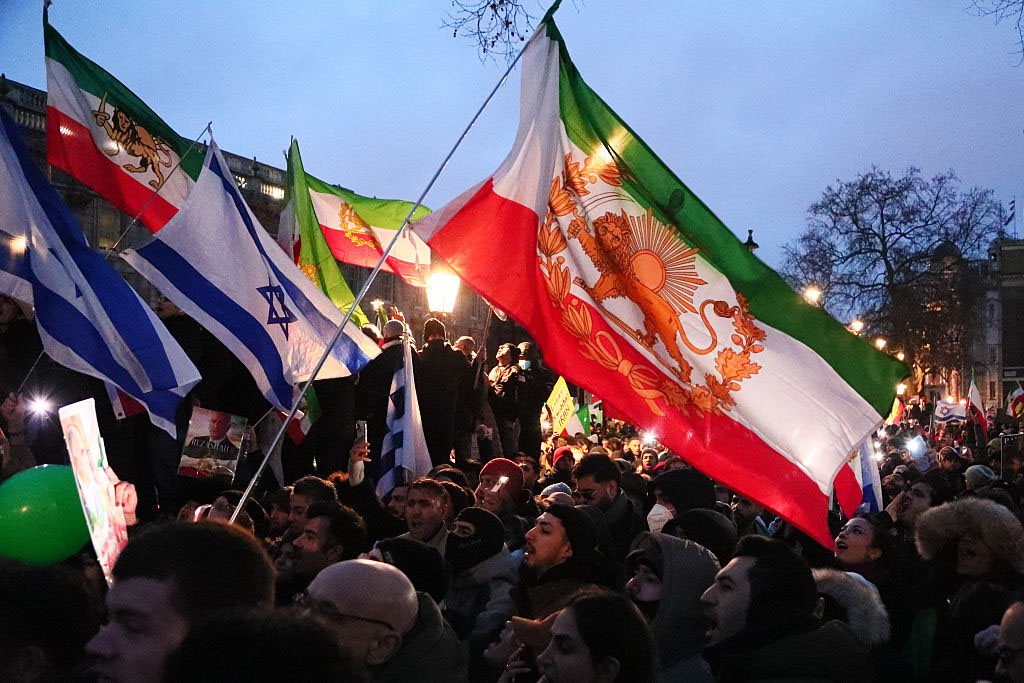
Progressives have damaged their vocal cords for the past two years in support of the Palestinians in Gaza. Now, as thousands of Iranian protesters are being massacred by the butchers of Tehran, they’ve gone silent.

One of the sharpest memes on the Internet is a shot of an empty college campus with an ironic caption about “social justice warriors protesting the massacre of Iranians.”

Why the silence?

Are the people of Iran less worthy than Palestinians?

“One would think that those who claimed that elementary human decency justified their opposition to Israel’s defensive operations in Gaza after the October 7 massacre would race to voice support for the Iranian people,” Noah Rothman writes on National Review Online.

Indeed, the silence makes no sense.

Or does it?

Let’s hear from a leftist writer in The New Republic, Adrienne Mahsa Varkiani, who has the courage to take on her own.

“Many of those on the American left are doing the Iranian people dirty,” Varkiani writes. “They’ve either greeted the pain and suffering being meted out with total silence, or they’ve fallen back on familiar hobbyhorses, using Iranian pain to issue threadbare critiques of U.S. imperialism.”

If we need an answer for the shameful silence, that’s our best lead right there: It all depends on who the players are.

If America bombs anything or commits any violence, it’s “all hands on deck” for the left against big bad imperialist America.

If Israel bombs anything or commits any violence, it’s time for encampments on campuses and massive protests to “globalize the intifada.”

If condemning the theocratic murderers of Tehran means helping the other team– like America or Israel– better keep our mouths shut.

And if we recognize that the killings are terrible and must assign blame, just follow the Mullahs who blame the U.S. and Israel for fomenting the riots.

In other words, forget about victims. In the progressive mindset, victims are just a cover for what really matters: Going after the bad guys of the West, and Israel and America are the ultimate bad guys.

The “pro-Palestinian” protests that continue to haunt Jews everywhere have nothing to do with the Palestinians. Just ask the Palestinians who have been living in misery in Jordan and Lebanon for decades. No one ever says a word on their behalf, because Israel is not involved. Same thing with Palestinians who are routinely executed in Gaza by Hamas. If it’s not Israel, not a peep from the social justice warriors.

Now, with millions of Iranians on the streets seeking their freedom and our support, these “warriors” have turned into cowardly sheep in hiding, following their herd to the next anti-Israel hatefest.

Imagine how Iranian protesters who are risking their lives must feel as they see demonstrations around the world about Gaza and not Iran.

The silence on Iran from so-called social justice warriors is a betrayal of everything that is noble about social justice.

Silence of the Sheep: Why Progressives Are Ignoring the Massacre of Iranians Read More »

Hope After Revolution: Iran + Israel = BFFs?

The revolution unfolding in the streets of Iran is a marvel to behold. I pray that the freedom fighters win.

But I am witnessing a lot of confusion and outdated thinking, as people debate these developments. Almost everyone gets key facts wrong about the Middle East. And these mistakes make it harder for western outsiders to truly grasp the incredible promise of this moment.

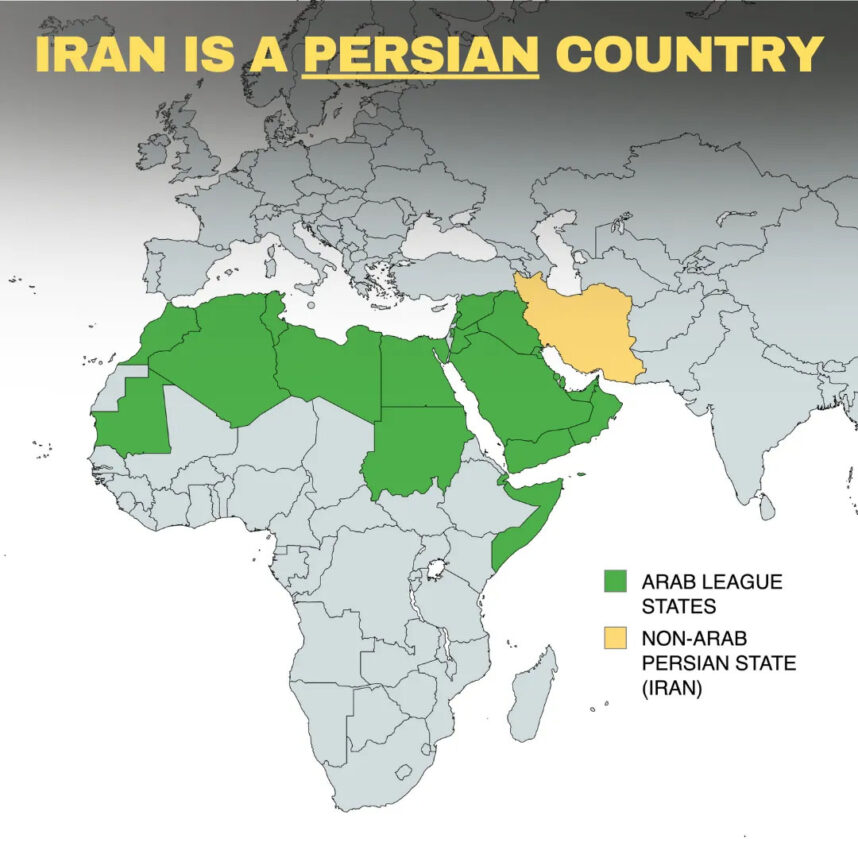
Persian ≠ Arab

For example, Iran is not an Arab country. It’s a Persian country.* And tucked inside that distinction is real hope for true peace in the Middle East.

Let me explain.

People still speak about the Arab-Israeli conflict. That phrase once made sense – a long time ago. But today that description no longer accurately captures the circumstances in the region.

Quick context for readers who are new to this conflict & region:

Those facts taken together offer real hope for regional transformation – as soon as the Iranian people shake off their dictators and hold free elections.

Arab states are quietly making peace with Israel.

The preconditions for peace are already there. The landscape has changed dramatically in recent years.

Just to be clear – I am not saying all Arabs love Israel. Not at all. Far from it.

  • There is deep Arab resentment, anger and frustration toward Israel, especially toward the Netanyahu government.
  • The Palestinians continue to fight for dignity, and they enjoy broad Arab support.
  • Unfortunately there remain death cults like the ISIS-remnants and ISIS-wannabes, also in the mix.

But these facts overshadow a more complex reality emerging on the ground.

Most Arab nations have begun quietly waving the white flag; they seek no more military conflict with Israel. Even states that once waged war against Israel have moved on. They are no longer working to wipe out the Jewish state.

The major Arab League nations that no longer seek Israel’s destruction include:

Other Arab states and forces have stood down, been beaten down or backed off.

Bottom line: Israel’s adversaries want no more smoke. They’ve stopped betting on Israel’s disappearance. They know their oil will run out long before a nation like Israel falls. Most now choose reality and prosperity over jihadist fantasy and permanent war.

As a result: no Arab state is openly, actively seeking Israel’s destruction anymore.

None.

Sit with that.

This shift toward normalization is only accelerating and deepening. Egypt and Israel just announced a multi-billion-dollar natural gas deal a few weeks ago. Smart business ties between Arabs and Israelis are slowly becoming the rule, not the exception.

If Arabs can trade with Israel, Persians DEFINITELY can. The last big holdout in the region is Iran.

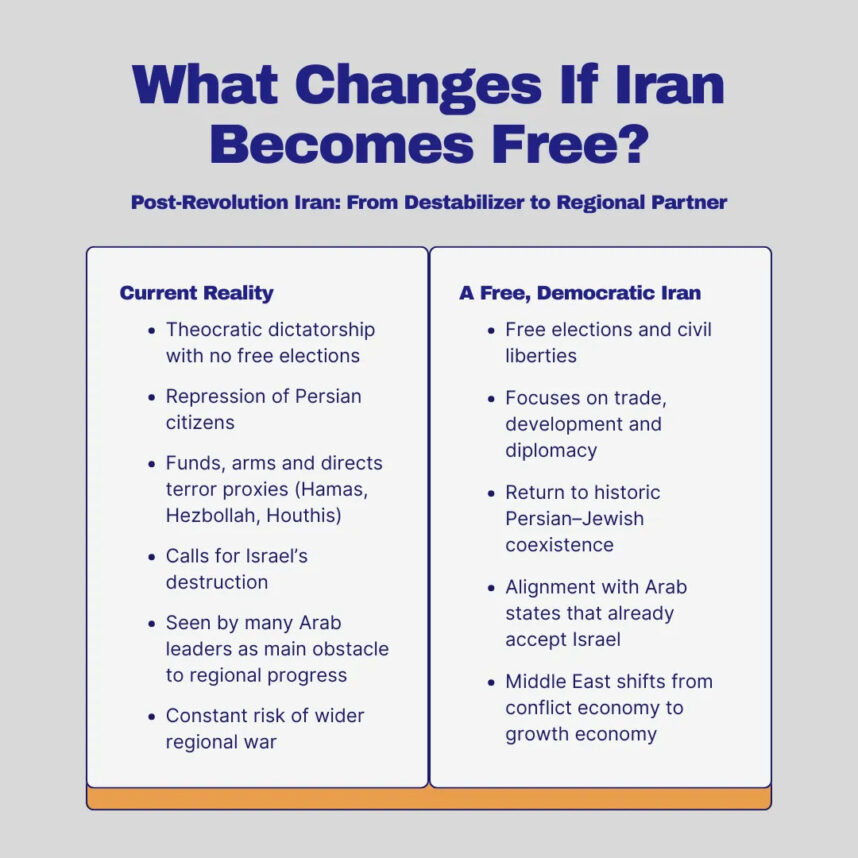
Iran’s Ayatollahs still want to wipe Israel off the map; they still lead chants of “Death to America! Death to Israel!” In the fight for peace and stability in the region, the Islamic Republic of Iran is the “final boss.”

But here’s the key point: In Iran, the dictators are mainly subjugating Persians, not Arabs.

Why is that fact so important – and encouraging? Because Persians and Jews do not typically fight each other. To the contrary: the alliance between Persians and Jews dates back for thousands of years, since King Cyrus of Persia.

They have lived together in relative peace for centuries. (Many Jews ARE Persian!) While the governments of Israel and Iran have tangled for decades, the historical norm between the Jewish people and the Persian people is thousands of years of predominantly peaceful coexistence.

It seems normal to us to see Israel fighting Iran-backed Hamas, Iran-backed Hezbollah and Iran-backed Houthis. But historically, sustained “Persian versus Jew” conflict has been rare and highly atypical.

Therefore, a free, democratic Iran would almost certainly stop funding terror, normalize ties with Israel and become a more peaceful, trade-based partner for prosperity.

Arab leaders secretly hate the Islamic Republic of Iran.

Nobody would be happier to see a new regime in Tehran than the leaders of the Arab states.

Here’s the open secret: most Arab leaders are fed up with Iran. They see the biggest obstacle to progress in the region as the Islamic Republic of Iran. (Not Israel!)

The reason: Iran’s rulers have funded terror proxies throughout the region, which have destabilized the entire Middle East.

That’s one reason that Arab governments backed Israel (!!!) and the United States against Iran, during recent military clashes. (Yes, that really happened!)

Translation: the most important fault line in today’s Middle East conflict is not the idea of “Israelis versus Arabs.” That’s outdated thinking.

The defining conflict right now is “Israel versus the Iranian regime + its proxies.” Given the long love affair between Persians and Jews, that’s an absurd reality.

When the Persian people overthrow the Ayatollahs, everything could change.

That absurdity points to a hopeful possibility: a free Iran is almost certain to join the Arab states in accepting Israel’s existence – either expressly or tacitly.

The minute that happens, a regional settlement — including real dignity and freedom for Palestinians — becomes far more achievable. More Israelis would welcome a Palestinian state, if they knew Iran wouldn’t turn it into a staging ground for its terror proxies.

The people of Iran are not genocidally anti-Israel or anti-Jewish in the way Iran’s rulers are.

  • A free, democratic Iran would not pose an existential threat to Israel.
  • It would not brutalize its own people.
  • And it could become a credible, constructive advocate for Palestinian dignity and freedom – rather than an enabler of extremist fantasies that only prolong fear and suffering.

Arabs and Israelis are finding a way to coexist – begrudgingly, but peacefully and productively.

If Persians and Jews return to their historic partnership, they can do the same thing – and more! If that happens, the entire region could blossom and bloom in ways not seen in centuries.


* NOTE: I am using the terms Arab state, Persian state and Jewish state colloquially – with no intention of erasing the incredible diversity inside each country.

In reality, few countries are made up of only ONE ethnicity. For example, the 22 “Arab League states” and the one “Jewish state” contain many other ethnicities besides Arabs and Jews. And while Persians are by far Iran’s largest ethnic group (around 60 percent) – other significant minority groups include Azerbaijanis (20 percent), Kurds (10 percent), Lurs (six percent) and others. Additionally, many Jews come from Iran (and also from Arab League countries).

It’s an ethnically and religiously complicated region. That’s one reason why the reductionist and didactic conversations we have about the Middle East fall so flat – and do so much harm.


Van Jones is a three-time New York Times bestselling author, a CNN host and contributor, and an Emmy Award winner.

Hope After Revolution: Iran + Israel = BFFs? Read More »

‘They Let Us Burn’ — Tensions Run High as Los Angeles Marks One Year Since the Palisades and Eaton Fires


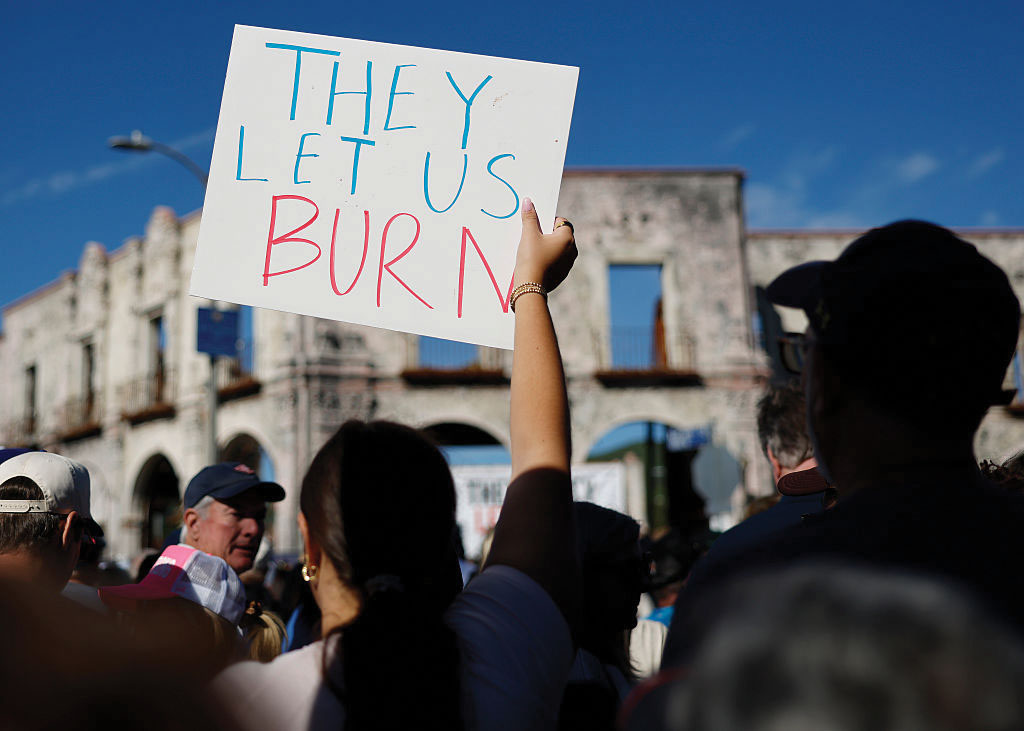
“They let us burn.”

The phrase appeared across black T-shirts handed out at a rally in Pacific Palisades on Jan. 7, marking one year since the Palisades Fire tore through the community. The rally, titled “They Let Us Burn,” was organized by Jeremy Padawer, a Pacific Palisades resident and toy industry executive. Addressing a crowd gathered at the edge of the burn zone, Padawer introduced himself as a citizen rather than a political figure.

“California leadership at the city and state level failed,” Padawer said. “They let us burn one year ago in ineptitude, gross negligence, lack of proper planning, lack of resources, lack of people and purposeful policy that let it burn.”

The Palisades Fire burned 23,448 acres over 31 days and caused an estimated $25 billion in damage, making it the most destructive wildfire in Los Angeles history. The fire killed 12 people, destroyed 6,837 structures, damaged another 1,017, and forced the evacuation of more than 100,000 residents across Pacific Palisades, Topanga and Malibu.

In a statement released on the anniversary, Mayor Karen Bass acknowledged the scale of loss. “One year ago, the City of Los Angeles faced the most destructive wildfire in our history,” Bass said. “Twelve lives were tragically lost, thousands of homes were destroyed, and too many families remain displaced.”

The statement did not address criticism surrounding evacuation alerts, water access or permitting delays. It also did not reference that Bass was in Ghana during the fires, or include figures on destroyed and damaged structures or the estimated $25 billion in losses tied to the Palisades Fire.

Rick Caruso, a real estate developer and Bass’s opponent in the 2022 mayoral election, issued a series of public statements around the anniversary criticizing city leadership and outlining recovery work carried out through his organization, Steadfast LA.

Caruso alleged that an after-incident report had been altered by city officials to “protect leadership.”

“Finally, it’s real. Firegate. There’s a real cover up in the city of Los Angeles,” Caruso said. “We need an independent commission to come in, just like we did years and years ago with the Warren Christopher Commission…none of this has been easy, and we’ve had to contend with insurance payouts, permitting delays, bureaucracy, and red tape.”

Kehillat Israel: A Community Still Displaced

Beyond political criticism, the anniversary also underscored how daily life across the Palisades remained unsettled.

Kehillat Israel in Pacific Palisades remained standing after the fire, though smoke damage and an already underway renovation left the building unusable for much of the year. The congregation spent the year displaced, holding services and lifecycle events across Los Angeles County.

Synagogue leadership said approximately 250 Kehillat Israel families lost homes in the fire. All three members of the clergy team lost their homes, including Associate Rabbi Daniel Sher.

Sher said the one-year mark did not feel like closure. “This didn’t feel like a yahrzeit,” he said. “This felt like partway through the year. The red tape and bureaucracy, no matter the justification at its start, can feel like quicksand.”

In a four-part reflection shared on social media over the anniversary week, Sher described displacement as a prolonged state rather than a temporary interruption.

Sher said children processed loss unevenly over time. “The kids do not grieve in one big conversation,” Sher said. “They do it in tiny bursts.”

Frustration had not eased because many residents remained stuck in what he described as an “arrested” state, unable to move forward due to unresolved logistics.

“We as a state have to figure out how to make sure that when people do move back to these homes, they can have insurance,” Sher said. “Any of the infrastructure that had been ignored for 80 plus years in the Palisades needs to be brought completely up to date.”

“Fast track all of it,” Sher said. “Get rid of the red tape. Get us to the space where we can start to be the doers and not be stuck in protocols.”

Eaton Fire: Pasadena and Altadena One Year Later

While residents along the coast marked the anniversary of the Palisades Fire, communities to the east reflected on the Eaton Fire, which struck Pasadena and Altadena around the same time.

The Eaton Fire burned 14,021 acres in the Pasadena foothills and Altadena area, killed 19 people, destroyed 9,418 structures, damaged another 1,071, and caused an estimated $27.5 billion in losses, ranking it as the second most destructive wildfire in California history.

The fire destroyed the Pasadena Jewish Temple and Center, though thirteen Torah scrolls were removed before the structure was fully lost. The night before the anniversary on Jan. 6, 2026, Rabbi Joshua Ratner addressed a crowd of hundreds gathered on the site where the sanctuary had stood since 1941.

“PJTC never has been defined by walls,” he said. “It is defined by our congregants and by the strength of our shared purpose.” Leaders said rebuilding plans were underway, with design and construction expected to conclude in advance of a targeted reopening by the High Holy Days of 2028.

Altadena resident Tannis Mann, who lost her home, said she never received an official evacuation alert.

“I actually never received the evacuation alert to my phone,” Mann said. “Without people texting me, I wouldn’t have necessarily known as quickly as I should have.”

Mann said some residents returned to their neighborhoods, but owners of standing homes faced another set of challenges.

“With the neighbors and friends that I know whose houses did survive, I actually think it’s a lot more difficult to navigate the situation with the standing home,” Mann said.

Mann, her fiancé, and their dog moved about 20 minutes away. Even a year later, she said her attachment to the land remained.

“I feel very protective over my piece of land,” Mann said.

Homes Still Standing, Lives Still Stalled

While entire neighborhoods were lost in the fires, some residents said homes that remained standing created a different kind of uncertainty.

Malibu resident David Levy said the passage of a year had not brought relief.

“No, not really going great,” Levy said. “Just to give you an idea, we’re still fighting the insurance companies.”

Much of Levy’s neighborhood in Carbon Beach remained empty. “Basically on my block, I’m one of three people that are living here,” he said. “No repairs have started.”

Insurance payments had fallen far short of costs. “They’ve provided less than 20% of what the cost is to repair things here,” Levy said. “The people who lost their home got paid out in full, period, right away. But the people who have suffered with damage have barely gotten anything.”

Levy said his home remained unsafe. “My home survived the fires, but that’s ridiculous,” he said. “I have a house that still has lead contamination.” The equipment in his home office recording studio is corroding and unusable from the soot. Levy said the anger surrounding the fires persisted because the same disputes remained unresolved.

“There’s no end in sight,” he said. He said a major question among neighbors is about not just whether rebuilding made sense, but whether to stay in California at all. 

“How can you justify keeping your life in a place where there’s no insurance or really terrible insurance?” Levy said. “When a disaster happens and they don’t pay, what do you do?”

The one-year mark, he said, did not represent any kind of positive milestone. 

“I don’t think anybody’s going to really be fairly compensated at the end of this.”

‘They Let Us Burn’ — Tensions Run High as Los Angeles Marks One Year Since the Palisades and Eaton Fires Read More »

Noah Wyle, Seth Rogen and Timothée Chalamet Win Golden Globes

The 83rd Golden Globe Awards, held Jan. 11 at the Beverly Hilton in Beverly Hills, featured several Jewish winners and nominees across television, film and music.

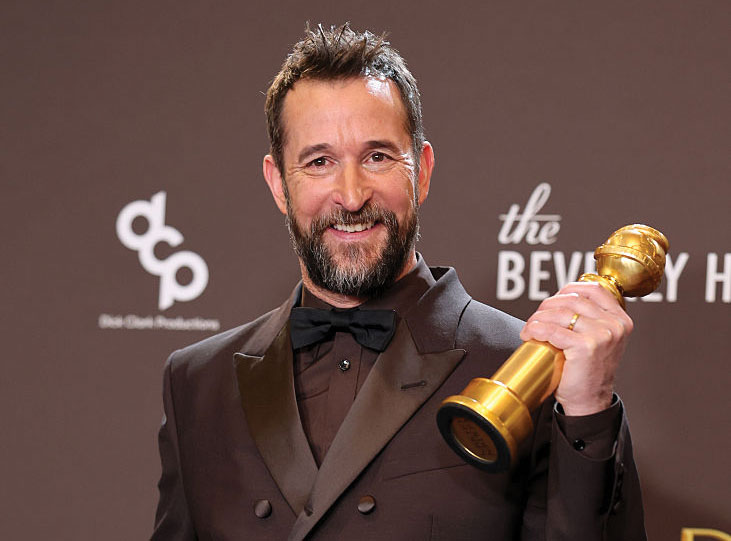
Actor Noah Wyle won the Golden Globe for Best Performance by a Male Actor in a Television Series – Drama for his role in “The Pitt.” Wyle portrays Dr. Michael “Robby” Robinavitch, a Jewish emergency room physician whose identity is made explicit in the series. In one episode during the first season, the character recites the Shema following a particularly difficult shift.

“I was raised in a family that put a high priority on art and on curiosity and on service,” Wyle said. Wyle’s father, Stephen Wyle, was an electrical engineer descended from Russian Jewish immigrants, while his mother was raised in the Episcopalian faith.

Later in the ceremony, “The Pitt” also received the Golden Globe for Best Television Series – Drama.

Comedian Seth Rogen earned his first Golden Globe, winning Best Performance by a Male Actor in a Television Series – Musical or Comedy for “The Studio.” The Apple TV series, which Rogen created with Evan Goldberg, also won Best Television Series – Musical or Comedy.

Seth Rogen attends the 83rd annual Golden Globe Awards at The Beverly Hilton on January 11, 2026 in Beverly Hills, California. (Photo by Kevin Mazur/Getty Images)

The show satirizes Hollywood’s fixation on trophies and award shows, and included a storyline that stages a fictional awards ceremony that seems to be inspired by the Golden Globes. Rogen made sure to reference that in his acceptance speech. 

“This is so weird,” Rogen said. “We just pretended to do this and now it’s happening. I thought the only way I would get to hold one is to create a whole show to give myself a fake one.”

In the film categories, Timothée Chalamet won Best Performance by a Male Actor in a Motion Picture – Musical or Comedy for “Marty Supreme.” Chalamet plays Marty Mauser, a Jewish shoe-store employee pursuing a career in professional table tennis. The character is loosely inspired by real-life Jewish table tennis player Marty Reisman.

Timothée Chalamet, winner of the Best Performance by a Male Actor in a Motion Picture – Musical or Comedy Award for “Marty Supreme” (Photo by Brianna Bryson/Getty Images)

Songwriter and composer Mark Sonnenblick was part of the team that won Best Original Song – Motion Picture for “Golden” from “KPop Demon Hunters.” Sonnenblick is also known for his work on “Saturday Night Seder,” the pandemic-era fundraising event that raised millions of dollars for COVID relief.

Three days before the awards ceremony, the Golden Globes expanded their programming with the debut of the Golden Eve Awards, a new primetime special introduced as part of a broader “Golden Week” of events. During the Jan. 8 broadcast, Sarah Jessica Parker received the Carol Burnett Award for lifetime achievement in television.

“Oh God, I love you so deeply and admire so much the people you are becoming that every day at home and at work I want to make you proud,” Parker said. “Once again to Carol Burnett, to the Golden Globes, and all my friends and colleagues gathered here this evening and at home, I humbly thank you for being such an integral part of an inconceivable life.”

As in previous years, the Golden Globes did not include a formal In Memoriam segment. The broadcast did, however, feature a tribute to filmmaker Rob Reiner near the end of the ceremony. Host Nikki Glaser, who is not Jewish, wore a “Spinal Tap” hat in reference to Reiner’s work.

Several Jewish nominees did not take home awards but remained part of the evening’s broader story. Actor Adam Brody was nominated for Best Performance by a Male Actor in a Television Series – Musical or Comedy for “Nobody Wants This.” “Marty Supreme” also received a Best Screenplay nomination for Josh Safdie and Ronald Bronstein.

Political references during the ceremony were limited, though a few moments drew attention. Actress Hannah Einbinder, nominated for Best Supporting Female Actor on Television for “Hacks,” appeared wearing an Artists4Ceasefire pin. The red enamel badge has been associated with a campaign launched by members of the creative community calling for an immediate ceasefire in Gaza. The design of the pin has been the subject of dispute. Some critics have argued that the imagery resembles photographs from a 2000 lynching in Ramallah, in which two Israelis were murdered and the attackers displayed their bloodied hands to a crowd. 

The issue surfaced again in the Best Non-English Language Film category. “The Voice of Hind Rajab,” a film centered on the death of a Palestinian child during the war in Gaza, was nominated but did not win.

Creative Community for Peace, a nonprofit advocacy organization that works with entertainment professionals, criticized the film following the ceremony. “‘The Voice of Hind Rajab’ presents a one-sided and misrepresented account of a Palestinian child’s tragic death. … Her life deserves dignity, and the truth of how she died matters. By omitting critical context, the film turns tragedy into political propaganda. That is unacceptable, and it should not be rewarded as serious, responsible filmmaking.”

In separate posts on social media, the organization also commented on political signaling during awards season. “All Eyes on Iran. Let’s see how many of these celebrities actually cared about human rights …” the group wrote in one post. In another, it added, “Let’s see how many celebrities who proudly wore the ‘blood hand ceasefire’ pin will show up at the Golden Globes with a Free Iran message. We’ll be watching.”

Noah Wyle, Seth Rogen and Timothée Chalamet Win Golden Globes Read More »

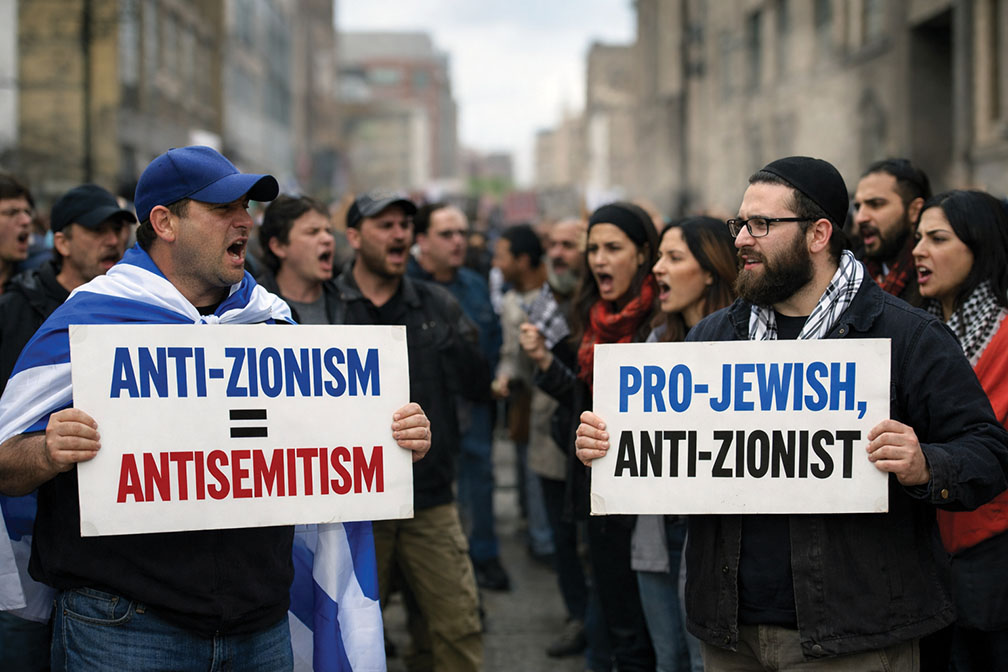
The Anti-Zionism Versus Antisemitism Debate

The latest debate unfolding in the Jewish community today concerns whether anti-Zionism should be treated as its own distinct form of hatred and separated from antisemitism.

Proponents argue that anti-Zionism is not merely political criticism of Israel nor simply “antisemitism by another name,” but a distinct, contemporary form of Jew-hatred with its own history, ideology, language, and tactics. They argue that treating it as a form of antisemitism fails to explain how it functions and why it so often targets Jews as Jews.

This is a topic I have been wrestling with for some time, particularly the question of whether anti-Zionism is inherently antisemitic.

It was heartening to see that my views on the topic are shared by Professor Deborah Lipstadt, the former U.S. envoy for antisemitism, who believes that treating anti-Zionism as a category entirely separate from antisemitism is not an especially accurate or a helpful framework for combating it. 

I suspect that author Yossi Klein Halevi, another expert on Zionism and anti-Zionism, would also agree. 

He has often argued that anti-Zionism is best understood as the most recent iteration of antisemitism and not something wholly distinct from it, but rather the form it has taken in our time. I find that argument persuasive. 

The push to treat anti-Zionism as a category distinct from antisemitism is not primarily coming from historians or experts on antisemitism. Rather, it has emerged largely from segments of the pro-Israel activist and influencer community, particularly those focused on advocacy, campus politics and policy strategies. Their aim is not analytical precision, but rhetorical and strategic effectiveness.

In my view, not all opposition to Zionism is inherently antisemitic, even if much of the Jewish community worldwide regards such opposition to Zionism as repugnant.

For example, some ultra-Orthodox Jews are anti-Zionists because they believe that no Jewish state should be established until the coming of the Messiah. This position is theological rather than antisemitic. 

Notably, in this instance, the goal — a Jewish state (or kingdom) in the land of Israel — is shared with Zionism; the disagreement concerns the means and the timing, not the legitimacy of Jewish presence or history in the Land of Israel. In the ultra-Orthodox view, the new kingdom of Israel should come from a pious descendant of King David and not the secular hand of David Ben-Gurion. 

Similarly, Palestinian Arab opposition to Zionism is not intrinsically antisemitic. 

From their perspective, this is a national conflict over land and sovereignty, much like other territorial disputes throughout history. They seek all the land between the river and the sea, and that struggle — however tragic or irreconcilable one may find it — is not automatically hatred of Jews as Jews.  Just as the Indians and the Pakistanis are at war over Kashmir or the Armenians and the Azeris are at war over Nagorno-Karabakh, doesn’t mean any side is inherently bigoted against the other. They are warring parties. 

That said, anti-Zionism as a movement and as a culture, almost inevitably devolves into antisemitism and we already have two widely regarded frameworks for identifying when that occurs.

The International Holocaust Remembrance Alliance (IHRA) working definition of antisemitism explicitly recognizes that while criticism of Israel is not inherently antisemitic, certain forms of anti-Zionism — particularly those that deny Jewish self-determination or apply classic antisemitic tropes to Israel — do cross that line. Similarly, Natan Sharansky’s well-known “3D test” (demonization, delegitimization and double standards) offers a practical guide for distinguishing legitimate political critique from antisemitism. These frameworks do not claim that all anti-Zionism is antisemitic — but they reflect the reality that, as a movement, it routinely collapses into antisemitism.

We see this clearly in the rhetoric of the BDS movement and the broader anti-Israel ecosystem. 

Claims that Jews lack Jewish DNA, that Jews are really Khazars, that Jesus was a Palestinian, that modern Jews have no historical connection to the land of Israel, that Zionists are Nazis or that Zionism is racism — these are not critiques of state policy. They are classic antisemitic tropes, repackaged for modern consumption. 

We are seeing antisemitic tropes also largely present in Palestinian society in general, and in turn throughout Palestinianism — whether that is in the Palestinian textbooks that teach there was no Jewish Temple in Jerusalem or that Jewish Israelis are thirsty for the blood of Palestinian children. That is classic antisemitism. So, yes, it is true that Palestinian anti-Zionism has largely devolved into antisemitism. 

In that sense, the term “anti-Zionism” has become no less insidious than “antisemitism” was when Wilhelm Marr coined the latter. It functions as a red herring—a politically sanitized label that often masks a call for the dismantling of the world’s only Jewish state.

Once again, if Palestinians oppose Israel as part of a national conflict, that alone is not necessarily antisemitic. But the ideological movement that surrounds and amplifies that struggle has repeatedly and predictably crossed into antisemitism, both in its language and in its targets.

One of the strongest arguments for understanding anti-Zionism as antisemitism is this: Zionism is arguably the oldest anti-colonial movement in existence. It is the return of an indigenous people to their historic homeland and the pursuit of self-determination in their ancestral homeland — a right universally recognized for other peoples. To deny that Jewish history, to deny Jewish attachment to the land of Israel, is to deny Jewish peoplehood itself. That denial is antisemitic.

This is especially striking when voiced by those who claim to oppose colonialism, given that the Arab conquest is one of many successive colonialist dominations of the land of Israel. Singling out Jewish self-determination as uniquely illegitimate reveals something deeper than political disagreement.

But should anti-Zionism be treated as a separate form of hatred from antisemitism? That is the central debate. Antisemitism seeks the destruction of the Jewish people; anti-Zionism seeks the destruction of the Jewish state. The two are not identical—but they are intimately connected. That is why anti-Zionism so frequently collapses into antisemitism, and why the anti-Zionist movement is so rife with antisemitism. 

What we should not do is artificially separate the two, because doing so muddies the waters. 

Lipstadt concurs, stating “I fear it would simply confuse matters.”

Antisemitism is widely recognized as morally abhorrent and socially toxic; even antisemites recoil at being branded with the label.

“Anti-Zionist,” by contrast, has become a badge of honor. It allows people to evade moral scrutiny while indulging the same old hatreds. Anti-Zionists would (and do) welcome the label. 

Why let them off the hook? If what they are espousing is antisemitic, they should be labeled as such. 

Meanwhile, Jewish individuals, gatherings, synagogues, cemeteries and Holocaust memorials are being attacked in the name of Gaza and the Palestinian cause. Jews who have never been to Israel, Jews who oppose Israeli policy, Jews who are long dead—none are spared. To support Israel is to be a supporter of genocide and it thus makes Jews everywhere legitimate targets in their worldview. That is not political protest. That is antisemitism.

In this worldview, to support Israel is to be labeled a supporter of genocide — and that framing has consequences.

Once Israel is cast as a Nazi-like state committing the ultimate crime, Zionism ceases to be a political position and becomes a moral stain. Because roughly 85% of North American Jews and more than 90% of Jews worldwide support Israel in some form, this logic renders Jews everywhere complicit in genocide. In this distorted worldview, Jews are no longer innocent, but supporters and enablers of evil, and therefore legitimate targets.

Furthermore, the charge of “genocide” is not merely a modern-day blood libel; it echoes a much older pattern. 

Jews have often been cast as whatever a given civilization defines as its most loathsome qualities. As Klein Halevi has observed, under Christianity Jews were the Christ-killers; under Islam, the killers of prophets; under communism, they were capitalists; to capitalists, they were communists; under Nazism, they were racial polluters. 

Today, the gravest moral crimes are racism, colonialism, apartheid and genocide — and once again, Jews and the Jewish state, now recast as “Zionists” and the “Zionist entity,” are accused of embodying them all.

Denying Israel’s right to exist, labeling it the “Zionist entity,” and demonizing all Zionists is not a policy critique; it is a quintessential example of the rhetoric that has led to the persecution and slaughter of Jews throughout history. That is why this language is not incidental — it is antisemitic at its core.

This is why I agree that quibbling over when anti-Zionism crosses the line into antisemitism is beside the point: the real-world consequences are already evident.

Those who insist that they can be anti-Zionist without being tainted by antisemitism may feel unfairly implicated by these acts. But the deeper unfairness lies elsewhere: Jews, regardless of nationality, politics, military service, or even whether they are alive, are being targeted simply for being Jews.

That doesn’t mean we should introduce yet another euphemism. Trying to reframe anti-Zionism as a distinct hate movement would take decades to bear fruit, if it ever catches on. Meanwhile, it will give a pass to the antisemites at a time of record levels of antisemitism. 

Those who advocate separating anti-Zionism from antisemitism are people working on these issues day-to-day, when most people simply aren’t paying attention. They’re talking to an echo chamber 

The vast majority of Americans don’t even know what Zionism is, let alone why anti-Zionism should be considered hatemongering. 

Polling indicated that only about one-third (34%) of the general U.S. population claimed to be familiar with the term Zionism in any regard, while just 14% could correctly define Zionism — meaning a solid majority have no idea what you would even be talking about. 

You know who is also seeking to separate anti-Zionism from antisemitism? The anti-Zionists. 

Because anti-Zionists often claim to oppose only “Zionists” and not “Jews,” they can evade accusations of antisemitism while still harassing Jews at synagogues and in Jewish neighborhoods, applying ideological litmus tests to Jews, treating “Zionist” as a slur, and justifying or minimizing violence against Jews framed as resistance to Zionism. 

So, why is this movement to separate the two catching on within the pro-Israel community?

It’s because the pro-Israel influencer and activist community don’t want to deal in nuance or academic debate.  

They just want to say — anti-Zionism is a form of hatred like anti-Black racism, and it must be outlawed and condemned by everyone. It’s a valid argument. 

Like much in the world, things are more complex than many would like them to be, and nuance is not something people these days — in the era of social media hot takes — want to embrace. 

The anti-Israel movement certainly embraces this lack of nuance — and intentionally works to control the conversation surrounding the Israeli-Palestinian conflict. 

I outlined this in a piece I penned just before Oct. 7, that to further their aims, the modus operandi of the anti-Israel movement can best be described as reductive, adaptable and discursive. 

They are trying to establish the narrative and control the rules of discourse. They try to shut down speech and silence people who run afoul of their guidelines. They are not interested in discussing history, nuance or facts, but rather reducing the conflict to a few simple buzzwords that are meant to demonize Israel. 

This pro-Israel movement to detach anti-Zionism from antisemitism is simply trying to re-tool the way this form of antisemitism is fought, by fighting back the same way — without nuance and without complexity. They are seeking to embrace the placard strategy. 

I do agree with this movement that the Jewish community must do a better job of educating our children about Israel and anti-Zionism. 

Parents outsource this education to Hebrew Schools and Jewish summer camps. The only problem being — these entities don’t discuss Israel in any meaningful way, but rather, focus on Judaism. 

Hebrew schools and the Jewish summer camps don’t teach about Herzl, Jabotinsky, Begin, Golda, Ben-Gurion, and Rabin. They don’t teach about the breakup of the Ottoman Empire or the Balfour Declaration. They don’t teach about the San Remo Conference, the Hebron Massacre, the White Papers, the Irgun, the Arab Revolt on 1936, the Peel Commission, and the United Nations’ (UN) vote for partition. They don’t teach about the P.L.O., Black September, Hamas, Gaza, the first intifada, the second intifada, and UNRWA. They don’t teach about 1948, 1967, 1973, and 2000. And they certainly don’t teach about the Boycott, Divestment, and Sanctions (BDS) movement or about Arab-Israelis and the Abraham Accords. Instead, they only are told Israel is a magical land. Utopia.

But you know who does know all about Israel? Most young Palestinian and Arab children growing up in North America. They grow up learning the history of the “Nakba,” “Palestine,” and all the talking points that come with this. They have been indoctrinated with their anti-Israel talking points since birth.

When these two groups of children eventually meet on a college campus, the Jewish kids are outmatched. The Arab kids wax poetic while the Jewish kids look on dumbfounded.

As Sun Tzu stated: “If you know the enemy and know yourself, you need not fear the result of a hundred battles. If you know yourself but not the enemy, you will also suffer defeat for every victory gained. If you know neither the enemy nor yourself, you will succumb in every battle.”

The movement to decontextualize anti-Zionism from antisemitism rests on very unsteady ground, and this movement to do so actually weakens the argument rather than strengthening it. 

This conversation and the dangers of antisemitism (and anti-Zionism) are too important to be ceded to slogans and activism. 

Anti-Zionism may not always begin as antisemitism, but in our time, it has functioned as its most socially acceptable and politically protected expression. Treating it otherwise does not protect Jews—it protects those who target them.


Ari Ingel is an attorney and Executive Director of Creative Community for Peace

The Anti-Zionism Versus Antisemitism Debate Read More »

When Synagogues Burn

The man who set fire to Beth Israel Congregation in Jackson, Mississippi did not describe his target as a random building. He called it a “Synagogue of Satan.” That phrase did not come from nowhere. It is a piece of ideological contraband that has been circulating for decades in the bloodstream of modern antisemitism—laundered through pseudo-theology, conspiracy culture, and influencer politics until it sounds to its consumers not like hate, but like revelation.

And when a synagogue burns, it is worth asking who has been flooding the culture with exactly this kind of language.

Louis Farrakhan and the Nation of Islam have spent years depicting Jews and Jewish institutions in explicitly demonic terms, repeatedly invoking the “Synagogue of Satan” trope. That alone is reprehensible. What is far more dangerous is that this rhetoric has not remained quarantined on the fringe. It has been normalized, praised, and amplified by people with enormous audiences—most infamously by Candace Owens and Tamika Mallory.

Owens has not merely echoed Farrakhan’s themes. She has actively mainstreamed them to millions of people. In recent months she has promoted the assertion that the Star of David is not an ancient Jewish symbol at all, but a satanic emblem—a grotesque inversion of Jewish identity designed to strip Jews of historical legitimacy and recast them as metaphysical enemies. That claim is not just false; it is a classic antisemitic maneuver: take a people’s most recognizable symbol and redefine it as proof of hidden evil.

Mallory, meanwhile, has praised Farrakhan as the “G.O.A.T.” and refused, even when pressed on national television, to condemn his antisemitism. That was not a neutral omission. It was a signal—to millions of viewers—that Farrakhan’s worldview, in which Jews are portrayed as corrupt, spiritually illegitimate, and demonic, was not disqualifying. That it could be treated as an unfortunate footnote to an otherwise admirable public figure.

This is how antisemitism moves from the margins to the mainstream: not only through outright endorsement, but through celebrity, applause, and the strategic refusal to draw lines. When influencers and activists with mass followings normalize demonological language about Jews—when they recycle myths and lies about satanic symbols, secret power, or cosmic evil—they shift the Overton window. They make ideas that once would have been recognized as dangerous and openly hateful, suddenly sound edgy, brave, or insightful. And that cultural shift does not stay online. It follows Jews into the real world.

Which brings us to New York City.

Mayor Zohran Mamdani has recently spoken about the need to protect synagogues after antisemitic attacks. Yet he also appointed Tamika Mallory to his transition team for city’s Community Safety Board—a body tasked with advising on public safety, including the safety of Jewish communities. That is not a bureaucratic footnote. It is a moral statement.

You cannot claim to care about antisemitic violence while elevating people who have celebrated those who preach it.

You cannot decry burning synagogues while honoring those who helped paint targets on them.

Because when public figures tell the world that Jewish institutions are “satanic”—or decline to challenge those who do—they are not engaging in provocative rhetoric. They are creating moral permission structures. They are telling unstable, angry, or radicalized people that Jews are evil—and that evil, in their minds, deserves to be destroyed.

That is how an idea becomes an accelerant.

Candace Owens did not light the fire in Jackson. Tamika Mallory did not. Louis Farrakhan did not. But they helped make it thinkable. They helped turn Jews from neighbors into metaphysical villains. And once that transformation occurs, a synagogue is no longer seen as a house of worship—it becomes, in the imagination of a radicalized mind, a legitimate target.

This is what antisemitism looks like in 2026. Not only swastikas and slurs, but influencer-driven demonology: Jews recast as cosmic enemies whose symbols, institutions, and very existence are portrayed as corrupt, satanic, and illegitimate.

So, the question for Mayor Mamdani is not whether he condemns arson after the fact. Almost anyone who is not steeped in antisemitism can do that. The real question is whether he is willing to confront the people who helped build the narrative that made it feel justified.

Because Jews do not need more empty – after the fact – statements of concern.

They need fewer people in positions of power who flirt with, excuse, or elevate those who traffic in the language that turns synagogues into kindling and Jews into targets.


Micha Danzig served in the Israeli Army and is a former police officer with the NYPD. He is currently an attorney and is very active with numerous Jewish and pro-Israel organizations, including Stand With Us and the FIDF, and is a national board member of Herut North America.

When Synagogues Burn Read More »

Confessions of a Catastrophizer

I am a catastrophizer, which, believe me, is not fun. I’ve always been a pro at scaring myself. I’m not a hypochondriac — I don’t make up an illness — but once I have something, I really have something. Then I blow it up into IMAX size. 

Decades ago, when I had stomach surgery for a twisted colon, and the doctor warned that if I did not have emergency surgery, I’d be dead in 11 hours or about the time it takes to walk from my home in Los Angeles to the closest mailbox, I was uncharacteristically relaxed with this information.  Because I really had something big. It’s when I have a hangnail or twitch that I think the end is near. 

If I get stuck in an elevator, I fear that the air will be cut off, and I will choke to death and be found lifeless on the cold floor. If it’s not too many floors, I’ll walk up.  Otherwise, if I must ride, I try to keep gum or water on hand to prevent choking to death. 

When I have a bad cold and get slightly short of breath, I am convinced it is a pulmonary emphysema, and I might need a lung transplant.  

I once had a bump on my tongue and knew for sure it was mouth cancer, and within seconds, I flashed to my funeral. Thank God there was a big crowd to say au revoir; if not, it would have been really depressing.      

I’ve pictured myself in a hospital bed, strapped down, screaming in agony. In this vision, I had no known illness to speak of. I was just in horrendous pain, screaming like a banshee. I was screaming so loud that my own family stopped visiting me. 

On a recent trip to Israel, I noticed a bright red rash on both my thighs and the backs of my knees. I immediately sent photos to my doctor in Los Angeles. He said it was hard to tell from the photos exactly what it was, but he told me to put on cortisone and an itch cream. The fact that he immediately did not know what it was alarmed me.

When I showed the rash to my wife, she asked what I thought it was (after 35 years of marriage, she should know better than to ask me to diagnose myself). I told her I was sure it was a flesh-eating bacterium.

All headaches are aneurysms. Eye pain is always a sign of a torn retina or a tumor behind my eye, which can lead to total blindness. I once took it as far as asking a blind person what his seeing-eye dog cost and where I could get the best deal on one if need be.  

God forbid, a family member or friend is ill, I’ll try to calm them, but deep down, I know they will not recover.

Now at 73, dying in my sleep is a nightly mind dance. As I drift off, I wonder if tonight will be the big drift-off? Or in the morning, when I wake, will I find my wife dead when I ask her if she slept well?  It’s not uncommon for me to stare at family members napping and wonder if they are still alive. 

Luckily, I have found a way to deal with this, and it’s not by talking to my family. They mean well but are of zero help. When I stare in the mirror at the bump on my tongue, I can’t be convinced by them or even a doctor that it’s nothing. Instead, I have a group of friends who, like me, also think insane thoughts. When I notice a freckle on my leg, and I think I’ll need my leg amputated, my catastrophizer friends tell me they’ve had similar thoughts. Then we laugh at our stupidity.  

The truth is, it’s about not feeling alone and out of control. When someone tells me I will be alright, I feel more alone. I need to know others who think just like me. One time, I did hear about a friend who had their leg amputated, and I could not sleep or relax until I found out it was from a car accident, not from a freckle.


Mark Schiff is a comedian, actor and writer and hosts, along with Danny Lobell, the “We Think It’s Funny” podcast. His new book is “Why Not? Lessons on Comedy, Courage and Chutzpah.”

Confessions of a Catastrophizer Read More »

Hope in Iran, Trouble at Home

I spent a lot of time this week thinking about Ali Khamenei and Zohran Mamdani. 

To be clear, I am not drawing any type of parallel between the two men. Khamenei is a murderous theocratic dictator and Mamdani is merely a misguided politician. But while there is certainly no moral or practical equivalency between them, both represent aspects of the rising antisemitism that has flourished since Hamas began the war in Gaza more than two years ago. And both have reminded us this past week why we need to remain vigilant against that threat in the Middle East and here in the United States.

Iran’s religious leaders have ruthlessly suppressed all dissent for decades, mercilessly crushing the hopes of the Iranian people for even small freedoms, basic human rights and minimal economic opportunity. But the size and fury of the current protests suggest that this time may be different. In addition to what this means for those long-oppressed people and millions of Iranian emigrants around the world, a regime change in Iran could also eliminate the most significant remaining existential threat to the safety and security of Israel. 

Barack Obama, Donald Trump and Joe Biden were all presented with opportunities to come to the aid of previous insurrections in 2009, 2019 and 2022, and all three presidents chose to offer only rhetorical support. But Iran’s military was exposed as a shadow of its former self last year given its inability to support their client states or protect their prized nuclear facilities. Their current weakness may be encouraging Trump to engage more forcefully this time around.

Nothing is assured at this early stage: the mullahs have survived such uprisings many times in the past and a secular military takeover could be just as dangerous to Israel as the ayatollah. But the possibilities — of liberty for Iranians and safety for Israelis – are real. Coupled with an increasingly likely normalization of Israel’s relationship with Saudi Arabia in the not-too-distant future, the prospect of a less-fraught Middle East is more plausible than at any time since 1948.

But at the same time, the U.S. landscape looks much less encouraging. Both Representative Dan Goldman of New York City and State Senator Scott Wiener of San Francisco, progressive Zionist Democrats running in heated congressional primaries against strident anti-Israel opponents, announced in recent days that they would now use the term “genocide” to describe Israel’s military actions in response to the Hamas terrorist attacks. The fact that two such avowed supporters of the Jewish state would succumb to such uncompromising grassroots pressure is an ominous sign of how rapidly the political environment in this country is shifting against Israel’s interests. (The rise of antisemitism and antizionism on the right is just as disquieting.)

And then there is Mamdani. In last week’s column, I posed several questions to the new mayor, one of which requested a clarification on his views of the genocidal slogan “globalize the intifada.” When pro-Hamas protesters who were demonstrating recently near a Queens synagogue used that language, leading Democrats across the city and the state swiftly and harshly denounced them. The governor, state attorney general, both U.S. Senators, several House members, and leaders of the state legislature and City Council did not hesitate to condemn their behavior. To her credit, even Alexandria Ocasio-Cortez posted a statement saying that “marching into a predominantly Jewish neighborhood and leading with a chant saying ‘we support Hamas’ is a disgusting and antisemitic thing to do. Pretty basic!”

But Mamdani said nothing, either the night of the protest or for much of the following day. Finally, late on Friday afternoon and just minutes before Erev Shabbat, the mayor responded to a reporter’s question with this tepid response: “That language is wrong. I think that language has no place in New York City.”

Mamdani did not explain what type of anti-Israel language would be more tolerable to him. But his message was clear: progress in Tehran may come sooner than in New York City.


Dan Schnur is the U.S. Politics Editor for the Jewish Journal. He teaches courses in politics, communications, and leadership at UC Berkeley, USC and Pepperdine. He hosts the monthly webinar “The Dan Schnur Political Report” for the Los Angeles World Affairs Council & Town Hall. Follow Dan’s work at www.danschnurpolitics.com.

Hope in Iran, Trouble at Home Read More »

One Nation under God

Every summer I take a few of my children on a cross-country drive. Since we had already crossed all 49 land-connected states and exhausted the national parks circuit, I wanted a different assignment. We had seen deserts, mountains, forests and the oddities that decorate the empty miles in between. This time, I wanted to understand the country through the men who built it.

I mapped a route from Hyde Park to Yorba Linda and informed my sons Jess and Rocky that their summer would involve several thousand miles and every presidential home and library we could reach. They were not thrilled until they realized the alternative was staying home with their mother. They got in the car.

The trip took us from Massachusetts to Texas, from Virginia to California. We even included the home of Jefferson Davis in Biloxi because American history does not become less true when it makes you uncomfortable.

The landscapes were familiar. The voices were not. Inside these homes and archives, we encountered the presidents in their own words — not the slogans printed on textbooks, but their private letters, drafts, confessions. What surprised us most was how often they spoke of God, and how different their faith sounded from the Christianity shouted in parts of American politics today.

America has always been religious and “In God We Trust” is not a mantra but a mission statement. But the Founders’ religious vocabulary bears no resemblance to today’s populist “Christ is King” rhetoric. In fact, that particular phrase, increasingly used as a political identity marker, is the one sentiment you will not find in the speeches or writings of Washington, Adams, Jefferson, Madison or Lincoln.

Washington invoked Providence constantly yet never mentioned Jesus in a public address. Jefferson sliced the miracles out of the New Testament with scissors because he admired the ethics but rejected the supernatural. Adams was a theological outlier even in his own time. Madison treated sectarian language like a live grenade. Lincoln’s Second Inaugural, one of the greatest religious meditations ever delivered by an American president, is woven out of Deuteronomy and the prophets, not the Gospels. My yeshiva-educated sons recognized the sources before I did.

None of this made these men any less Christian. It made them Christians who understood exactly what Europe had become when religious doctrine defined political belonging. They chose another path: a republic grounded in virtue rather than creed. Separation of Church and State was not a slogan for them; it was the architecture of a country that would belong to all its citizens.

The Founders did not treat Hebrew Scripture as ornament. It shaped their political conscience. Several could read the Bible in the original Hebrew. James Garfield would often quote Tanach in Hebrew on the House floor. They revealed how deeply the Jewish story sat inside the American moral imagination.

America became the greatest Diaspora home Jews have ever known not because the Founders designed it that way, but because their theology was ethical, humble, and critically Providential. They created a society where Jews could walk in the front door rather than the side entrance. A nation with no state church, no religious tests, and no mandated creed is not an accident. It is the product of a worldview that trusted God but distrusted anyone who claimed religious ownership.

Somewhere past Knoxville, my sons asked the obvious question: How could such devout men speak constantly about God yet almost never invoke the figure at the center of Christian theology? By the time we reached Monticello, the answer had taken shape.

Their religion rested on Providence, a God who governs history, judges nations and calls men to account, but does not demand doctrinal uniformity. This is a biblical God, but not a sectarian one. That distinction, more than any constitutional clause, is what opened the American door to Jews.

Its intellectual roots blossomed in Philadelphia but were initially planted in Amsterdam. A Jewish philosopher named Baruch Spinoza was excommunicated for questioning the structure of religious authority. His arguments shook Europe’s theological foundations to the core. The Founding Fathers did not subscribe to Spinoza’s conclusions and would have rejected them.

The thinkers they admired though, including Locke, Hume, Voltaire, the Scottish Enlightenment, were very much inspired by Spinoza. They inherited a world in which faith had been separated from dogma, and where religion’s moral power no longer depended on enforcing doctrine.

The result was unprecedented, a nation shaped by faith without being governed by it. A republic under God rather than under theology.

Two and a half centuries later, the pattern is clear. The United States has elected presidents from nearly every Protestant stream and only two Catholics. No sect has ever claimed ownership of the republic. And the state honors God not by imposing belief but by protecting dignity.

My children know America is not perfect. Anyone who has sat with me through a 600-mile stretch of interstate knows I complain far too much to believe in national sainthood. Even so, the Founders left behind a blueprint of religious humility unmatched in world history. They created space for all.

 We saw the proof on the road. As we approached the George Washington Bridge and watched Manhattan rise across the Hudson, I asked my sons what united the presidents we had studied. They told me that these men disagreed on nearly everything, yet they all understood their role in a moral republic under God, a God they invoked but never presumed to own.

That is the American miracle. And to a Jewish father and his sons crossing the continent in safety and pride, it still feels like Providence.


Philip Gross is a Manhattan-born, London-based business executive and writer. He explores issues of Jewish identity, faith, and contemporary society through the lens of both American and British experience. 

One Nation under God Read More »