A few weeks ago, the Jewish Journal published a lightning rod of an opinion piece by the Brandeis Center’s Kenneth Marcus that exposed how nine student groups had changed their bylaws to forbid hosting “Zionist” speakers. The piece went viral and generated a firestorm in the Jewish world. Even Barbara Streisand tweeted about it, innocently asking if anti-Zionism had morphed into antisemitism.
When I recently spoke at a meeting of Jewish leaders about growing leftwing antisemitism, one Jewish professional leader responded rhetorically: “Isn’t the Berkeley Law School situation a success story?” Indeed, after the usual bout of denial and waffling, the Dean of Berkeley Law School, a self-described progressive Zionist, committed to enforce Berkeley’s anti-discrimination rules against the nine organizations if they attempt to enact the discriminatory bylaw provisions.
Problem solved. Crisis averted. Right? Not so fast. We may achieve tactical success in putting down some of the more extreme examples of progressive antisemitism as we saw at Berkeley, but we are steadily losing ground, and if we don’t come to terms with the ideological roots of this variant of Jew-hatred, we are likely to experience even greater problems in the future.
In June of this year, a similarly outrageous controversy erupted on the opposite coast. The Boston “Mapping Project,” affiliated with the BDS movement, issued a heat map of Jewish organizations and leaders it deemed unacceptably Zionist. The group stated that its goal was to show “institutional support for the colonization of Palestine is structurally tied to policing and systemic white supremacy here where we live, and to US imperialist projects in other countries.” The Mapping Project was especially egregious as it jeopardized the safety of Jewish groups and individuals.
Mainstream Jewish groups sprang into action, securing condemnations against the Mapping Project. Senator Elizabeth Warren and Senator Edward Markey, for example, issued a joint statement, “At this moment of rising anti-Semitism, racist attacks, and political violence, this ‘mapping’ of the Jewish community is dangerous and irresponsible.” Once again, a very extreme manifestation of progressive antisemitism was exposed as a marginal phenomenon.
In October 2021, the D.C. chapter of the environmentalist Sunrise Movement withdrew from a voting rights rally in Washington due to the participation of three Jewish groups, stating, “Given our commitment to racial justice, self-governance, and indigenous sovereignty, we oppose Zionism and any state that enforces its ideology.” Prior to the march, the Sunrise Movement—the national organization with which Sunrise DC is affiliated–hadn’t commented on the D.C. chapter’s position, claiming it hadn’t had time for review. But when the chapter made its pronouncement about Jewish participation and a fierce backlash ensued, its parent organization objected in no uncertain terms, calling it “unacceptable and antisemitic.”
In each case of leftwing antisemitic overreach, mainstream Jewish organizations jumped into action, mobilized key officials, extracted the necessary condemnations from the powers that be, and then assured the Jewish community that they’ve got it under control. Tactically, they have a point. But this is not just a tactical battle. It’s a long-term strategic battle. And on that front, I fear, we are getting routed.
While the Jewish community is playing the short game, doing what it’s always done to win the moment, radical social justice warriors are playing the long game—what activists call “the long march through institutions”—in inculcating a stark ideological worldview that portrays anyone with power or success (success is a function of power, in this worldview)—America, Israel, Jews, Asians, men, etc.—as oppressors. Schools are teaching students to see people’s identities as markers of privilege and power and to “recognize and resist systems of oppression.” The problem is that the ideologues who are driving the agenda define the oppressor as anyone perceived to be powerful and successful, and the oppressed as anyone they deem powerless and, hence, unsuccessful. It’s a highly simplistic, binary worldview.
With this ideological software running through our kids’ brains, the school system does not have to even utter the word “Jew” or “Israel” for Jews and Israel to be ultimately implicated in oppression. Indeed, this is already happening. Survey data shows a strong correlation between progressive political attitudes on oppression and antisemitism on the left. The Jewish Institute for Liberal Values commissioned a poll of 1,600 likely voters. Survey respondents were split roughly between Democratic and Republican voters. Respondents were asked: “Do you agree or disagree with the following statement? America is a structurally racist country in which white Americans, and white-adjacent groups who emulate white culture (like Asian Americans and Jewish Americans), have unfair advantages over minorities which must be addressed to achieve equity?” The poll revealed that those on the far left were much more likely to agree with the statement, an indication that progressive ideological attitudes about structural racism are fueling antisemitic and anti-Asian sentiment (viewing Jews and Asians as privileged).
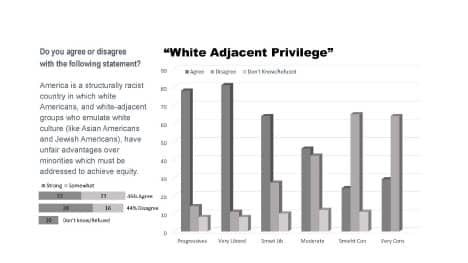 Poll conducted by OnMessage Public Strategies, August 2022
The ideologues are rewiring the way young people think so that they’ll adopt their worldview, including the view that Israel is a “settler-colonialist” state. They are, in effect, laying the groundwork for the Berkeley Law Schools of the future, when there will be more true believers on their side, at which time the future Dean of the Law School will face more pressure from radical activists and less pushback from us.
For Jewish organizations to effectively counter the long-term threat, they must come to terms with the underlying ideology that powers progressive antisemitism. They cannot, on the one hand, pretend to support this oppressor/oppressed binary, as many did in the California Ethnic Studies controversy, and, on the other, hope and pray that such a stance doesn’t ultimately manifest in the portrayal of Jews and Israel as oppressors. As long as radical social justice ideologues are experiencing success pushing a program that simplistically divides the world into oppressed and oppressors and condemns anyone who doesn’t agree with them, we are going to have major antisemitism problems, in ever greater frequency and intensity.
The sooner the Jewish community comes to terms with this reality and stops playing footsie with radical forces, the sooner we can develop strategies and tactics aimed at winning the long game.
David Bernstein is the founder of the Jewish Institute for Liberal Values (JILV.org) and author of the forthcoming “Woke Antisemitism: How a Progressive Ideology Harms Jews.”

Mainstream Jewish Organizations Don’t Have Leftwing Antisemitism “Under Control”
David Bernstein
A few weeks ago, the Jewish Journal published a lightning rod of an opinion piece by the Brandeis Center’s Kenneth Marcus that exposed how nine student groups had changed their bylaws to forbid hosting “Zionist” speakers. The piece went viral and generated a firestorm in the Jewish world. Even Barbara Streisand tweeted about it, innocently asking if anti-Zionism had morphed into antisemitism.
When I recently spoke at a meeting of Jewish leaders about growing leftwing antisemitism, one Jewish professional leader responded rhetorically: “Isn’t the Berkeley Law School situation a success story?” Indeed, after the usual bout of denial and waffling, the Dean of Berkeley Law School, a self-described progressive Zionist, committed to enforce Berkeley’s anti-discrimination rules against the nine organizations if they attempt to enact the discriminatory bylaw provisions.
Problem solved. Crisis averted. Right? Not so fast. We may achieve tactical success in putting down some of the more extreme examples of progressive antisemitism as we saw at Berkeley, but we are steadily losing ground, and if we don’t come to terms with the ideological roots of this variant of Jew-hatred, we are likely to experience even greater problems in the future.
In June of this year, a similarly outrageous controversy erupted on the opposite coast. The Boston “Mapping Project,” affiliated with the BDS movement, issued a heat map of Jewish organizations and leaders it deemed unacceptably Zionist. The group stated that its goal was to show “institutional support for the colonization of Palestine is structurally tied to policing and systemic white supremacy here where we live, and to US imperialist projects in other countries.” The Mapping Project was especially egregious as it jeopardized the safety of Jewish groups and individuals.
Mainstream Jewish groups sprang into action, securing condemnations against the Mapping Project. Senator Elizabeth Warren and Senator Edward Markey, for example, issued a joint statement, “At this moment of rising anti-Semitism, racist attacks, and political violence, this ‘mapping’ of the Jewish community is dangerous and irresponsible.” Once again, a very extreme manifestation of progressive antisemitism was exposed as a marginal phenomenon.
In October 2021, the D.C. chapter of the environmentalist Sunrise Movement withdrew from a voting rights rally in Washington due to the participation of three Jewish groups, stating, “Given our commitment to racial justice, self-governance, and indigenous sovereignty, we oppose Zionism and any state that enforces its ideology.” Prior to the march, the Sunrise Movement—the national organization with which Sunrise DC is affiliated–hadn’t commented on the D.C. chapter’s position, claiming it hadn’t had time for review. But when the chapter made its pronouncement about Jewish participation and a fierce backlash ensued, its parent organization objected in no uncertain terms, calling it “unacceptable and antisemitic.”
In each case of leftwing antisemitic overreach, mainstream Jewish organizations jumped into action, mobilized key officials, extracted the necessary condemnations from the powers that be, and then assured the Jewish community that they’ve got it under control. Tactically, they have a point. But this is not just a tactical battle. It’s a long-term strategic battle. And on that front, I fear, we are getting routed.
While the Jewish community is playing the short game, doing what it’s always done to win the moment, radical social justice warriors are playing the long game—what activists call “the long march through institutions”—in inculcating a stark ideological worldview that portrays anyone with power or success (success is a function of power, in this worldview)—America, Israel, Jews, Asians, men, etc.—as oppressors. Schools are teaching students to see people’s identities as markers of privilege and power and to “recognize and resist systems of oppression.” The problem is that the ideologues who are driving the agenda define the oppressor as anyone perceived to be powerful and successful, and the oppressed as anyone they deem powerless and, hence, unsuccessful. It’s a highly simplistic, binary worldview.
With this ideological software running through our kids’ brains, the school system does not have to even utter the word “Jew” or “Israel” for Jews and Israel to be ultimately implicated in oppression. Indeed, this is already happening. Survey data shows a strong correlation between progressive political attitudes on oppression and antisemitism on the left. The Jewish Institute for Liberal Values commissioned a poll of 1,600 likely voters. Survey respondents were split roughly between Democratic and Republican voters. Respondents were asked: “Do you agree or disagree with the following statement? America is a structurally racist country in which white Americans, and white-adjacent groups who emulate white culture (like Asian Americans and Jewish Americans), have unfair advantages over minorities which must be addressed to achieve equity?” The poll revealed that those on the far left were much more likely to agree with the statement, an indication that progressive ideological attitudes about structural racism are fueling antisemitic and anti-Asian sentiment (viewing Jews and Asians as privileged).
The ideologues are rewiring the way young people think so that they’ll adopt their worldview, including the view that Israel is a “settler-colonialist” state. They are, in effect, laying the groundwork for the Berkeley Law Schools of the future, when there will be more true believers on their side, at which time the future Dean of the Law School will face more pressure from radical activists and less pushback from us.
For Jewish organizations to effectively counter the long-term threat, they must come to terms with the underlying ideology that powers progressive antisemitism. They cannot, on the one hand, pretend to support this oppressor/oppressed binary, as many did in the California Ethnic Studies controversy, and, on the other, hope and pray that such a stance doesn’t ultimately manifest in the portrayal of Jews and Israel as oppressors. As long as radical social justice ideologues are experiencing success pushing a program that simplistically divides the world into oppressed and oppressors and condemns anyone who doesn’t agree with them, we are going to have major antisemitism problems, in ever greater frequency and intensity.
The sooner the Jewish community comes to terms with this reality and stops playing footsie with radical forces, the sooner we can develop strategies and tactics aimed at winning the long game.
David Bernstein is the founder of the Jewish Institute for Liberal Values (JILV.org) and author of the forthcoming “Woke Antisemitism: How a Progressive Ideology Harms Jews.”
Did you enjoy this article?
You'll love our roundtable.
Editor's Picks
Israel and the Internet Wars – A Professional Social Media Review
The Invisible Student: A Tale of Homelessness at UCLA and USC
What Ever Happened to the LA Times?
Who Are the Jews On Joe Biden’s Cabinet?
You’re Not a Bad Jewish Mom If Your Kid Wants Santa Claus to Come to Your House
No Labels: The Group Fighting for the Political Center
Latest Articles
On the First Night of Rosh Hashanah, We Remember Shabbat
Chosen Links by Boaz – Ep 19 | 9/11: Remembrance and Resilience, 25 Years Later (Part Two)
Let’s Create Real Support for Our Nation’s Jewish College Students
The Slow “I Do”: Why Portugal Is Becoming the Destination Wedding Couples Are Choosing Over Tuscany
Avinu Malkeinu — A New Poem
The Genocide Lie: When a Libel Becomes a Label
Hosting Hillel Fuld
A Bisl Rosh Hashana ~ Not Your Typical New Year
Rosh Hashana is reserved for soulful transformation: Resolving to be something different in the Jewish new year.
The Chapter Ahead
Rosh Hashanah is Like Time and Isaac When Both Come to Life
Print Issue: Confronting Personal Tragedy: A Rosh Hashanah Reflection | September 11, 2026
These are among the themes of Rosh Hashanah: Who will live and who will die? Who will suffer and who will prosper? And if I may add a couple of questions of my own: Who will be grateful and who will be ungrateful? Who will complain and who will create?
L’Shana Tova: In the Spirit of the Jewish New Year
Happy Birthday, Judea Pearl
One thing I am sure of: Judea is inarguably a proud Jew, a steadfast member of this multimillennial Jewish Peoplehood. The other is that I love the man, plain and simple.
Exiled from Zamosc, Survival in the Far-Off Lands
Daniela Gerson’s “The Wanderers” is all that you can ask for from a book. Meticulously researched, exquisitely told, it is an adventure story spanning more than 80 years, even a love story.
At 6:29 A.M., to Honor Nova, the Music Stopped at Burning Man
The project was organized by the Nova Tribe Community Association, the nonprofit created after Oct. 7, by producers of the Nova festival to support survivors and bereaved families and commemorate those murdered.
9/11 Didn’t Make America Immune to Strategic Surprise
Assume the next surprise attack is only a matter of time, and use that time to make it harder to carry out and less catastrophic when it comes.
More Than Just a Meal: Bringing People Together at OBKLA
OBKLA has welcomed more than 80,000 volunteers, including students, synagogue and church groups, corporate organizations, top leadership teams from companies such as Netflix and Amazon and, of course, celebrities.
The Shofar Blower
Through poetic reflections, Torah wisdom and personal stories, Salem explores the shofar as a tool for mindfulness, healing, surrender and inner transformation.
Political Activists Are Erasing September 11 in K-12 Education
Islamist terrorism remains a threat to the United States, the West, and the Jewish people. We cannot allow the history of September 11 to be twisted into an indictment of the society that was attacked.
Table for Five: Rosh Hashanah
God Remembers
Dating, DMs & Lie Detectors ft. Zach Margs
Confronting Personal Tragedy: A Rosh Hashanah Reflection
Sweet Devotion: An Apple Cake Recipe
I’m telling you that there’s something special about this apple cake and the way that it just melts in your mouth.
Beware: the Durban Delirium Trumped the Essential Lessons of 9/11
This ideological pogrom eerily mapped out the antizionism mania that has now hit America’s shores, using the noble fights against racism, colonialism and oppression for ignoble ends.
Rosner’s Domain | A Rough Balance Sheet of the Past Year
A blessing looks forward. An assessment looks back. This week, we asked Israelis to look back.
Two Dolls
More news and opinions than at a Shabbat dinner, right in your inbox.