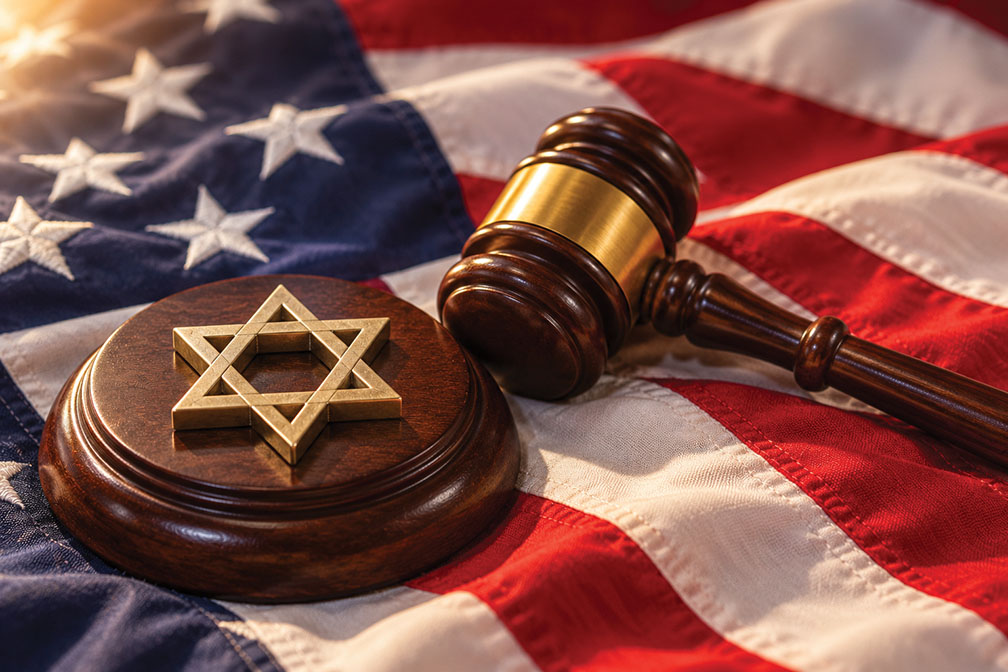

Lyndon Baines Johnson is undoubtedly rolling over in his grave. For more than six decades — with bipartisan support from Republican and Democratic presidents and members of Congress — a landmark law has stood as a bulwark against using public funds to breach the wall separating church and state. The so-called Johnson Amendment — authored by LBJ during his Senate tenure (but passed by a Republican-majority Congress and signed into law by President Dwight D. Eisenhower) — prevents all tax-exempt entities, including religious organizations, from directly or indirectly participating in any political campaigns on behalf of, or opposed to, any candidate. At the risk of losing this tax-exempt status, the Johnson Amendment expressly forbids all rabbis, ministers and imams from using their pulpits as partisan political platforms.
Spurred on by his evangelical right-wing base, President Donald J. Trump has now pledged to “get rid of and totally destroy” this decades-long, common sense legislation. Fortunately, the Jewish community understands the dangers posed by such a radical revision. In a strongly worded statement issued the day Trump uttered his vow at the National Prayer Breakfast, the American Jewish Committee (AJC) said a repeal of the Johnson Amendment “would result in government support — through the tax code — for religious speech in a manner contrary to binding interpretations of the Constitution’s Establishment Clause.” And if applied to all tax-exempt organizations, the AJC properly warned that such a change “would threaten to drag civil society more broadly — from museums and other charitable organizations, to national, communal and religious groups of every sort — into the political arena.” Joining the AJC in expressing immediate outrage was the Baptist Joint Committee for Religious Liberty, noting that “politicizing churches does them no favors.”
Trump’s obsequious effort to pander to Christian conservatives’ desire to “totally destroy” a law that has well served the principle of church-state separation cannot be accomplished by means of a mere executive order. Only Congress can change the tax code. Unfortunately, House Speaker Paul Ryan (R-Wis.) quickly quipped that he had “always supported” such a repeal. Moreover, the day before Trump’s speech, House Majority Whip Steve Scalise (R-La.) and Sen. James Lankford (R-Okla.) separately introduced House and Senate bills to accomplish this goal. And Rep. Walter Jones (R-N.C.), who has introduced unsuccessful repeal legislation in every session of Congress since 2001, hopefully declared, “This is the best opportunity we’ve had.”
Meanwhile, even if Congress declines to repeal the Johnson Amendment, the same functional result may be achieved if Trump directs the Internal Revenue Service not to enforce the law. Indeed, since 2008, more than 2,000 mostly evangelical clergy have dared the IRS to do its job by holding “Pulpit Freedom Sundays,” during which their sermons incorporate political views; only one such case has ever been investigated and no one has been punished.
Beyond encouraging the unseemly spectacle of religious leaders pontificating about partisan political campaigns, any actions that undercut the efficacy of the Johnson Amendment will allow churches to spend their congregants’ tax-exempt 501(c)(3) donations to support political campaigns. This scenario poses at least two problems. First, there is no reason why we should allow tax-free dollars to be used to support or oppose candidates for public office. If individuals want to spend their money on political campaigns, they should do so with after-tax dollars, rather than asking other taxpayers to subsidize their partisan electoral choices.
Second, nonprofit organizations such as religious groups do not have the same federal tax reporting obligations as those required of PACs. If campaign funding were funneled through houses of worship, political spending could become even less transparent than it already is. In the words of David Herzig, a Valparaiso University tax law professor, “If you allow churches to freely allow political activity … you’ve turned those into Super PACs.”
As with many of the hot-button campaign issues that the Trump presidency has now moved to the front burner to the delight of his die-hard supporters (such as building a Mexican border wall, barring refugees and deporting immigrants), the broader American public opposes the philosophical basis for repealing or weakening the Johnson Amendment. In 2015, Lifeway, a Christian polling firm, found that 79 percent of Americans thought that religious leaders should not endorse politicians from the pulpit. Now that the Trumpian gauntlet has been thrown down, it will be up to this silent majority to ensure that the church-state wall remains in place and that tax deductible donations are not used to support political campaigns. And so long as the Johnson Amendment remains the law of the land, the IRS should not render it a dead letter through coerced non-enforcement.
Douglas Mirell is an attorney and board member of the ACLU and ACLU Foundation of Southern California. As a volunteer attorney, he has litigated numerous church-state separation and other First Amendment cases. He can be reached at dmirell@hmafirm.com.