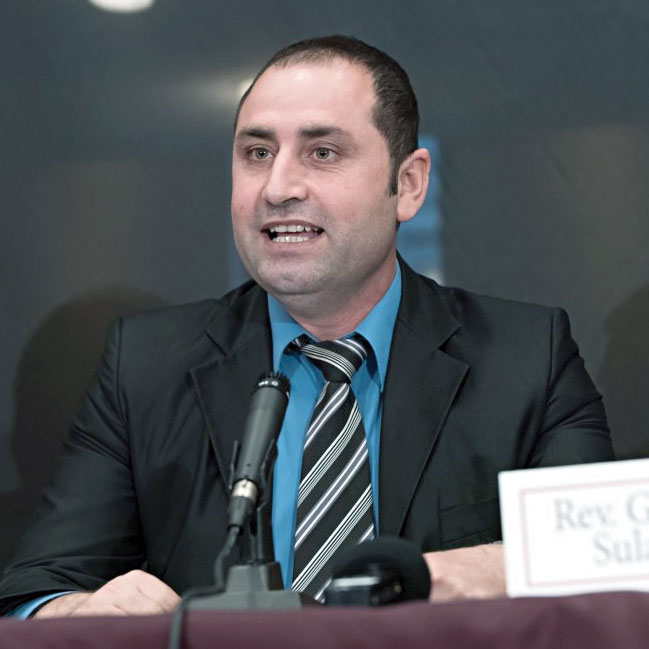
In the summer of 2014, Gili Getz flew home to Israel to visit family. But the 43-year-old actor and photojournalist, who has lived in New York for the past 20 years, spent much of that trip going in and out of bomb shelters, heeding the incessant warnings of sirens from the Gaza War.
That bloody summer, which widened the canyon-like ideological divides between many in the pro- and anti-Israel camps, also silenced the spirited political debate Getz had long appreciated with his father.
“It was the first time we ever struggled talking,” Getz said. “We reached some sort of wall that I’d never experienced before. With the war and that volatile atmosphere, conversation became contentious, and our ability to talk openly about choices Israel faced was shrinking.”
Getz’s new one-man show, “The Forbidden Conversation,” is his attempt to scale that wall and expand the discussion. The 35-minute show is an intimate, honest reflection on his experience with his father, the current state of how people with conflicting political views talk about Israel, and why it matters.
He will stage the show at The Pico Union Project, a multifaith cultural arts center, on Feb. 14 and 16. The Feb. 14 show will be a workshop and lunch for mostly clergy, educators and community professionals. The Feb. 16 show will be open to the public and will feature a panel of experts discussing the challenges of dialogue.
Getz grew up talking politics endlessly with his father, a career politician who spent time as Israeli ambassador to Uzbekistan and Kazakhstan. Getz was optimistic about achieving a lasting peace with the Palestinians. His father was of another generation — hardened, more conservative. Tense debate wasn’t uncommon. Disagreement abounded. It fueled compelling discussion. It kept Getz engaged and in tune with Israel’s political landscape. It always ended with food.
Getz developed his show as an artist fellow at LABA: A Laboratory for Jewish Culture at the 14th Street Y in New York. He wanted space to understand if others experienced what he had and what they were doing about it in their communities.
He was fascinated with what people felt when talking about the Israeli-Palestinian conflict. People young and old, politically left and right, were tired of screaming matches, tired of being demonized. He found rabbis fearful of any conversation about Israel, afraid to alienate congregants. The struggle, and often pain, was ubiquitous.
Getz premiered the piece in the spring of 2015 at the 14th Street Y. A panel discussion ensued from it and Getz decided to have the audience break up into discussion groups afterward to continue the dialogue. It’s a signature of the show that stuck for subsequent performances on college campuses and at Jewish institutions. The show has now become as much of a dialogue with the audience as it is a performance.
Getz said he loves seeing his audiences break up into groups because “that’s where they can really talk.”
“We have had people representing many different political perspectives,” he said. “Some might disagree with me personally, but most have had a positive experience overall. People on my left and right have shared their struggle to engage with others on Israel.”
A high point for Getz was hearing a male audience member loudly boast after a performance that he had managed to talk to people about the Gaza War without yelling or screaming.
“For this guy, it was the fulfillment of his own personal ‘I have a dream,’ ” Getz said.
However, Getz has received one note of criticism: Why even bother talking about Israel? If it’s so strained, why not just disengage?
Getz pushed back on that view:
“The American-Jewish community is deeply connected to Israel. The notion that we can’t develop a culture where we can talk openly about such an important issue in our community, I don’t accept. It’s the one opinion I have a hard time with.”
Getz makes it a point at performances to address individuals who are skeptical about engagement on Israel. For him, that’s where the discussion starts — persuading people that, because Israel is such a near and dear issue in American-Jewish circles, engaging on Israel equates to engaging communally in a strictly Jewish context.
“A kid growing up in the Jewish community today learns that we can’t disagree respectfully while sharing a space grounded in Jewish identity and commitment to the community,” he said. “A space like that doesn’t exist. If they don’t learn there’s a healthy way to disagree while also being committed to the community, they’re likely to leave it altogether. If we have a space that supports engagement with Israel, however it comes — as long as it’s grounded in Jewish identity and genuine concern for the well-being of Israelis and Palestinians — it should be welcomed. That includes supporting the settlement movement, opposing occupation, solidarity with Palestinians and everything in between. Spaces like that have to develop or it will exacerbate the divide.”
Getz also believes that hearing the other side, something his show strongly promotes, can benefit hardliners, regardless of their political leanings.
“Those spaces and honest dialogue help us better understand our own arguments,” he said. “We don’t always understand our own viewpoints fully until we are confronted by other human beings who voice a counterargument.”
In the play, Getz discusses his own progressive position. He opposes the occupation and is a proponent of a two-state solution. An illuminating moment comes when he refers to Israel’s fallen prime minister, Yitzak Rabin, as his “first political hero.”
During the early 1990s, Getz was a photographer for the Israeli military — his mandatory service. In 1995, on his final assignment, he took photos at the funeral for Rabin, who before his death was on the precipice of peace with Palestinian leadership.
When asked about Rabin, a drawn-out silence passed before Getz answered:
“Doing this play, I went back and thought about those times, and looked at those photos, and relived the trauma of the Rabin assassination and the death of the peace process, essentially — what I feel ended up being the death of the two-state solution,” he said. “This play is definitely a way for me, still, to mourn all that. And it definitely shaped my point of view.”
It was well before dawn on Aug. 3, 2014, when fighters for the Islamic State of Iraq and Syria (ISIS) streamed out of the northern Iraqi cities of Mosul and Tal Afar, heading east. By daybreak, the Kurdish forces protecting the region’s civilian population had melted away. They fled with few warnings to the villagers, most of them Yazidis, members of an ancient and oft-persecuted religious minority.
The hundreds of settlements dotting the region, known together as Sinjar, are the locus of the global Yazidi population, which counts about 1 million souls worldwide. Across the arid expanse, the ISIS fighters who overran it seemed to follow the same script: Men and women were separated. Prepubescent boys were kidnapped for indoctrination as ISIS fighters. Women and their young children were sequestered into sexual slavery. And the men — those older than 12 — were forced to convert or else murdered, either shot in the head, sprayed from behind with bullets or beheaded as their families watched.
The picture painted in United Nations reports is dim. Within days, 5,000 were dead and about half a million displaced from their homes. One report, in June 2016, called the genocide “on-going,” estimating that 3,200 Yazidi women are still held as sex slaves by ISIS — bought, sold and raped by some of the same men who murdered their husbands and fathers. The bulk of Yazidis in Iraq who remain free stay in squalid refugee camps where basic needs are met barely or not all, while an untold number have embarked on the journey west, over perilous seas to the uncertain promise of refuge in Europe or the United States.
What’s worse is that the genocide of this tiny religious group didn’t take its victims by surprise. “We had a sense that it’s going to happen,” one Yazidi activist in Houston, Haider Elias, told the Journal.
In fact, ISIS has been remarkably forward about its genocidal intentions. “Unlike the Jews and Christians, there was no room for jizyah [ransom] payment,” explained an article in Dabiq, a glossy ISIS propaganda magazine. “Their women could be enslaved unlike female apostates who the majority of the fuqaha [Islamic jurists] say cannot be enslaved.”
A group of Islamic law students reviewed the Yazidi question, Dabiq reported, and ruled that unlike Jews and Christians, who are monotheists, Yazidis are pagans to be exterminated in preparation for Judgment Day. (In fact, Yazidis are monotheists whose Mesopotamian creed predates Islam by thousands of years.)
The Obama administration helped break a siege that stranded thousands of Yazidis on Mount Sinjar shortly after the Aug. 3 massacres, but it was a brief show of American airpower. The United States has done little else to ameliorate the situation; the West can claim neither ignorance nor impotence.
A handful of Jewish organizations have raised the alarm, including the U.S. Holocaust Memorial Museum, and at least one, IsraAID, has even offered on-the-ground assistance (see sidebar). But with the global population of forcibly displaced people topping 65 million, most of civil society is tuned to the larger picture. A network of Yazidis in the U.S. seeks its aid and protection for their coreligionists, but their numbers are few.
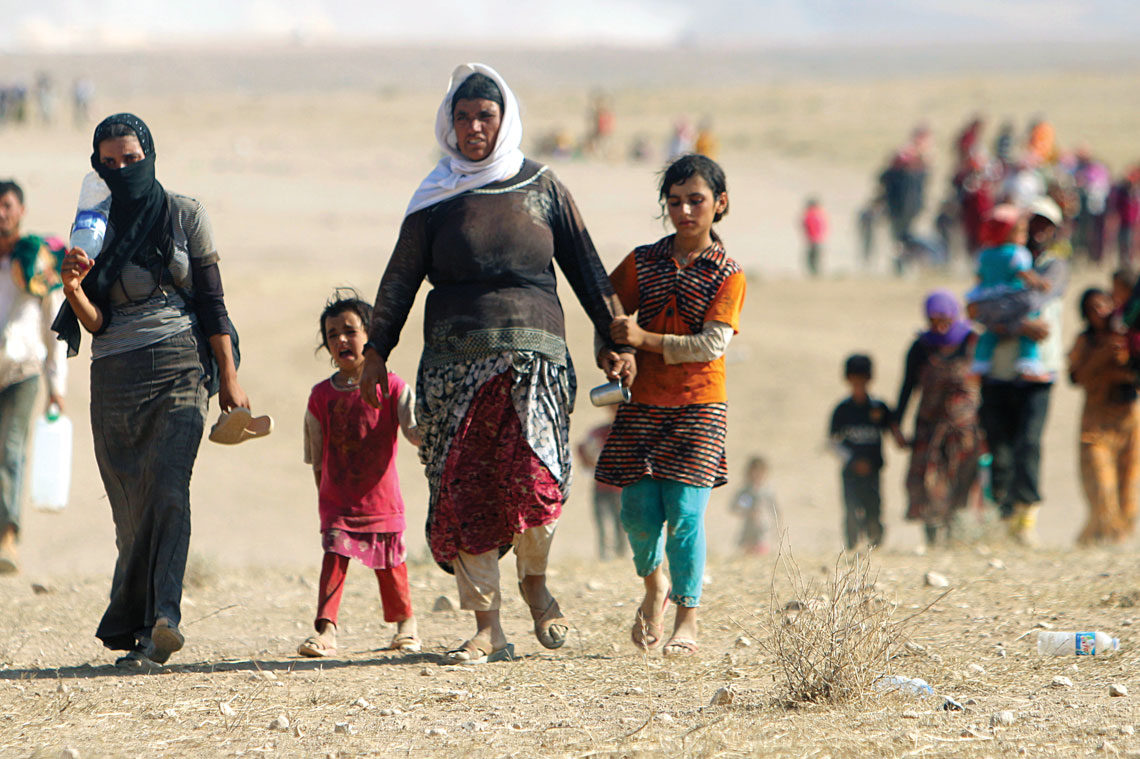
Displaced people from the minority Yazidi sect, fleeing violence from forces loyal to ISIS in the town of Sinjar, walk toward the Syrian border on Aug. 11, 2014. Photo by Rodi Said/ Reuters
Iraq is one of the seven countries whose citizens are banned from entering the U.S. for at least 90 days, according to President Donald Trump’s recent executive order. The order makes an exemption for religious minorities, but at present, the procedures for exercising that exemption are unclear. At press time, the order had been blocked by the courts and was awaiting appeal, but the constitutionality of a religious exemption appeared murky in the first place. Meanwhile, the president has promised “safe zones” in Syria but the majority of Yazidis in the Middle East are in Iraq.
The persistence of genocide into the second decade of the 21st century makes a cruel joke of “never again,” just as Rwanda, Bosnia and Cambodia did in the second half of the 20th century. More than two years after the Yazidi genocide began, the question remains: Shouldn’t we do something about it?
‘Nobody helped’
Salem Daoud is Mir of the Yazidis in the United States, the community’s chief religious functionary, serving alongside a council of elders. He speaks a halting English that would be difficult to fully comprehend even if he weren’t describing some of the most trying days of his life. So his son, Seif, who goes by Sam in the U.S., and Rabbi Pamela Frydman, an activist in Los Angeles, joined him on a recent conference call from Glendale, Ariz., to make sure he was understood.
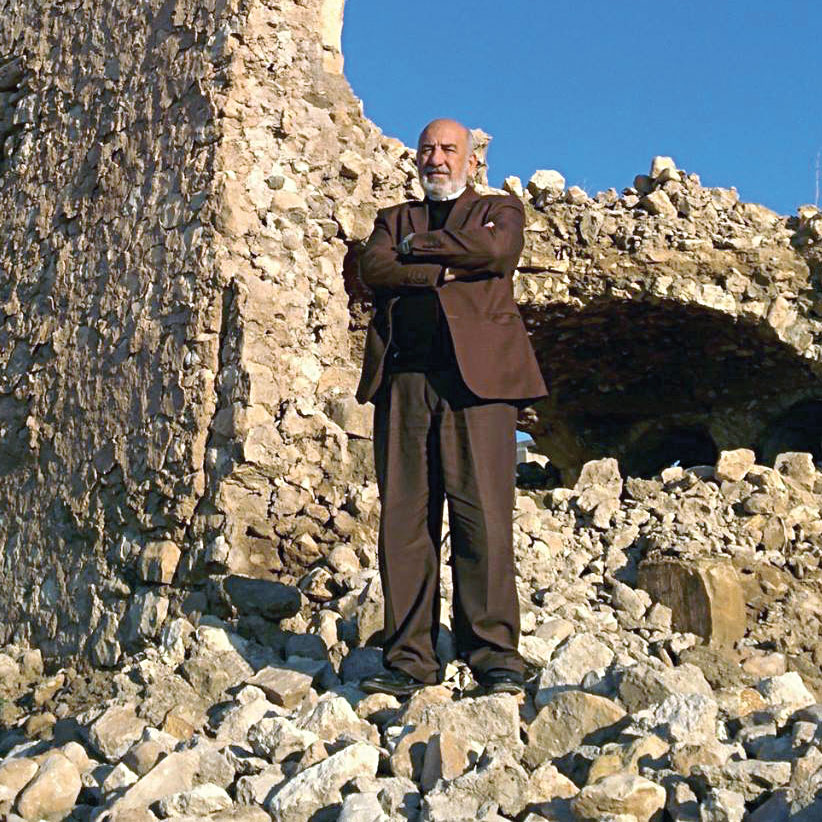
Salem Daoud at the Castle of Mir Ali in northern Iraq. Photo by John Murphy.
In such a tiny community, no family is unaffected by an event on the scale of the genocide. Salem’s sister and brother-in-law were kidnapped and then rescued six months later; they’ve never been quite the same since, Salem said. It’s hard to know what to ask a person who sat, more or less helplessly half a world away, while his relatives and countrymen were slaughtered and enslaved.
When Salem’s phone began to ring in early August 2014, there was little he could do to help the man on the other end, a local leader in Sinjar by the name of Ahmed Jaso.
“Till the last minute, till before they killed him, he was calling my dad, like, every, I would say, hour,” Sam said on the phone. “And he’s saying, ‘Do something for us, to save us from their hands.’ ”
Jaso was in a village called Kocho, where ISIS troops were lining up the villagers in groups of 60 or 100 and demanding payment to spare the locals’ lives. When the ransom was not forthcoming, they killed residents in a hail of gunfire, Jaso told Salem. Sam explained that his father has many contacts, people who might have been able to help, “whether here in the U.S., in Iraq, Russia, to people in Germany” — even people close to the White House. “Everybody put their hands on their eyes and their ears,” Sam said.
“[Jaso] would call, ‘[ISIS] said they just killed a hundred, so we need support to save the rest. … They killed another hundred, they need money.’ ” he said. “But nobody wanted to pay.”
“We give the information to a lot of people,” Salem added in his imperfect English. “Just nobody helped. No government, and nobody.”
The village of some 1,800 people was cleared out — the men slaughtered, the young boys kidnapped, the women enslaved.
“Very hard time, that was,” the Mir said. The last time he called Jaso back, the local leader was awaiting his turn at the death squad. “The last time, I hoped I’d be one of these people with them,” Salem said.
The activist
Frydman — known more commonly as Rabbi Pam — is a recent arrival to Los Angeles from Northern California, having moved here in May. There, she started the San Francisco congregation Or Shalom Jewish Community 25 years ago and spent a decade as a social justice activist and educator.
One January morning, Frydman sat down in front of her laptop at a Coffee Bean & Tea Leaf on Pico Boulevard. In front of her, a manila folder contained a manuscript of a book about the Holocaust she’s writing that she put on hold two years earlier, when she first learned about the genocide of Yazidis and Assyrian Christians in Iraq and Syria. She finally was finding time to get back to work on the book. Asked to describe how she became active in the struggle for Yazidi survival, she scribbled an impromptu timeline on the back of the manila folder.
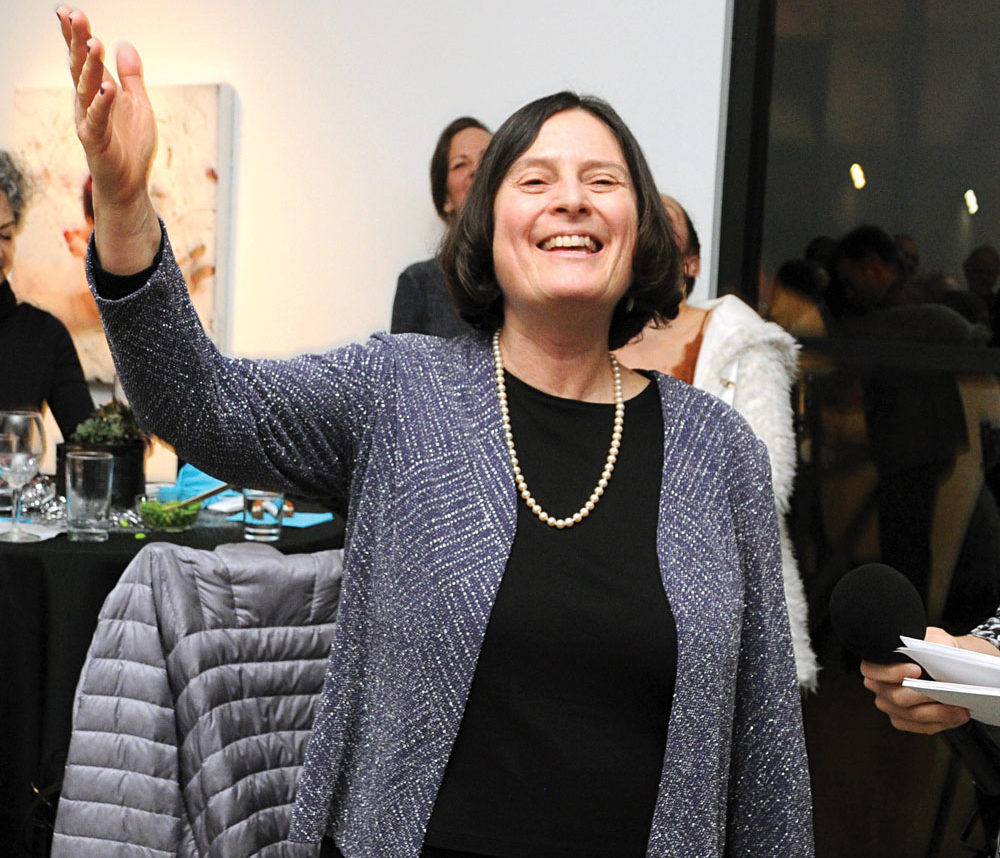
Rabbi Pam Frydman. Photo by Bret Putnam
In November 2014, Frydman saw an email from the Board of Rabbis of Northern California about an event at a Jewish Community Center in the Bay Area. “It said, ‘Act before it’s too late,’ ” she recalled. At the gathering, she saw footage of Yazidis being marched up to the heights of Mount Sinjar, where they were trapped.
“We heard about children who were dehydrated because there just wasn’t enough water,” she said. She heard a story about a woman being driven up the mountain by ISIS forces and struggling to carry both of her children — one of many such stories to emerge from these forced marches. When this particular woman grew too exhausted to hold both children, she put one of them down.
“As soon as she put that child down, the child was slaughtered, was killed, and I said to myself, ‘This is a death march! This is what our people went through in the Holocaust!’ ” Frydman said, her voice wavering. “The fire was in my belly and my heart was shattered, and I felt that I had to do something. And I returned to my home and I started to contact Jewish and interfaith colleagues, and I said, ‘What are we gonna do?’ ”
Soon, she organized a program called Save Us From Genocide, a consciousness-raising campaign for the plight of the Yazidis and Assyrians, hosted by four Bay Area interreligious councils in concert with the United Religions Initiative, a global interfaith network. A project of Save Us From Genocide administered by the Northern California Board of Rabbis, called Beyond Genocide, hopes to gain attention and relief specifically for atrocities perpetrated against Yazidis.
In addition to helping finance university scholarships for Yazidis studying outside Iraq, Beyond Genocide assists in Yazidi migration and resettlement. On that last score, Frydman could describe her efforts only in vague details, out of abundant caution against putting Yazidis in danger.
Asked how much Beyond Genocide had raised for resettlement, she responded, “A very small amount. But with this very small amount, we have performed miracles.”
‘My brother’
Frydman’s resettlement and advocacy work runs primarily through tight-knit networks of American Yazidis such as the one operated by Saeed Hussein Bakr, whom she calls “my brother.” Bakr arrived in the U.S. about five years ago and found his way to Phoenix, where currently he works as a cook for a local Panda Express. As the disaster in Sinjar unfolded, groups quickly sprang up among American Yazidis to help those fleeing for their lives in the Middle East, managed by people like Bakr.
“Yazidis are not a big community,” he said. “So, almost, we all know each other.”
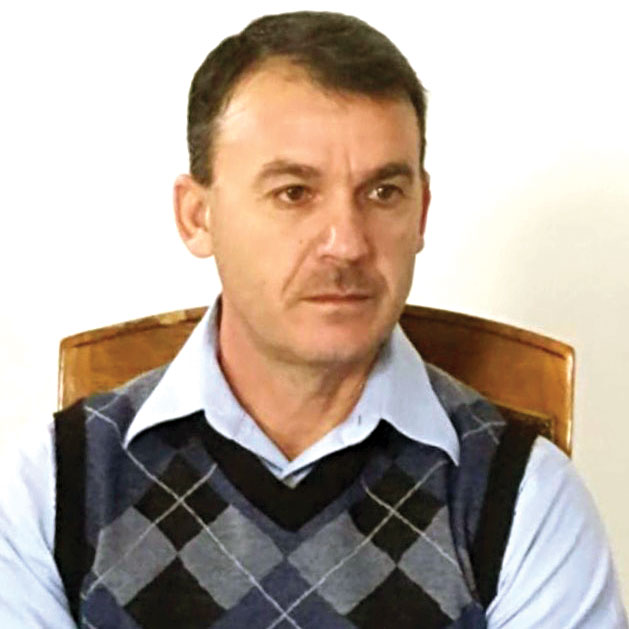
Saeed Hussein Bakr
Headquartered in places such as Lincoln, Neb., the largest American Yazidi population center, these networks raise money when possible, though the community is in large part newly arrived and not a wealthy one. More often, they deploy contacts in the United States, Europe and the Middle East to help Yazidi migrants who find themselves in trouble.
Bakr’s group, Yazidi Rescue, will alert Coast Guard officials in Greece, for example, when a boatload of Yazidi refugees is abandoned or waterlogged in the Mediterranean or Aegean sea. In other cases, they’ll help Yazidi women escape from slavery or help refugees who are imprisoned abroad. There are no rules or standard operating procedures for this type of operation, only dire phone calls to anybody who might be able to do something, whether civilians or government officials.
“Some nights, I can say we help 1,000 people in one night,” Bakr said.
Bakr first became involved after one of his sons, Layth, on his way to the U.S., got on a boat headed to Greece from Turkey. His boat capsized, and some of the refugees on board with him drowned. “That’s why I work to help those people,” Bakr said.
Remarkably, though, his son’s near-death experience in the Aegean Sea was not the most harrowing episode for Bakr. That would be earlier, in August 2014, when Bakr’s son and other relatives were turned out of their homes and driven up Mount Sinjar.
“For seven days, they were in the mountains, no power, no communications. We don’t know at any time if ISIS, they captured them,” he said. “It was horrible days. Those seven days, they were the worst seven days in my life.”
An ancient people long oppressed
The Yazidis are an ancient people, born in the cradle of civilization. Consecrated to one God, they survived through the ages. In each generation, the yoke of oppression found them, and they cried out for deliverance — except sometimes their savior was a long time in coming.
Sound familiar?
“In each and every generation, they rise up against us to destroy us,” Jews recite each Passover. It would be equally true on the lips of a Yazidi.
The parallels between Jews and Yazidis become uncanny at a point. Both are ethnically distinct religions dating to the birth of monotheism. Both have been singled out by Muslim rulers for persecution based on their strange and foreign faith, slandered as perversions of Islam.
But somewhere along the ages, the historical arcs of the two people diverge. Whereas the history of Jewish genocide ends after the Holocaust, Yazidis have had no such luck.
Since the 15th century, Yazidis count 74 farmans against them — literally, decrees, calls by rulers for their destruction that inevitably result in mass slaughter. They’ve faced genocide at the hands of Kurds, Turks and Arabs, mostly Sunni Muslims backed by the Ottoman Empire. ISIS is only the most recent in a long line of persecutors.
Invariably, Yazidi customs and belief are offered as the reason for their oppression. The religion has no central texts that have survived the ages, but its folklore is vivid and distinct from any other faith. Adherents claim to descend not from Abraham but from Adam. Their legend has it that Adam and Eve, as a sort of competition, each placed their seed in a jar. When Eve’s jar was opened, it held an unpleasant stew of filth and insects. Adam’s contained a beautiful baby boy, ibn Jar, literally the son of Jar, who became the ancestor of the Yazidi people.
Ironically, it is their guardian angel that has earned them the fanatical ire of radical Islamists. Yazidis regard as sacred Melek Taus, the Peacock Angel, a fallen angel who refused to bow to Adam when God requested he do so, and who consequently gained dominion over the fates and follies of man. This origin story bears a similarity with that of the Islamic legend of Iblis, the archdevil in Muslim theology. The resemblance between the tales has historically motivated the slander of Yazidis as devil worshippers, a kind of Middle Eastern blood libel that continues to claim the lives of its subjects.
“They have made Iblis — who is the biggest taghut [idolator] — the symbolic head of enlightenment and piety!” the article in the ISIS magazine Dabiq exclaims. “What arrogant kufr [infidels] can be greater than this?”
One irony to emerge from this account is that peacocks don’t exist in the region where Yazidi civilization arose. If the community of nations is not watchful, it’s not inconceivable to imagine a Middle East with no more Yazidis, either.
‘Never again requires a lot of energy’
Google searches for “Yazidis” saw a massive spike in early August 2014 and then returned, but for a few small flutters, to a flatline. But things never went back to normal for Haider Elias, a Yazidi activist in Houston who is the president of Yazda, an advocacy, aid and relief organization.
That’s not the role he’d imagined for himself before ISIS began to wreak catastrophe. A former translator for the U.S. Army in Iraq who immigrated in 2010, Elias was raising three children and studying biology as an undergraduate in the hopes of attending medical school. When his brother was murdered in Iraq and the rest of his family displaced from their homes, he dropped his medical school dreams to dedicate himself to advocacy.
Haider Elias
Elias and his peers at Yazda run a gamut of programs aimed at helping those displaced by the genocide. They’ve presented on the catastrophe in more than 10 states, including California, and in Europe. In Iraq, the group offers psychological and psychosocial therapy to help reintegrate women who have escaped or been rescued from ISIS. On top of all that, Yazda runs documentation projects to record video testimonies about the genocide and document mass graves.
Elias is still a full-time student at the University of Houston, though he’s switched majors to psychology at the recommendation of some American friends. A social science degree would better suit him for advocacy work, they told him. His days are long and busy, but he’s motivated by the knowledge that his people still face imminent danger.
“Many people want to come back [home] but they’re afraid that the security forces again are going to fail and run away, and this time it’s going to be more fatal, more catastrophic,” Elias said.
And so Yazda now is advocating for international protection for Yazidis, without which resettling Sinjar is unfeasible. “Without some form or guarantee of protection, this community is terrified,” he said.
Elias admits to still being angry. He’s angry with ISIS, naturally, and with the world for standing idly by; but more specifically, he’s angry with the Kurdish fighters, the Peshmerga, for abandoning their posts before the Islamists’ murderous advance.
“It’s not a battle and they lost — they ran away,” he said. “They did not tell the population. When you lose many lives and you think you lost the battle, the first thing you do, you inform the population. The second thing, you run away.” To hear Elias and other Yazidis tell it, the Peshmerga didn’t quite bother with the first.
Though most Yazidis are behind Kurdish lines for the moment, their situation remains precarious and their advocates few. Elias made note of a chilling silence in Congress, broken only on occasion by legislators who represent Yazidi population centers, including two Republicans, Rep. Jeff Fortenberry of Nebraska and Sen. John McCain of Arizona.
“We need a campaign in 2017 to help the Yazidis, whether to advocate for international protection or accepting Yazidi refugees in the U.S. or sending more humanitarian aid to the areas,” Elias said.
Responding to the genocide, Yazda took up “never again” as a rallying cry. But Elias is not naïve about the prospects of his people.
“Never again requires a lot of energy, a lot of passion, a lot of work,” he said.
‘Save us!’
The Yazidi call for aid is neither subtle nor nuanced. Even before the genocide, theirs was a struggle for existence. There is no conversion into the community, and a child with even one non-Yazidi parent is considered to be outside the faith. The massacres and enslavement of Yazidis compound an already dire population problem.
“An entire religion is being exterminated from the face of the earth,” Vian Dakhil, a Yazidi member of the Iraqi Parliament, told the legislature on Aug. 5, 2014, in a tearful plea that briefly went viral on the internet. “Brothers, I appeal to you in the name of humanity to save us!”
Before she could finish the next sentence, she collapsed, weeping.
The Yazidis interviewed for this story made clear they are open to any help they can get — military, political, financial and otherwise. Currently, Frydman and her colleagues are advocating for a real immigration pipeline to allow Yazidis to come to the U.S. notwithstanding the Trump administration’s refugee policy.
Three men prepare to leave Mount Sinjar. Saeed Hussein Bakr’s sons, Layth Saeed Hussein (right) and Hussein Saeed Hussein (left), and his nephew, Fuad Shaker Hassow.
The Trump order, before a federal judge blocked the bulk of it on Feb. 3, in theory allowed Yazidi immigration to continue largely unimpeded. In practice, though, the International Organization for Migration, which coordinates refugee admission, has told Yazidi refugees their immigration has been canceled until further notice, Reuters reported. A faith-based exemption raises constitutional questions and its legality is a matter for the courts to decide.
But not all displaced Yazidis want to leave Iraq, anyway. Many simply want to resume their lives in the villages where they were born and escaped death, according to Salem Daoud, the Yazidi Mir. Much of that territory is still held by ISIS.
For now, the totality of a people’s homeland lives in limbo and its diaspora finds only limited means to help them. Often, prayer is the only recourse. Frydman recalled a joint prayer group near Phoenix with Yazidis, Jews and Universal Sufis. After the prayers were over, a Yazidi elder approached her and showed her a tiny book in a plastic pouch. Peering through her bifocals, she discovered it to be the Book of Psalms. A Jewish friend had given it to the elder, he told her, shortly before immigrating to Israel after the declaration of the Jewish state. “He said the prayers in this book will protect me,” the elder told Frydman.
The themes reflected in the Book of Psalms, as it happens, are more topical now for the Yazidi people than they ever have been in recent memory. As it says in Psalm 7:
O Lord, my God, in You I seek refuge; deliver me from all my pursuers and save me, lest, like a lion, they tear me apart, rending me in pieces, and no one to save me.
How to help
LEARN more about the plight of the Yazidis by reading reports from the United Nations, Amnesty International or other news articles.
CALL or write your elected representatives to request that they act on behalf of the Yazidis.
DONATE to organizations working to assist Yazidis through advocacy and direct aid, listed below:
In Daphne Merkin’s new memoir, “This Close to Happy: A Reckoning With Depression,” the author recalls: “By the age of 8, I was such a traumatized specimen, such an anxious, constipated mess. … I cried inconsolably about everything … not to mention the raging insomnia that kept me up night after night.”
The primary source of her depression, she reveals, was her remote, rage-prone father and, especially, her mother, who was capable of “insidious cruelty.”
“I remember I used to stare out of the window of the bedroom I shared with my sisters, and think about jumping out,” Merkin, 62, said, speaking slowly and deliberately in a telephone interview from her Manhattan home. It was at age 8 she was first hospitalized for her illness, in what would become several such stays throughout her life.
Merkin will discuss her memoir in conversation with “Transparent” creator Jill Soloway as part of the Aloud series at the Los Angeles Central Library on Feb. 21. The book has already received laudatory reviews from major literary critics, including in The Washington Post and The New York Times, where it graced a recent cover of The Review of Books.
“This Close to Happy” flashes backward and forward in time to document Merkin’s struggle with her desire to commit suicide, even as she built a career as a novelist, essayist and critic.
The memoir took her 16 years to complete, in part because of her nagging fear that her illness might spiral downward, her recurring bouts of depression and the pain of reliving her fraught childhood, she said.
She persevered to counter the bias she believes still exists against those who suffer from chronic severe depression. The state is often considered “a fraudulent bundle of symptoms, an inflated case of malingering that everyone suffers from but that only a select, self-indulgent few choose to make a big deal about,” Merkin writes.
And so she aspired “to show the interior of the experience of severe depression, in a life that went on around it,” the author told the Journal.If readers “could see someone who was ostensibly functioning, working at a magazine like The New Yorker, it could perhaps help relax the stigma,” she said.
Even before “This Close to Happy,” Merkin was already known for unabashedly writing about highly personal, and at times provocative experiences; her 1996 New Yorker essay about her penchant for sadomasochistic spanking, for example, raised interest as well as eyebrows.
“Of course I’ve written about many other things,” Merkin said. “But Freud said that art exists to disturb the sleep of the world. … And I’ve always felt I don’t have that much to lose by telling the truth. I’m fascinated by truth-telling. I think that comes directly from my family. We lived with a certain truth on one level and then a much darker truth on another level. We appeared affluent and sort of golden, but underneath it was all dark and deprived.”
Merkin’s mother, Ursula, who died of cancer in 2006, hailed from an esteemed German-Jewish family. Ursula’s great-grandfather was Samson Raphael Hirsch, who many consider a creator of Modern Orthodoxy.
Both of Merkin’s parents fled Nazi Germany with their families in the 1930s; Ursula traveled to Palestine and, at 29, to New York, where she met and married Merkin’s father, Hermann, a wealthy financier.
Daphne Merkin grew up in a Modern Orthodox household and attended the Ramaz School yeshiva. But despite the religious observance, the servants and the family’s Park Avenue address, Daphne and her five siblings lived in an atmosphere of stark emotional and physical deprivation.
“There was … never enough food to go around and a pervasive feeling of hunger,” Merkin writes. The children wore ragged clothing and suffered at the hands of a nanny, Jane, who often beat and kicked them.
In the interview, Merkin surmised that her mother hired the blatantly unmaternal Jane because she didn’t want her children to feel closer to their nanny than to her. Ursula also had a sadistic streak: “I have written that I thought my mother was [the Nazi perpetrator] Ilse Koch,” she said.
Once Ursula even drew a series of swastikas on Daphne’s arm. “I guess a shrink could say that that was counter phobic — that she was warding off the Nazis by drawing [their symbol],” Merkin said in the interview. “But I would say that it was a complicated gesture. My mother could have a macabre sense of humor. And she had this sort of split identification as victim and aggressor — because there was a lot of aggression in her.”
As a girl, Merkin also chafed against her family’s Orthodoxy — partly because the religion felt rigid within a household that already had so many restrictive rules and partly because she wondered how a God could allow the abuse taking place in her own home. She slowly drifted from religious observance.
Even so, Daphne’s mother became her “everything,” because “if you don’t get what you need, you cling, and you hope for it to come,” Merkin said.
Despite her early-onset depression, Daphne went on to attend Barnard College, where she won the school’s annual poetry award, and to write for such publications as Elle, The New York Times and Vogue. She said she penned her 1986 autobiographical novel, “Enchantment,” to try to “fix” her relationship with her mother. Did it work? “No, no,” Merkin said, with a rueful laugh.
After Ursula died a decade ago, Merkin felt “a radical dislocation … as though the world had spun off its axis,” she writes in “This Close to Happy.”
Yet at the end of her memoir, Merkin sees glimmers of hope.She writes that she has come to realize “the opposite of depression is not a state of unimaginable happiness, but a state of approximate contentment, of relative all-right-ness.”
Since Merkin finished her memoir, she told the Journal, she had one severe depressive episode after she tried to wean herself off some of her medications last summer. She added that she has always felt “ambivalent” about taking pills, due to the stigma, the side effects and because even psychiatrists don’t know exactly how they work.
These days, she said, she’s back on her meds, is working on a new novel, about sexual obsession, and has only fleeting thoughts of suicide. “I hope [‘This Close to Happy’] will help people understand depression better, and that it will help those who suffer from it to feel less alone,” she said.
As for herself, Merkin added, “I guess there is something melancholy about me.But with that, I am now melancholically moving forward.”
For more information about Merkin’s Aloud appearance, visit lfla.org.
“In that hour the ministering angels wished to utter the song [of praise] before the Holy One, blessed be He, but He rebuked them, saying: My handiwork [the Egyptians] is drowning in the sea; would you utter song before me!”
— Babylonian Talmud, Sanhedrin 39b
This week’s Torah portion contains one of the most powerful — and ethically challenging — teachings in the Torah as the Hebrews cross the Sea of Reeds, to be followed by the Egyptians, who are drowned. Jews are taught not to take joy in the pain of others. This is especially true when it is the pain of our enemies. The Bible and Talmud are full of remonstrations against this practice, and yet, sometimes it is all too easy to succumb to our yetzer hara (evil inclination) and do just that.
I will always retain the sad memory of walking into a cigar lounge in 2014, and hearing many of the people there cheering as they watched CNN. I thought it must be some sporting event; instead they were watching the destruction of a terror tunnel into Israel, and the people were cheering at the death of the Palestinian terrorists.
Dozens of parents had just lost their children, siblings had lost their brothers, and children had lost their fathers, and we could be assured that they all would hate Israel forever. In my mind, there was nothing to celebrate. Remembering the teaching of how God chastised the angels when they started to celebrate the death of the Egyptians at the Sea of Reeds, I accepted that it was necessary to destroy the tunnels, but simply wrong to celebrate the agony of others. Pharaoh, those terrorists and other adversaries are not our “enemies.” Rather they are adversaries that need to be defeated — but still respected as creations of God.
It is an important Jewish understanding — and particularly important now — that we don’t need to polarize our world even more by viewing the world through the lens of “enemies,” but instead respect all of life strongly enough that we work to change those adversaries into friends.
It seems that almost daily we read about incidents of hate around this country, from both sides of the political aisle. Instead of the healthy debate that is illustrated throughout the Talmud by our Sages, we see conservatives and liberals viewing the “other” not as wrong, but as evil. Each side seems to revel in any shortcoming by the other. History has shown repeatedly that if we continue down this path of celebrating the pain of our adversary, it leads only to a mutual pain for everyone involved.
So how can we regain a healthy and respectful dialogue with those whom we oppose? How can we learn to do what we believe we must without sacrificing our Jewish essence?
One of the many answers that our tradition teaches can be found in the holiday of this weekend, Tu B’Shevat. As we remember the goodness of God’s creations, as we celebrate the gifts that God has given to all of us no matter what our beliefs, our Sages teach that it can influence our behavior to embrace our personal differences and respect every other human. The celebration of nature has the potential to lead us to understanding. In nature, we find a balance that we can emulate in our interpersonal relationships.
There is an ancient text, “Perek Shirah” (Chapter of Song), that reminds us to treasure all of nature, and as a byproduct, to treasure all others, even if we disagree with them. It includes prayers about all aspects of nature — from the elements to plants to animals — and teaches us that when we really appreciate these Divine gifts, we change how we act with others. The idea is simple: bring balance and harmony to every relationship in nature, including between your friend and foe, and the benefits will extend from this world to the next.
As the political climate becomes polarized and it is difficult to stay centered, it is incumbent upon us to remember this Jewish teaching. Let us not only celebrate this magnificent holiday of Tu B’Shevat, but return to nature and appreciate the gifts that God has given us all. Maybe then we can bring real harmony into the world.
My prayer for all of us is to appreciate the divine gifts of life, including the disagreements we have with other people, and to use these disagreements as bridges to understanding and respecting one another — making adversaries into friends and remembering that we are all children of the same God.
Six people were wounded in a shooting and stabbing attack in the central Israeli city of Petach Tikvah.
Israeli police said a 19-year-old Palestinian man from the West Bank opened fire Thursday afternoon near an outdoor market, CNN reported. One person reportedly was stabbed in the commotion.
The alleged assailant was arrested at the scene.
None of the wounded suffered life-threatening injuries, according to media reports.
In Jerusalem: “The Jerusalem municipality is shutting down the Barbur Gallery, a nonprofit art space in the downtown area, because it planned to host an event by Breaking the Silence, an Israeli veterans’ anti-occupation group which collects testimonies from soldiers serving in the Palestinian territories.”
In Britain: “Prime Minister Benjamin Netanyahu on Monday asked his British counterpart Theresa May to halt funding for what he called nonprofit organizations that are “hostile to Israel.”
Also in Jerusalem: “The Foreign ministry plans to reprimand the Belgian Ambassador to Israel Olivier Belle over his country’s support for the non-governmental groups Breaking the Silence and B’Tselem. Prime Minister Benjamin Netanyahu instructed the Foreign Ministry to do so, after discovering that Belgian Prime Minister Charles Michel had met with representative of the left-wing group during his three-day visit to Israel.”
At the airport: “senior Jewish-American executive of the New Israel Fund, which helps fund many left-wing organizations working in Israel and the West Bank, was delayed for questioning by immigration officials upon arrival in Israel on Wednesday in what the group claims was for political reasons.”
Understanding and explaining their meaning is more difficult.
It is more difficult because all explanations are politically charged.
Certain people, the New Israel Fund has many such people, believe the government is involved in an attempt to silence legitimate voices. The event in which the NIF was involved, they say, was “a serious act aimed at intimidating a social activist because of her activities for Israel and Israeli society. The Israeli government… has been persecuting Israeli human rights activists for some time now. Now this policy is being directed at diaspora Jews as well.”
Other people believe that the government of Israel has finally mustered the courage to do something against organizations that take advantage of Israel’s relaxed approach and hurt its foreign relations and security. “The Barbur Gallery” – the gallery that hosted the Breaking the Silence event – “is funded from public money”, Minister Miri Regev reminded the Mayor of Jerusalem. It should not use these funds to “constitute a house for Breaking the Silence, an anti-Israel propaganda organization which spreads lies against the State of Israel and IDF fighters.”
Of course, every case is unique, and every case should be examined separately. A gallery that gets public funding might be subjected to rules different from those governing Israel’s foreign relations. Israel requesting the Brits to reexamine their funding of Israeli NGOs is different from Israel’s decision to reprimand Belgium for a meeting the Belgian PM had in Israel. The questioning of an NIF dignitary at the airport should be looked at carefully to determine whether this was intentional political harassment or maybe an intentional provocation by the visiting NIF staffer.
But overall, it is clear that Israel is upping the ante in its activity against some of the most politically critical organizations that operate here. Why? Two possible reasons come to mind – and these are not mutually exclusive.
One – it is politically beneficial for a right-wing coalition aiming to convince its voters that it is “doing something” about the most annoying elements within Israel’s society. The NGOs in question are the political strawman against which the coalition can unite.
Two – it is strategically important for Israel to dismantle a complicated infrastructure, run by irresponsible Israelis and funded by foreign governments, aiming to weaken Israel. This infrastructure of organizations is a crucial player in the BDS battle against Israel, as it gives Israel’s enemies the ammunition and the cover they covet as they strive to undercut Israel’s ability to defend itself and its interests.
For some Israelis and foreign observers, it’s easy to determine which of these considerations has been fueling the government’s actions. If they dislike the government, they’d go for the less flattering explanation. If they dislike the organizations, they’d go for the more flattering one. It is not as easy for the many Israelis who dislike both the government – or at least some of its more populist actions and rhetoric – and also dislike organizations that appeal to world public opinion in an attempt to turn the world against Israel.
Last year, in a survey I handled for JPPI, we found that a majority of Jewish Israelis believe that there is “too much freedom of expression” in Israel. This belief is widespread, and, as one can expect, grows stronger as we move from left to right and from secular to religious.
It is a disturbing belief, which is not quite characteristic: Jewish Israelis are known for being blunt, for being straight, for refusing to accept authority, for refusing to recognize hierarchy. But still, they feel that a line is being crossed by too many Israelis, and that the government, by letting all things pass, does not properly serve the interests of the country. We did not ask about this specifically in our survey, but it would not be unfounded to assume that Israelis’ unease with Israel having “too much freedom of expression” is mostly about the organizations that the government is currently trying to tame.
Is it a reasonable action by the government? I think it is, within limits. Asking the Brits not to fund opposition organizations in Israel is reasonable. Asking a Belgian visitor not to meet with Breaking the Silence during a formal visit is also reasonable. Asking an art gallery whose funding comes from my taxes not to engage in political activities is reasonable. Still, I’m a little concerned about all of these actions. I am concerned because I don’t trust that the government will identify the red line beyond which these actions become dangerous to Israel’s freedom of speech.
Tu B’Shevat, the New Year of the Trees, is the time of year in the Mediterranean region when the trees are just starting their early bloom. Called Las Frutas (The Fruit), by the Sephardim, it is observed by planting new trees, and is a time when family and friends celebrate at the table by eating a variety of fresh winter fruits and vegetables.
The ingredients that mark the holiday — which will be celebrated this year on Feb. 11 — include nuts, grains, legumes, dried fruits and winter citrus. They symbolize the cycle of the seasons, and hold the seeds for the future. It is a time to celebrate, as our ancestors did, with fabulous winter meals.
With all this in mind, one can be creative in deciding how to plan the menu with recipes that everyone is going to be able to enjoy, including the vegetarians and vegans among the family.
Begin with Mushroom-Barley Soup — the technique of sautéing all the ingredients brings out the intense mushroom flavor of this robust soup. For the main dish, try Risotto With Mushrooms. There is only one way to prepare an authentic risotto: The rice is not boiled in water but is sautéed in broth, which is added gradually and must be watched constantly. Invite guests into the kitchen to help stir, while you prepare their dinner. Serve in heated, shallow soup bowls — the authentic Italian way.
For dessert, eat everyone’s favorite Tu B’Shevat cookies, Lemon “Shortbread” Cookies topped with creamy Lemon Icing, and sing a hearty “Happy Birthday!” to your trees.
In a large heavy pot, heat olive oil over medium-high heat and sauté onion, celery and carrots, stirring occasionally, until tender, about 10 minutes. Add mushrooms and garlic and cook uncovered, stirring occasionally, until lightly browned, about 5 minutes.
Add stock, soy sauce, barley, thyme and sherry. Reduce heat to low, cover partially and simmer gently for 45 minutes. Season with salt and pepper to taste. To serve, ladle into heated soup bowls.
Makes 8 to 10 servings.
RISOTTO WITH MUSHROOMS
– 6 tablespoons unsalted margarine
– 1 onion, finely chopped
– 2 1/2 cups Arborio rice
– 6 to 8 cups hot vegetable stock
– 1/2 cup thinly sliced domestic mushrooms
– 1/2 cup sliced dried porcini mushrooms, soaked in water for 30 minutes
– 1/4 cup minced fresh parsley
– 1/2 to 1 cup cream
– 1 cup freshly grated Parmesan cheese
– Salt and freshly ground black pepper to taste
In a large heavy skillet, melt 4 tablespoons of the butter until foamy. Add the onion and sauté over medium heat until soft. Add the rice and mix well with a wooden spoon. Add 1 or 2 ladles of stock or enough to cover the rice. Cook, stirring constantly, as the stock is absorbed. Continue adding stock a little at a time, until the rice is just tender, 10 to 15 minutes.
In a small skillet, melt 1 tablespoon of the butter and sauté the domestic mushrooms until soft.
With a slotted spoon, transfer the porcini mushrooms from their soaking liquid to a bowl. Strain the soaking liquid into a small saucepan; bring to a boil and simmer for 5 to 10 minutes, until thick and the flavor intensifies.
Add the sautéed mushrooms, the porcini, parsley and cream to the rice mixture. Mix well and cook 3 to 4 minutes longer. Risotto should be served al dente — creamy and chewy — never mushy, so do not overcook. When the rice is tender but firm to the bite, blend in 1/2 cup of the Parmesan cheese and the remaining 1 tablespoon butter. Season to taste, with salt and pepper. Serve immediately in heated shallow bowls. Garnish each serving with the reduced porcini liquid, and serve the remaining Parmesan in a bowl, to be passed separately.
Makes 8 to 10 servings.
LEMON “SHORTBREAD” COOKIES WITH LEMON ICING
– Lemon Icing (recipe follows)
– 1 cup unsalted margarine
– 3/4 cup sugar
– 2 1/2 cups flour
– Grated peel of 1 lemon
– 1 cup toasted ground walnuts or pecans
Prepare the Lemon Icing; set aside.
Preheat the oven to 300 F.
In the bowl of an electric mixer, cream the butter and sugar together until well blended. Add flour and lemon zest and beat until crumbly and moist. Blend in the nuts.
Divide the dough into 4 portions; on a floured board, knead each portion into a ball. With palm of hand, press each ball into a smooth, flat disc 1/4- to 1/3-inch thick. Cut into rounds and cut each round in half. Arrange the cookies on a greased, foil-lined or Silpat-lined baking sheet in symmetrical rows to economize space. Leave space to allow for spreading.
Bake in preheated oven for 25 minutes or until lightly brown. Cool on racks. Decorate with Lemon Icing.
In the bowl of an electric mixer, combine sugar, egg white, lemon juice and vanilla. Beat at low speed until the sugar is dissolved. Then beat at high speed until mixture is light and fluffy. Cover with damp towel until ready to use.
Makes about 1 1/2 cups.
Judy Zeidler is a food consultant, cooking teacher and author of 10 cookbooks, including “Italy Cooks” (Mostarda Press, 2011). Her website is judyzeidler.com.
Jan. 21 was a wonderful example of women and men marching peacefully with great dignity so their voices might be heard.
My environmentalist daughter in the Bay Area marched; my pregnant younger daughter, son and husband marched in Brooklyn. I marched with friends in Los Angeles, proud to be an American.
We will not move backward in time and tolerate anything less than progress forward. We will not lose our right to make healthy choices about our bodies.
Marilyn Stolzman, Calabasas
Emotions About Obama, Run High
Judging by the letters you are getting that chide Rob Eshman’s reverent goodbye to President Barack Obama (“Thank You, Obama,” Jan. 20), it appears that your Jewish readers are beginning to wake up. We should thank Obama for showing the Jews how mistaken they were in voting for him with all his underhanded anti-Israel handiwork.
Chuck Colton, Sherman Oaks
Hal-e-Jew-Ya to Fran P. Jackson’s letter (Jan. 27) about former (thank God) President Obama! He was the worst president America has ever known, and thank God we have a brilliant man like Donald Trump as our president! Shabbat shalom to the very interesting Jewish Journal! I am a visitor from Manhattan, and even if I wasn’t Jewish, I would love reading your great magazine!
Sandy Kane Brodsky via email
Three Decades of Jewish Journalism
I enjoyed Tom Tugend’s feature story on the 30 years of the Jewish Journal (“A Paper Evolves and Innovates,” Jan. 27) with some sense of nostalgia.
My first “real” job was with the B’nai B’rith Messenger in 1977. The world was different then. But Jewish journalism was still a very challenging and rewarding profession, just as it is today. I salute the Jewish Journal for 30 years of providing thought-provoking ideas that impact our community.
The one omission I think Tugend made was not devoting a little more space to the early Jewish editors who “set the table” for the banquet that the Jewish Journal would eventually become. At the very least to name people like Joseph Jonah Cummins and Gil Thompson of the Messenger, Manny Chait of the Jewish Community Bulletin (which gave birth to the Journal), Herb Brin and a young guy with dark hair named Tugend at the Heritage.
Tom Tugend is and has been a treasure for this Jewish community.
Ron Solomon, Beverly Hills
Intentionally Omitting the Jews
I completely agree with Rob Eshman’s concept that President Donald Trump’s omission of the Jews from his Holocaust speech was intentional so that he would not alienate his large anti-Jewish base (“A Holocaust Without Jews,” Feb. 3). And I am tired of hearing that Trump can be forgiven because his daughter and son-in-law are Jewish. I have yet to see evidence that Trump arranged his daughter’s shidduch (dating, being wooed by and marrying an Orthodox Jew) nor that he was delighted that it happened. Yes, now that he has a bright son-in-law, he is using him, just like an Arab head of state uses a Jewish surgeon.
My Israeli-born friend, Ofer Raveh, assures me that Tu B’Shevat is celebrated and important in the Jewish state. “Trees are planted everywhere,” he told me. “And we eat fruits, especially from the kind that Israel is blessed with and are mentioned in Torah: grapes, figs, pomegranates, olives and dates.”
My experience with the birthday of the trees here in Los Angeles has been less engaging. Some years, when my children were in school, there was a trip to the environmental nonprofit TreePeople. Other years, there were songs about Israel, and paper plates of nuts and dates for a children’s version of the kabbalists’ Tu B’Shevat seder.
In the United States, Tu B’Shevat is often called the Jewish Arbor Day, after an American holiday created in the 19th century. It’s also called Jewish Earth Day, after the holiday created in 1970.
In talmudic times, the holiday had an important purpose: It helped people keep track of the age of their trees. Leviticus 19:23-25 requires that no one in Israel eat a tree’s fruit for its first three years. In the fourth year, the fruit must be dedicated to God, and in the fifth, the fruits can be eaten by everyone.
That’s all there was to Tu B’Shevat. Like many Jewish rituals and observances, it has been repurposed and reimagined over time, but it is still called the Rosh Hashanah L’illanot or the new year of the trees.
There are four new years on the Jewish calendar. On the first of Tishrei (Rosh Hashanah), creation turns a year older, while the months actually start from the first of Nisan. Cattle get older on the first day of Elul, and the trees mark their new year on the 15th of Shevat.
So Tu B’Shevat was a day of counting trees, of considering the success of human stewardship, before it became a day of planting. There’s plenty of evidence in Jewish texts that our tradition is very pro tree planting. First-century sage Rabbi Yochanan Ben Zakkai said, “If you have a sapling in your hand, ready to plant, and the Mashiach comes, plant the tree first and then go to greet him.”
Planting trees has been seen as a sure way to make the world a better place since long before the modern ecology movement. We want trees in the desert and the parkways of our city streets, on the banks of our rivers, in our parks and on our playgrounds. They breathe out, we breathe in.
The phrase bal taschit, from the admonition in Deuteronomy not to destroy trees in a time of war, has been taken up by Jews concerned about the future of the planet. Do not destroy. There’s an implication in it of caution. A proposal to revive the first of Elul as a new year of the animals imagines a day to pay attention, as we prepare for the new year of life, to our relationship with the other living beings here. It would be a day to stop, to notice what’s going on and then to start over.
In the information-overloaded 21st century, it might be useful to have a day, like Tu B’Shevat, to stop, to just be in the world and see ourselves as part of a whole. Not to stop planting altogether, but to take purposeful notice of what is before we determine what will be.