fbpx

February 9, 2017

Why it’s so hard to write about Trump

Every profession has its challenges. For writers who try to come up with fresh insights on current events, the Donald Trump era is especially challenging. I mean, how many different ways can you write that our new president is a human train wreck?

What I have found, though, is that most people don’t want to talk about anything else. Right now, many of them are so angry and worked up over Trump that they have this deep need to express that anger. So, when they seek out what to read, they gravitate toward stuff that makes them feel better — in other words, stuff they completely agree with.

It’s tempting for writers to feed into that. I know I can write column after column bashing Trump and make lots of readers happy. Of course, I will essentially be repeating what many of you already know and are already fuming about. These days, anti-Trump columns are not a dime a dozen, they’re a penny a million (and for good reason).

But if all I do is confirm your beliefs, I’ll be doing you a disservice. I’m also here to challenge you, even if you may not be in the mood.

Take the case of Trump’s sloppy and overextended executive order on visas and immigration that resulted in hundreds of people, mostly Muslims, being humiliated or put in limbo or stranded at airports. In response, much of the country has exploded in anger, marching at airports and mobilizing an opposition movement. You can read hundreds of columns tapping into that anger.

But do you know what I think about when I see the pain and chaos inflicted by a rude and reckless Trump? I think of former President George W. Bush, who, unlike Trump, was a polite and decent man.

You see, this polite and decent man was responsible for squandering $3 trillion of our tax money on a ruinous war in Iraq that cost hundreds of thousands of human lives. And then I ask myself: As much as I can’t stand the vulgarity of Trump, would Trump have sucked our country into that big rip-off of a war? And if the answer is no, what is that worth?

I also think of the polite and decent former President Barack Obama, who allowed a humanitarian disaster to unfold in Syria that resulted in nearly 500,000 dead and millions of refugees, and I ask myself: Where were all the demonstrators then? Where was the public outcry? It’s not fair to blame the complex Syrian disaster only on Obama, but it is fair to ask why he didn’t do more.

One reason is that he didn’t want to jeopardize his nuclear deal with Iran, which has empowered the world’s No. 1 sponsor of terrorism to spread its carnage to Iraq, Syria and throughout the region. The deal is not without its benefits, but I still have to ask myself: Would Trump have driven a harder bargain that would have taken into account Iran’s sponsorship of terrorism? And if the answer is yes, what would that be worth?

It’s uncomfortable to think that decency doesn’t necessarily correlate with success.

None of this should make you feel better about Trump. It’s not meant to. Rather, it’s meant to put things into some larger perspective. America is coming off 16 years under two of the most decent and classy presidents in recent memory, and yet, we still ended up with untold horror for millions of people in a part of the world those presidents were totally focused on.

It’s uncomfortable to think that decency doesn’t necessarily correlate with success. Trump’s offensive style may be infuriating. His ideas may be scary. His initial moves may be reckless and cruel. All that may be true, and it may well lead to much darker days ahead. But it’s also possible that his forceful approach may spook and deter evil regimes like Iran, or shake up the hypocrites at the United Nations or even help create humanitarian safety zones in Syria. If such success happens, will we discount it because it came from a man we abhor?

People who are still in meltdown over Trump can’t conceive of the possibility that he may have any redeeming qualities. I get that and I have my own doubts. That’s partly why it’s so hard to write about him — most people just expect you to bash him. They don’t really want to read anything else.

Once in a while, though, it’s good to take our minds out for a walk and hear things we don’t expect to hear, if only to remind us of what makes America really great — that we live in a society that honors diversity of thought, including thoughts we have no time for.


David Suissa is president of TRIBE Media Corp./Jewish Journal and can be reached at davids@jewishjournal.com.

Why it’s so hard to write about Trump Read More »
Women leaders respond to prohibitive Orthodox ruling

Modern Orthodox community leaders who favor women serving as clergy say they intend to continue advocating for them despite a ruling by the Orthodox Union (OU) last week that bars member synagogues from hiring women.

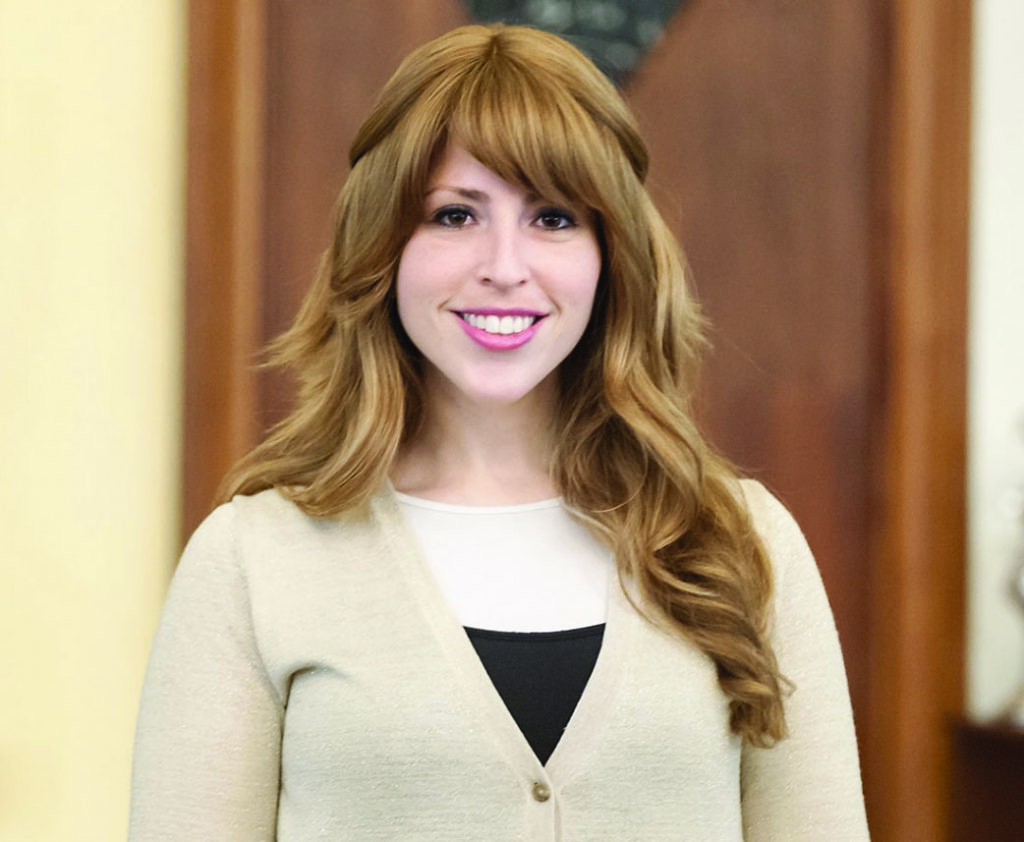
“My response is to continue teaching Torah and inspire others to connect to our mitzvot, to each other, and to HaShem,” said Rabbanit Alissa Thomas-Newborn of B’nai David-Judea, the first woman to serve as an Orthodox clergy member in Los Angeles.

Her view was echoed by Rabba Sara Hurwitz, co-founder and dean of Yeshivat Maharat in New York, the first yeshiva to ordain women as Orthodox Jewish clergy, including Thomas-Newborn.

Hurwitz said in a phone interview, “We remain resolute to continue to train and ordain and place our women in synagogues, college campuses and organizations, and we also know that there is a communal need for the voice, the unique voice that women bring to communities, and we think that the communities will be better off with male and female leadership.”

While Yeshivat Maharat is not governed by OU policy, B’nai David-Judea is, and its decision to ignore the ruling could have implications for its future relationship with the OU, a New York-based umbrella organization for Orthodox life with approximately 400-member synagogues as well as programs related to kosher food, youth and college campus life.

“BDJ has a longstanding positive relationship with the OU, and we hope to continue to in the future,” Thomas-Newborn said.

B’nai David-Judea is the only Los Angeles Orthodox synagogue with a female clergy member and one of only four in the United States.

The Jewish Orthodox Feminist Alliance (JOFA), which advocates for an expanded female leadership role in Orthodox life, denounced the OU ruling, saying, “We are confused as to why this is being raised now after women have been serving as halakhic spiritual leaders in OU synagogues for well over a decade.”

JOFA Executive Director Sharon Weiss-Greenberg said female clergy members can often serve in ways in which their male counterparts might be less effective, such as counseling women on issues pertaining to sexuality.

“There are various topics where women would rather speak to women, especially given the gender dynamics in the Orthodox community,” she said. “Certainly I would say it’s true when it comes to laws about sex and … family purity.”

She said she also found it troubling that none of the seven members of the OU panel that decided  against female clergy were women. Nor, she added, were women even consulted. “That speaks to the problem,” she said.

The OU’s self-described mission is “to engage, strengthen and lead the Orthodox Jewish community, and inspire the greater Jewish community.”

According to its 17-page ruling on female clergy, “Legal sources, historical precedent and the halakhic ethos” informed the panel’s decision, which echoes a 2015 statement by the Rabbinical Council of America, an association of Orthodox rabbis.

“We feel that the absence of institutionalized women’s rabbinic leadership has been both deliberate and meaningful, and should continue to be preserved,” it said. “This restriction applies both to the designation of a title for women that connotes the status of a clergy member, as well as to the appointment of women to perform clergy functions on a regular ongoing basis — even when not accompanied by a rabbinic type title.”

Thomas-Newborn’s responsibilities at B’nai David-Judea include delivering sermons, providing pastoral care and officiating lifecycle events. She is excluded from being counted toward a minyan, leading services and reading from the Torah before the congregation.

She said she has received widespread support from her community, following the OU’s decision “from BDJ and beyond, including from other Orthodox individuals in L.A. as well as from those of other denominations.”

She addressed the ban briefly at the beginning of her most recent Shabbat sermon, while the synagogue’s head rabbi, Rabbi Yosef Kanefsky, who has also denounced the OU ruling, was in Israel on a study trip. (In an opinion piece published on page 12, he called her sermon “an act of sacred civil disobedience.”)

“Over the past Shabbat, I expressed my gratitude to our community, and then taught on the Parsha, which is my duty and great joy,” Thomas-Newborn said.

Women have served as rabbis in the Reform movement since the 1970s and in the Conservative movement since the mid-1980s. While Orthodox Judaism has traditionally resisted naming women to clergy positions, an activist strain of Orthodox Judaism, known as Open Orthodoxy, has attempted to transform attitudes toward female leadership within the movement.

The OU ruling says women play an important role in Jewish life. It describes ways women who are interested in leadership positions can be involved, whether it is serving as a scholar-in-residence, working as an educator or being a synagogue staff member. Furthermore, it encourages women to educate themselves — to learn halachah — and use that knowledge of Jewish law to serve in leadership positions in their respective synagogue communities.

“The spiritual growth of our community is dependent upon a steady stream of talented women both serving as role models and teachers, and filling positions of influence,” the ruling says.

A synagogue faces two requirements in becoming eligible for OU membership: the synagogue must use an Orthodox siddur, and the synagogue must have in its worship space a mechitzah, a divider between male and female worshipers. Therefore, to issue statements regarding the hiring of clergy at synagogues is “not what the OU is really here for,” Weiss-Greenberg said.

Some critics of the ruling and accompanying statement have said it undermines the autonomy of individual synagogues. OU Executive Vice President Allen Fagin, however, disputes that.

“It’s important to stress the determination of the OU’s board was to adopt those responses [the OU ruling] as a statement of OU policy. We weren’t there to define for any particular synagogue how it was required to behave — that’s a determination the synagogues and their lay leadership need to make,” Fagin said in a phone interview. “What we were defining is OU policy.” 

Women leaders respond to prohibitive Orthodox ruling Read More »

Trump’s immigration order elicits action from Jewish community

Jewish leaders around Los Angeles have begun speaking out —  some more forcefully than others — against President Donald Trump’s immigration ban. And many temple congregants are doing more than merely listening.

“People are stepping forward because they see a direct call to their Jewish values in this moment,” said Senior Rabbi Ken Chasen of Leo Baeck Temple. “The values in the Torah and rabbinic literature are clear, and they are now being threatened. [Activism] feels like a very organic way to live out our Jewish values.” 

Trump’s effort to restrict entry to immigrants from seven Muslim-majority countries, including Iran and Iraq, has touched off protests around the country and a legal war that is likely headed to the Supreme Court to determine if the ban is constitutional. One protest in New York this week led to the arrests of about 20 rabbis affiliated with the liberal group T’ruah, according to The New York Times.

No arrests have occurred in Los Angeles, but the ban and other Trump actions have sparked outrage among many Jewish groups.

More than 200 Leo Baeck congregants participated in the Women’s March in Los Angeles the day after the inauguration, and large numbers attended a pro-immigrant demonstration at Los Angeles International Airport the following weekend. Chasen said he’s taking calls daily from people who ask what they can do to get involved.

Rabbi Sarah Bassin of Temple Emanuel of Beverly Hills said 65 congregations participated in the Women’s March, and last week, the synagogue hosted a class on immigration and refugees from a Talmud and Torah perspective. An American Civil Liberties Union representative talked to the group as well.

Bassin said she encourages her members to speak up and participate, even if she personally doesn’t have the same political views.

“I just gave a sermon on how we’ve channeled our civic engagement into yelling on social media and how that’s not civic engagement,” she said. “I don’t care where people are on the political spectrum as long as they responsibly and thoughtfully lend their voice into the public sphere from a place that’s motivated by Jewish values.

“I think Judaism has deeply woven into it the connection between politics and faith,” she added. “It’s very important that people have a safe space to articulate their values.”

“I think Judaism has deeply woven into it the connection between politics and faith.” – Rabbi Sarah Bassin

Rabbis Lisa Edwards and Heather Miller of Beth Chayim Chadashim are infusing their sermons and prayer commentaries with news and have added a weekly prayer for the country.

Edwards attended two meetings for interfaith clergy at the Islamic Center of Southern California, “aimed at what our communities can do in particular to help support Muslims and undocumented immigrants” and at the Holman Methodist Church, organized by Clergy & Laity United for Economic Justice-Los Angeles and the Southern Christian Leadership Conference. She learned that, “People are afraid and anxious. Anxiety is the more operative word than fear. People feel very aware about possible deportations.”

IKAR’s founder and Senior Rabbi Sharon Brous is also collaborating with other faith communities. The weekend of the inauguration, she organized events involving congregants from her synagogue as well as those from the Islamic Center mosque and All Saints Church in Pasadena.

“We have very robust and growing multi-face community relationships we work on and continue to prioritize right now,” Brous said. “We’re much more effective when we join together with mosques and churches.”

Brous, who spoke at the Women’s March in Washington, D.C., said the history of Jews as immigrants should prompt action.

“Our sacred texts demand that we stand up and fight for the most vulnerable people in our midst,” she said. “This is not about political preference. This is about moral imperative.”

Jay Sanderson, president and CEO of The Jewish Federation of Greater Los Angeles, distributed a letter by email in which he did not take a position for or against the president’s executive order, but detailed Federation’s work with Jewish immigrants and refugees. The letter said that since 1973, Federation has helped more than 27,000 refugees.

Other Jewish leaders made their feelings known through letters to their congregants.

Rabbi Yoshi Zweiback and his fellow clergy at Stephen Wise Temple indicated that “… because our Torah calls upon our Jewish people to be a moral light unto the nations, we feel it necessary to voice our profound protest to the President’s recent executive order that has the effect of banning people from certain Muslim majority countries, as well as all refugees for a period of 120 days, from entry into this nation.”

They reminded members of the temple’s namesake and his work for compassion and social justice: “We proudly commit ourselves to advocating for a society that embodies the teaching of our Torah: ‘The stranger who resides with you shall be to you as one of your citizens; you shall love the stranger as yourself for you were strangers in the land of Egypt.’”

For the past year and a half, Temple Beth Am has had a refugee task force. In a letter to his congregants, Senior Rabbi Adam Kligfeld said Trump’s executive orders “trouble me, to say the least.” But he acknowledged the complexity of the issues: “No country willy-nilly flings its doors open to anyone who wants in. There are reasonable fears regarding how the wrong immigration policy could enable terrorism, as some recent events in Europe have sadly shown. We have to take it seriously. Deal with it in some meaningful way. But we cannot let it paralyze us.”

Senior Rabbi Ed Feinstein of Valley Beth Shalom found inspiration for his letter by imagining his zayde confused, sitting in a detention cell at LAX. He called Trump’s order “destructive” and said we must be inclusive and “welcoming to those seeking the freedoms we cherish.”

Representatives of four religious groups — the Academy for Jewish Religion, California; Claremont School of Theology; University of the West; and Bayan Claremont, an Islamic graduate school — collaborated on a statement, saying, “As interreligious partners, we live the dream of inclusion, understanding, and compassion. We know there is a better way — better than building walls and banning human beings based on religious beliefs or country of origin.”

Without addressing the ban or taking sides in his letter to congregants, Senior Rabbi Steven Leder of Wilshire Boulevard Temple encouraged people to volunteer with the Karsh Family Social Service Center and to help build houses for the poor.

“Although I will not assume the role of political pundit, upholding the extremely high value Jewish law places on Shalom Bayit — maintaining a peaceful home and community — is a role I cherish,” he wrote.

Trump’s immigration order elicits action from Jewish community Read More »

Moving & Shaking: Jewish athletes celebrated, NFL players visit home shul, AIPAC holds gala

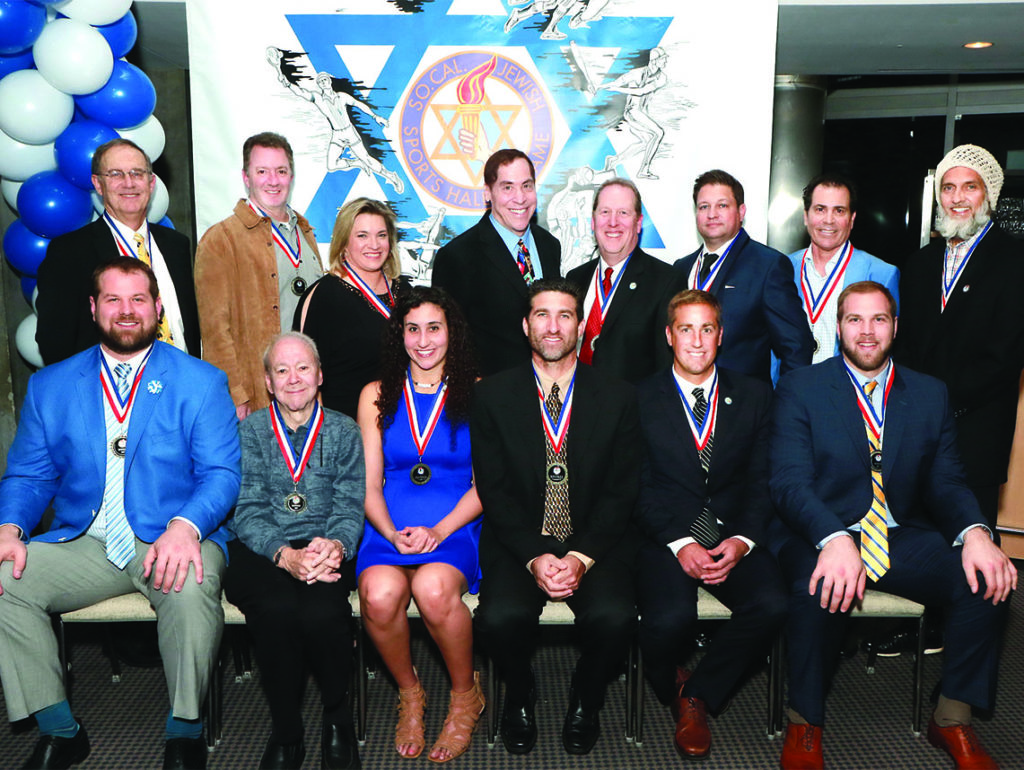
Fourteen athletes and sports media members were inducted into the Southern California Jewish Sports Hall of Fame on Jan. 28, during the organization’s 18th annual induction ceremony at the Skirball Cultural Center.

The 2016 inductees were Andrew Lorraine (baseball); Andy Hill (basketball); brothers Mitchell and Geoffrey Schwartz (football); Erik Aff-holter (football); Stanley Tarshis (gymnastics); Glenn Diamond and Marc Stein (media); Ramona Shelburne (softball); Andi Murez (swimming); Steve Kuechel (tennis); Andrew Bailey and Ashley Grossman (water polo); and Jerry Weinstein, a sports broadcasting producer who was awarded the Eli Sherman Pillar of Achievement Award.

The event also recognized as high school athletes of the year Allyson Rosenblum, a member of the Mater Dei High School girls basketball team, and Ben Goldberg of the Palisades High School tennis team. Henry Vogel, a student at Harvard-Westlake School, received the Allan Malamud Memorial Scholarship.

The Southern California Jewish Sports Hall of Fame spotlights distinguished amateur and professional athletes and people in sports-related activities and careers.


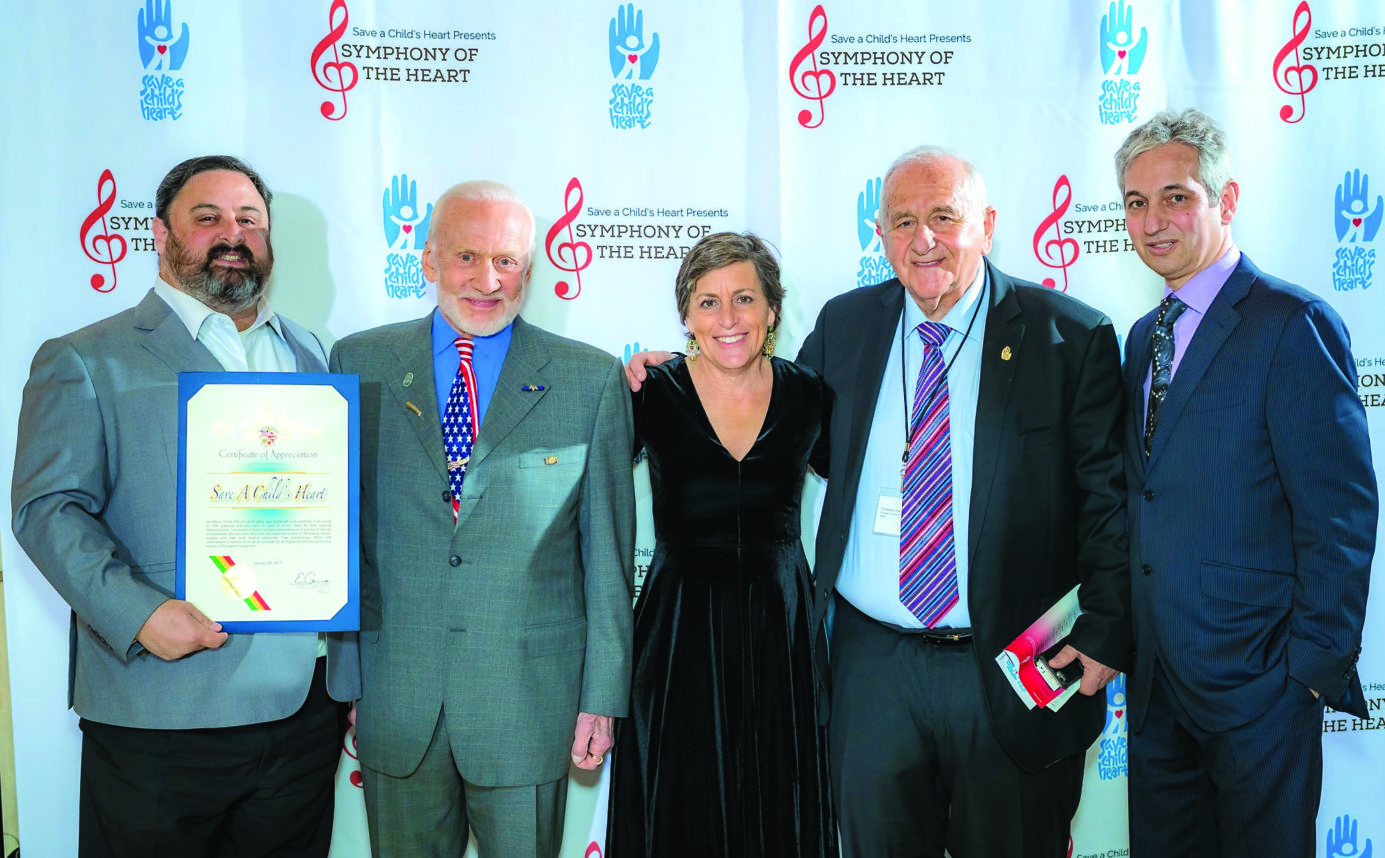
Kevin Taylor, representative of L.A. Mayor Eric Garcetti; Apollo 11 astronaut Buzz Aldrin; Save a Child’s Heart West Coast co-chair Judy Shore; Arie Schachner, co-founder of Save a Child’s Heart; and international president and Save a Child’s Heart West Coast co-chair David Shore attend the Israeli-based international humanitarian organization’s concert event. Photo by Pal Photography

long list of artists donated performances on Jan. 29 to the Symphony of the Heart concert, benefiting the Save a Child’s Heart (SACH) organization, at the Valley Performing Arts Center at Cal State Northridge.

The Israeli-based international humanitarian organization has provided lifesaving heart surgeries for children from 53 developing countries and creates centers of medical competence in those countries. The children are screened by volunteer doctors from SACH and then flown to Israel, where they are treated at Wolfson Medical Center in Holon.

More than 4,000 children have been treated at the Israeli center. One of those kids, Benjamin Baldwin, 7, was found in an orphanage in China, suffering from multiple heart problems. He was flown to Israel and had several heart operations. The little boy, who was adopted by a couple from Orange County, Melissa and Larry Baldwin, was all smiles during the gala event.

Producer and television writer David Shore and his wife, Judy, who are supporters of SACH, attended the event. Holding Benjamin in his arms, David Shore, who created the TV series “House,” told the touching story of the boy, who was not able to run and play like other kids his age due to his illness but is now healthy and physically active.

“So, what do you like to do best?” Shore asked Benjamin, expecting an answer along the lines of “Run, climb and jump.” Benjamin hesitated for a moment before answering,“Play with my iPad,” eliciting a roar of laughter from the audience.

Among the performers at the concert were Israeli singer Rita; her daughter, singer Meshi Kleinstein; singer Melissa Manchester; singer Liel Kolet; the Keshet Chaim Dance Ensemble; and the Los Angeles Jewish Symphony.

Pianist Emily Bear, 15, stole the show while performing a piece she composed three years ago, along with a jazz rendition of Rimsky-Korsakov’s “Flight of the Bumblebee.” Bear started playing at age 2 and already has 10 years of experience as a professional concert pianist.

The concert ended with the audience standing and singing John Lennon’s “Imagine” along with the performers onstage.

Among the 1,500 attendees was astronaut Buzz Aldrin, 87, the second man to walk on the moon and a supporter of SACH.

— Ayala Or-El, Contributing Writer


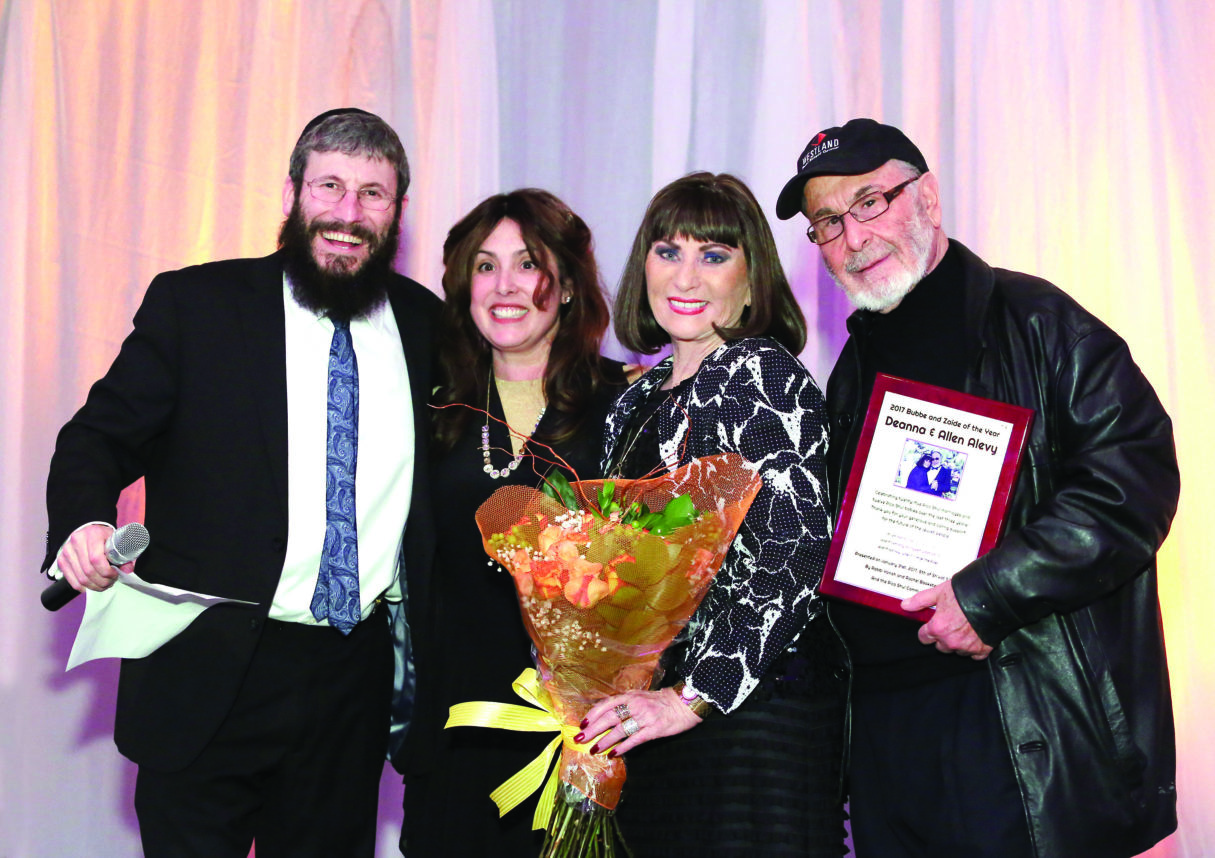
Pico Shul Rabbi Yonah Bookstein and his wife, Rachel, join Deanna and Allen Alevy at the Dinner Party Charity Soiree. Photo by Jonah Light Photography

Pico-Robertson Orthodox congregation Pico Shul held its Dinner Party Charity Soiree at the Mark for Events on Jan. 31.

During the event, which drew about 160 attendees, Pico Shul Rabbi Yonah Bookstein and his wife, Rachel, presented philanthropic husband and wife Allen and Deanna Alevy with the 2017 Bubbe and Zaide of the Year award. The Alevys have underwritten Bookstein’s position at the shul, “so that all funds raised during the year are for Pico Shul overhead, staff and programming,” according to the event website.

The evening featured Pico Shul resident yogi Marcus Freed leading meditation sessions in a “Soul Revival” tent while a guitarist fingerpicked “Jerusalem of Gold” on the opposite side of the room. Meanwhile, Simon Wiesenthal Center co-founder Rabbi Marvin Hier, Chai Center Vice President Mendel Schwartz and others mingled over glasses of kosher wines from Shirah Wine Co. and appetizers prepared by, among others, Mexikosher chef Katsuji Tanabe, Kosher Latin chef Deborah Benaim and organic kosher food expert Sarah Zulauf.

Artwork by Fabian Lijtmaer decorated the walls; members of the band Moshav played upbeat traditional music. Lijtmaer, when not discussing his artwork to admirers, staffed a carnival-style game testing players’ Torah knowledge.

Founded three years ago, Pico Shul operates in the Pico-Robertson neighborhood out of a former fish market. The community comprises 20- and 30-somethings interested in leading observant lives while participating in activities such as Shabbat celebrations at music festivals and camping trips in the mountains.

Pico Shul’s Bookstein has led Jewish communities all over the world, including in Poland, Long Beach and Los Angeles.


Mitchell and Geoff Schwartz, along with Rabbi Nolan Lebovitz, participate in a recent program at Adat Shalom. The Schwartzes attended religious school and became b’nai mitzvah there. Photo courtesy of Adat Shalom

NFL players Mitchell and Geoffrey Schwartz appeared at congregation Adat Shalom on Jan. 29 to discuss their book, “Eat My Schwartz: Our Story of NFL Football, Food, Family and Faith,” in a conversation with the synagogue’s Rabbi Nolan Lebovitz.

The visit to the West Los Angeles synagogue was a homecoming for the brothers, who attended religious school and became b’nai mitzvah at Adat Shalom. Geoffrey, the older of the two, is a free agent who has played for five NFL teams, while Mitchell plays for the Kansas City Chiefs. The two offensive linemen are the first pair of Jewish brothers to play in the league in nearly 100 years.

We were overjoyed to have them back,” Lebovitz said in an email following the event, which drew more than 120 people. “The entire community had a ton of fun with them.”


Firefighter Ben Arnold at the AIPAC gala dinner. Photo by Timothy J. Carr
Firefighter Ben Arnold at the AIPAC gala dinner.
Photo by Timothy J. Carr

The pro-Israel lobbying organization American Israel Public Affairs Committee (AIPAC) Los Angeles held its gala dinner Feb. 1 at the Beverly Hilton.

Retired U.S. Navy Admiral James Stavridis, a former NATO commander and the evening’s keynote speaker, appeared in an interview with AIPAC Los Angeles Director Julie Munjack. The two discussed the importance of a strong U.S.-Israel relationship.

The event also featured appearances by Los Angeles Fire Department firefighter Ben Arnold, who leads the Emergency Volunteers Project, an Israeli-backed organization that trains emergency responders abroad to assist in Israel in times of need, and AIPAC Regional Director Wayne Klitofsky, who delivered the “State of AIPAC” address.

The event also commemorated late Israeli president and prime minister Shimon Peres, who died in 2016.

Attendees included California Secretary of State Alex Padilla and Sam Yebri, president of 30 Years After.

Moving & Shaking highlights events, honors and simchas. Got a tip? Email ryant@jewishjournal.com.

Moving & Shaking: Jewish athletes celebrated, NFL players visit home shul, AIPAC holds gala Read More »

Science and technology camp coming to California

Parents who want their kids to have a Jewish camp experience but also a summer of science learning soon won’t have to choose between the two.

The Union for Reform Judaism (URJ) is planning a science and technology camp in California, the Union’s first such camp on the West Coast. The 6 Points Sci-Tech Academy is set to open in the summer of 2018 at a site to be determined, with organizers expecting several hundred campers in fifth through 11th grades for two-week overnight sessions.

The camp will be modeled after URJ’s science and technology camp in the Boston area, which began in 2014 and now attracts about 500 students each year. Campers explore a variety of scientific fields, such as robotics, video game design, computer programming, forensics and environmental science, all within the context of Jewish practices and values. Each student picks an area of study, along with two electives, each week.

The West Coast camp is being funded by grants from the Foundation for Jewish Camp and the Jim Joseph and Avi Chai foundations.

“We’re so excited to be able to bring this to California,” said Miriam Chilton, the URJ’s vice president for youth initiatives. “We think it will be a really powerful fit for the Jewish community.”

The URJ is exploring locations in both Southern and Northern California, Chilton said. Once a site is found, the plan is to design a camp curriculum that draws on the expertise and industries in the surrounding area: animation and film in Southern California, for example, or computer technology if located closer to Silicon Valley, according to Chilton.

“We’re still looking for the perfect location,” she said. “We’re searching for an environment where the camp can feel very intimate, where [the campers] have freedom of movement, where the facilities are top-grade, and where they can experience both the advantages of technology equipment and labs but have a wonderful outdoor space.”

Chilton said the URJ expects to have a site for the camp identified by March.

Jordanna Flores, a former assistant director of the Hebrew Union College-Jewish Institute of Religion’s School of Education, Los Angeles campus, is serving as director of the West Coast camp. She has a wealth of experience leading educational and youth programs.

Flores said she hopes the science camp will appeal to kids who might not be interested in traditional Jewish summer camp.

“The idea of specialty camp is that we can reach kids who just wouldn’t find enough stimulation at a general camp and reach them through the specific thing that gets them excited and shows them how that thing can intersect with their Judaism,” she said. “A kid who loves robotics or designing video games can do it through a Jewish lens and see how those things can be Jewish.”

A goal of the camp is to bring in scientific experts — particularly Jewish ones — to talk with kids about cutting-edge research and take campers on field trips to see science at work, Flores said.

Campers will gain not only new scientific knowledge but also an understanding of how science and technology relate to the Jewish faith and people, Flores said. She cited examples such as how astronomy ties into the Jewish calendar and how biotechnology innovation in Israel prevents tomatoes from going bad during shipping.

“Education and creativity and approaching problems in a different way is part of our Jewish history, it’s part of our Jewish culture,” Flores said. “The way that the State of Israel was founded and all of the technological innovations coming out of Israel, it’s a very [Jewish] thing to approach something in an innovative way.”

A science camp in Southern California would be URJ’s second in the area, operating in the style of 6 Points Sports Academy on the campus of Occidental College, and its seventh speciality camp overall. The per-camper cost for the California Sci-Tech Academy is projected to be similar to the $3,100 cost of the sports camp, Flores said. Scholarships also will be made available, she said.

Chilton said she hopes students who attend the science camp will leave with “a sense of curiosity to want to continue to learn, and also very much a sense of pure joy. An understanding of how they themselves fit into the larger world, not only in terms of
the skill acquisition … but also how those skills help build out a strong and vibrant community.”

For more information about the URJ 6 Points Sci-Tech Academy in California, visit 6pointsscitech.org/california.

Science and technology camp coming to California Read More »

How grandmother paid her passage to New York

One by one her mother sold her silver spoons
and heirloom bracelets, goodbye porcelain bear,
silk blouses, patent-leather Mary Janes, the scarves
and stud earrings for newly pierced ears, the red wool coat
spotted walking on another tiny body’s shoulders
down Wittenbergplatz. Goodbye books bound
in leather, bone china, even the hangers, the goblets
and cabinets, goodbye to the Torah buried in the backyard,
the neighbors, the schoolmates, the mothers dressed so well
at services, the men with businesses who stayed behind
one week, two weeks more. What stylish
objects they became: the coins from fillings
and wedding rings, the soap, the wigs, lamp
after lamp to light a thousand decorated homes.


Rachel Mennies is the author of “The Glad Hand of God Points Backwards,” Texas Tech University Press (2014), winner of the Walt McDonald First-Book Prize in Poetry. She teaches at Carnegie Mellon University and is a member of AGNI’s editorial staff.

How grandmother paid her passage to New York Read More »

Two Journal writers shine, in poetry and prose

Readers of the Jewish Journal already know the work of Carol V. Davis, our poetry editor, and Tom Teicholz, author of the long-running “Tommywood” column. Now we can read the literary efforts of Davis and Teicholz between the covers of two newly published books, each one notable for the light it casts on their work.

“Being There: Journalism 1978-2000” by Teicholz (Rare Bird Books) is a collection of his essays and profiles, appropriately described by its publisher as “like the best dinner party you never went to.” We eavesdrop on Teicholz in conversation with movers and shakers ranging from rock impresario Bill Graham to financier Baron Guy de Rothschild, from junk-bond-king-turned-philanthropist Michael Milken to Nobelist and Yiddishist Isaac Bashevis Singer, and even novelist Jerzy Kosinski, author of the novel that shares a title with Teicholz’s book. Many of these pieces first appeared in The Paris Review, The New York Times Magazine, and The New Yorker, but the anthology is leavened with a few previously unpublished pieces.

As we discover in the autobiographical preface to “Being There,” the title is the key to understanding Teicholz’s writing career as well as the principle of selection that produced the book itself. He describes how he made the scene with the literati and glitterati of Manhattan starting in the mid-1970s, a who’s who of artists, writers and celebrities of every stripe: “Being there was a case of right place, right time,” he explains. “Journalism was a way in — to people, places, experiences as much reason as excuse always to be learning.”

Teicholz displays all of his characteristic wit and insight. He dubbed Singer “the Yiddish Yoga,” for example, and reports that Kosinski thought Peter Sellers was too old for the role he played so memorably in the movie version of “Being There,” but reconciled himself to the casting decision because Sellers “underwent plastic surgery for the role.” Some of Teicholz’s most sustained and important journalism, by contrast, focuses on aspects and echoes of the Holocaust, including an article about the protest against Ronald Reagan’s visit to the Bitburg cemetery in Germany, where SS troops are among the buried, and the war crimes trial of John Demjanjuk in Israel.

Teicholz, who is a producer as well as a journalist (and, by the way, an attorney), has an eye for the telling detail and the revealing word, as he demonstrates in “The Trial of John Damjanjuk,” which was first published in the Forward in 1990.

“There had been talk that Demjanjuk would sit in Adolf Eichmann’s bulletproof glass booth, but security officials decided against that precaution,” he writes. “Wearing a brown suit, he had adopted Israeli custom and wore no tie, just an open shirt. … Demjanjuk raised his arm in what some feared would be a salute but turned out to be a gentle wave of his hand. He shouted in his deep voice, ‘Boker tov’ — Hebrew for ‘good morning’ — and then, ‘Hello, Cleveland,’ to the TV cameras.”

Davis’ work for the Jewish Journal consists of curating the poetry of others, but her book “Because I Cannot Leave This Body” (New Odyssey Series/Truman State University Press) is a showcase for her own verse, both exquisite and powerful. Perhaps the best way to signal the extraordinary scope of her work is to note that the new collection includes a glossary with definitions ranging from “Hamsa” to “Kufi” to “Tzitzit.” Equally significant is the fact that an earlier book of her poetry, “It’s Time to Talk About” was published in Russia, which Davis twice visited as a Fulbright scholar, in an English-Russian edition.

Poetry criticism requires a vocabulary that is often intelligible only to other poets, but I think it is both useful and accurate to say that the poems in Davis’ new collection are blessedly accessible to the general reader, always lucid and affecting. Her eye travels from the flawed beauty of a coneflower to the blackbirds on the Nebraska prairie to the long shadows of Vietnam and Jonestown. Sometimes she will share a golden memory of childhood, as in the poem titled “Dare,” and then confront us with the fate that befell one childhood friend who served in Vietnam and another whose mother took him to the Jonestown commune — and yet the hard truth does not overmaster the delicacy of her verse.

Her eye falls on mundane sights but her mind conjures up mystery and mayhem. The title of a poem about a beauty supply store on Pico Boulevard is “Money Laundering,” for example, and the title of a poem about life’s trivial annoyances is “Contemplating Murder.”

Yet she is just as capable of soaring into the sublime, as in the poem “Because,” which describes a visit to a Russian monastery in the Pushkin Hills:

Because I cannot leave this body
I dream I am flying
The air splits subdivides
Splinters into layers of grey and worn lavender

* * *

Because I cannot leave this body
I climb a circular staircase to the bell tower.

A line from “Because” gives the collection its title, a fitting reference because her words take flight in one poem after another, and Davis invites us to fly with her.


JONATHAN KIRSCH, author and publishing attorney, is book editor of the Jewish Journal.

Two Journal writers shine, in poetry and prose Read More »

A bar mitzvah amid tears — and kvelling

This was a day that Loren Evans’ family thought they would never see.

In a heartwarming ceremony featuring an unlikely front man, Loren — a high-functioning autistic 18-year-old — celebrated his bar mitzvah at a landmark Los Angeles synagogue.

The young computer whiz also suffers from selective mutism, an anxiety disorder which makes it nearly impossible for him to speak to anyone except family members, let alone headline an oration-heavy bar mitzvah.

With the help of a volunteer leader from Camp Chesed, a camp for young people with special needs, and a Chabad rabbi, Loren stood on the bimah and participated in the ceremony to his fullest ability.

“Loren was glowing brighter than I’ve seen him glow in a very long time,” his mother, Gilda, said. “It brought him great joy, meaning and fulfillment. I think he smiled more than I’ve ever seen him smile.”

The bar mitzvah took place on Dec. 25, Christmas Day as well as the first day of Chanukah, at the Breed Street Shul in Boyle Heights, one of the city’s most historic houses of worship. About two dozen or so friends and relatives attended.

Loren, who lives with his family in Tarzana, currently attends Pierce College and has an affinity for electronics and computers, which his mother says he hopes to parlay into a future in the gaming world.

However, Loren’s family, longtime members of Stephen Wise Temple, previously had doubted he would be able to follow in the footsteps of his older brother and sister in the bar and bat mitzvah tradition.

“I had always assumed Loren’s personal challenges would prohibit it,” his mother said. “We weren’t sure it was feasible.”

camp-jaquesJacques Hay, a man the Evans family knew well, had other plans, offering to make all the bar mitzvah arrangements.
Hay, a short, bubbly man with gray stubble, owns a store in Northridge that sells awards, plaques and trophies. For the past 21 years, he has run Camp Chesed, a Reseda-based, two-week-long summer camp for Jewish children with special needs. The camp is free for all campers, and its operations rely on private donations Hay works to obtain.

Loren attended Camp Chesed for the past five summers. Several Camp Chesed alumni and their families were present for his bar mitzvah.

A few weeks before the big day, Hay called Gilda to invite the family to a Chanukah party for Camp Chesed campers, counselors, alumni and families. During that same call, he proposed giving Loren a bar mitzvah.

“When he said to me it’s something Loren deserves, the tears began to flow. I asked Loren and he didn’t hesitate,” Gilda Evans recalled.

Hay met with Loren once before the bar mitzvah for a 1 1/2-hour tutoring session about the Chanukah haftarah portion that would be read on his special day. They went over the prayers and what Loren’s role would be.

At the ceremony, Loren stood smiling next to Hay’s friend Rabbi Yitzchak Sapochkinsky of Chabad of Westlake Village — who made the more than 50-mile trip to officiate.  Loren carried the Torah in the procession around the chapel. He then followed and pointed at the text of his haftarah portion while the rabbi sang. Sapochkinsky gave voice to the voiceless and the ceremony reduced many to tears.

Gilda; Loren’s older brother, Louis, and grandparents Ernest and Ida Braunstein were in attendance. His older sister, Leigh, watched via Facetime from Boston, where she works for AmeriCorps.

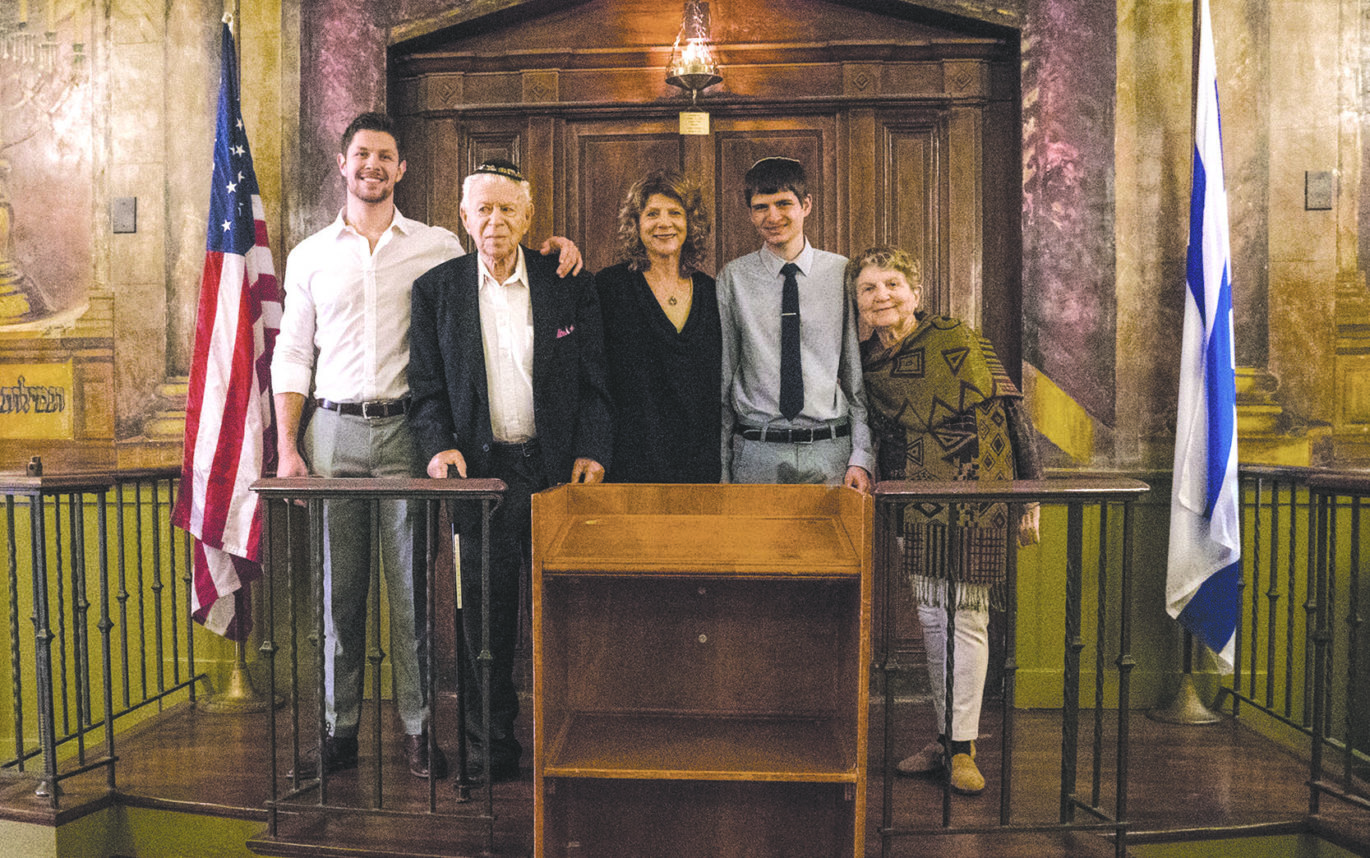
From left: Family members Louis Evans, Ernest Braunstein, Gilda Evans, Loren Evans and Ida Braunstein gather on the bimah at the Boyle Heights synagogue.

Loren’s 92-year-old grandfather joined the man of the hour on the bimah. Behind them, an ornate mural depicted lit chanukiyahs and commandment tablets, a permanent fixture in the sanctuary, which recalls the heritage of the 101-year-old synagogue. A Holocaust survivor who has macular degeneration, rendering him blind, Ernest Braunstein recited an aliyah from memory. His 88-year-old wife watched alongside Gilda in the women’s seating section.

Louis beamed with pride as he aimed his cellphone at the altar so his sister Leigh could watch from the East Coast.

“I’m just happy he got to have a bar mitzvah like my little sister and I did,” Louis said. “Now it’s all three of us. It’s so great for my grandfather. All the culture, tradition and heritage is really important to him. He, along with the rest of the family, really loved seeing him up there.”

Gilda was quick to credit Hay, saying, “It was all due to the generosity of [Jacques], who is one of the most amazing people I’ve met in my life.”

During the summer, Hay’s Camp Chesed hosts about 40 campers of all ages. For every camper, there are two to three counselors, usually volunteer high school and college students. Hay’s campers span the gamut of special needs, although he estimates more than 80 percent are on the autism spectrum.

In recent years, Camp Chesed has treated campers to trips to Disneyland and Universal Studios, as well as flights over the greater Los Angeles area in two-seater airplanes.

At the ceremony, Hay was modest and shrugged off the amount of time and energy he pours into performing good deeds.

“This is what Camp Chesed does,” he said. “It’s a very special camp.”

Hay told the Journal he has had seven campers bar mitzvah’d under his watch. Four years ago, he helped coordinate a Breed Street Shul bar mitzvah of another Camp Chesed alumnus, a young man with a brain tumor.

“Eighty thousand Jews used to live within a five-mile radius of this place,” he said of the synagogue. “It’s the oldest and maybe most respected synagogue in Los Angeles. Coming back here is like going back to the future.”

Once the hub of the city’s Los Angeles Jewish community until many Jews migrated to West Los Angeles and the San Fernando Valley after World War II, the Breed Street Shul later fell into disrepair and was vandalized. An ambitious restoration project that includes seismic retrofitting and repainting is under way. The large, iconic Byzantine-style sanctuary remains closed for that work. The smaller chapel to the rear, where Loren’s bar mitzvah was held, is now used mainly as a community center serving the largely Latino population of Boyle Heights.

Founding and board president of the Breed Street Shul Project Stephen Sass, who was present for the bar mitzvah, has overseen the restoration for the past 16 years. Sass said the shul hosts a Jewish event such as Loren’s bar mitzvah four or five times a year.

Gilda, who knew little of the shul’s history before Hay filled her in, deemed it a perfect setting for the occasion.

“How appropriate is that? It’s amazing to have a young man overcome seemingly impossible odds and accomplish this wonderful mitzvah in a place that also overcame impossible odds to be restored as the place of worship it is today,” she said.

Gilda went on to say that she hopes more people with special needs draw motivation from what Loren was able to do.

“I hope this will serve as an inspiration to other young people who have challenges, obstacles they perceive too difficult to overcome, and who might be able to accomplish the same thing. I hope this will inspire them to take another look at it, adopt another viewpoint and perhaps find a way to have the same wonderful experience.”

After the bar mitzvah and a bagel brunch, 450 guests attended a Chanukah party for Camp Chesed alumni and families on an Encino estate, home to a prominent camp donor. Loren was bestowed with the honor of lighting the menorah welcoming the second night of Chanukah.

A bar mitzvah amid tears — and kvelling Read More »

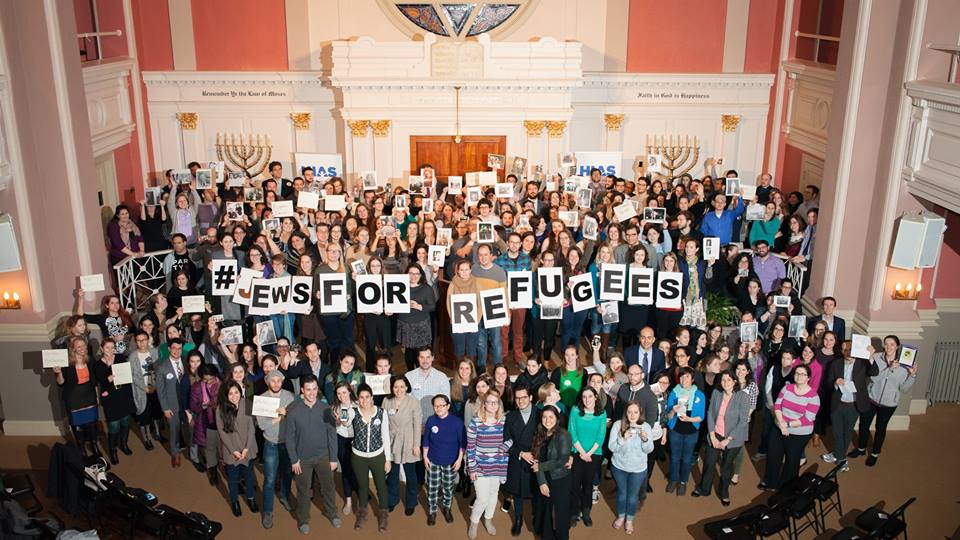
HIAS sues Trump over refugee order in first for resettlement agency

A Jewish refugee resettlement agency filed a lawsuit against the federal government Feb. 7 on behalf of Muslim immigrants, a first for the 138-year-old organization.

HIAS, formerly the Hebrew Immigrant Aid Society, sued President Donald Trump in a Maryland district court Wednesday. As one of nine State Department sponsors, HIAS provided services to 350,000 refugees and asylum seekers last year.

The class-action suit also names the Departments of Homeland Security and State and their chiefs as defendants.

In the filing, HIAS alleges the president’s Jan. 27 order restricting entry to the United States from seven Muslim-majority countries “was intended and designed to target and discriminate against Muslims.” The order also freezes global refugee admissions.

By suing the government over the order, HIAS joins a number of parties that have taken Trump to court, most notably the state of Washington in a case currently under consideration by the Ninth Circuit Court of Appeals. A ruling from a lower court in that case blocked Trump’s order. In a tweet, Trump said that ruling was “ridiculous and will be overturned!”

HIAS and its co-plaintiff, the International Refugee Assistance Project, are represented by attorneys from the American Civil Liberties Union.

The complaint alleges that the order violates the First and Fifth Amendment rights of Muslims in the country by singling them out based on their faith.

It names as plaintiffs several Muslims legally residing in the U.S. who are negatively impacted by the order, for instance, because they can’t leave the country without fear of being permanently barred.

“Our history and our values, as Jews and as Americans, require us to fight this illegal and immoral new policy with every tool at our disposal—including litigation,” HIAS President and CEO Mark Hetfield said in a statement.

The suit quotes the Torah as commanding Jews to “love the stranger because ‘we were strangers in the land of Egypt.’”

“The Executive Order severely impedes HIAS’s religious mission and work by intentionally discriminating against Muslims,” the suit alleges.

The lawsuit acknowledges that the order has been temporarily blocked by the Washington case, but notes that a reversal of the judge’s ruling would “reinstate the Executive Order in its entirety.”

The day before HIAS filed suit, the Jewish Federation of Greater Seattle filed an amicus brief with the 9th Circuit Court of Appeals in the Washington case, referencing Jewish refugee migration in the 20th Century and asking that the appeals court “heed the lessons from the past and uphold the district court at this historic juncture in our nation’s history.”

HIAS sues Trump over refugee order in first for resettlement agency Read More »