fbpx

February 9, 2017

Obituaries: Week of Feb. 10, 2017

Harold Alden died Jan. 7 at 88. Survived by wife Geraldine; daughter Tracey (Richard) Martin; sons Tony (Lucinda), David (Dina); 7 grandchildren; 1 great-grandchild. Hillside

Sadie Blumberg died Jan. 12 at 72. Survived by daughter Ethne McGuire; son Morris. Hillside

Fred Evans died Jan. 8 at 79. Survived by wife Elisabeth “Betsy”; daughters Jennifer Levin, Samantha (Dan), Molly (Max); sons Ted (Tracy), John VanSchraeder; 2 grandchildren. Hillside

Steven Feldman died Jan. 6 at 49. Survived by mother Diane; father Daniel; sister Wendy. Hillside

Randy Granovetter died Jan. 12 at 65. Survived by daughter Jo Anna (Vincent) Manganello; brother Richard (Susan) Freidman; 1 grandchild. Hillside

Eleanor Jacobson died Jan. 5 at 94. Survived by daughters Sheryl, Linda; son in-law Jeffrey Rosen; 2 grandchildren;1 great-grandchild. Sholom Chapels

Charles Kuperman died Jan. 12 at 79. Survived by wife Judy; daughter Lisa Veylianti; son John; 3 grandchildren. Hillside

Sylvia Levey died Jan. 8 at 99. Survived by nieces Susan (Hillel) Aronson, Janice; nephews Harry (Pegi), Michael, Albert. Hillside 

Maxine F. Meyer died Jan. 20 at 71. Survived by brother Robert. Simpson Gaus (Kingston, N.Y.)

Obituaries: Week of Feb. 10, 2017 Read More »

Preserving the barrier between church and state

Lyndon Baines Johnson is undoubtedly rolling over in his grave. For more than six decades — with bipartisan support from Republican and Democratic presidents and members of Congress — a landmark law has stood as a bulwark against using public funds to breach the wall separating church and state. The so-called Johnson Amendment — authored by LBJ during his Senate tenure (but passed by a Republican-majority Congress and signed into law by President Dwight D. Eisenhower) — prevents all tax-exempt entities, including religious organizations, from directly or indirectly participating in any political campaigns on behalf of, or opposed to, any candidate. At the risk of losing this tax-exempt status, the Johnson Amendment expressly forbids all rabbis, ministers and imams from using their pulpits as partisan political platforms.

Spurred on by his evangelical right-wing base, President Donald J. Trump has now pledged to “get rid of and totally destroy” this decades-long, common sense legislation. Fortunately, the Jewish community understands the dangers posed by such a radical revision. In a strongly worded statement issued the day Trump uttered his vow at the National Prayer Breakfast, the American Jewish Committee (AJC) said a repeal of the Johnson Amendment “would result in government support — through the tax code — for religious speech in a manner contrary to binding interpretations of the Constitution’s Establishment Clause.” And if applied to all tax-exempt organizations, the AJC properly warned that such a change “would threaten to drag civil society more broadly — from museums and other charitable organizations, to national, communal and religious groups of every sort — into the political arena.” Joining the AJC in expressing immediate outrage was the Baptist Joint Committee for Religious Liberty, noting that “politicizing churches does them no favors.”

Trump’s obsequious effort to pander to Christian conservatives’ desire to “totally destroy” a law that has well served the principle of church-state separation cannot be accomplished by means of a mere executive order. Only Congress can change the tax code. Unfortunately, House Speaker Paul Ryan (R-Wis.) quickly quipped that he had “always supported” such a repeal. Moreover, the day before Trump’s speech, House Majority Whip Steve Scalise (R-La.) and Sen. James Lankford (R-Okla.) separately introduced House and Senate bills to accomplish this goal. And Rep. Walter Jones (R-N.C.), who has introduced unsuccessful repeal legislation in every session of Congress since 2001, hopefully declared, “This is the best opportunity we’ve had.”

Meanwhile, even if Congress declines to repeal the Johnson Amendment, the same functional result may be achieved if Trump directs the Internal Revenue Service not to enforce the law. Indeed, since 2008, more than 2,000 mostly evangelical clergy have dared the IRS to do its job by holding “Pulpit Freedom Sundays,” during which their sermons incorporate political views; only one such case has ever been investigated and no one has been punished.

Beyond encouraging the unseemly spectacle of religious leaders pontificating about partisan political campaigns, any actions that undercut the efficacy of the Johnson Amendment will allow churches to spend their congregants’ tax-exempt 501(c)(3) donations to support political campaigns. This scenario poses at least two problems. First, there is no reason why we should allow tax-free dollars to be used to support or oppose candidates for public office. If individuals want to spend their money on political campaigns, they should do so with after-tax dollars, rather than asking other taxpayers to subsidize their partisan electoral choices.

Second, nonprofit organizations such as religious groups do not have the same federal tax reporting obligations as those required of PACs. If campaign funding were funneled through houses of worship, political spending could become even less transparent than it already is. In the words of David Herzig, a Valparaiso University tax law professor, “If you allow churches to freely allow political activity … you’ve turned those into Super PACs.”

As with many of the hot-button campaign issues that the Trump presidency has now moved to the front burner to the delight of his die-hard supporters (such as building a Mexican border wall,  barring refugees and deporting immigrants), the broader American public opposes the philosophical basis for repealing or weakening the Johnson Amendment. In 2015, Lifeway, a Christian polling firm, found that 79 percent of Americans thought that religious leaders should not endorse politicians from the pulpit. Now that the Trumpian gauntlet has been thrown down, it will be up to this silent majority to ensure that the church-state wall remains in place and that tax deductible donations are not used to support political campaigns. And so long as the Johnson Amendment remains the law of the land, the IRS should not render it a dead letter through coerced non-enforcement.


Douglas Mirell is an attorney and board member of the ACLU and ACLU Foundation of Southern California. As a volunteer attorney, he has litigated numerous church-state separation and other First Amendment cases. He can be reached at dmirell@hmafirm.com

Preserving the barrier between church and state Read More »

Edward Blau entertainment attorney, 94

Prominent entertainment attorney Edward Blau died at his Los Angeles home on  Jan. 31, surrounded by his family.  He was 94.

Blau was born in the Bronx, N.Y., on Aug. 3, 1922. His parents emigrated from Hungary in the early 1900s and ran a successful neighborhood bakery.

His clients included many luminaries from the world of entertainment, including writer Henry Miller; TV personality, musician, writer and actor Steve Allen; actors Fred Astaire, Rock Hudson, Dennis Hopper and Jerry Mathers; comedians/actors Jerry Lewis and Rowan & Martin; singers Bobby Darin and Dionne Warwick; magicians Siegfried & Roy; the Magic Castle; and Ralph Edwards Productions. He represented renowned singer Johnny Mathis for more than 50 years.

He received an honorary award from the Caucus for Producers, Writers and Directors for his dedication to the organization. He mentored junior attorneys, many of whom became successful entertainment figures.

From an early age, Blau excelled in school, graduating from City College of New York with a degree in business administration. During World War II, he enlisted in the United States Army Air Corps (forerunner of the U.S. Air Force), achieving the rank of first lieutenant. After serving in the military, he graduated from Harvard Law School in 1951. His career began with the MCA talent agency in New York, where he worked closely with legendary talent agent and studio executive Lew Wasserman. He then drove across the country to Los Angeles, where he became a prominent entertainment attorney and a partner at a prestigious law firm before eventually branching out on his own.

He loved to regale friends with stories and jokes, and approached every challenge as an adventure, his family said. He enjoyed his daily newspaper, watching movies at the Academy of Motion Picture Arts and Sciences, playing tennis and playing with his grandchildren, his family added.

Blau is survived by his wife, Rita; children Gary, Roni and Sharon (Scott); granddaughters Ariella and Elana; sister Rita Goldstein; and nephew and nieces.

Edward Blau entertainment attorney, 94 Read More »

U.S. has no official reaction to passage of controversial Israeli settlement law

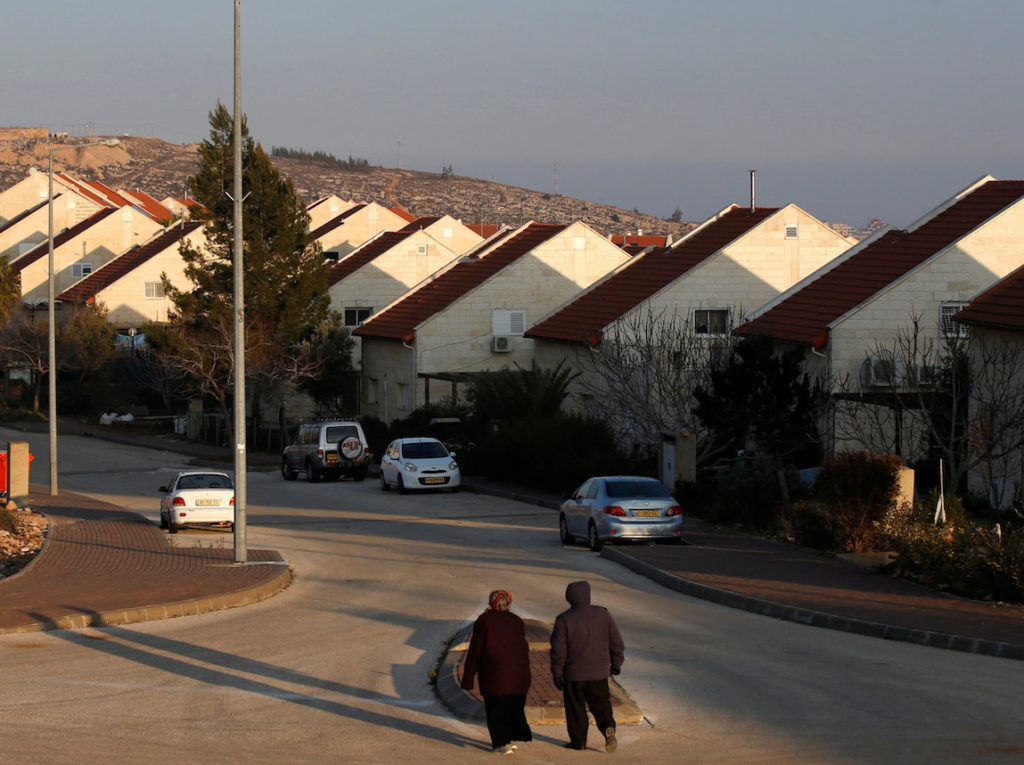
The United States refused to comment on Israel’s passage of a bill that retroactively legalizes settler homes built on private Palestinian land, saying the Trump administration was suspending judgment.

The White House’s immediate response to the controversial “regulation law” passed on Feb. 6 was to refer to its statement from the previous week that said the expansion of West Bank settlements “may not be helpful” to achieving Israel-Palestinian peace.

The Knesset passed the bill by a vote of 60-52 in a raucous late-night session, applying Israeli law to West Bank land for the first time. All but one of the lawmakers present from Prime Minister Benjamin Netanyahu’s right-wing ruling coalition supported the bill, while most of the opposition voted against. The law may still be overturned by the High Court of Justice.

The U.S. State Department said, “At this point, indications are that this legislation is likely to be reviewed by the relevant Israeli courts, and the Trump administration will withhold comment on the legislation until the relevant court ruling.”

A State Department official also told the French news agency AFP on condition of anonymity that the Trump administration needed “to have the chance to fully consult with all parties on the way forward.” The official added that Washington still hopes for a peace deal but understands the law will face judicial challenges.

The United Nations envoy for the Middle East peace process said the regulation law crossed a “thick red line” toward Israeli annexation of the West Bank, France called on Israel to “take back” the law, and Jordan and Turkey condemned it. Great Britain condemned the legislation hours after Netanyahu visited Prime Minister Theresa May, the European Union postponed a planned summit with Israel and the Palestinians called on the world to take punitive action.

The Palestinian delegation to the U.N. also denounced the measure, saying it was a clear violation of international law, including the recently adopted Security Council Resolution 2334.

“Adoption of this law is a clear sign that Israel is not interested in committing to the two-state solution nor in bringing about peace and stability to the region,” the statement said.

The pro-settlement Jewish Home party first put forward the legislation in an effort to save the West Bank outpost of Amona, built without government authorization on private Palestinian land, from a high court-ordered demolition. But the clause that would have circumvented the court ruling was nixed following coalition infighting, and Amona was evacuated and demolished.

Even without the Amona clause, Israel’s attorney general, Avichai Mandelblit, has said he would not defend the law before the high court. It was the first time that an Israeli attorney general has made such a refusal, legal experts said.

Speaking after the vote, Bezalel Smotrich, a Jewish Home lawmaker known for his fervent support of the settlements and inflammatory statements, thanked Americans for electing Donald Trump president, “without whom the law would have probably not passed.”

Smotrich added that it was a “historic day for the settlement [movement] and for the State of Israel.”

Tourism Minister Yariv Lavin of the ruling Likud party said on Israeli radio that judges should not have the authority to overturn laws.

“The situation in which everyone waits until a handful of judges who are self-selected behind closed doors decide whether they like the law or not is not democratic and not correct,” he said, calling for “soul searching” by the bench. 

U.S. has no official reaction to passage of controversial Israeli settlement law Read More »

Inclusion of people with disabilities is a rare shared value

Americans may not agree on very much these days but there is one issue that is widely supported across racial, economic and party lines: the desirability of including people with disabilities in our communities. In an April 2016 survey conducted by the Association of University Centers on Disability (AUCD) by Lake Research Partners, 90 percent of those surveyed said they support a key provision of the Americans With Disabilities Act (ADA) that states: “Public places like restaurants, hotels, theaters, stores, and museums may not discriminate against customers on the basis of disability.” In general, there is wide approval of the ADA, with support from 93 percent of Democrats, 77 percent of Republicans and 81 percent of Independents, according to the survey.

Likewise, in our own Jewish community, there is now a broad consensus among all religious movements and political views on the positive impact of including Jews of all abilities in our synagogues, camps and Jewish Community Centers (alas, not so much with day schools, but that is another article). In the 21 years since our son, Danny, was first diagnosed with developmental delays, I’ve witnessed the profound changes here in Los Angeles from limited tolerance, to acceptance and now inclusion. Back then, the only two Jewish special needs programs were the Shaare Tikvah Religious School at Valley Beth Shalom (still going strong, now part of a much broader Our Space program) and ETTA, where Danny is now part of its adult community day program.

For example, The Jewish Federation of Greater Los Angeles’ Special Needs Jewish Engagement Task Force partners with Jewish Family Service of  Los Angeles (JFSLA) on a Community Inclusion Project, now in its third year. Current organizations receiving consultations and resources are Camp JCA Shalom in Malibu, the Zimmer Children’s Museum, Temple Beth Hillel in Valley Village, the Westside JCC and Hillel 818 (which serves the campuses of Cal State Northridge, Pierce College and Los Angeles Valley College).

“We provide a very customized approach with each agency, first doing a focused needs assessment on what they need to do to be more inclusive for participants with special needs, and then helping to meet those needs, such as providing staff training,” said Sarah Blitzstein, JFSLA’s program coordinator for HaMercaz, a one-stop resource for kids with special needs and their families.

The term “inclusion” can mean different things to many people, but I like to use the words of Shelley Christensen, co-creator of Jewish Disability Awareness and Inclusion Month, or JDAIM (more on that in just a minute), and the author of “The Jewish Community Guide to the Inclusion of People with Disabilities,” when she says: “Inclusion is the opportunity for every person to participate in a meaningful way in the life of the Jewish community. … We do not do things for people with disabilities. We do things with people with disabilities.”

Inclusion also means a two-way relationship between those with disabilities and those without, and it is often the case that those participants without disabilities have more to gain from that encounter.

Inclusion also means a two-way relationship between those with disabilities and those without, and it is often the case that those participants without disabilities have more to gain from that encounter. The volunteers from Friendship Circle Los Angeles (a Chabad program serving children with special needs and their families) who have spent time with our son and other children and teens with special needs have shared with us that, after their volunteer stint, they have discovered greater patience and openness to people who may appear “different.” In some cases, teenage and young adult counselors who have been assigned to work with the campers with special needs have found that they are really drawn to that work, and later pursued professional careers as special education teaches or occupational therapists.

In celebration of the shared value of special needs inclusion, there is now a global initiative, JDAIM, every February, now in its 10th year. As the Facebook page says, JDAIM invites Jews in North America, Israel and around the world to “Join a unified initiative to raise disability awareness and support efforts to foster inclusion in Jewish communities worldwide.”

Groups as diverse as the Union of Reform Judaism and Chabad all participate in JDAIM, along with hundreds of community agencies and synagogues, including the Jewish Federations of North America and, closer to home, The Jewish Federation of Greater Los Angeles. Miriam Maya, the director of Caring for Jews in Need and the Los Angeles Jewish Abilities Center (LAJAC) at The Jewish Federation of Greater Los Angeles, said, “Our Federation and our partners make JDAIM a reality in many ways: We create inclusive environments and programs; we ensure each person feels valued and has a voice; we provide support and resources for making cultural shifts within organizations so that inclusion is part of their norm. Inclusivity is not just a word or program; it is a mindset that is embedded into our beliefs and actions.”

For the third year in a row, the 19 local organizations that make up the HaMercaz-LAJAC Partners group have come together to hold a Jewish Community Inclusion Festival in celebration of JDAIM, and families and persons of all abilities are invited to join in the fun. There will be arts and crafts, karaoke, gymnastics, Israeli dancing, farm activities, sensory-friendly activities, sports, musical performances, a photo boothand DJ Danny Wolf (yes, there’s a relation) will be spinning tunes. Kosher food will be available for purchase from Rosie’s and Holy Frijoles food trucks.

The event will be held Feb. 26, from noon to 3 (rain or shine), at Vista del Mar, 3200 Motor Ave., Los Angeles. Tickets are $10 for entire families or $5 a person.

Inclusion of people with disabilities is a rare shared value Read More »

5 ways Jewish summer camp changed my life

Ever since my first summer at Jewish sleepaway camp, it has been my favorite place in the world. I remember going my first year — I was 8 years old and terrified to be away from my family. The only person I knew who was going was my twin brother, and I was scared for a ton of reasons.

And yet, by the end of the eight-day session at Wilshire Boulevard Temple’s Camp Hess Kramer in Malibu, I knew I had found my second home. I have gone back every summer, bright-eyed and full of excitement. Every year has its milestones and amazing stories and little things that I’ll remember forever.

Now that I’ve been going back to camp for seven years — these days for a monthlong session — I think it’s safe to say it has changed my life for the better, and here are five reasons why it can change your child’s, too:

1. Connecting with Jewish identity 

When I’m not at camp, I go to temple only during the High Holy Days. I don’t consider myself very religious. I don’t think about Judaism that often, but at camp I feel like I am part of this ancient tradition. Going to services and learning about what being a Jewish youth in America means, not to mention how to interpret and learn from the Torah, has exposed me to so much amazing Jewish culture that I would be missing out on otherwise.

2. Trying new things

At camp, I discovered my love for art and archery, philosophy and gardening. I never would have had the opportunity to play games like ga-ga and angleball or try new things like climbing rock walls and Israeli dance without going to camp. Sleepaway camp is a place where you can step out of your comfort zone and try new things without being worried about being judged.

3. Learning to get along

Living with a group of 10 girls or guys in one cabin for a month can breed a lot of drama if people don’t communicate. On the first day of every session, each cabin makes a brit, or covenant. It is a list of things that we agree will make our summer as conflict-free as possible. Not all summer camps do this, but it’s made a huge difference at mine. Rules can range from straightforward and serious (“Don’t take other people’s things without asking”) to a little silly (“Don’t yuck other people’s yum”). We all sign the brit, creating terms for us to coexist in peace. I’ve become more mature at camp, learning to be the bigger person and acquiring problem-solving skills that I can use year-round.

4. Exposure to caring counselors 

Counselors at my summer camp are between the ages of 18 and 21. They’re responsible, caring and wise while still being young and cool. Think of them as older sisters and brothers — they take care of you no matter what. My camp counselors have helped me to be strong, kind, adventurous and so much more. When I injured myself last summer and got upset that I couldn’t participate in some activities, it was my counselor, Ofir, who put it all in perspective, saying, “Being unable to do something because of an injury doesn’t mean you are weak, it means you are strong enough to try and be here. I am so proud of you.”

5. Making lifelong friends

Camp brings together people from different places and walks of life. Cementing the bond you make is a love of Judaism and these four weeks of summer bliss. My best friend, Julia, lives in Paris, so I see her only during camp. Although we text as much as possible, I miss her so much during the year. When we see each other on the first day of camp, we become conjoined at the hip for the whole month. Every friend you make at camp is a friend who will be there for you through thick and thin. The people I’ve met at Camp Hess Kramer are the most caring, loving and amazing people in the world. We all have inside jokes and keep in touch year-round, whether we are next-door neighbors or live thousands of miles away. In fact, I’d say we aren’t just friends — we’re family.

To parents who are on the fence about whether to send your kids to Jewish camp, you can read a study that says campers are more likely to engage Jewishly as an adult, or you can listen to someone who’s been there. Everyone I have spoken to who attended Jewish summer camp has said the same thing: Camp changed their lives.

It’s a place where young people grow, learn and evolve. It’s where we make unbreakable bonds, memories and friendships. It’s the place where we can become the best versions of ourselves, full of love, kindness and positivity. In short, camp is the place we become who we truly want to be.

5 ways Jewish summer camp changed my life Read More »

First they came for the Muslims, and we said…

lax-protest-never-again

If my lower back could cry, it would. I have been standing in one spot for too long. My neck aches from peering around the shoulders of people taller than I. I am worrying about my friend Jake for whom loud noise can be painful in the extreme. This noise fills every space, presses into my head and vibrates like a living thing; takes me to the edge of my own threshold for pain. And I am filled with joy.

I am part of the great sound, bellowing at the top of my voice, “Say it loud, say it clear, immigrants are welcome here! Say it loud, say it clear, refugees are welcome here! Say it loud, say it clear, Muslims are welcome here!”

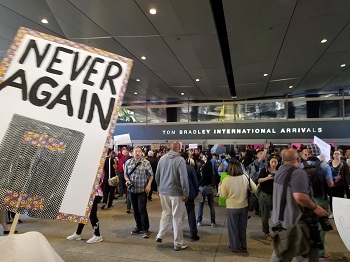
The America I love has gathered at this place, the Tom Bradley International Terminal at LAX, filling the sidewalk outside of the Arrivals level, filling the indoor space, allowing travelers through and calling out welcome while making a mighty noise, audible, we are told, to the 15 people who are detained on the other side of a lime green wall bearing the name Pinkberry. The crowd continues to swell as the afternoon shadows lengthen, marching along the sidewalk and the steps leading to the Departures level (again, making room for the travelers and their luggage), lining the balconies of the parking structure across the street. There are thousands of us.

I see Americans of every shade, gender, and size. One young Latina with a curtain of black hair carries a sign reading Angelinos Unidos. We chant Si Se Puede! I see Black Americans in dreadlocks and others in business attire with impeccably styled hair, young people in hoodies who cannot keep still, running joyfully back and forth with banners, and I see two dykely ladies of my acquaintance (newlyweds!) who have brought portable chairs on which to sit their bodies down.

I see hijabs and yarmulkas—mine is a crocheted affair of silver and white. Son of a gun, Trump has done something good in spite of himself; he really did bring Jews and Muslims together! I see a young woman of about twelve with Hermione Granger frizzy hair carrying a homemade sign that reads “Dumbledore’s Army, Still Recruiting.” Lot’s of homemade signs on cardboard or construction paper, some nicely stenciled, others scrawled in a hurry: “They warned me about this in Hebrew school,” “He will not divide us,” “El pueblo unido jamas sera vencido,” and my absolute favorite, “First they came for the Muslims. And we said, “Not today, mother!cker.””

Los Angeles is not alone in protesting and, again, Jews are well represented. On the other side of the country, 20 rabbis led by T’ruah, a rabbinic human rights organization, have been arrested (and released) protesting Trump’s travel ban. HIAS, the Hebrew Immigrant Aid Society, has filed a lawsuit contesting the executive order that instituted the ban.

Why this issue and the Jews? Certainly, many of us have found other things about the Trump campaign and administration to protest. We helped to swell the ranks of The Women’s March, praying on Shabbos, as Rabbi Abraham Joshua Heschel said in another context, with our legs. We have called and written our representatives, seeking “no” votes on Cabinet nominees who have expressed publically their contempt for the agencies they are about to lead.

But this ban on refugees, immigrants and travelers from certain majority Muslim nations (and while, yes, the Obama administration did create a list of countries to watch they did not shut off travel in the way that this administration has); this has resonated with Jews in a particular way. This hits close to home.

We are a people who bear long historical memories. We remember when our eventual compatriots objected to our coming here as refugees and immigrants. We remember the St. Louis. We remember Anne Frank. We remember that, indeed, the very same things as are now being said about refugees from majority Muslim countries were then said about us. That we would bring agendas shaped by radical ideologies. That we were actually spies, agents of the very terror from which we were trying to flee. Or, more nakedly, that we just came with too much difference—our religion, our faces, our flavors and our sounds were just too different from those of the majority for some folks to handle. We were a threat to a perceived national identity.

So we respond to this ban with outrage and grief for two kinds of reasons. Above all, there is our ancient imperative: “You shall not oppress a stranger, for you know the feelings of the stranger, having yourselves been strangers in the land of Egypt.” (Exodus/Vayikra 23:9). Our foundational story is the basis for a command: identify with the harried and the oppressed and the stranger. You are not only to support their cause, you are to have empathy.

And there is our not-so-ancient history in this very land. Those of us who were lucky enough to be born here are so very American indeed. Yes, our people, along with others, did transform this land—with culture and food and union organizing and entrepreneurship and, yes, the lesson that human beings can approach the Divine through different holy paths. We have also been transformed. We are Americans and we are not about to keep silent or allow newcomers to be bullied in our stead.

First they came for the Muslims, and we said… Read More »

Trump vs. Tu B’Shevat

When I think of Tu B’Shevat, I think of my childhood.

I grew up in the San Fernando Valley in the 1970s, and went to elementary school in the Hollywood Hills. At 3 o’clock, we’d get driven home, and as we started down the San Diego Freeway, we would see a layer of brown gunk on top of the Valley. It was just the way it was. During the summer, our eyes would sting, and sometimes we couldn’t even see the hills. “First-stage” smog alerts were common, and sometimes we would have second-stage alerts. I got asthma, as did many of my friends.

That doesn’t happen anymore: the Valley hasn’t had even a first-stage alert in years. No one would mistake the air for that of a national park, but it is a lot cleaner than it used to be. Seniors can walk outside now. Meanwhile, popular songs about contaminated water (like Tom Lehrer’s “Pollution” or The Standells’ “Dirty Water”) have become relics of a past age.

There is a reason why things have changed for the better: the Environmental Protection Agency. The EPA wrote the rules that cleaned up the Valley’s air and healed my lungs. It created and enforced the regulations that saved rivers around the country. And Donald Trump wants to destroy it.

This is not hyperbole. Trump’s choice to head the EPA, Oklahoma Attorney General Scott Pruitt, is currently suing the agency, and has expressed contempt for its work. Trump’s initial budget indicates that he will seek to cut the EPA by 50 percent — purposefully eviscerating its capacity and crippling it in the future. Within hours of taking the oath of office, the administration placed a gag order on all of its personnel, and began to alter content on its website. The agency’s scientific reports must now be vetted by political appointees before being made public. And last week, Trump issued a probably illegal executive order mandating that for every regulation enacted, two must be withdrawn — with no attention to whether any of the regulations are beneficial, or even crucial. It essentially enshrines ignorance as a matter of national policy.

The president embodies this ignorance. When asked by Fox News host Sean Hannity which federal departments he wanted to eliminate, Trump replied, “The Department of Environmental… I mean, the DEP is killing us environmentally.” No one bothered to tell him that the “DEP” does not exist, and it is not clear whether he knows now. But he knows he wants to kill it.

For Jews to support these policies represents a repudiation both of Tu B’Shevat and the values it stands for. Tu B’Shevat is not simply “the birthday of the trees” (as I also learned growing up). Rather, it celebrates humanity’s relationship with nature, and thereby with God. The rabbis declared it as an important day because it established the day on which produce counted for a new year for sacrifices. Later, Kabbalists constructed a Tu B’Shevat seder, now becoming more popular. Some ultra-Orthodox writers argue that we celebrate it because humanity is the “tree of the fields” — a purposeful and creative misinterpretation of a passage from Deuteronomy chapter 20.

Tu B’Shevat’s genius relies in no small part on its recognition that the spiritual humanity/nature relationship is also empirical. When the environment is destroyed, so is human health. We cannot detach ourselves from nature. Thus, the Hebrew name of Israel’s leading environmental advocacy organization, the Israel Union for Environmental Defense (on whose U.S. supporting board I serve), is Adam Teva V’Din — Humanity, Nature, and Justice.

The Trump administration’s war on the EPA, then, is a war on Tu B’Shevat. People who support Trump’s and the GOP’s efforts to gut and incapacitate the agency aren’t stopping some faceless bureaucrat: They are helping to destroy ecological resources and thus guaranteeing that thousands of children, maybe theirs or others, will get respiratory diseases or waterborne illness. That’s what these actions are: the Make Children Sick Act of 2017. And that is profoundly un-Jewish.

That’s what these actions are: the make children sick act of 2017. And that is profoundly un-jewish.

This is not a standard policy debate about the amount, character or pace of regulation. Reasonable people can disagree about such things. Indeed, environmentalism began as a conservative impulse and contained deeply sacred aspects. The great conservative writer Russell Kirk noted that:

“If men are discharged of reverence for ancient usage, they will treat this world, almost certainly, as if it were their private property, to be consumed for their sensual gratification; and thus they will destroy in their lust for enjoyment the prosperity of future generation…. The modern spectacle of vanished forests and eroded lands, wasted petroleum and ruthless mining … is evidence of what an age without reverence does to itself and its successors.”

Reverence. Destroying nature destroys humanity, in both its physical and its spiritual aspects. Both Judaism and conservatism properly understood have always known this.

The administration’s program, however, represents a rejection of the entire enterprise of environmental protection — not conservatism, but rather the materialistic philosophy of Ayn Rand. Rand’s “Fountainhead” hero, Howard Roark, expresses contempt for nature, saying that when he looks at mountain peaks, all he thinks of is tunnels and dynamite. Not surprisingly, the late Rabbi Aharon Lichtenstein suggested that the most un-Jewish philosophy was Rand’s. And, not surprisingly, Trump and many members of his Cabinet are big Rand fans.

The administration’s policy on climate change — or lack thereof — reveals its deepest contempt for the Jewish idea that humanity’s and nature’s fate are intertwined. Climate change represents the greatest ecological threat the planet has ever faced, but the White House home page was scrubbed of all climate change-related material a few hours after inauguration, and Trump has made clear that he will attempt to withdraw President’s Obama Clean Power Plan. There is no pretense of repealing and replacing — it is repeal outright. Again, this is not a difference of degree: It rejects the entire concept of wanting to know about the problem. Science, and truth, are to be subordinated to political needs.

No one with a commitment to Judaism can accept this. The rabbis knew it thousands of years ago. A midrash noted that when, in Genesis, God tells Adam to rule over the earth, the word used — radah — is equivocal: It can mean either “ruling” or “descending.” The message was clear: Unless humanity accepts genuine stewardship over the planet, it will “descend” to a lower level and betray its calling. But it required a stronger statement, and so they provided it, connecting our dependence upon nature, and the consequences of forgetting that dependence. As the midrash to Ecclesiastes relates:

“When God created the first human beings, God led them around all the trees of the Garden of Eden and said: “Look at My works! See how beautiful they are — how excellent! For your sake I created them all. See to it that you do not spoil and destroy My world; for if you do, there will be no one else to repair it.”

My lungs saved by the EPA remember this statement daily. Does anyone else?

Jonathan Zasloff is professor of law at UCLA, where he teaches, among other things, property, international law and Pirkei Avot. He is also a rabbinical ordination candidate at the Alliance for Jewish Renewal.

Trump vs. Tu B’Shevat Read More »

Anti-Semitic graffiti discovered in Conejo Valley park over the weekend

Three spray-painted swastikas were discovered over the weekend at Dos Vientos Community Park in the Conejo Valley — two on the wooden boards on the perimeter of a baseball field, and one on the concrete next to it, according to Cyndi Silverman, regional director of the Santa Barbara/Tri-Counties Anti-Defamation League (ADL).

Residents of the area discovered the graffiti at the Newbury Park site and notified authorities on Saturday, according to Steve Gold, a congregant of Congregation Am Hayam in Ventura County. It has since been removed.

The Ventura County Sheriff’s Department could not be reached immediately for comment, but the Ventura County Star reported that the incident is not being investigated as a hate crime but rather as a misdemeanor vandalism incident.

“We called it into the police department to have them investigate it, which they did, and it wasn’t registered as a hate crime, because it was not addressed to anyone in particular,” Gold told the Journal.

Gold said he was surprised to find the swastikas in his neighborhood in the first place.

“I really think this is just an independent person who probably has anger issues. I don’t feel in my neighborhood polarizations occurring,” he said.

Silverman said the three swastikas discovered at the park were only the latest incidents she has seen in the area. She declined to draw a correlation between the uptick and the election of President Donald Trump.

It’s “definitely a concern, seeing an uptick in hate symbols, especially in public parks,” she said.

Ed Jones, a member of the Conejo Recreation and Park District board of directors, wrote on his Facebook page, “Such a shame that this symbol of hate would appear in one of our parks.”

Anti-Semitic graffiti discovered in West Los Angeles references Israeli-American actress Natalie Portman's portrayal of Jackie Kennedy. Photo by Jennie Fahn via Next Door
Anti-Semitic graffiti discovered in West Los Angeles references Israeli-American actress Natalie Portman’s portrayal of Jackie Kennedy. Photo by Jennie Fahn via Next Door

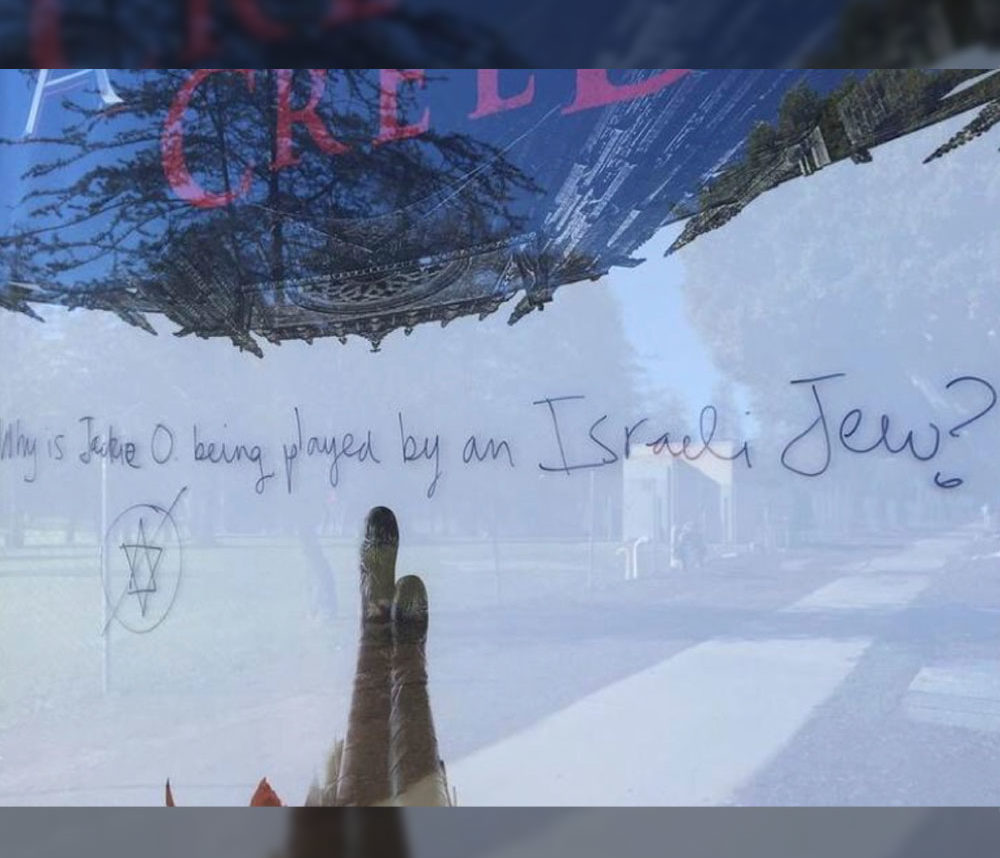
The incident followed a mid-December instance of an anti-Semitic scrawl discovered in West Los Angeles, near Temple Isaiah. The phrase, “Why is Jackie O being played by an Israeli Jew?” — a reference to Israeli-American actress Natalie Portman’s portrayal of Jackie Kennedy in the recent film, “Jackie” — was discovered at a bus stop on a poster of the film “Assassin’s Creed.” A slashed-through Jewish star appears next to the scrawl.

Los Angeles’ ADL Associate Regional Director Ariella Schusterman said the West L.A. incident was “taken care of pretty quickly.”

Both incidents were documented via the neighborhood-centric social network app Nextdoor, which provides a platform for residents to describe positive and negative activity in their respective neighborhoods.

In separate interviews, Schusterman and Silverman said they appreciated people using Nextdoor to document instances of hate but also reminded people it is important to inform local law enforcement agencies and report them to the ADL, which compiles a record of reported hate incidents and crimes.

“Obviously we want people to call us when we have anti-Semitic incidents or crimes,” Schusterman said, “or to call the police.”

Anti-Semitic graffiti discovered in Conejo Valley park over the weekend Read More »

The blessings of prayer, liturgical or personal

With the celebration of Tu B’Shevat, the New Year for Trees, on Feb. 11, environmentally friendly Jewish organizations and individuals fill social media feeds with exhortations to protect the environment and to appreciate the bounty of produce that most of us enjoy.

But do you know what blessing to say for planting a tree? And what if that tree is in Kisumu, Kenya, to celebrate a partnership of Kenya, Israel and Germany that has yielded great strides in tilapia fish farming?

This example sounds random enough to be made up, but it really happened for 12 of us on an Israeli Consulate-sponsored trip to Kenya last November to see the work of an Israeli international development organization called MASHAV.

As we watched a representative from each partner country plant a tree at the Ramogi Institute of Advanced Technology, I asked fellow trip participant Rabbi Noah Farkas of Valley Beth Shalom, “Is there a blessing for a trilateral fish farming partnership tree-planting?”

He said there wasn’t one, so we riffed on the concepts and words relating to the physical act of tree-planting as well as thematic meanings of partnerships. The rabbi’s version went biblical, invoking Eden, the first garden sown by humans and the notion that God creates everything. My version was more interpersonal: about God as the overseer of human existence and both witness to and nurturer of relationships between people and the earth.

We settled on the Shehecheyanu prayer that expresses gratitude for having reached a new or special moment or occasion.

But an idea also had taken root: Was there really no blessing for tree-planting? When I got home, I asked my favorite always-on-duty religious expert, Rabbi Google. I learned there is a blessing said on a fruit-bearing tree once a year during the month of Nisan, but generally, no blessing for tree-planting. Shouldn’t there be, especially when it marks a deepening of human relationship as well as the intention of seeding the earth?

I thought: Why not teach people to use their words to find their own blessings? And yet, the thought seemed heretical. Who was I — or anyone without rabbinic training — to negate the canonized liturgy? And if everyone was “vigilante blessing” things, would that put Farkas and my other rabbi friends out of a job? Would there still be a need for synagogue and community around standardized prayer?

Pondering these thoughts, I read the reflections of my friend and Jewish Journal colleague Ryan Torok, who also was on the Kenya trip.

“It’s comforting how the words of the Amidah are the same in Kenya as they are back home,” he wrote in the Journal. “No matter where one is in the world, Judaism is Judaism.” 

There is a tension between institutionalized liturgy and personal prayer. We have a robust liturgy, sanctioned by rabbis, time and generations of people who have intoned the same words in different geographical and emotional places. They have called on the same phrases for strength, as mantra, as comfort, as praise in countries around the world. Indeed, there are “official” blessings for lots of Jewish acts and occasions — even observing strange things or unusual people.

But in moments during which there are no standardized blessings, how do we non-rabbis — or those of us unfamiliar with the liturgy, unfamiliar with Hebrew, or even lacking a traditional belief in God — mark those moments?

There’s a Chasidic folktale about a young shepherd who was nearly illiterate and went to a synagogue, where he recited the letters of the Hebrew alphabet repeatedly. When asked why, he said he didn’t know the prayers but knew that if he spoke the letters, God would assemble them to form words expressing his intended prayer.

Depending on the audience, this story — and its many variations — is invoked to teach several lessons. In my interpretation, I learn two things. First, you don’t need officially sanctioned words to pray or express gratitude. Second, even when you are expressing your heart’s desires, gratitude or prayer — which may be very much outside of the communal norm — there is value and power to being in the presence of community.

We have our own letters, and we have our own words. We don’t need words that are biblical in origin, or grandiosely phrased, or rabbinically sanctioned. If the “God” concept is a challenge for you, opt out of language like “blessed are you, oh God,” and instead use “how incredible it is to be having this experience” or “how grateful I am to be in the presence of this thing.” Prayers don’t have to be in Hebrew, either, because if God is an entity or concept that has meaning for you, you can bet your bracha (blessing) on the fact that any deity worth anything would be fluent in any language.

I think that institutionalized liturgy provides a framework, something to rely on if we aren’t having a spontaneous or creative prayer moment. It also suggests words and phrases to guide us in our own interpretation of what it means to use language to express vulnerability, humility, respect, praise and gratitude.

Of course, most people — and that includes me most days — don’t create their own prayers. They may not see the point in prayer at all. Or they may feel unworthy, unpoetic or unholy. Or they may think personal prayer is forbidden or some sort of hubris, that when it comes to Jewish prayer, it’s codified liturgy or bust. And maybe that belief creates a stronger bond to both community members and to places of institutionalized prayer.

But perhaps, when we’re seeking ways to connect to prayer and gratitude, it’s not “this” or “that.” Rather, it’s worth looking to our structured community spaces, as well as into the unique words that we hold within ourselves and our unique experiences, to find the answers.

The blessings of prayer, liturgical or personal Read More »