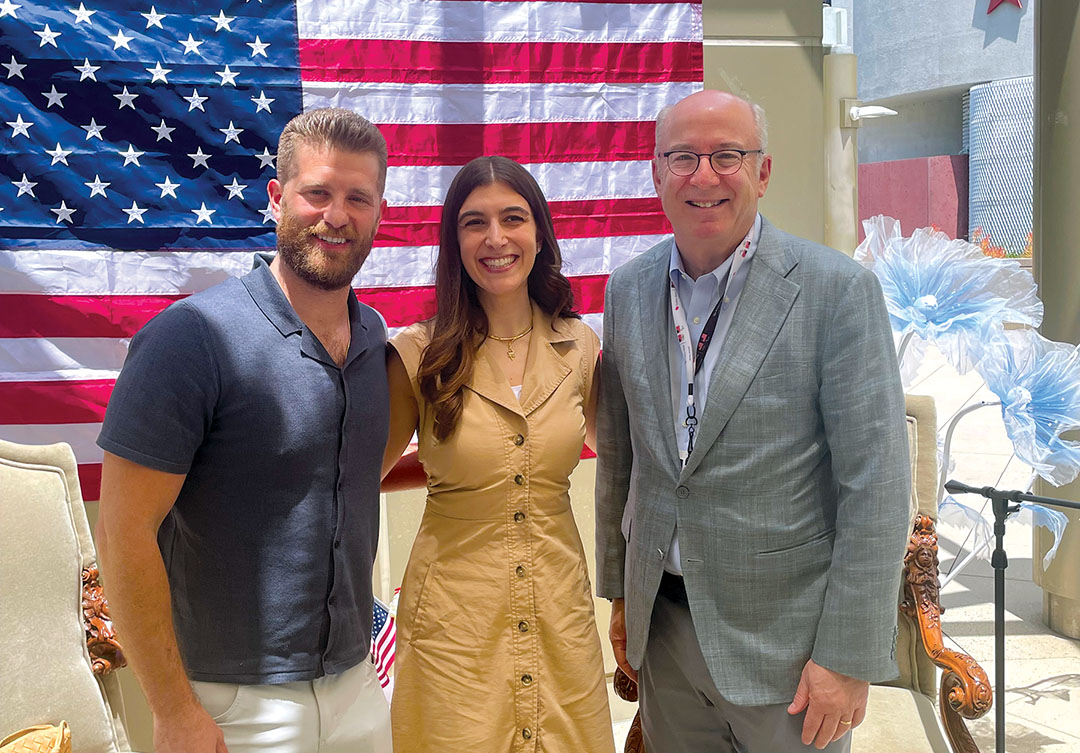
Some of the best examples of coexistence in Israel can be found in the most unlikely of places. I recently met with Guy Solomon, the Executive Director of Tsad Kadima (A Step Forward), the Association for Conductive Education in Israel, a community-based agency started by a group of parents in 1987 who had children with cerebral palsy and other neuro-motor conditions.
One of these parents from Jerusalem embarked on worldwide search for the best treatment options and when they learned about the Conductive Education (CE) method that Professor Andreas Petõ, a Hungarian Jewish physician, developed in the 1920s and 1930s, they brought their daughter to Budapest for long training sessions. Soon, hundreds of other Israeli families followed the Jerusalem pioneering family, and now Tsad Kadima is the second largest center of Conductive Education (CE) outside of Hungary, and is recognized worldwide for its holistic approach to rehabilitation and education of children, adolescents, and young adults with cerebral palsy (CP) or motor dysfunctions. Conductive Education is used throughout Europe, but less so in North America although there are centers in Claremont, Menlo Park and Petaluma.
A key aspect of CE is making choices. From an early age, children with CP are asked to make choices, using picture cards, special software on Ipads and other technology. Also, Conductive Education takes into account the fact that for children with severe motor disabilities, learning even the most basic movements needed for everyday activities such as dressing and eating are extremely difficult, and most be learned and repeated over and over. It also recognizes that the disability, in and of itself, causes learning difficulties for children with disabilities and so there is a need for specialized education and teaching that will enable them to overcome these difficulties at home, at school, and in society. And lastly, there’s a large psychosocial component that goes way beyond conventional physical therapy approaches.
The Israeli teachers, known as “Conductors” study for three years post college to receive their certification in Conductive Education, and every year a professional instructor from the Petõ Center in Budapest comes to Israel to provide continuing education and administer the final exam to the graduating class.
Guy was in Los Angeles as part of the Kolot program for Israeli Leading Social Entrepreneurs funded in part by the Jewish Agency and the Los Angeles Jewish Community Foundation. He shared with me that his entire professional career has been helping adults with disabilities, including sports for the disabled and the Para Olympics. He told me about their preschool, elementary school programs, funded by the Israeli Minister of Education, along with the newer adult day programs for adults with severe disabilities, most of who use electric wheelchairs. The Adult Day Program, which has funding from several Israeli ministries but still needs private support includes teaching living skills, sports, therapeutic treatments and socialization in groups.
I asked Guy how public accessibility was coming along in Israel, knowing its challenges from own trips there with our son with CP, and he told me a story about checking out a new location for a school in Jerusalem, since they had outgrown their current location. The new site was large, and had seemed to have everything they needed. The real estate agent had been told the facility was going to be used by 40 people who use wheelchairs. But when the agent took Guy up the stairs to the entrance, and Guy asked where the ramp or elevator was, there was a blank expression on the agent’s face. There was no way to enter the building except up those stairs.
And here’s the coexistence part. I asked Guy if there were Haredi (ultra-religious) families who sent their children and young adults to Tsad Kadima’s programs. As it turns out, the clients in Tsad Kadima come from every sector, secular to very religious Jews, and also Arab Israelis and Druze. Watch the video to see for yourself the remarkable work they are doing, and support them by clicking here.