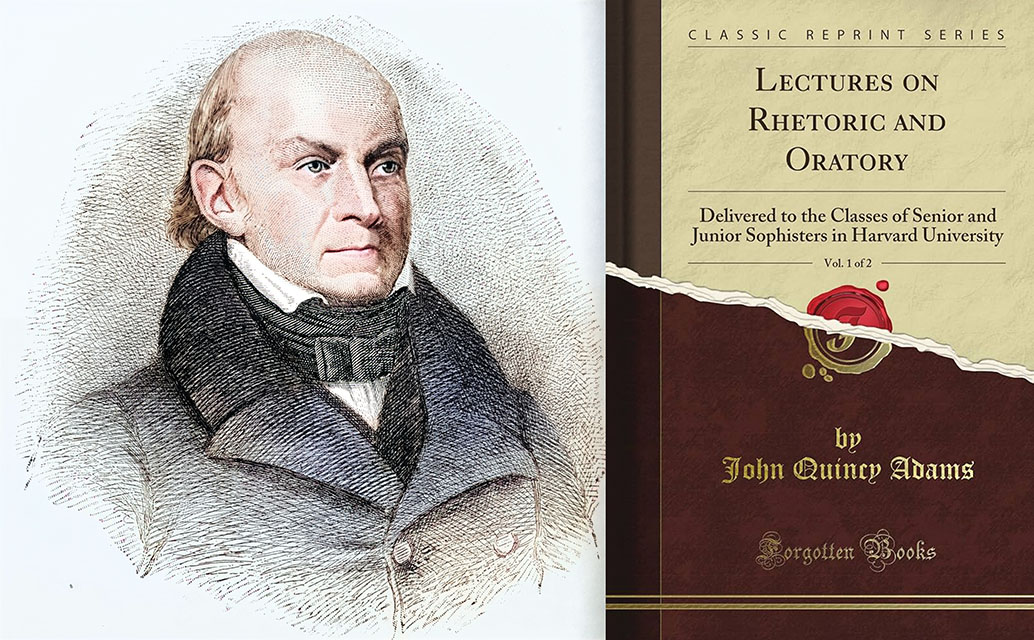
John Quincy Adams was quite the multitasker. While serving in Congress as a senator for Massachusetts during the first decade of the 19th century, he also taught logic at Brown University and was the Boylston Professor of Rhetoric and Oratory at his alma mater, Harvard.
It was at the latter that he delivered a multi-part lecture series on the nature and history of public speaking, and the power of the spoken word to unify the new nation and its diverse peoples.
The series, published in 1810 as “Lectures on Rhetoric and Oratory,” includes a remarkable ode to a central figure from the biblical book of Exodus, Aaron, Moses’ brother, who articulated the aspiration of national liberation on behalf of his famously heavy-tongued younger sibling.
Since Israel’s political leader was a reluctant rhetorician, Adams detailed in the “Inaugural Oration,” “another favored servant of the Most High was united in the exalted trust of deliverance and specially appointed for the purpose of declaring the divine will to the oppressor and the oppressed; to the monarch of Egypt and the children of Israel.”
Recapping God’s instructions to Moses to head to Egypt and urge Pharaoh to let His people go, Adams paraphrased Exodus 4:14-16, in which the Lord reassures a hesitant Moses, “Is not Aaron, the Levite, thy brother? I know that he can speak well. And he shall be thy spokesman unto the people; and he shall be, even he shall be to thee instead of a mouth, and thou shalt be to him instead of God.”
Adams then continued:
“It was not sufficient for the beneficent purposes of divine Providence that the shepherd of his flock be invested with the power of performing signs and wonders to authenticate his mission and to command obedience to his words. The appropriate instrument to appall the heart of the tyrant upon to control the wayward dispositions of the people, was an eloquent speaker.”
Moses’ miracle-working abilities were not enough. To inspire a new nation to abide by Providence and acclimate its population to liberty, one needed a way with words – which Aaron was there to provide.
Adams went on: “and the importance of the duty is apparent in the distinction which separated it from all the other transcendent gifts with which the inspired leader was endowed, and committed it, as a special charge, to his associate. Nor will it escape your observation that, when the first great object of their joint mission was accomplished, and the sacred system of laws and polity for the emancipated nation was delivered by the voice of heaven from the holy mountain, the same Eloquent Speaker was separated from among the children of Israel to minister in the priest’s office, to bear the iniquity of their holy things, [and] to offer up to God, their creator and preserver, the public tribute of their social adoration.”
Subsequent to the Israelites obtaining their freedom from Pharaoh, Aaron was promoted from public speaker to High Priest. That, Adams argued, was a natural next step. After all, the power of words served to unite a nation for multiple purposes – in both obtaining freedom from one’s enemies and in practicing one’s faith.
Aaron’s public speaking became a career in spiritual public service. Israel’s High Priest would serve for decades as the divine representative of not only his brother, but of the entire polity, ensuring their spiritual survival amidst their desert wanderings.
Now turning to directly address his audience of students, Adams encouraged them to echo the leader of ancient Israel’s Sanctuary as they seek to serve in America’s Temple of Liberty: “Sons of Harvard! You, who are ascending with painful step and persevering toil the eminence of science, to prepare yourselves for the various functions and employments of the world before you, it cannot be necessary to urge upon you the importance of the art, concerning which I am speaking. Is it the purpose of your future life to minister in the temples of Almighty God, to be the messenger of heaven upon earth, to enlighten with the torch of eternal truth the path of your fellow-mortals to brighter worlds?”
As the students would soon occupy positions of influence throughout the country, Adams insisted, “Remember the reason, assigned for the appointment of Aaron to that ministry, which you purpose to assume upon yourself. ‘I know that he can speak well’; and, in this testimonial of Omnipotence, receive the injunction of your duty. Is your intention to devote the labors of your maturity to the cause of justice; to defend the persons, the property and the fame of your fellow citizens from the open assaults of violence, and the secret encroachments of fraud? Fill the fountains of your eloquence from inexhaustible sources, that their streams, when they shall begin to flow, may themselves prove inexhaustible.”
Adams then concluded: “Consecrate, above all, the faculties of your life to the cause of truth, of freedom and of humanity. So shall your country ever gladden at the sound of your voice, and every talent, added to your accomplishments, become another blessing to mankind.”
No doubt Adams kept Aaron’s model in mind as his own political career advanced. He would seek to emulate Aaron’s elocution upon being elected president, bringing the High Priest’s legacy with him to the White House.
Rabbi Dr. Stuart Halpern is Senior Adviser to the Provost of Yeshiva University and Deputy Director of Y.U.’s Straus Center for Torah and Western Thought. His books include the newly released “Jewish Roots of American Liberty,” “The Promise of Liberty: A Passover Haggada,” “Esther in America,” “Gleanings: Reflections on Ruth” and “Proclaim Liberty Throughout the Land: The Hebrew Bible in the United States.”