Turning 60 in December hasbeen a milestone wrapped both in sad loss and the gift of new life.
Two weeks before my birthday, my father Messod passed away. So, I didn’t mark the moment the way I might have imagined, with a big blowout celebration or a girls trip. (My children did host the most incredible Hanukkah birthday dinner for me that was so special!)
I didn’t yet know that my mother-in-law Becky would pass away only a few weeks later. It was a season heavy with grief, with one loss folding into another.
Yet in the midst of all of the loss, HaShem was kind to me, as our family welcomed new life, a beautiful granddaughter, Denisse, named after her maternal grandmother.
I thought my heart had reached its capacity for love with our first granddaughter Raquel. It expanded again in a way I didn’t know was possible. Holding this tiny baby felt like a gift. A quiet reminder that even after loss, life continues and finds its way back to you.
Raquel, who is named after me, turns two this month. She brings that same kind of joy and wonder into my life. These girls, each in her own way, have helped soften the edges of grief and fill our home with light again.
Becoming a grandparent has changed me. I find myself slowing down, sitting on the floor to play, wanting to be fully present in every moment. I don’t want to say no, I just want to give, to love, to soak it all in.
I think often about my own parents and how they were with my children. I remember getting frustrated at times, telling them it was too much, to stop giving so much. Now I understand them in a completely different way. There is something boundless about this kind of love, wanting to protect, to nurture, to give your whole heart.
Even after my husband Neil and I leave the girls, the joy lingers. We go home and keep talking about them, laughing at the little things they did, looking at photos we took just hours before.
Shabbat has also taken on a new meaning, with dinner scheduled at six o’clock, so that Raquel can be home and asleep by 8 o’clock. She loves Shabbat, the kiddush, the challah, the feeling of sitting at the table with everyone. We cherish having her there and the new traditions we are creating.
I am determined to make these years count. I try to see my grandchildren as often as I can because I know the bonds we build now will become the memories they carry of me one day.
My own children were blessed with extraordinary grandmothers. “Maman” and “Grandma” were not just part of their lives, they helped me raise my caring, loving children. The memories they gave them and the love they shared are lasting gifts my children carry with them to this day.
Now, I find myself hoping to do the same.
This Mother’s Day, I feel the fullness of it all, the grief, the gratitude, the deep and expanding love. The generous generations before me and the hope and light of the younger generations that is my privilege to love.
– Rachel
Peach Upside Down Loaf
The first time I tasted this peach upside-down cardamom loaf cake was at high tea in London. After that, I started noticing cardamom loaf featured at many of the bakeries in London.
What makes this loaf recipe unique is the unusual use of rye flour, which adds such a nutty flavor and a gritty, hearty texture that is not typical in tea cakes. The combination of butter and brown sugar and cardamom give the loaf a wonderful hint of spice and molasses, with all working together. The first taste feels completely unexpected and unlike a typical cake and unlike anything you might expect for brunch or tea.
Save this recipe for your next dairy brunch or dinner.
Caramel
3 Tbsp salted butter, cut into 3 pieces
2/3 cup packed light brown sugar
2 or 3 ripe, firm medium peaches or plums, pitted and sliced into ¼ inch wedges
Pinch of table salt
For the cake
1¼ cups almond flour
¾ cup rye flour
2 1/2 tsp ground cardamom
1 tsp baking powder
½ tsp baking soda
1/8 tsp table salt
2 large eggs, room temperature
2 tsp vanilla extract
1 cup packed light brown sugar
2 tsp grated orange zest
13 Tbsp salted butter, room temperature
Heat the oven to 375°F with a rack in the middle position.
Spray an 8½-by-4½-inch loaf pan with cooking spray, then line with parchment paper, allowing the excess to hang over the long sides of the pan.
To make the caramel-peach layer. In a small saucepan, combine the butter and sugar. Cook over medium heat, stirring occasionally, until thick and well combined, about 2 minutes. Transfer to the prepared loaf pan and use a silicone spatula to spread in an even layer. Place the fruit slices in the caramel, overlapping them as needed to fit. Sprinkle the salt over the fruit, then set aside.
To make the cake. In a medium bowl, whisk together the almond and rye flours, the cardamom, baking powder, baking soda and salt.
In a small bowl or liquid measuring cup, whisk together the eggs and vanilla.
In a stand mixer with the paddle attachment, beat the sugar and orange zest on medium until fragrant, about 1 minute. Add the butter and beat on medium-high until light and fluffy, scraping the bowl as needed, about 3 minutes. With the mixer running on low, gradually add the egg mixture, then beat on medium until well combined, about 1 minute. Scrape down the bowl. With the mixer running on low, add the dry ingredients and mix, scraping the bowl once or twice, just until the mixture is evenly moistened, about 1 minute. Fold the batter by hand with the spatula, scraping the bottom and sides of the bowl to ensure no pockets of flour remain. The batter will be thick.
Spoon the batter onto the fruit in the loaf pan, then spread in an even layer and smooth the surface. Bake until the top is deeply browned and a toothpick inserted at the center comes out clean, 45 to 55 minutes.
Cool in the pan on a wire rack for about 15 minutes; the center of the cake may sink slightly during cooling. Slide a knife between the short ends of the cake and the pan to loosen, then invert the cake onto a platter. Lift off the pan and peel off the parchment. Cool to room temperature.
Allow the cake to cool for 2 hours before serving (even better the next day).
Sharon Gomperts and Rachel Emquies Sheff have been friends since high school. The Sephardic Spice Girls project has grown from their collaboration on events for the Sephardic Educational Center in Jerusalem. Follow them on Instagram @sephardicspicegirls and on Facebook at Sephardic Spice SEC Food. Website sephardicspicegirls.com/full-recipes.
One verse, five voices. Edited by Nina Litvak and Salvador Litvak, the Accidental Talmudist
“If you follow My statutes and observe My commandments and perform them, I will give your rains in their time, the Land will yield its produce, and the tree of the field will give forth its fruit.”
-Leviticus 26:3-4
Kira Sirote
Author of “Haftorah Unrolled,” Ra’anana, Israel
After many years of living in Israel, I was in London on a business trip. It was June and I went for a walk in Hyde Park after work, enjoying the yards and yards of bright green grass. I still recall my awe when I realized that there were no sprinklers on any of the lawns. Back in Israel, there was a drought, sprinklers were turned off, and a hotel we stayed at put up a sign near a barren patch of lawn, “Our apologies, there is no grass here now. Better days will come.”
In Israel, we need the rain. Even now, with desalination plants, we don’t have to worry about actually running out of food and water, but we still need rain. We still see it as a gift from Above, the first and best reward and acknowledgement of our relationship with our Creator. The right kind of rain at the right time. Not the kind that floods parking lots and elevators, or tears down highways, but the kind that causes the hills to bloom and the valleys to overflow with red anemones and purple irises, and the orange blossoms to fill the air with their scent, and the lemon trees to be covered in golden fruit as if drawn by a child.
When we read Parsha Bechukotai, and we look out the window, that is what we see. If we follow His statutes and observe His commandments, and perform them.
Leviticus 26 presents a striking dichotomy. It lays out a stark blueprint for our national existence: a promise of sublime blessing for faithfulness, set against a harrowing warning of the consequences of transgression. Yet, to preserve the sanctity of free will, these consequences are not always immediate or predictable; they operate within a realm of concealment.
We have lived the reality of this chapter. We have endured the agony of exile and the shifting masks of antisemitism, only to witness the breathtaking, miraculous rebirth of the Land of Israel. Through it all, one undeniable fact remains: the survival of the Jewish people against all odds is not a historical accident, it is a supernatural phenomenon.
This survival is anchored in the eternal promise found at the conclusion of Chapter 26: “Yet in spite of this, when they are in the land of their enemies, I will not reject them or abhor them so as to destroy them completely, breaking my covenant with them … But for their sake I will remember the covenant with their ancestors whom I brought out of Egypt in the sight of the nations to be their God. I am the Lord.”
This verse is the ultimate refutation of “Replacement Theology.” It stands as a divine guarantee that the Jewish people are never abandoned and never replaced. It is our shield against those who deride us as “rejected,” proving that the Covenant is as unbreakable today as it was at Sinai.
David Sacks
Happy Minyan of Los Angeles
God makes us a very surprising promise.
If we keep the mitzvahs, it will rain in the proper times. Keep in mind that back in the day, we were all farmers which meant …
If it didn’t rain.
We didn’t eat.
And if we didn’t eat – well, you know how that ends.
Rain literally meant life and death.
But think about it for a moment –
Does my giving a dollar to a homeless person really affect clouds way up in the sky?
The answer is, yes.
To understand how, let’s take a deep dive.
When God gave us the Torah at Mount Sinai, the mountain was smoking. In Hebrew, the word ashan, smoke, is as an acronym for space, time and soul: the three fundamental aspects that contain all of reality.
In other words, at Mount Sinai, we saw an X-ray of the universe and that the Torah is the wiring that ties the universe together. So, yes, when we do a mitzvah – like giving charity – it does cause it to rain, because the entire world is made out of Torah.
The Ishbitzer Rebbe says something unbelievable. The parsha begins, “Im bechukosai telechu” — if you walk in My ways. The Ishbitzer points out that the word “im,” if, is lashon tefillah, a word of prayer.
God is praying, “Please, keep My Torah because I want to bless you with everything.”
Reb Shlomo says that when we keep the mitzvahs, we’re dreaming God’s dreams and we’re praying God’s prayers.
Rabbi Cantor Hillary Chorny
Cantor, Temple Beth Am
Some people look out on the world and see a luscious garden full of ripe fruits to pick; others see a fertile place with unrealized potential, and they resolve to spend their years on earth planting. The Torah uses the language of produce and farming as allegory, framing its lessons on being in relationship with God in the language of agriculture. Rashi reads the language “If you follow My statutes” as a metaphor for Torah. Study Torah carefully, and you will see a bountiful harvest. Not of grapes and dates, wheat or barley, but rather a healthy crop of Jews in the next generation.
We are fortunate to live in a city with bountiful Jewish resources. In today’s atmosphere of unrelenting “unprecedented times,” it would be easy to think in the present tense: to use our resources to put out the fires of war and antisemitism, housing shortages and refugee crises. We have to think like farmers, investing first in Jewish education and the affordability of Jewish experiences for the youngest Jews and the ones to come. We affirm our place in this grand metaphor every time we offer the blessing over bread. When we say “hamotzi lehem min ha’aretz,” blessing God as “the One who brings bread out of the earth,” we remember that God cannot do that alone. It is up to us to plant, nurture, and cultivate. We are eternal partners in the sustenance of our planet and our people.
Rabbi Sofia Zway
Rabbi, Base Los Angeles
As the parent of a toddler, I now find myself speaking almost exclusively in conditional sentences like the one in our verse: “If we change your diaper, then we can have a snack.” These conditions are not punishments; they are boundaries meant to guide my child safely through the world. Toddlers constantly observe and study (and test!) the world around them. My role as a parent is to see the world through my daughter’s eyes and teach her, along the way, how to live safely and responsibly on this earth.
Similarly, the conditional language in this verse serves as a guide for responsible and sustainable living, rather than a system of reward and punishment. The commentator Ibn Ezra identifies the commandment in this verse as the mitzvah to study, teach, and observe. This reading reframes the if/then structure of the verse: rain and abundance are not rewards for obedience, but outcomes of careful attention to the world we inhabit. Observing fosters humility and curiosity; studying and teaching cultivate wisdom and continuity. Together, these practices enable us to live more responsibly and sustainably within the natural systems that support life. In this light, the verse becomes less about divine reward and more about attunement — to the natural world and to the limits of our power. The Torah’s language here serves not as a threat, but as a reminder that what we nurture, whether children or the earth itself, is ultimately what will grow.
A boy in a Beirut class said this, knowing his classmate, Gad Saad was Jewish.
Then the students clapped.
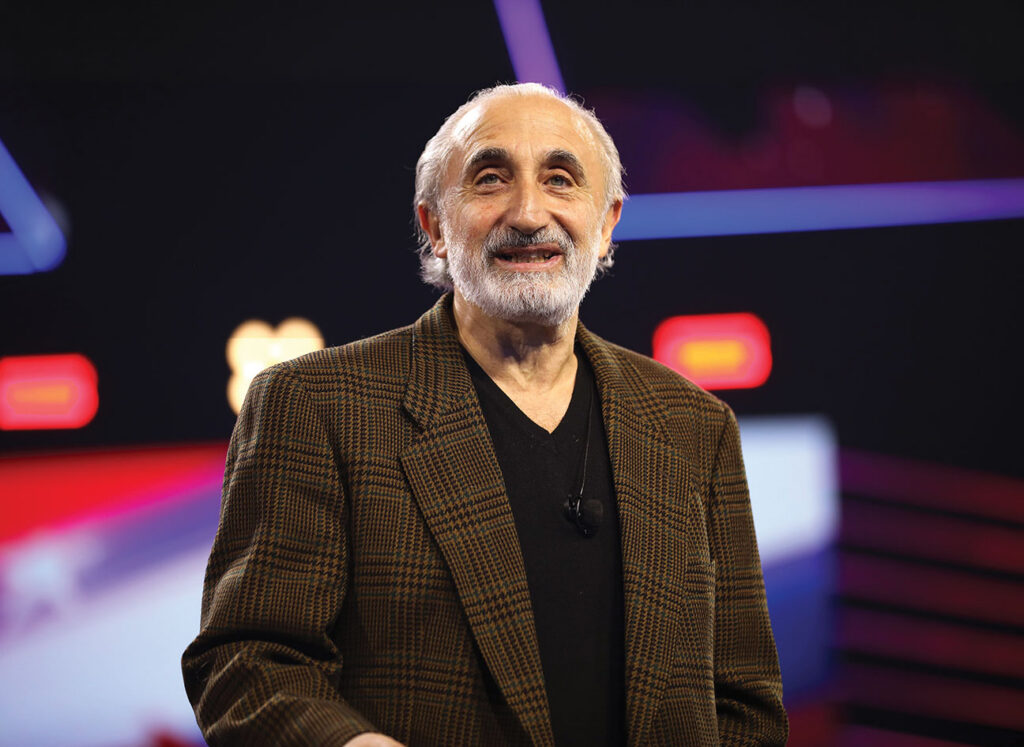
Saad wanted to grow up to be a soccer player, but wound up settling for verbally kicking the butts of Jew-haters, and becoming an internationally best-selling author. He is also one of the most frequent guests on America’s top podcast, and a marketing professor with a whopping 1.2 million X followers. He has 362,000 subscribers on his own YouTube channel, and is a renowned lecturer booked to speak around the world.
Getting The Hell Out of Lebanon
As the Lebanese Civil War erupted in 1975, Saad’s family knew they had to flee for their lives. Since the Palestinian Liberation Organization controlled the airport, Saad’s family paid the PLO militia to drive them there.
Saad tells this movie-like story in “The Parasitic Mind: How Infectious Ideas Are Killing Common Sense.” In the book, he notes that while there were Muslims who wanted to kill him, Muslims saved his life. By the time the pilot announced they were out of Lebanese airspace, his mother put a star of David necklace on him and said he should know he could wear it proudly. Several decades later, in Montreal, his son came from soccer practice and said had his father been at that location wearing a Jewish necklace, he’d be dead. Saad, who is of Lebanese and Syrian descent, said his upbringing has caused him to realize that being politically correct is a luxury he can’t afford.
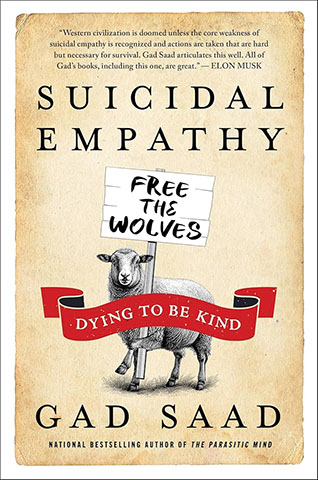
Elon Musk’s Muse? The meaning of the title of his new book: “Suicidal Empathy.”
Dropping May 12, “Suicidal Empathy: Dying To Be Kind” will likely be hate-read by many on the left who will find it inflammatory and offensive, while many on the right will find it powerful. Saad, who said he’s gotten plenty of threats over the years, told The Journal there have been hit pieces against him since well before the release of his new book.
In 2024, The Wall Street Journal ran an article, “The Man Whose Musings Fuel Elon Musk’s Nightmares,” seemingly warning about the “bromance” the Canadian marketing professor developed with the world’s richest man, who quoted Saad and praised his new book. Saad also interviewed Musk several times, but said he resents an antisemitic trope the article suggested.
“That general line of attack – there is this shady dark Jewish puppeteer who coined ‘suicidal empathy’ and is trying to create this dark Jewy world because he is the Svengali of Elon Musk and Donald Trump,” Saad said.“Because of course, Jews are so diabolical, and I, as the head of the movement, am trying to rid the world of empathy. I don’t even think I experienced this level of Jew-hatred in Lebanon, and that’s saying a lot.”
Saad said he coined the phrase “suicidal empathy” more than ten years ago. One example could be making sure to fund and house immigrants while leaving American veterans in the cold. Saad argues that the West has allowed mass immigration of some who don’t share Western values. Things are good in moderation, but the problem is when there is too much empathy and in the wrong place, leading to a detrimental result. He added that it’s hijacking our emotional system.
Rogan and Saad Have a Great Connection
Most people would throw their grandmothers down two flights of stairs to get one appearance on “The Joe Rogan Experience,” which is the top podcast in America with 20.9 million YouTube subscribers. Saad has been on 11 times.The two have a great rapport. Rogan will often mirror or at least tacitly agree with a guest, so if the guest is anti-Israel, he may speak to those points, while if the guest is pro-Israel, he may do the opposite.
During one appearance, Saad told Rogan it was incorrect to call Israel’s response to Hamas’ Oct. 7, 2023 attack a genocide. He explained that it is tragic for even one Palestinian child/civilian to be killed, but unfortunately that happens in war, and it is disingenuous to hold Israel to a standard that no other country has been held to in the history of war. On another episode, Rogan called Saad “my man” and a “beautiful bastard” while Saad said his son, who just had his bar mitzvah, loves Rogan’s show. When Saad asked Rogan how many Jews he thought there were, he turned his answer from one billion to 500 million. Saad told him there are 13 to 15 million Jews in the world.
Saad speaks with firm eloquence but is respectful (though online he takes the gloves off) and said one thing that is helpful is that he and Rogan can speak about many different topics. They’ve spoken about war, food and even Belgian shepherd dogs.
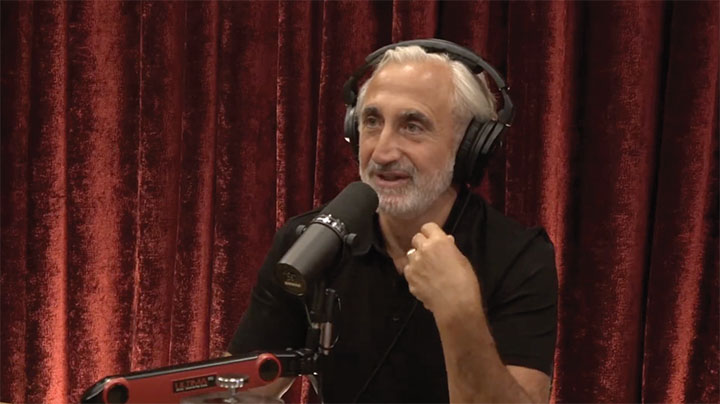
Screenshot from The Joe Rogan Experience podcast
“I’m not a stay in your lane professor,” Saad said. “Once I forged a relationship and a friendship with Joe, I’m available when he invites me, because I’m in the business of disseminating knowledge and what better place than on Joe’s show?”
Did Dave Smith’s Dis Daunt Saad? Would He Debate Smith or Bassem Youssef?
Comic Dave Smith is also a friend of Rogan’s and has appeared on his podcast 15 times, which might be more than anyone else.Since Oct. 7, Smith has gone on Rogan’s show as well as others, invoking his Jewish identity and claiming that Israel committed a genocide. He later mocked Saad’s book title, saying, “Let’s Not Have Homicidal Empathy,” and called Saad an admitted Mossad agent.
In “The Saad Truth: 8 Secrets For Leading The Good Life” the professor writes that he never joined the Mossad but did take part in two tests assigned to him. Did Smith get under Saad’s skin with the book insult?
“If I were to be offended by this kind of stuff, I would have jumped off a ledge 15 years ago,” Saad said. “The haters come at me in every direction possible. I have thick skin. There’s a fixed tank of attention people have. If Dave Smith is monopolizing the attention of millions of people who should be getting information elsewhere, well, it’s a small defeat in the information war. In this democratization of information, unfortunately, you get a lot of imbeciles spewing their nonsense.”
Smith and comedian Bassem Youssef have both appeared on the “Triggernometry” podcast, where neither gave a serious answer when host Konstantin Kisin asked what Israel should have done after Oct. 7. Youssef used satire to assail Israel in an interview with Piers Morgan that got 23.6 million views.
If Saad debated Smith, it would likely get several million views. If he debated Youssef in long form, it could be the most viewed argument on the Israeli-Gaza war.Would Saad be willing?
“It’s a great question because you have to develop a behavioral rule for many things in life,” Saad said. “My reticence to debate Dave Smith or Bassem Youssef is not that they’re not professors with the titles that I hold, it’s that I know they are not coming from an intellectually honest place where I stand a chance if I offer evidence to move them from their position. So, we’d just be speaking in different modalities, not being able to even have a shared sense of what constitutes shared meaning. So, what is the point of me engaging?” It would also be a waste of time, he said, to debate Holocaust deniers or Orthodox rabbis who didn’t believe the Earth is as old as evolution indicates it is, as there would be no possibility to change their minds. “I have a fixed amount of time each day,” he said. “And to spend it trying to convince Bassem Youssef that the Jews are not Satan is probably not on my to-do list.”
Could He Have Predicted Candace Owens Would Take a Heel Turn?
Saad interviewed Owens on his show, prior to her meltdown in which she said Stalin was Jewish, Israel may have killed Charlie Kirk, and Brigitte Macron, the first lady of France, is a man. “There is nothing Candace Owens exhibited when I knew her that would have allowed me to see or predict where she’s ended up now,” he said.“As to why that is, there’s a theory she’s bought off, but I have no proof of that. There’s a theory that she’s gone into a psychotic conspiratorial mindset. She’s so unhinged, it’s difficult to imagine that even if you were bought off by someone, that you could spin such insane stories.”
Why Has It Become Cool to Hate Jews?
Saad got his Ph.D. in Marketing from Cornell University. He examined the application of evolutionary psychology to business. Saad says scapegoating Jews is nothing new, but it’s become stylish to say someone is simply antizionist.
“The ultimate objective of demonizing the Jew is eternal and inherent,” he said. “But now, the goal is to alter the channel by which to [represent] Jew-hatred. In the current form, it’s ‘hey, I have nothing against Jews, I just hate Zionism, which is simply the right of Jews to have their own land so they can’t be exterminated.”
Saad credited Amy Chua, Yale law professor and mentor of Vice President JD Vance, for speaking of “market dominant minorities” who punch above their weight class in achievements. It is explained as follows: when something goes right, people often say it’s their own doing, but when something goes wrong, they scapegoat.
In addition to the success of Israel, he said, diaspora Jews have been “astoundingly miniscule minorities and yet so outlandishly dominant in so many areas.” Anger may increase when there is war, and someone could easily fall down the rabbit hole of Jew-hatred. “Why didn’t I get the leading role in the latest Avengers movie?” he rhetorically asked. “Who controls Hollywood? It’s the Jews. Why didn’t I get the loan for my small business? It’s the Jews. Why did my wife cheat on me? Well, she probably consumed some porn behind my back. Who controls pornography? The Jews!”
He said the combination of a self-serving bias with a market dominant minority becomes the perfect cocktail for hate sipping. “All that’s happened today is no different than the past, only now we use the term ‘Zionism’ to demonize the Jew.”
Expect “Suicidal Empathy” to Be a Best-Seller
Whether you agree with his opinions or not, Saad’s writing style is highly impressive, as he weaves psychological terms with pop culture in a way that is easily digestible and provocative. He doesn’t pull punches and his infuriating examples are impossible to ignore. Saad does believe in empathy.
He writes that some Californians are too kind to criminals, sharing an example of the family of Jen Angel, the baker murdered during a robbery in Oakland in 2023. Family members claimed that Angel would have been against her murderer being incarcerated. One of the best and most important elements of Saad’s new book is his willingness to criticize Jews who use their status to simply demonize Israel. Saad takes aim at the Jewish father-son duo of Gabor and Aaron Maté who claim Israel committed a genocide.
Aaron Maté can often be found on podcasts, sounding as if he was programmed to ignore what other guests said and hit Israel like a pinata. In his book, Saad refers to them as “useful idiots. … Their suicidal empathy is not an indulgence that will free them from the firing squad. They are uninformed fools engaging in malignant narcissism masquerading as infinite compassion.”
Saad said many are reluctant to admit life is about tradeoffs and he writes in the book that he values truth more than making someone feel good.
Iran
In the first weeks of the U.S. and Israel’s bombing of Iran, when Supreme Leader Ali Khamenei and many of Iran’s top leaders were killed, some podcasters and news anchors said Iran is winning the war. Does he consider these people grifters, or do they really believe what they’re saying? Saad said elements of the media take things which are obviously true and try to convince people of things like “men can give birth.”
“If they can get you to gaslight that reality, it’s not a difficult thing for me to convince you that the country that’s had its entire Air Force, its entire Navy and its top leadership completely annihilated is actually the one that’s winning,” Saad said. “That’s why ‘The Parasitic Mind’ and ‘Suicidal Empathy’ are resonating so much with people. It explains the means by which you hijack people’s pre-frontal cortex so that reality ceases to matter.”
What Have Critics Said About Saad and How Has He Responded?
Some have dismissed claims that Islam is a threat to the West as alarmist, hysterical or Islamophobic. In addition, they argue his criticism of progressive policies may be geared to help Republicans win, while others argue that it shouldn’t matter to anyone else if they identify as male, female, nonbinary or anything else.
Appearing on “Piers Morgan Uncensored,” Morgan said Saad seemed to unfairly paint all Muslims with one brush; most Muslims are lovely, peaceful and law-abiding. Saad said that while this is true, since 9/11 there have been more than 46,000 terror attacks by radical Islamists in 70 countries.
Morgan asked about the argument that terrorists have twisted Islam, and the evidence of that is most Muslims are peaceful, and we’ve not seen more attacks. “Most Jews eat prosciutto and also eat shrimp but they’re not practicing a more gentle form of kosher law,” Saad told Morgan. “They simply ignore the fact that kosher laws dictate that you don’t eat shrimp and that you don’t eat prosciutto. I eat prosciutto. I’m Jewish. I’m not practicing a more peaceful version of Judaism. I just ignore that which I don’t wish to apply. Most Muslims don’t commit those acts because they are kind and decent people who choose to ignore whichever they don’t wish to follow in their texts.”
Morgan pointed out the Bible also contains violent passages that are problematic. “Deuteronomy has a lot of nasty things; find the Amalekites and kill them,” Saad told him. “But I don’t know many guys called Mordechai Rubinstein looking for Amalekites to kill them. So common sense matters … I know more Muslims than most people will ever meet in their lives. None of them have ever been terrorists. This doesn’t take away from the fact there is an astounding problem with Islamic terrorism.”
He added that to say something is inherently wrong with a Jew or Muslim would be antisemitic or anti-Muslim, and something that should not be said. But criticizing sacred texts is fair game. Other times he’s said that people are free to call themselves whatever they want and nobody should be discriminated against as individuals, but people should not be forced to deny a biological fact.
Saying Goodbye to Charlie Kirk
A few months before Charlie Kirk was assassinated, Saad appeared on “The Charlie Kirk Show.” As an Arabic speaker, sometimes Saad didn’t let on he was Jewish and Muslim men would tell him they considered the West “a woman to be mounted.” He said there is a clear plan to empower itself in the West through high birth rates, immigration and using the freedom and liberties of the West against it. “I escaped that world 45 years ago and here it is hunting me down 50 years later,” Saad told Kirk.
Saad, known for being humorous and satirical, was furious when Kirk was assassinated, saying that Kirk was a family man, a man of faith, friendly and always respectful.He implored people that “It is better to solve the problem in the arena of ideas because tomorrow the problem will be solved in the arena of violence” and he hoped people would wake up and realize that violence is not acceptable simply because you disagree with someone.
Saad’s Reaction to Oct. 7 and Fleeing His Second Home
In “The Parasitic Mind” Saad writes that he saw the fear in his parents’ eyes when they returned from Lebanon after a trip in 1980, in which they were kidnapped by Fatah. He said seeing the atrocities of Oct. 7 brought him back to when he was 15; while he believes terrible things were done to his parents, it was some comfort that they were held captive for only eight days, as opposed to the hundreds of days many Israelis were held by Hamas.
Teaching at Concordia University in Montreal had become difficult; there have been constant protests since Oct. 7. Eventually, he had to get security, but since they were unarmed, they weren’t much of a comfort. While his own students were respectful, the “venom” against him has accelerated on campus. He took a two-year leave of absence and now teaches at “Ole Miss,” the University of Mississippi.
Saad was half-surprised by the attacks of Oct. 7.“What surprised me is not the orgiastic debauchery of Hamas in doing what they did, because you can study the past 1,400 years of history to know that could happen,” Saad said. “I was more surprised that Israel was somehow sleeping at the wheel, so to speak.”
What he is offering is a vaccine against self-destruction from what he calls “suicidal empathy.” He said some may be bullied or unnaturally think they must do anything to help another group and not help themselves. He has said it is not Islamophobic to criticize Islam, it is not racist to criticize open borders.
Saad Didn’t Want to Say “I Told You So”
Many have been stunned by the unprecedented levels of antisemitism in the world and especially the West: Jews in New York and L.A. at times fear wearing Star of David necklaces;a January 2025 story in The Times of Israel article headlined, “Most British Jews Believe They Don’t Have a Long-Term Future in The U.K.”; B’nai Brith Canada documented 6,800 antisemitic incidents, the most since the group’s inception in 1982. Casey Babb, a Canadian commentator on antisemitism and security, told podcaster Haviv Rettig Gur that the Muslim community has been silent since Oct. 7 as there have been attacks against Jews. Last March, three synagogues were hit by gunfire. “Right now we’re left with this really toxic environment,” Babb said, adding that it is dangerous to wear a yarmulke in Ottawa, and some are looking for exit plans.
“How the hell are we going to make antisemitism a part of the past … if we can’t have honest and open conversations about it?” Babb told Rettig Gur, adding that young Muslims and progressives protest in the streets and claim they are not antisemitic, but antizionist. He added that the majority of Muslims represent a great fabric of Canda’s community.
Saad knew the direction things were headed a few decades ago. “Until the late ‘90s, I could never have imagined that anything as bad as what is going on now could ever happen,” Saad said. “I started noticing an increase in the veiled women in Montreal and that accelerated at a breathtaking pace. I started standing on top of the mountain screaming into the void trying to warn people. People didn’t listen. Now people are sending me emails saying ‘Oops, we should have listened to you back then.’”
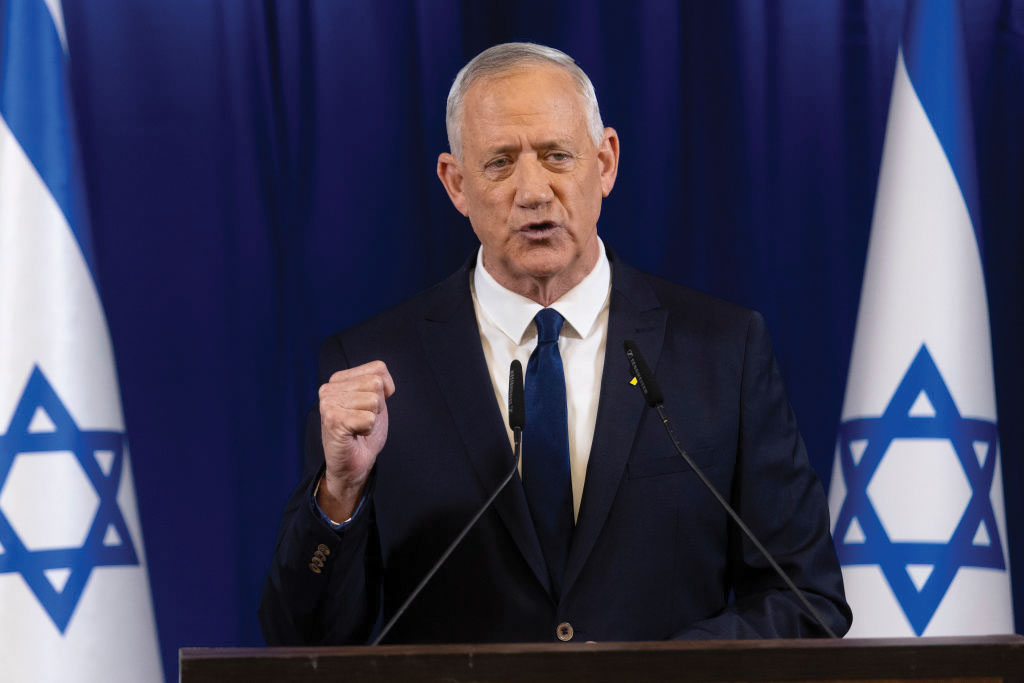
On Sunday, former minister Chili Tropper announced his departure from what remained of the Blue and White party. It was more than just a standard political exit; Tropper was the last valuable political commodity the party held. His farewell, to a yet-unknown destination, signals the final, quiet evaporation of a movement that once promised to reshape the Israeli landscape. Today, Blue and White is no longer an entity worthy of consideration. There are no significant institutions, no grassroots infrastructure and, increasingly, no voters. Those who remain by Benny Gantz’s side do so out of a sense of lingering loyalty or perhaps a touch of pity, waiting for the moment the leader himself realizes the pointlessness of the endeavor.
How did a man who once commanded 35 seats and seemed destined for the Prime Minister’s office end up here? The truth is that nothing “happened” to Gantz. He was, and remains, the same man. For a brief, shining moment, he fit the exact dimensions of the political “Alternative.” Now, he no longer does.
Gantz was never a leader in the visceral, traditional sense. He never commanded a camp that would follow him into the fire. He was not a Netanyahu, a Deri or even a Yossi Sarid – figures who represent a distinct tribe. Gantz the man is refined, intelligent and soft-spoken. Gantz the politician, however, was a virtual creation – a placeholder designed to fill a vacuum for a limited time.
In recent months, Gantz has tried to reinvent himself as the epitome of the ideological “seam” between Israel’s two emerging political blocs: the Netanyahu bloc and the Bennett-led alliance. This position can be interpreted in two ways. Tactically, this seam is a political reservoir where undecided voters await a remedy. These are Israelis who find the rigidity of the camps exhausting and prefer the ambiguity of the center. This middle is not a seam – it is “glue.” It is a space intended to connect the blocs rather than divide them.
But does this middle space actually exist as a political reality?
Statistically, roughly 15% of the electorate isn’t yet fully committed to a bloc. This demographic includes the “reservist” movement, Likudniks weary of the coalition’s more extreme partners and Bennett supporters having second thoughts about his renewed alliance with Yair Lapid. When polled, two-thirds of these undecided voters say they don’t actually want either bloc to win. To them, the promise of a “non-aligned” party led by figures like Tropper or former Likud minister Gilad Erdan is a powerful temptation. If it works, such a party could harvest enough seats to act as a kingmaker.
However, there is a yawning chasm between the desire for a nonaligned party and the reality of forming a broad coalition. In the cold light of the morning after an election, sentiment dies and mathematics takes over. If either the Netanyahu or Bennett blocs achieve a majority, they don’t need “seam” mediators; the mediators need them. A “broad coalition” under these circumstances is often merely a rhetorical flourish – a bloc-based government with a decorative centrist wing. It is an “expanded” coalition rather than a truly “broad” one.
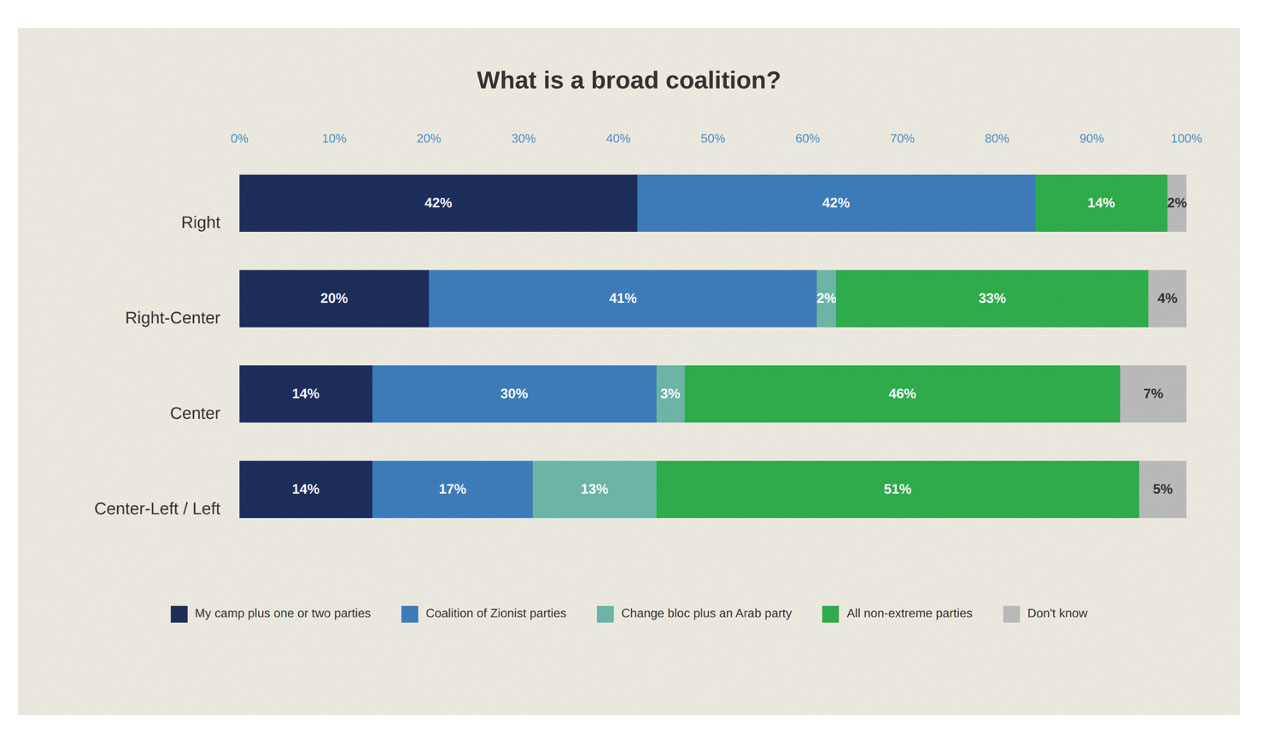
The data confirms this gap. While nearly half of right-wing voters say they want a “broad coalition,” they define the term very differently than the center does. For the right, a broad coalition means a right-wing government that graciously allows one or two centrist parties to join on the victor’s terms. It is a “plus-one” strategy.
The center’s vision is even more complicated. While a majority of centrists advocate for a broad coalition, they define it primarily by who is excluded. They want a government without “extremists.” But in Israel, extremism is in the eye of the beholder. For many centrists, Shas is a non-Zionist party they refuse to sit with over the military draft issue. For the right, Shas is a natural Zionist partner. Similarly, while the center sees “anti-Zionism” in the ultra-Orthodox, the right applies that label almost exclusively to the Arab parties.
Gantz’s ideological message is based on a noble dream: a grand bargain that could seat everyone from Bezalel Smotrich to Yair Lapid at the same table. In this dream, Itamar Ben-Gvir is sidelined as the far-right fringe, Yair Golan and the Arab parties are excluded on the other side, and the country moves forward on a path of moderate consensus.
But deep down, even optimistic Israelis suspect this is a mirage. A grand coalition requires answering the existential questions currently tearing the country apart: Who will be Prime Minister? What is the policy on judicial reform? How do we handle Haredi subsidies or the sharp rise of violent crime in the Arab sector?
Maybe this is what the voters who have abandoned Gantz are effectively telling him, without necessarily telling themselves that’s the real message. His vision of a Great Compromise is unrealistic in our polarized country.
Something I wrote in Hebrew
Most voters do not rank the “Haredi challenge” as their primary concern relative to the other issues haunting them ahead of the elections. First, there is security. Second, the debate over democracy and judicial reform (on both sides of the aisle). Third, the cost of living (which occasionally swaps places with second). One could, of course, argue that the Haredi challenge sits precisely at the intersection of these three pillars. Haredi recruitment is security. … The transfer of budgets to Haredi institutions is the cost of living … And, naturally, the Haredi challenge touches upon the very character of Israeli democracy. In this context, some will argue that the Haredim have joined the camp of those undermining democracy, while others will argue the exact opposite: that they are essential allies in the vital campaign to strengthen it.
A week’s numbers
What do Israelis mean when they say they want a broad coalition? See column above. (Survey by Madad.com)
A reader’s response
Ron Halper asks: “Do most Israelis want the war with Iran to start again?” My response: Most Israelis want Iran not to have enriched Uranim in their possession, and would prefer a war over accepting such reality.
Shmuel Rosner is senior political editor. For more analysis of Israeli and international politics, visit Rosner’s Domain at jewishjournal.com/rosnersdomain.
I’ve been working for decades, as an Orthodox Jew, with devoted Christians, both Catholic and Evangelical. It has always been and remains a warm and mutually appreciative relationship. Yet in the country as a whole, a bitterness is increasingly evident across faith divides.
I have never seen anything like it. It started with Tucker Carlson, self-identifying as a Bible-reading Episcopalian, who has mounted from insinuating that the Jews killed Charlie Kirk, an Evangelical Christian, to insinuating that President Trump is the Anti-Christ. For Tucker’s political Right, Evangelical “Christian Zionists” are the boogieman, and the new, despised “civil religion” of the U.S. is “Israelism.”
Some young Christians worry they’ll be drafted to “die for Israel” in a Middle East war. One said so to me the other day. Harsh voices dispute over the Catholic Church’s stance on Zionism, and whether a “Judeo-Christian” tradition exists. Oh, and Trump and Vice President J. D. Vance (a Catholic) are feuding with the Pope.
These are just a few developments that seem calculated to alienate Christians from Jews, Protestants from Catholics, Protestants from Protestants, Catholics from Catholics, and a Christian-majority country, the United States, from Israel. As the prophet Jeremiah asked, is there no balm in Gilead?
There may be, and it might surprise you to hear it could be science. Some of my scientist colleagues at Discovery Institute, here in Seattle, appear in a new theatrical documentary, “The Story of Everything.” They include Christians, Jews, and agnostics. The movie offers what it terms the scientific evidence that “reveals a mind behind the universe.”
The argument of the documentary describes three scientific discoveries. The discoveries are that the universe began to exist at the Big Bang, caused by no force within nature. The cosmos was ultra-finely tuned at that moment to support life, by an intelligence outside nature. And life is ingeniously engineered, again gesturing to an intelligence beyond nature.
That concludes my recommendation of the film and of my colleagues’ work. The reason I bring it up is that science on all three subjects directs us not to a particular religion but to theism, the belief in the existence of a deity.
We could be more specific by saying it directs us to monotheism, the belief in one deity. There was only one Big Bang, sometimes called the Singularity, following the theories of physicist Stephen Hawking. A singular beginning means a singular creator.
All this unites, or it could unite, American religious believers.
If combining science and religion troubles you, remember that the men who ignited the scientific revolution were all believers in God. So were the men of the Enlightenment who founded the United States. Interestingly, not all (notably Isaac Newton, Thomas Jefferson, Benjamin Franklin, and John Adams) were orthodox believers.
I was moved recently by reading social scientist, and ex-atheist, Charles Murray’s wonderful little book “Taking Religion Seriously.” He recounts his intellectual evolution to a not perfectly orthodox Christianity, which included thinking about (that’s the first half of the book) topics in science, especially the “brute facts” of the Big Bang and the cosmic fine-tuning.
Murray’s view includes the “utmost respect” for a range of world religious figures, from Moses to Gautama to Laozi, but “reverence” for Jesus alone. There is a sweet universalism to this science-inspired theism.
Something like it was foreseen by the most respected Orthodox rabbi of the 20th century, Joseph B. Soloveitchik. Writing in 1964, in an essay titled “Confrontation,” and coordinated with a statement of the Rabbinical Council of America, he sketched a way of relating for Americans of different faiths, all equally confronted by the specter of ideological materialism.
He argued that religions possess individual dignity in a way that is incommensurable with each other: meaning, they should be respected but can never be understood in each other’s terms. Yet in what he called “secular” arenas, from science to politics, the same faiths could achieve understanding and friendship.
The science of monotheism may be one of those arenas. A Judeo-Christian tradition, wrote the dialectical Rabbi Soloveitchik, in religious terms is a fiction. But in the fields of the secular, including science, it is very real.
God as “secular”? It seems paradoxical but yes. On specific points of belief, Christians and Jews are not mutually understandable to each other. But the cosmic foundation of scientific evidence is equally accessible to us all, on the very same terms.
Is there, then, no salve to heal our fractures? Maybe it is the universal, non-denominational hypothesis of a singular God.
David Klinghoffer is a Senior Fellow at Discovery Institute and the author most recently of “Plato’s Revenge: The New Science of the Immaterial Genome.”
There are times when we are struck by the simplest things: the shape of a tree, even one we’ve seen hundreds of times, or the sound of a bird in the morning as we wake. The one that’s been chirping for months outside our bedroom window. And now, for some reason, on this particular day at this particular time, we detect something we hadn’t stopped to consider. Or water, the very idea of water, which had become so common it no longer deserved a moment of our attention. Or words. How many words have we spoken or heard, read and forgotten, used to defend ourselves or to cheat others or to seduce or to betray, until at some point the words themselves seemed bereft of their ability to convey meaning?
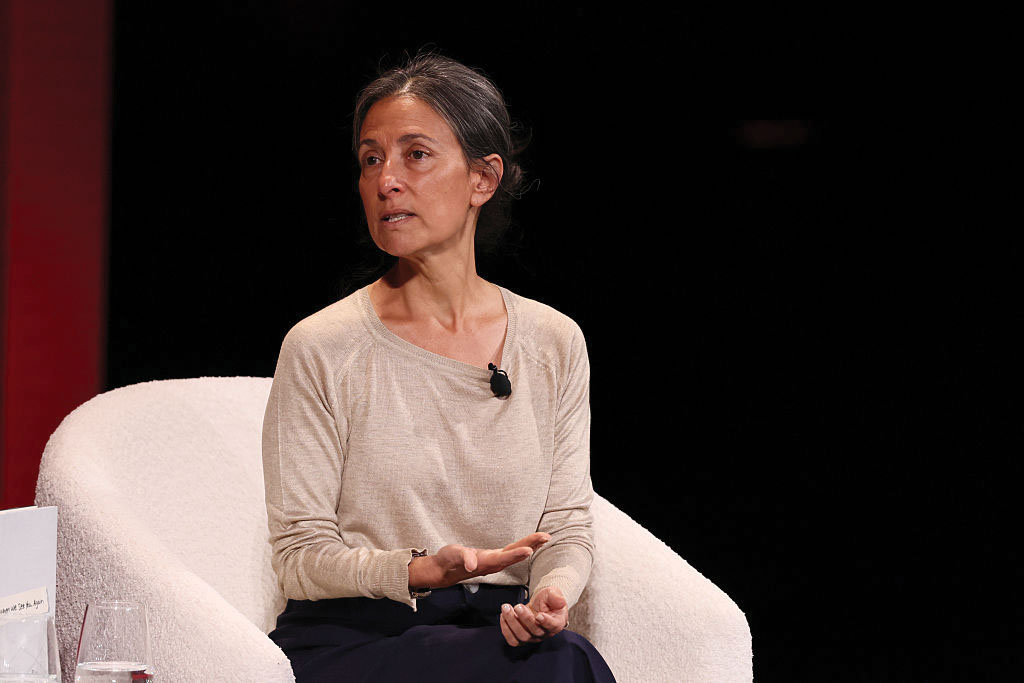
Yesterday evening, my wife and I had come to hear Rachel Goldberg-Polin use her words.
Those simple things formed from the interaction of teeth and tongue, palate and lips, a strand of flesh vibrating somewhere in the back of the throat like the string of a guitar. Today, having heard Rachel’s words, I have become once again astonished at their power, reawakened to their strangeness and to their potentially infinite value.
Rachel Goldberg-Polin, to remind you, is the mother of Hersh Goldberg-Polin, the young man taken captive by Hamas terrorists after his left arm was blown off below the elbow while attempting to throw a live grenade out of a roadside shelter packed with young people. “It was as big a space as my bathroom,” Rachel said. He was held, tortured, starved and eventually murdered in cold blood along with five other captives in a tunnel beneath Gaza.
So you see, Rachel has not only words at her disposal, but a story to tell.
“My name is Rachel Goldberg,” she said at the outset. “How many Rachel Goldbergs do you know?”
The crowd assembled at Stephen Wise Temple in Los Angeles laughed immediately. Every American Jew knows at least five or six Rachel Goldbergs.
Rachel has been lauded, rightly, by many people, and I count myself among them. “She is our hero.” “A powerful force for good in a cruel world.” “A mother to us all.”
Yes. It does feel that way.
It feels, too, that she resembles the biblical Rachel who waits by the roadside near Bethlehem, “weeping for her children,” refusing to be consoled. But I want to suggest something else besides these things, truthful though they are.
Rachel Goldberg-Polin is a Jew.
Not uniquely so. Not some alien creature dropped among us. Rather, she embodies something recognizable to Jews themselves: a particular fusion of sorrow, intellect, humor, argument, tenderness, endurance, memory and sanctification. What appears extraordinary to the outside world often feels strangely familiar to our own people.
Perhaps that gives some answer to those who are not Jewish and who may occasionally wonder — sometimes with admiration, sometimes with resentment — how a mere 15 million Jews in a world of 8 billion could have exerted such disproportionate influence upon civilization, or how, after the horrors of the Shoah, after a third of the Jewish people had been annihilated in crematoria and ravines across Europe, the Jews could build again: families, schools, books, orchestras, laboratories and, finally, the State of Israel itself.
Rachel is not the answer to that question. She is an exemplar of it.
The unelected — except perhaps through God — bearer of an ancient disposition: the wrestler. The one who wrestles between the temporal and the eternal, between despair and meaning, between unbearable grief and an insistence upon the sanctity of life itself.
Rachel did not sing or dance. There were no special effects, no throbbing music to fill the spaces between sentences. She had words.
Words that, had I not been seated in public, might well have had me weeping aloud instead of quietly wiping tears with the back of my trembling hand. Words that spoke less of triumph than of brokenness. Words that told not only her story, but ours.
Words that alerted us once again to the wonder and fragility of life, to its beauty and to the mystery of its value.
A week or so ago, after reading a piece of mine about Rachel, Jon Polin wrote to tell me that years earlier he had attended several of my Chicago shows and had introduced Rachel to my music back then. Then he added something small, almost impossibly small in the face of everything their family has endured: had Hersh been born a girl, Raina — my daughter’s name, and the title of a song of mine Jon had heard in the early 1990s — was among the names they had considered.
Early on, Rachel described feeling as though she had left this world entirely after Hersh’s abduction and murder.
A friend was extremely helpful,” she said. “A Breslov Hasid — you know, long peyos, beard, the real deal — and also a psychiatrist with a medical degree from Brown …”
Yes. Those are indeed the sorts of people one encounters in Jerusalem.
He did not attempt to coax her back down into ordinary language or refute her feeling of existing elsewhere.
“He told me,” Rachel said, “that I wasn’t entirely in this world anymore. That part of me was now in Olam Haba.”
At that moment, I gasped.
Literally. And held back tears with all my strength.
Because tears do not come only from sadness. They also come from hearing something that feels perilously close to truth, something so true that language itself begins to fail before it. It is often at that edge of inexpressibility that tears arrive.
What is Olam Haba?
It refers to the “World to Come,” the world beyond the one we presently inhabit, beyond the rote and the overly familiar, beyond the normal shapes of trees, the ordinary sounds of birds, the commonness of water — or even of words themselves.
“Grief is a badge we wear,” Rachel said. She made the point that it shows we know love, that we have loved deeply, that another person’s existence had become inseparable from our own.
This is not a healing balm. It does not eliminate pain. But perhaps, especially if one believes there is an order beyond this visible world, it offers some orientation within suffering. A sense that existence is not random, that there remains some force — however one defines it — that places us where we need to be when we need to be there.
“I hate that Hersh is not here,” Rachel said. “I hate it.”
And yet, through all her words — exceptionally articulate, exceptionally emotive, at times hilarious and unmistakably Jewish — she somehow reminded us that our task remains here, in this world, in this week, this morning, this very moment.
In the afterword, Jon Polin is given the final words. He describes being stopped on the street by a stranger a year after Hersh’s murder. The man pulled out his phone and showed Jon a photograph of Hersh.
“Every morning the first thing I see is this picture of Hersh,” the stranger told him, “and I start each day by asking myself what I can do today to be better, to make the world better.”
“What a legacy!” Jon writes.
Then, addressing his son directly:
“Hersh: I continue to love you every second and always will. May your memory be a revolution … for good!”
My gratitude to Rachel, to her husband Jon Polin, whose quiet strength holds Rachel, lets her breathe, lets her speak, and to the Creator of the Universe for granting me, and you too, another day of life.
Peter Himmelman is a Grammy and Emmy nominated performer, songwriter, film composer, visual artist and award-winning author.
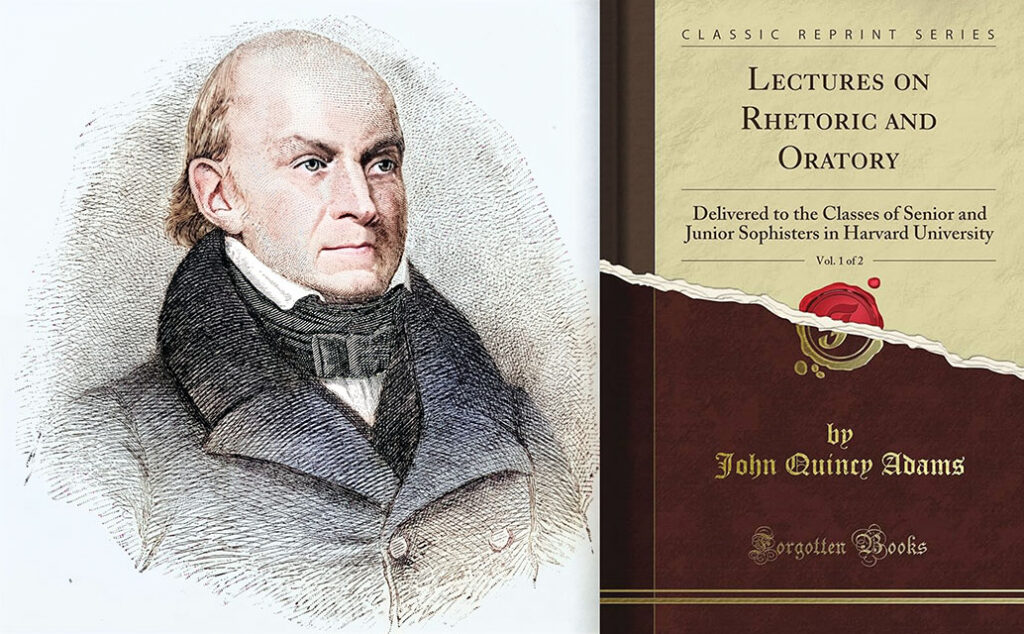
John Quincy Adams was quite the multitasker. While serving in Congress as a senator for Massachusetts during the first decade of the 19th century, he also taught logic at Brown University and was the Boylston Professor of Rhetoric and Oratory at his alma mater, Harvard.
It was at the latter that he delivered a multi-part lecture series on the nature and history of public speaking, and the power of the spoken word to unify the new nation and its diverse peoples.
The series, published in 1810 as “Lectures on Rhetoric and Oratory,” includes a remarkable ode to a central figure from the biblical book of Exodus, Aaron, Moses’ brother, who articulated the aspiration of national liberation on behalf of his famously heavy-tongued younger sibling.
Since Israel’s political leader was a reluctant rhetorician, Adams detailed in the “Inaugural Oration,” “another favored servant of the Most High was united in the exalted trust of deliverance and specially appointed for the purpose of declaring the divine will to the oppressor and the oppressed; to the monarch of Egypt and the children of Israel.”
Recapping God’s instructions to Moses to head to Egypt and urge Pharaoh to let His people go, Adams paraphrased Exodus 4:14-16, in which the Lord reassures a hesitant Moses, “Is not Aaron, the Levite, thy brother? I know that he can speak well. And he shall be thy spokesman unto the people; and he shall be, even he shall be to thee instead of a mouth, and thou shalt be to him instead of God.”
Adams then continued:
“It was not sufficient for the beneficent purposes of divine Providence that the shepherd of his flock be invested with the power of performing signs and wonders to authenticate his mission and to command obedience to his words. The appropriate instrument to appall the heart of the tyrant upon to control the wayward dispositions of the people, was an eloquent speaker.”
Moses’ miracle-working abilities were not enough. To inspire a new nation to abide by Providence and acclimate its population to liberty, one needed a way with words – which Aaron was there to provide.
Adams went on: “and the importance of the duty is apparent in the distinction which separated it from all the other transcendent gifts with which the inspired leader was endowed, and committed it, as a special charge, to his associate. Nor will it escape your observation that, when the first great object of their joint mission was accomplished, and the sacred system of laws and polity for the emancipated nation was delivered by the voice of heaven from the holy mountain, the same Eloquent Speaker was separated from among the children of Israel to minister in the priest’s office, to bear the iniquity of their holy things, [and] to offer up to God, their creator and preserver, the public tribute of their social adoration.”
Subsequent to the Israelites obtaining their freedom from Pharaoh, Aaron was promoted from public speaker to High Priest. That, Adams argued, was a natural next step. After all, the power of words served to unite a nation for multiple purposes – in both obtaining freedom from one’s enemies and in practicing one’s faith.
Aaron’s public speaking became a career in spiritual public service. Israel’s High Priest would serve for decades as the divine representative of not only his brother, but of the entire polity, ensuring their spiritual survival amidst their desert wanderings.
Now turning to directly address his audience of students, Adams encouraged them to echo the leader of ancient Israel’s Sanctuary as they seek to serve in America’s Temple of Liberty: “Sons of Harvard! You, who are ascending with painful step and persevering toil the eminence of science, to prepare yourselves for the various functions and employments of the world before you, it cannot be necessary to urge upon you the importance of the art, concerning which I am speaking. Is it the purpose of your future life to minister in the temples of Almighty God, to be the messenger of heaven upon earth, to enlighten with the torch of eternal truth the path of your fellow-mortals to brighter worlds?”
As the students would soon occupy positions of influence throughout the country, Adams insisted, “Remember the reason, assigned for the appointment of Aaron to that ministry, which you purpose to assume upon yourself. ‘I know that he can speak well’; and, in this testimonial of Omnipotence, receive the injunction of your duty. Is your intention to devote the labors of your maturity to the cause of justice; to defend the persons, the property and the fame of your fellow citizens from the open assaults of violence, and the secret encroachments of fraud? Fill the fountains of your eloquence from inexhaustible sources, that their streams, when they shall begin to flow, may themselves prove inexhaustible.”
Adams then concluded: “Consecrate, above all, the faculties of your life to the cause of truth, of freedom and of humanity. So shall your country ever gladden at the sound of your voice, and every talent, added to your accomplishments, become another blessing to mankind.”
No doubt Adams kept Aaron’s model in mind as his own political career advanced. He would seek to emulate Aaron’s elocution upon being elected president, bringing the High Priest’s legacy with him to the White House.
Rabbi Dr. Stuart Halpern is Senior Adviser to the Provost of Yeshiva University and Deputy Director of Y.U.’s Straus Center for Torah and Western Thought. His books include the newly released “Jewish Roots of American Liberty,” “The Promise of Liberty: A Passover Haggada,” “Esther in America,” “Gleanings: Reflections on Ruth” and “Proclaim Liberty Throughout the Land: The Hebrew Bible in the United States.”
Two and a half years after the killing of Paul Kessler in Thousand Oaks on November 5, 2023, Ventura County Superior Court Judge Derek Malan offered Loay Alnaji a plea deal that could result in a maximum sentence of one year in jail and three years of probation.
Alnaji, 54, of Moorpark, accepted the deal and pleaded guilty, avoiding a jury trial that had been scheduled for May 12.
The incident in which Kessler died took place during a pro-Palestinian protest at the corner of Thousand Oaks and Westlake Boulevard. Kessler, 69, a Jewish resident of Thousand Oaks, was struck with a megaphone, fell and died the following day. Authorities said Alnaji approached the area where Kessler was standing with pro-Israel demonstrators, and the two exchanged words before the confrontation.
Alnaji had initially pleaded not guilty. His defense attorney, Ron Bamieh, argued that his client did not intend to strike Kessler and accidentally hit him with the megaphone after Kessler placed a cellphone close to his face. Bamieh also argued that Kessler’s death was linked to a preexisting brain tumor that exacerbated the injuries from the fall.
However, Assistant Chief Medical Examiner Othon Mena testified during a May 2024 preliminary hearing that Kessler died from blunt force injuries.
Jonathan Oswaks, a friend of Kessler who attended the rally with him, said he is shocked by the outcome.
In an interview with the Journal, Oswaks questioned how the case was handled.
“I’m angry. I don’t know what to call it, but it’s not justice and the resolution is deeply frustrating,” Oswaks said. “I’m not a lawyer, but the way this was handled raises serious questions for me. It sends a troubling message about accountability.”
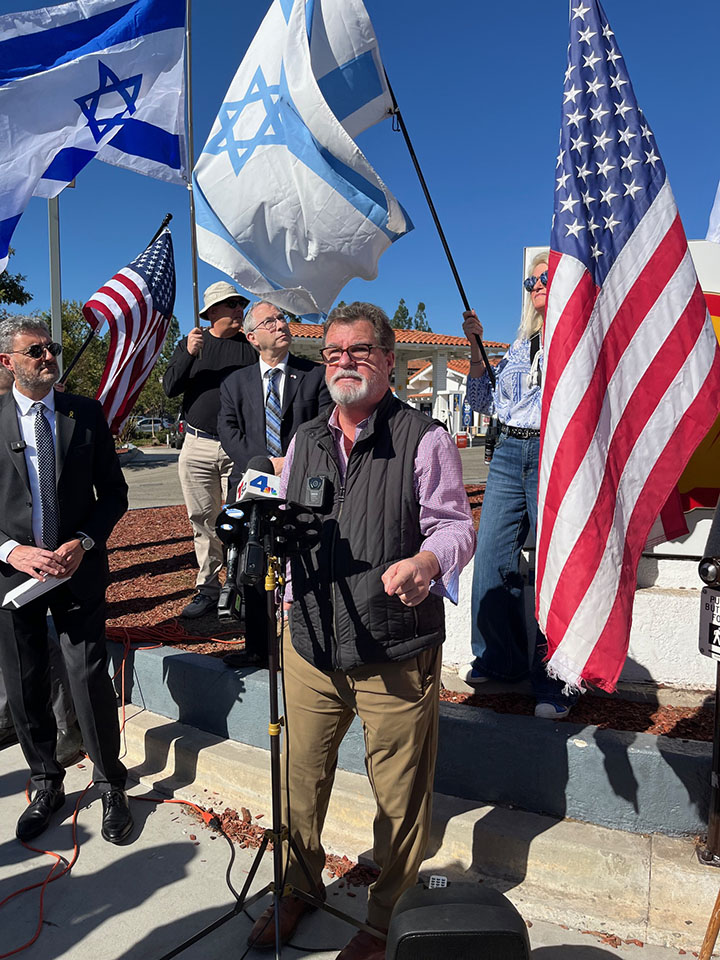
Oswaks, 70, met Kessler about three weeks before his death. In a November 2024 interview he gave the Journal at a memorial for Kessler at the corner of Thousand Oaks and Westlake boulevards, he said he had been trying to raise awareness and called on others to attend a pro-Israel rally.
“I was immediately booted off Nextdoor,” Oswaks said. “The only person who responded to my call on social media was Paul Kessler.”
Recalling the day of the incident, Oswaks said the two initially stood together before deciding to separate.
“At around 3 p.m., when the rally began, Paul and I were standing here at the corner, but there were so many pro-Palestinian protesters, so I told him we should split up because we only had two flags,” he said. “I told him, ‘You stay here, and I’ll go to the other corner, about 80 feet away.’”
Oswaks said that shortly after, two men approached him and began shouting antisemitic slurs.
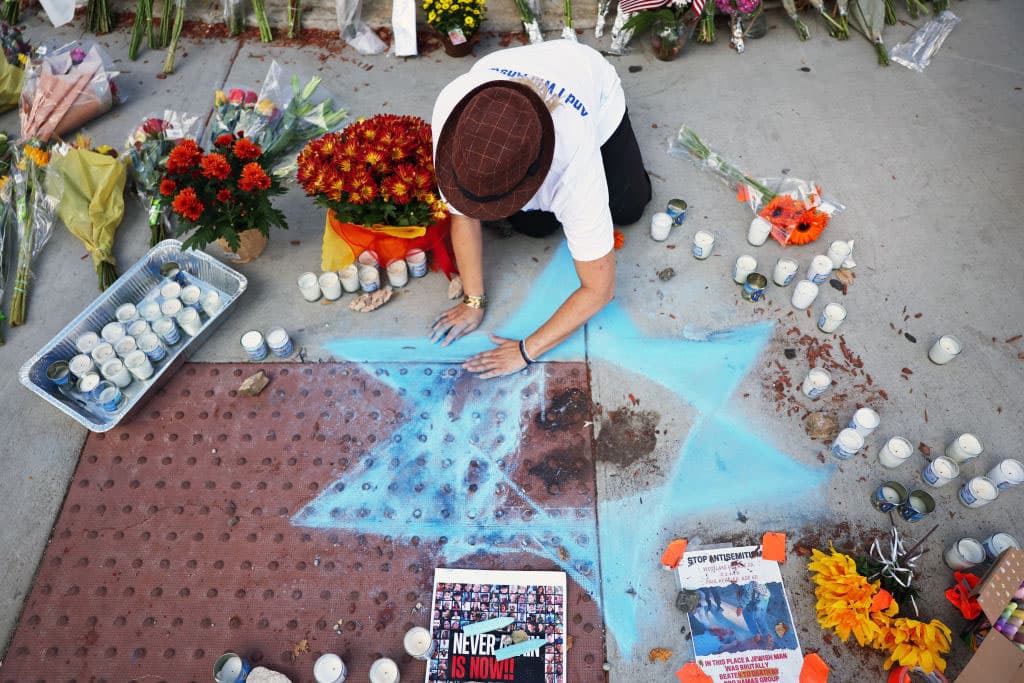
Elena Colombo creates a Star of David at a makeshift memorial at the site of an altercation between 69-year-old Paul Kessler, who was Jewish, and pro-Palestinian protestor on November 7, 2023 in Thousand Oaks, California. (Photo by Mario Tama/Getty Images)
“When I tell you I had never experienced that level of hate in my life, I hadn’t,” he said.
He described the men standing inches from his face, yelling into his ear and using a megaphone.
“I told them to get out of my space,” he said. “They backed off briefly, then started again. I made it clear they needed to stay away, and eventually they did.”
Despite the experience, Oswaks said he is not afraid to attend rallies in the future, but believes safety is a growing concern.
“You’re basically unprotected. You have to look out for yourself, and that’s really unfortunate,” he said. “It feels like things are deteriorating — like we’re becoming some kind of third-world sh—hole.”
Senior Deputy District Attorney David Russell said both the Ventura County District Attorney’s Office and Kessler’s family opposed the judge’s offer and instead sought the maximum possible sentence of four years in state prison.
Alnaji, a professor at a community college, will be sentenced on June 25.
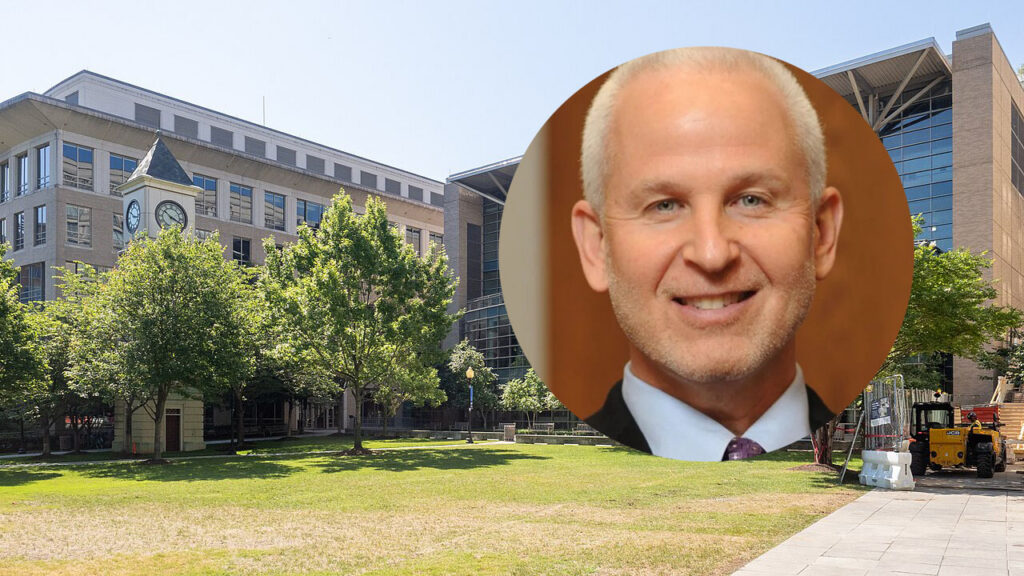
When Georgetown Law School announced recently that Dr. Morton Schapiro, Professor and President Emeritus of Northwestern University, would be its commencement speaker, Interim Dean Joshua C. Teitelbaum noted that Schapiro is “highly informed about the challenges facing colleges and universities today,” and that “there are few who can speak to it with as much clarity and insight as he can.”
How prescient that was.
Indeed one of the challenges facing universities today is a growing intolerance for free speech, especially speech that is supportive of Israel.
In his Jewish Journal column, Schapiro has written about a range of subjects, including the need for hope and optimism and improving the public discourse. But he has also expressed supportive views of Israel.
That was a bridge too far for a group of law students.
“Since April 2023, Schapiro has written a column discussing faith, politics, and Jewish identity for The Jewish Journal,” the campus paper the Voice reported. “Students who spoke to the Voice took issue with some of the articles Schapiro has written, specifically focusing on Israel and its relationship to Judaism and U.S. universities.”
Some of the complaints related to Schapiro’s lack of a legal background, but the thrust of the outrage was connected to his support for Israel.
“The selection of Morton Schapiro as our commencement speaker is an absolute shame,” a student named Mari Latibashvili wrote to the Voice. “His views on the genocide of Palestinians are despicable and disqualifying; instead of holding Israel accountable for the horrors it has perpetrated, he blames the media and universities for allowing people to speak the truth.”
Faced with a petition by protesters decrying his invitation, the opposition became loud enough that Schapiro could only imagine what would be reserved for him on the day of the address. So, as he told me, he felt he had little choice but to withdraw.
In his announcement this morning, Teitelbaum wrote:
“In the past week, a number of law students raised concerns about Dr. Schapiro as commencement speaker, due primarily to opinion essays he published on Israel and Palestine in the aftermath of October 7, 2023…After independently learning of the students’ concerns, Dr. Schapiro informed me that he regretfully has decided to decline our invitation to speak at commencement.”
In his letter, Schapiro wrote: “I have presided over 28 commencements as a president and dean, and those ceremonies are about celebrating the graduates and their supporters. I was looking forward to giving a talk about humility and gratitude, but I don’t want my presence to distract from the day’s festivities.”
Teitelbaum announced that Schapiro will be replaced by David Cole, Professor in Law and Public Policy at Georgetown and former National Legal Director of the American Civil Liberties Union. Cole has been outspoken in recent years, in particular for defending the right to express antisemitic views.
“Given Georgetown Law’s desire to keep politics out of its commencement ceremony, I am a little surprised by their choice of a speaker to replace me,” Schapiro told me.
Earlier this year, Georgetown announced that Elizabeth Magill, the former President of the University of Pennsylvania, will be the new dean of Georgetown Law. Magill resigned from Penn on December 9, 2023, following her controversial testimony during a House Committee hearing on campus antisemitism. When asked whether calling for the genocide of Jews constituted bullying or harassment, Magill responded that it was “context-dependent.”
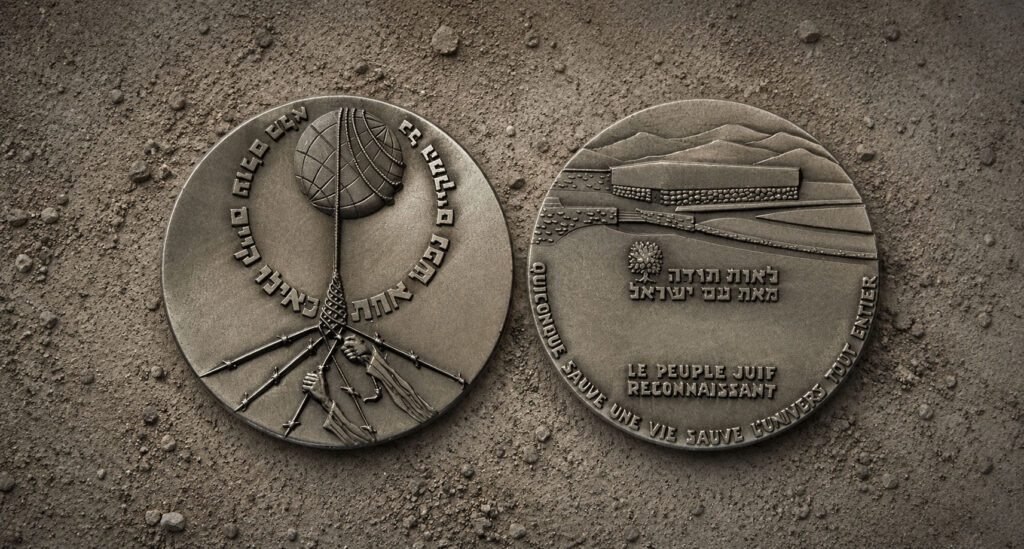
There truly are the righteous, those who have a conscience, who think not of their personal safety, but about what is right and just, who are humane and compassionate. Even in these trying times, they are among us today. They always have been — so great that they did not even think that what they did was exceptional. It seemed natural and obvious to them.
From the days of the Bible, Shifra and Puah, Egyptian midwives, defied Pharaoh’s command to drown all Jewish males born in his kingdom. And Pharaoh’s own daughter took baby Moses in and saved him. Moses grew up and saved the Jewish people, bringing them from slavery to freedom, gave them the Torah and led them to the land of Israel.
The Holocaust was, of course, the greatest test of society’s virtue and humanity. Tragically, society failed miserably. And yet, the righteous did exist and accomplished the impossible. By 2002, more than 19,000 non-Jews had been honored as Righteous of the Nations at Yad Vashem, Israel’s Holocaust memorial, according to Sir Martin Gilbert’s book, “The Righteous.” More than 800 non-Jews were being honored every year.
More than 200,000 Jews of France’s wartime population of 300,000 survived thanks to many righteous. Albania, a Muslim country, was the only Nazi-occupied country with more Jews after the war than before. Not only did they save all their Jews, but Jewish refugees were also protected.
Everyone knows the name of the Swedish diplomat, Raoul Wallenberg, who saved tens of thousands of Jews. However, few know about Sultan Mohammed V of Morocco. Ordered by the Nazis to do what was being forced on the Jews in Europe – expropriate their property, force them to wear yellow stars and finally deport them to their death –he refused! He considered Jews his responsibility, protected under his spiritual care: “There are no Jews in Morocco. There are only Moroccan subjects,” he announced. In 1941, during the Feast of the Throne, he invited Nazi officers and leaders of the Jewish community, seating the rabbis next to the Vichy French generals and next to his own throne.
In 1939, Chiune Sempo Sugihara, a Japanese diplomat, was sent to the capital of Lithuania as Japanese Consul. The Jewish community came to him for transit visas that would allow them to cross the Soviet Union on the way to Curaçao, a Dutch colony that did not require entry visas. Knowing that his supervisors would not allow him to issue the papers, he issued them the visas himself. When the response came from Japan, it was negative. He still issued between 2,000 and 3,000 transit visas. Orders continued to come from Japan not to issue visas but he accelerated the process; such was his sympathy for the Jewish community. The Nazis invaded Lithuania in 1941 and the murder of all Jews began immediately after the occupation. The ones he saved would all have been murdered.
Closer to home, in Billings, Montana in 1933, white supremacists intent on establishing an Aryan state intimidated the Jewish community. They tried to destroy a menorah in a window, among other desecrations. The police advised the householder to take down the menorah. Instead, she went to the local newspaper, which published a story about the incident. A Christian resident, Margaret Macdonald, called her pastor, Keith Torney, who asked the Sunday school children to draw menorahs and to display them in solidarity with the Jewish community. Other churches joined in. Hundreds followed their lead. The newspaper published a full-page picture of a menorah to post in the windows and thousands did. The supremacists withdrew from the town. A simple gesture by many decent people averted a disaster for the Jews and for the community.
As a French columnist wrote: “Courage does not need an army, heroic acts don’t wear a uniform and one person armed with conviction, who refuses to be intimidated, can stand up to an evil empire and win” (my translation).
If there had been only 10 truly righteous people in Sodom and Gomorrah, God would not have destroyed the cities. The destruction of these cities is a declaration that we cannot survive physically, morally or spiritually without righteousness. A city, or a country, without righteousness cannot long exist in any meaningful sense. A place with no conscience and no compassion is morally dead.
As long as there are righteous people, there is hope. The world is redeemable. When the righteous outnumber the others, that will constitute redemption. Maybe that’s what they mean when they refer to Moshiach (Messiah), Heaven on Earth. May it come speedily in our time.
Dr. Paul Socken is Distinguished Professor Emeritus and founder of the Jewish Studies program at the University of Waterloo.


 Dropping May 12, “Suicidal Empathy: Dying To Be Kind” will likely be hate-read by many on the left who will find it inflammatory and offensive, while many on the right will find it powerful. Saad, who said he’s gotten plenty of threats over the years, told The Journal there have been hit pieces against him since well before the release of his new book.