fbpx

May 6, 2026

An 11-Year-Old Girl

“An 11-year-old girl who was
critically wounded in an Iranian
cluster bomb attack on her home
in Bnei Brak earlier this month
died of her injuries …”

I read the two-line update
in my Jewish newsletter
on the afternoon before
my daughter’s 11th birthday

Sit quietly on the sofa
alone in my apartment
in New York City, I don’t
sob, the sadness stays

instead inside my chest
sinks in, makes a home
as my head tilts sideways
staring at the three dots …

She died of her injuries …
what comes next? what
has become of us, will
be coming into a world

where I learn that an 11-year
-old girl has died half way
though an email newsletter
in the “other updates” section

not a headline this story
doesn’t even merit a full
paragraph … she died …
of her injuries … of our

failure to protect her
from the sky falling and
I don’t even know her
name, not worth mentioning

so I go searching, find her
name is Nesya, a “miracle
of God” hit on Erev Pesach
and I regret the research the

moment I see in the photo
the same gold heart hoop
earrings as my daughter,
now asleep in her bed, who

will turn eleven tomorrow …


Avi Killip is a poet and rabbi who serves as the Executive Vice President at Hadar. Avi is host of the Responsa Radio podcast.

An 11-Year-Old Girl Read More »

The End of Passive Judaism, The Rise of Jewish Power

After the recent stabbing attack in England, something deeply unsettling emerged — not only the violence itself, but the reaction that followed.

Jewish voices began to say the same thing: They are taking off their kippahs, removing their Star of David necklaces, and hiding the visible signs of who they are.

This is not new. It is a reflex Jews have developed over centuries.

When danger rises, disappear.

But that instinct belongs to a different era.

For most of Jewish history, Jews had no power. No army. No ability to defend themselves beyond hoping that the societies around them would protect them. In that reality, survival often meant lowering your profile.

Today, that reality has changed, but the mindset has not.

In Israel, Jews live differently. There is a state. There is an army. There is a culture that understands that survival requires strength.

In the diaspora, especially in places like England, Jews do not have that same structure.

And that is exactly the problem.

If Jews abroad do not have a state protecting them directly, then communities themselves must become stronger, physically, mentally and socially.

“Jewish power” is not about violence. It is about readiness. It is about presence. It is about refusing to disappear.

During the events of October 2000 in Israel, I experienced firsthand what it feels like when a Jewish city effectively loses its freedom of movement.

I was a soldier at the time. On my way home from the base, the bus driver stopped in Migdal HaEmek, a city next to Nazareth Illit where I lived, and told me he would not continue any further.

My father had to take alternative routes, including dirt roads, to get me home.

There was no official declaration of a siege, but on the ground, it felt like one.

For several days, movement was restricted. A Jewish city inside Israel felt isolated. All the main roads leading into Nazareth Illit ran through surrounding Arab towns and the city of Nazareth, and during those days those routes were blocked, effectively cutting off access in and out of the city.

And then came Yom Kippur.

In Israel, that is the one day when the streets are completely open. No cars. People walk freely. Families, children and entire communities fill the roads.

That day, people came out. They walked. They gathered.

From across the city, people began moving toward one place, the mall.

Men, women, young people, older residents. Not organized by any authority, but drawn by something deeper, a shared understanding that we had to act.

Within a short time, thousands had gathered in the mall.

We marched into Nazareth, the largest Arab city, together, showing that we were not afraid, moving through the city with visible confidence and a clear sense of strength.

The entire city of Nazareth saw that we were not afraid, that we were united, no longer isolated. By the next day, the roads opened, the isolation was broken and it has not returned since.

That moment carries a lesson: Jews must come together and walk openly, confidently, and proudly, not only in familiar areas, but also in parts of their own cities where they once felt hesitant or unwelcome.

My recommendation to Jews in England is to organize.

Create local groups, even simple WhatsApp groups, that bring people together on a regular basis. Walk together, visibly and confidently, in your own neighborhoods and public spaces. Do not remain isolated individuals.

Wear visible Jewish symbols. Let it be clear, you are not alone and you are not ashamed of your Judaism.

Coordinate, when necessary, with local authorities. Let it be known that these are lawful, peaceful gatherings of a community that simply refuses to disappear.

Consistency matters. Do it regularly. Build routine. Build familiarity. Build strength through unity.

Because when people see individuals, they see vulnerability.

When they see a community, they see resilience.

That is how you change reality, and how you fight antisemitism.


Maoz Druskin writes about Israel, democracy and the challenges of national identity in modern societies.


The End of Passive Judaism, The Rise of Jewish Power Read More »

Scandal on the Ballot

Page 24 of the California Voter Information Guide is no place for the faint of heart. There you will find charges that Israel was responsible for the Sept. 11 terrorist attacks, secretly funds Hamas and is currently planning a nuclear strike against the United States. For good measure, there are also links to a buffet of websites featuring odious anti-Semitic, racist and anti-LGBTQ diatribes.

How did this repulsive material end up in the state’s official voter materials, posted on a government website and mailed to millions of California voters at taxpayer expense? Because California Secretary of State Shirley Weber allowed an odious fringe candidate for governor to include these vile items in his ballot statement.

Weber’s office was clearly aware of the inflammatory language, as the candidate’s statement was accompanied by a disclaimer stating that the “views and opinions expressed by the candidates are their own and do not represent the views and opinions of the Secretary of State’s office.” The other 31 candidates’ statements have no such disclaimer.

Weber’s office defended themselves by asserting that she is bound by laws that only allow the state to reject candidate statements if they directly reference an opponent. But that is demonstrably untrue, as the Secretary’s own website declares that statements “shall be limited to a recitation of the candidate’s own personal background and qualifications.” Weber’s office did not explain how conspiracy theories regarding the 9/11 attacks, the Gaza War or the deployment of a nuclear weapon were related to the candidate’s background and qualifications.

The same guidelines said the Secretary of State could disqualify statements if her office raised objections and candidates did not make appropriate changes. There is no record of the Secretary’s office raising any such objections. They were apparently satisfied that the disclaimer that Weber and her staff did not share these sentiments was sufficient.

Members of the Jewish Legislative Caucus, led by Assemblymembers Jesse Gabriel (D-Encino), the caucus chair, and Gail Pellerin (D-Santa Cruz), a longtime county election official, condemned the inclusion of the incendiary references and have promised to carry legislation to address a problem that should not require legislation to address. Weber will almost certainly support their proposed remedy, but as of this writing, the unacceptable language remains on her office’s website and every California household with a registered voter inside will soon have this filth inside their homes.

Gabriel was appropriately incensed. “We were outraged to learn that the Official Voter Information Guide for the California Primary … includes antisemitic conspiracy theories and links to websites with horrific racism, homophobia and misogyny,” he said. “This is dangerous, deeply offensive and antithetical to California’s proud tradition of standing up to hate.”

Several Jewish community groups expressed their anger as well, including the Anti-Defamation League, the Jewish Federation of Orange County, the Jewish Community Action Network (JCAN) and the Israeli American Council. (JCAN leader Ilana Meirovitch correctly questioned whether the secretary of state’s office would have permitted a discriminatory statement against a different minority group.) And the coalition has justifiably requested an explanation from Weber as to how such a misguided decision was made in the first place.

None of this should be confused with a circumvention of the First Amendment. A bigoted individual has every right to run for office and to peddle his hatred, both in the public square and its digital equivalent. But those rights to free speech do not entitle him access to a government website or the ability to use public tax dollars to spread his detestable claims. Weber owes the voters of California an explanation for her carelessness and a full investigation into how these decisions were made – and by whom. A predictable pseudo-apology and support for a bill that should not have been necessary if not for her abdication of responsibility is not good enough.

Similarly, it would be tempting for unannounced presidential aspirant Gavin Newsom to ignore this mess and avoid stoking the fires of a political party now deeply divided over Israel. But a gubernatorial spotlight is a necessary part of the solution, to make sure this debacle receives the attention it deserves.


Dan Schnur is the U.S. Politics Editor for the Jewish Journal. He teaches courses in politics, communications, and leadership at UC Berkeley, USC and Pepperdine. He hosts the monthly webinar “The Dan Schnur Political Report” for the Los Angeles World Affairs Council & Town Hall. Follow Dan’s work at www.danschnurpolitics.com.

Scandal on the Ballot Read More »

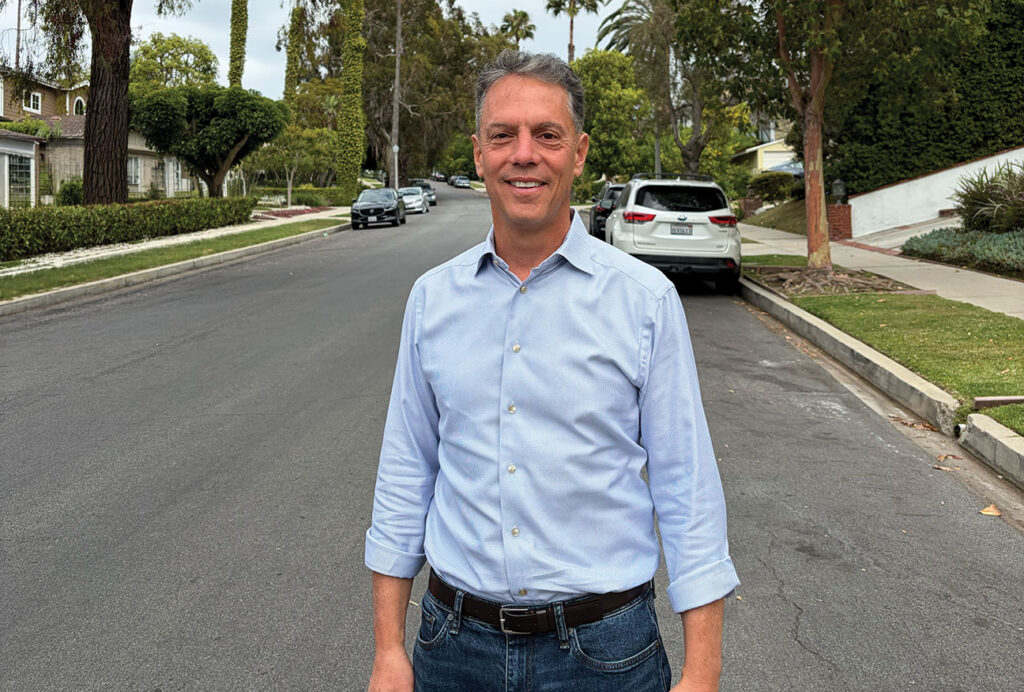
Adam Miller Hasn’t Given Up on L.A.

“Dogs are starving on Skid Row,” Adam Miller told me as we met at my home on a recent Sunday afternoon.

It was an impromptu remark after a long discussion of what ails Los Angeles, including what Miller would do if he became mayor.

This was the first time we met in person, but in recent weeks, with primary elections around the corner, the Jewish, Israel-supporting Miller has drawn a buzz in the community.

No kidding.

So many Angelenos, Jews and non-Jews alike, feel exasperated with the recent decline of our city. Some have given up and even left.

Miller doesn’t like the idea of giving up.

He doesn’t wear the easy smile of a politician. He’s not a schmoozer. He’s more the earnest type – a no-nonsense entrepreneur with solutions.

He has come up with a comprehensive “7×7 Plan” that outlines what his campaign says are “ambitious goals to address our most significant challenges with the clearly defined steps to achieve them.”

The plan is indeed ambitious, from reducing street homelessness by 60% to lowering average rents by 10% to doubling law enforcement patrols to cutting permitting times by 80% to unlocking housing and economic growth to rebuilding 1,500 miles of roadway to creating 100,000 new jobs across key industries to modernizing the city’s processes and infrastructure.

That alone is ambitious enough, but his biggest challenge may be to cut through the cynicism of voters who have been burned one too many times by politicians who make big promises but fail to deliver.

Which brings me back to the starving dogs on Skid Row.

“I’ve never heard a candidate talk about animals,” I told him.

The subject came up near the end of our conversation because Miller mentioned he was off to an event on animal welfare.

I was intrigued, so we extended our meeting.

He talked about the animal crisis with the same passion he showed for other crises. It struck me that this is not just a man with empathy; it’s someone who gets charged up by the very notion of fixing problems.

His campaign describes “a serial entrepreneur” who is running for mayor “to bring an operator’s mindset and executive leadership to City Hall, focused on making LA work better so Angelenos can live better.”

When you meet him in person, you get the sense that this successful high-tech entrepreneur means all of this. For him, it’s personal. He doesn’t need the job. He just loves this town.

“My wife and I raised our kids here, and like so many families across the city, we want them to be able to live, work and thrive in the neighborhoods they call home,” he writes on his website.

Will he get a chance to use his problem-solving skills to fix our city’s problems?

Can his centrist style prevail at a time when extremism is in vogue?

In other words, can he win?

If enough people hear his message, he thinks he can.

The top two vote-getters in the June 2 primary will advance to the general election in November. Polls show that incumbent Mayor Karen Bass will advance, but who will be her rival?

To her left is Nithya Raman of the Democratic Socialists of America, and to her right is reality TV star Republican Spencer Pratt, who has been making waves with satirical “California Dreaming” and “Batman” video clips.

Miller is running in the middle as a Democrat, but not the leftist progressive version. He’s more in the old-school liberal, pragmatic, pro-Israel tradition of Democrats.

If Raman makes the runoff and wins in November, we will have our own version of socialist New York Mayor Zohran Mamdani. If the Republican Pratt makes the runoff, we can assume Bass will win.

Miller sees himself as the reasonable center, the Democrat with solutions everyone is looking for.

He’s a co-founder and longtime member of IKAR, a spiritual community with a history of advocating for social justice and building bridges across the cultural kaleidoscope of LA.

He’s also a proud supporter of Israel, and waxes nostalgic about the days when he lived there and immersed himself in Israeli life. He takes the rise in antisemitism as seriously as any of us, and we discussed the importance of “bubble zones” around synagogues and other measures to protect Jewish spaces.

Miller is earnest and practical, but he’s also visceral.

While so many Angelenos have lost trust in the political class, Miller is asking us not to lose faith. He sees competence as the road back. Mayors can have a major impact, he told me. The key is to take full advantage of the laws we currently have to recharge our city.

Adam Miller is not giving up on the city he loves, and he’s asking us to do the same.

And that includes not giving up on the starving dogs on Skid Row.

Adam Miller Hasn’t Given Up on L.A. Read More »