Interfaith relations between Christians and Jews have become a feel-good cliché among the well-meaning and a target of satire, a la Tom Lehrer’s “National Brotherhood Week,” among cynics.
For readers in either category, the two-hour documentary, “Jews and Christians: A Journey of Faith,” provides a first-class history lesson and an antidote against oversimplification and easy stereotypes. The documentary will air Dec. 7 on PBS station KCET, starting at 10:30 p.m.
Despite appearances of no less than 40 academics and clerics, the film is much more than 120 minutes of talking heads. Producers Gerald Krell and Meyer Odze, both Jewish, illustrate the evolution of the two faiths, their similarities and divergences, with close-ups of religious ceremonies, exchange visits between synagogues and churches, focus groups discussing stereotypes of the “other” and sidetrips to Jerusalem and the Vatican.
The film is based on the book, “Our Father Abraham: The Jewish Roots of the Christian Faith,” by professor Marvin Wilson, an evangelical Christian.
Particularly intriguing for the layman are the parallels between biblical events and Jewish celebrations and their replication in different forms among Christians.
A seder scene, with the breaking of the matzah and blessing of the wine, is followed by a depiction of Holy Communion, with its consecration of the wafer and the wine.
Purification through baptism is based on cleansing at the mikvah, with one Christian scholar referring to John the Baptist as “John, the mikvah man.”
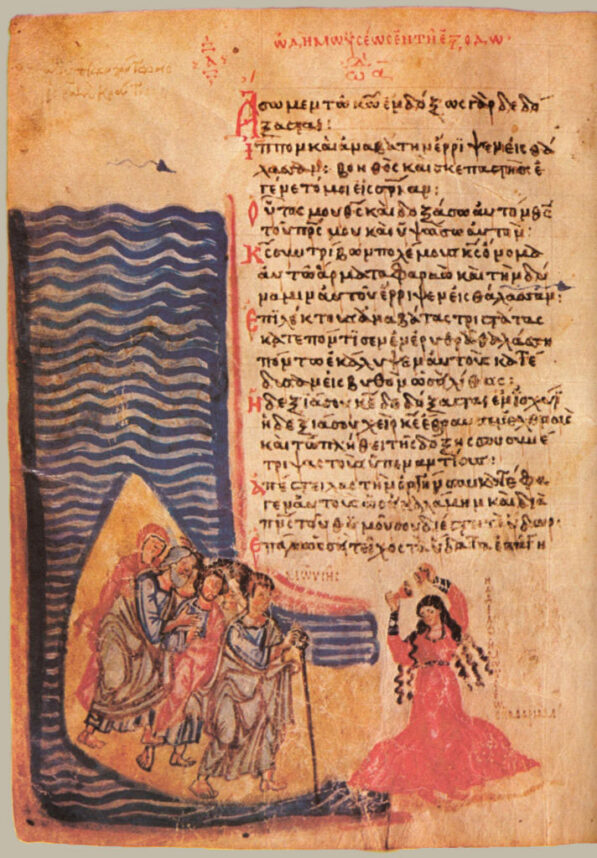
The baptism of Jesus and his 40-day fast in the desert is linked to the Israelites’ passage through the Red Sea and 40-year wandering in the desert. The singing of the “Yigdal” by a cantor at the end of the Sabbath is followed by a church choir rendering exactly the same melody to the words of “God of Abraham Praised.”
Perhaps most striking is the common theme of a loving father sacrificing his son, expressed in the Torah through Abraham’s sacrifice of Isaac and in the Christian Bible through God allowing the crucifixion of Jesus.
There is no attempt to gloss over the differences between the two faiths or the history of Christian persecution of Jews.
Jewish scholar Stephen Katz notes about the Holocaust, “You cannot get from the New Testament to Auschwitz directly … on the other hand, you could not have Auschwitz had you not had the long prehistory made possible by Christian anti-Judaism.”
From the Jewish perspective, a rabbi laments that the only tie between an observant and a secular Jew may be a common suspicion of Christianity.
One of the obvious differences between the two faiths is that Christians believe that Jesus is the messiah, while the Jews are still waiting for him.
In a humorous “resolution” of the theological debate, Rabbi Irving “Yitz” Greenberg, a left-of-center Orthodox theologian, visualizes the arrival of the messiah at his first press conference when he is asked, “Is this your first or second coming?”
And the messiah responds, “No comment.”
A comprehensive study guide, organized around the majorthemes of the documentary, is available through Auteur Productions by calling(866) 299-6554, or through the Web site