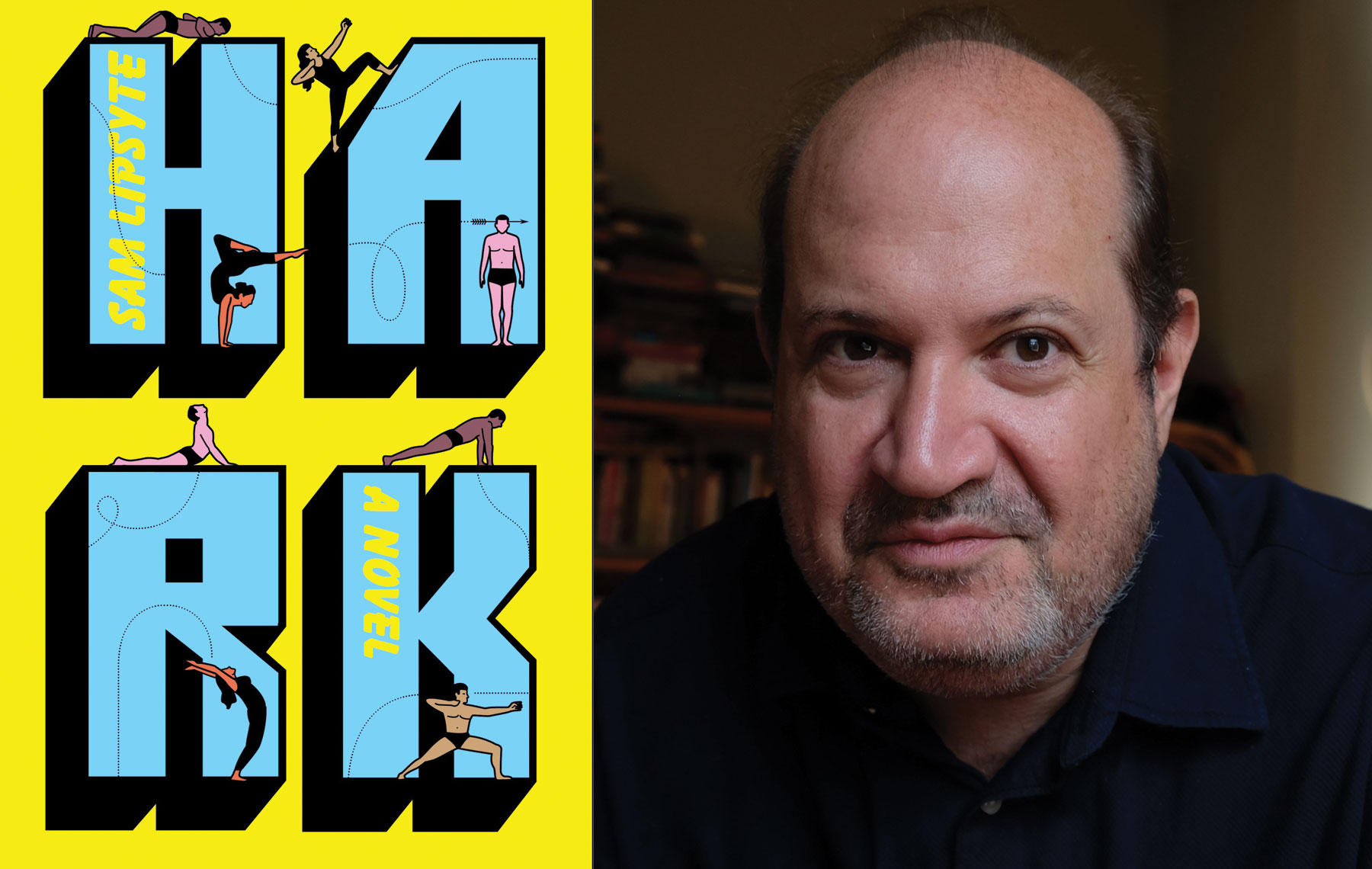
“Writers are just regular people, if not a bit more vain and shallow than most,” one of the characters in “Hark,” Sam Lipsyte’s new novel, explains.
Lipsyte spoke with the Journal by phone from his home in New York.
The son of New York Times Sports Columnist Robert Lipsyte and novelist Marjorie Lipsyte, he grew up in a house “where people were going to work at their typewriters for hours at a time” and the home was always “full of books and book talk.” Lipsyte started writing at an early age, but as many children who have gone into the family business have discovered, “you have to branch out in your own category.”
Over the years, Lipsyte, 51, definitely has done that. As with his previous novels (“Home Land,” “The Subject Steve,” “The Ask”) and his short story collections (“Venus Drive” and “The Fun Parts”), “Hark” is full of sharp satire, verbal dexterity, black humor and deep compassion. His characters tend to live on the fulcrum of middle-class life and utter ruin, overeducated and barely getting by.
Set in the near future, “Hark” tells the story of Hark Morner, the inventor of “Mental Archery,” a mindfulness technique, and his acolytes. Hark goes from itinerant huckster to giving presentations at corporate retreats, where he’s booked as a joke to relieve stress, to leader of a quasi-religious cult. Mental Archery’s chief tenet is focus, which is achieved through various poses explained through Hark’s invented history lessons. And the meaning of this? Hark repeatedly tells his most devoted followers that there is no meaning.
“[My books] have secret Jewish currents running through them. They’re not very overt, and they don’t get me invited to synagogues.” — Sam Lipsyte
Lipsyte admits that Hark, the character, could be seen as Trumpian, but he started writing this novel in 2012, when President Donald Trump was still best known as a TV reality show host. “I see Trump ultimately as a symptom of the direction we’re going in,” Lipsyte said. “So I think, even before Trump was elected, I was picking up signals about the state of our republic.”
The most obvious connections between Hark and Trump, he said, is “not so much the lying, but that they don’t really stand for anything.” Mental Archery is a reaction to “the distraction, the atomization, the feeling that there’s no story that we all belong to, that’s part of it. People have lost faith in the political system and the civic system.”
He added that the search for meaning in today’s climate is one he takes “very seriously, because this is a real yearning that people have had in the absence of other kinds of meaning in their life.”
In “Hark,” Lipsyte has created two clearly Jewish characters, Fraz Penzig, Hark’s most devoted acolyte, and Fraz’s wife, Tovah. However, Lipsyte makes it clear he doesn’t consider himself a “Jewish novelist. I don’t sit down and say, ‘Today, I’m going to write a Jewish novel.’”
Nevertheless, as a Jewish writer from New Jersey, Lipsyte said he feels “in some ways, deeply connected to author Philip Roth. In others ways, I need to run away from him as far as possible just to get out of his shadow.”
He cites his biggest influences as the “so-called post-modernists” of the 1960s and ’70s, specifically the dark comic writer Stanley Elkin. “That’s somebody I’ve read very deeply and revere, and he’s a literary hero of mine,” Lispyte said.
Lipsyte wasn’t raised in an observant Jewish home. Rather, he said, “my father said we were ‘stomach Jews’ — we ate the Jewish food.” Nonetheless, Lipsyte said he still has “a very strong identification with my Jewishness, but I feel I’m always in a constant conversation with myself about what that means.”
And what does that mean? “If it’s just the practice of religion, I’m not sure,” Lipsyte said. “If it’s connected to a wonderful culture and a tradition of artistic and intellectual excellence, that is very important to me. I think it’s always in flux.”
Still, he said, his books “have secret Jewish currents running through them. They’re not very overt, and they don’t get me invited to synagogues.”
Sam Lipsyte will read from “Hark” at Skylight Books, 1818 N. Vermont Ave., Los Feliz, at 7:30 p.m. on Jan. 31.