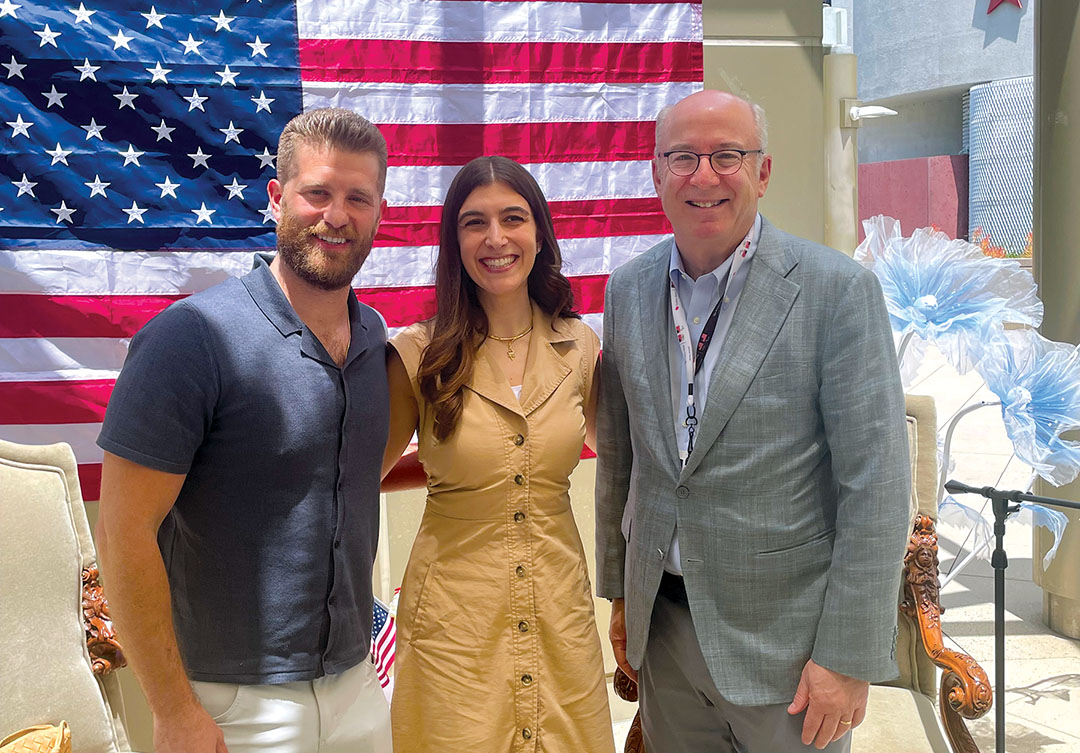
Andrew Sokoler, an incoming freshman at New Jewish Community High School in West Hills and member of Temple Aliyah in Woodland Hills, won first place in the 2011 National Bible Contest, Middle School English Division. He is one of four Americans who will advance to next year’s Chidon HaTanach International Bible Contest in Jerusalem.
Founded by David Ben-Gurion and sponsored by the Jewish Agency, the Bible Contest brings together hundreds of middle- and high-school students from Israel and the Diaspora to test their acuity on preselected chapters of the Bible. The American Bible Contest, whose winners travel to Israel for the finals, begins with hundreds of middle- and high-school students who take preliminary exams during the school year. Around 125 regional winners participated in national finals held in Manhattan on May 15 at Ramaz Middle School.
Sokoler is a second-generation winner, following in the footsteps of his mom, Rosalyn Weiss Sokoler, who won in 1979 and also went on to compete in Israel. His mother was thrilled he was interested in participating because “when you learn the material like that, you just know it for life … by studying so intensely, you really get to learn the Tanach, something most kids don’t do.”
Sokoler, who just completed eighth grade at Alice C. Stelle Middle School in Calabasas, studied the books of Exodus, Samuel II, Jonah and Esther with his mom two or three evenings a week and created note cards to help him practice on his own. On Saturday afternoons, Sokoler met with Cantor Avrum Schwartz, retired from Shomrei Torah Synagogue, who has been coaching students for the contest since 1968 and has had 23 national winners in the past 43 years.
The United States team will join approximately 50 other winners from around the world to compete in Jerusalem on Yom HaAtzmaut, Israel’s Independence Day, for the 2012 International Bible Contest. They will spend a week traveling the country and will be tested on more than 400 chapters of text from the Bible. The top 16 scorers, including the usually dominant Israeli students, will compete in the finals. A second contest for the top scorers from 16 different countries, excluding Israel, will determine the Diaspora. The winner receives a four-year college scholarship to Bar-Ilan University, while the first runner-up and the winner of the Diaspora contest win a scholarship to Machon Lev, a technical college and yeshiva in Jerusalem.