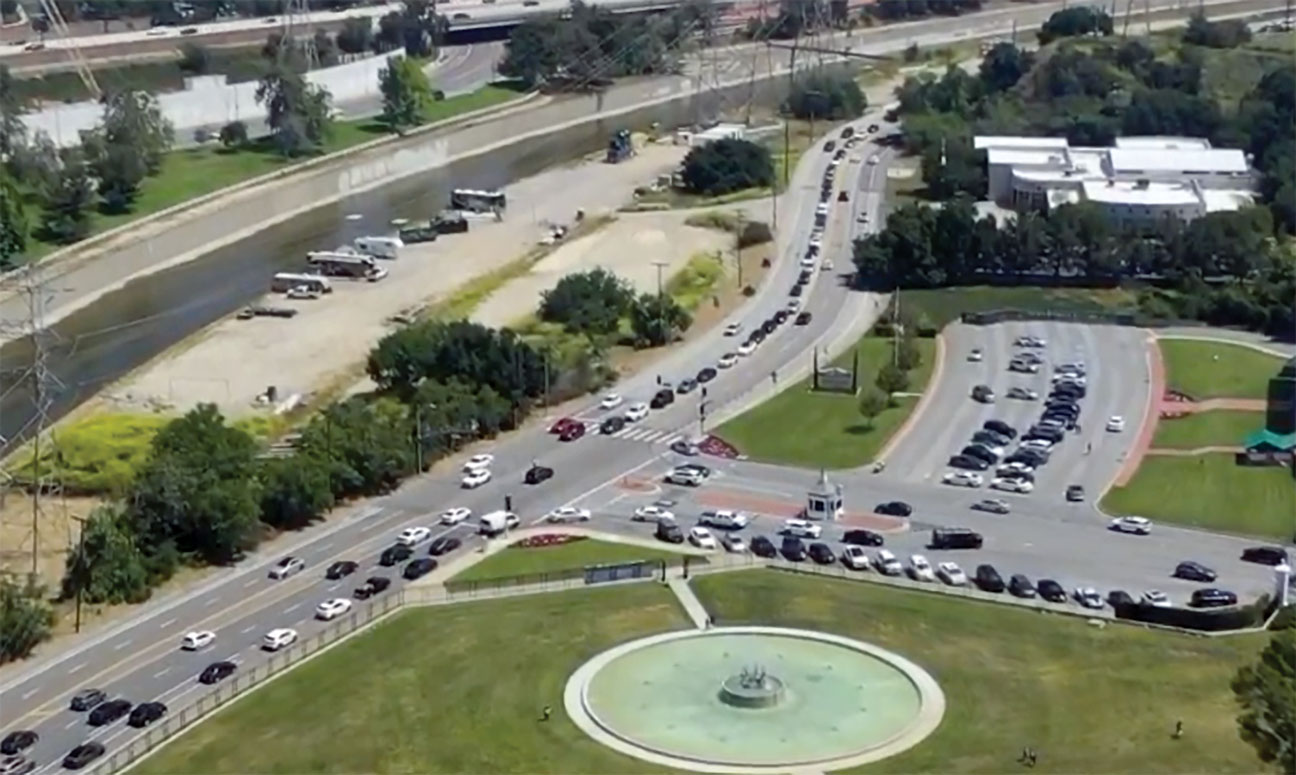
Forest Lawn and Mount Sinai Memorial Parks are expressing growing concern over a City of Los Angeles proposal to reduce Forest Lawn Drive to a single lane in each direction in order to make room for protected bike lanes. Mount Sinai estimates the road carries about 20,000 vehicles per day and provides the only route to both memorial parks, including large funeral processions.
After repeated appeals since 2024 to Mayor Karen Bass, the Department of Transportation and Councilmember Nithya Raman, city officials have moved forward with the plan, which, according to the two cemeteries, could create significant traffic congestion during funerals, particularly when multiple services take place at the same time.
The proposal has drawn strong opposition from Jewish leaders, who warn it could severely disrupt access to Mount Sinai Memorial Park, the largest Jewish memorial park in California. In a letter to the city, Mount Sinai General Manager Randy Schwab wrote that the change would “make it impossible for our memorial parks to operate to meet the needs of the families we serve.”
Local Neighborhood Councils, business owners and religious leaders have also voiced objections, including senior rabbis of Sinai Temple, who emphasized in an earlier letter the importance of ensuring timely arrival for mourning families.
In an interview with The Journal, Schwab expressed frustration, saying he has been trying to reach officials involved in the project but has not received responses. “We have left phone messages, written letters and gotten nothing from the Department of Transportation. No one wants to talk to Forest Lawn or Mount Sinai,” he said.
Two years ago, in 2024, Schwab met with Councilmember Nithya Raman to explain the potential impact on the two cemeteries and the traffic congestion the plan could create. “At the time she promised not to do it, but then I think Safer Streets LA got in touch with her and convinced her that it should be brought back.”
After senior rabbis, Councilmember Katy Yaroslavsky and the head of the Armenian Church appealed to Mayor Karen Bass, the plan was placed on hold. However, Schwab said it has since been revived for reasons unknown to him.
“When this was originally being proposed, we hired Lanham, a world-renowned engineering firm, to show what would happen if this actually took place,” Schwab said. “They did a computer model of all the traffic flow over a month and used real counts. We also did an animation presentation to show what it would look like and shared it with the City Council office, but they weren’t interested in looking at it.”
Lanham Engineering, which designs traffic solutions using data-driven methods, developed an alternative plan that preserved two lanes in each direction while also adding a dedicated bike lane. “We gave it to the Department of Transportation and the City Council office, and nothing,” Schwab said. “They have not communicated with us. They simply decided they are going to go with their plan, whether there is community uproar or not.”
The Journal contacted Councilmember Raman’s office and received the following response: “Forest Lawn Drive provides Angelenos access to key destinations, like Griffith Park and the LA Zoo, and is used by people driving, biking and running. About half of all drivers on Forest Lawn are speeding above the 45 mph legal limit, and at those speeds, a pedestrian or bicyclist struck by a car has a 50% chance of being killed. That is not acceptable, and we have been working to change it.”
Her office said the Forest Lawn Drive Safety & Mobility Project is intended to address these safety concerns by reducing vehicle speeds, adding physical protection for cyclists, and improving conditions for all users of the corridor. It also said the plan includes improved turns for both cemeteries and the Junior Achievement Center. A Raman spokesperson said issues raised by cemetery representatives were taken into account during the design process, and LADOT’s proposal includes expanded turn lanes.
However, Schwab said the response does not address his core problem with the reduction to a single lane in each direction, which he believes will severely impact operations and create “a traffic nightmare.”
“And this is only in front of the two cemeteries, not in front of Warner Brothers, or anywhere else in the area,” he said. “My fear is that she doesn’t understand the damage that this is going to do to the Jewish community. What will happen when there are 500 people coming to the park at the same time and we have one lane to get them in?”
Schwab said both cemeteries have tried to reach Mayor Bass and the Department of Transportation for the past 18 months, including through legal counsel, but have not received a response.
“I want to be clear, we do care about bikers and that’s why we spent money to give them exactly what they want to do, a protected bike lane. We have a plan that can do just that and it’s not more expensive than theirs, but they don’t care about it.”
He said that during the week only a small number of cyclists use the roadway, while on weekends the figure rises to an estimated 50 to 75 riders.
A spokesperson from Raman’s office said its traffic analysis for the corridor estimates the project would have a relatively minor impact on travel times, even during the busiest periods of the day. “According to LADOT guidelines,” they said, “anticipated delays are considered low and do not necessitate special consideration.”
However, Schwab disputed that assessment, saying the Department of Transportation’s analysis was based on only eight to 10 hours of data, which he argued does not reflect real-world funeral conditions.
“We have 25–27 funeral services a day,” he said. “On Sundays we have thousands of people coming to the park. What happens in case of an emergency? How is an ambulance going to get into the park?”
Raman’s office said that work is expected to begin in June.
Schwab said he still hopes city officials will reconsider the decision, which he believes would significantly impact many Angelenos. He said that that once the project is completed, it would be difficult to reverse due to cost.
“We have tried the assembly people who are in favor and asked Nithya to speak with us, but everything falls on deaf ears.”
The Journal reached out to the office of Karen Bass and the Los Angeles Department of Transportation but did not receive a response by press time.