
The two granddaughters sat just a few feet apart and shared personal stories of growing up in families scarred by memories of the Holocaust. But their stories couldn’t have been more different. One related stories of family survival. The other recounted stories of pure evil.
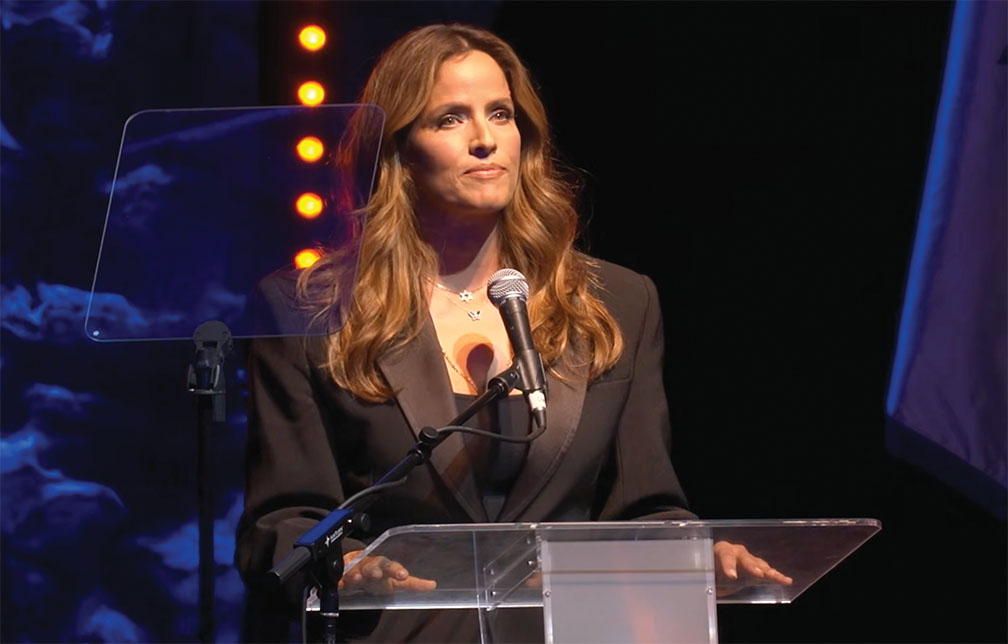
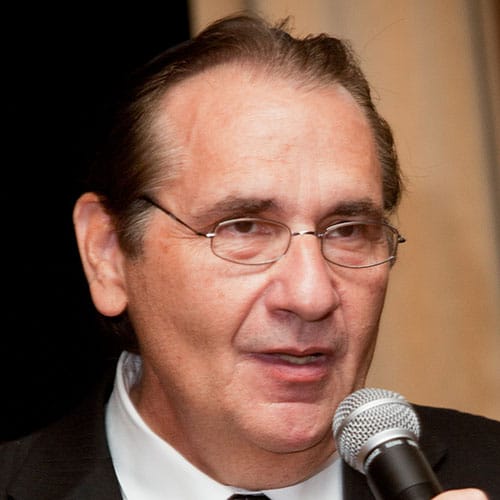
In a program titled “Granddaughters of the Holocaust,” the Holocaust Museum LA invited Dr. Franziska Frank to share and contrast her experiences with Museum CEO Beth Kean about growing up in the shadow of the Holocaust. Kean is the granddaughter of Holocaust survivors. Frank is the granddaughter of Hans Frank, the high-ranking Nazi official who served as Hitler’s personal attorney and as head of the General Government in Nazi-occupied Poland. Frank was tried at Nuremberg, found guilty of war crimes and crimes against humanity, and executed in 1946.
Growing up in Berlin, Frank became familiar with the Holocaust at an early age. “I grew up in a household where I was surrounded by books about the Holocaust,” she said. “I looked at all these books and I knew there had to be some connection with my family, but I really didn’t get it until I got older. Eventually my father told me stories about his father and who he was.”
Frank never knew her Nazi grandfather. He was executed before she was born.
Frank never knew her Nazi grandfather. He was executed before she was born. However, her father, Niklas Frank, worked tirelessly to educate his family and the world about the crimes of his father. He is a prolific journalist and author of books about his family including: “In the Shadow of the Reich,” “My German Mother,” “Brother Norman!” as well as plays and a television series.
Speaking out and chronicling the crimes of his father didn’t sit well with Niklas Frank’s siblings and many others in Germany. “The reception within the family to my father’s books was actually negative.” Frank said. “Some of his siblings even wrote letters to newspapers saying ‘This is not a proper son.’ They claimed he always was an outsider and they tried to disown him. But eventually his older brother told him, ‘I hated your books, but I am grateful that you wrote them.’ So some things did change over the years.”
Kean also learned about the Holocaust early in life. “I feel like there was never a time when I did not know about the Holocaust,” she said. “My grandmother had a tattoo on her arm and both my grandparents had thick Polish accents. There was always a sense that they were looked at as outsiders. As a little girl I didn’t really know what the Holocaust was, but I knew something bad had happened to my family. I knew many of my family members had been killed in Auschwitz but really didn’t understand the meaning behind that until I got older.”
Speaking about her infamous grandfather and the Holocaust is a recent activity for Frank. She spent her life building a successful career in consulting and academia. She holds a degree in history, she’s an attorney and she earned a Ph.D. in Russian law. She then worked for Boston Consulting and joined the European School of Management and Technology, where she is a visiting lecturer. She currently writes, speaks and teaches executives about humility, influencing, negotiations and decision-making.
While the two granddaughters with polar opposite Holocaust family experiences sat side-by-side, they were able to find common ground. “Listening to Franziska tell her story, it’s so interesting to me that we lived these parallel lives,” Kean said, directing her comments to Frank. “I find it so admirable what your father did. For us to connect like this and have a conversation is something I never imagined would happen in a million years.”
Asked how her father explained to her the actions of his father and the Nazi life he led, Frank said, “You become Hitler’s personal lawyer. It sounds like a good job initially, but as a cultured person, he could have known this is not where he wanted to be,” Frank said. “He had a number of chances to get out, but he never took [them].”
When the two granddaughters shared their memories, stories of hope and defiance also emerged.
When the two granddaughters shared their memories, stories of hope and defiance also emerged. As head of Holocaust Museum LA, Kean related interactions she has on a daily basis with survivors, and lessons of survival and defiance that emerge.

“When a survivor learned that my grandmother peeled potatoes while at Auschwitz, she told me, ‘Your grandmother saved my life.’” Kean said. “I asked her what she meant. She said the girls that peeled potatoes would toss the potato skins on the floor and she would walk in and pick them up. The Germans didn’t know the peels had all the vitamins. She returned to the barracks and shared the potato peels with the others in her barracks and that food saved their lives. Her story was not only a story of survival, but of defiance. Had the Germans known about the potato peels, they both would have been executed.”
The event was moderated by Jordanna Gessler, also a granddaughter of survivors and the museum’s vice president of education and exhibits. When Gessler asked Frank to describe her thoughts of growing up in a family where such evil was part of her family lineage, she replied, “Even now, many people are critical of what my father did. But I told my children that if I ever did something really evil, they also are not allowed to love me. I think it is important for parents to know they are rightfully disowned if you behave like my grandfather did.”
“It is so important to have a safe space where we can talk about uncomfortable things,” Kean said “I wonder what my grandparents would think right now that we’re sitting next to each other having this discussion. I think they would be very supportive and happy we’re doing this, because we need to build a future together without hate and have these conversations.”